
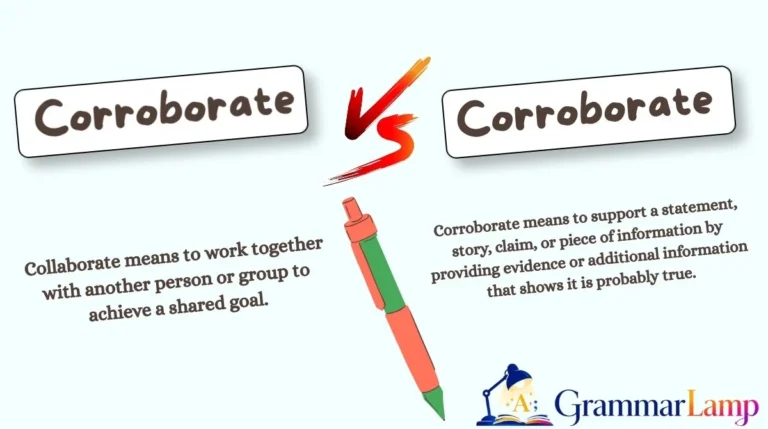
Collaborate vs corroborate is a common English word confusion, especially for students and non-native speakers.
The two words look and sound somewhat alike, but their meanings are completely different. Using one instead of the other can change the meaning of a sentence.
For example, if you say, “The two scientists corroborated on the project,” the sentence is incorrect. You need collaborated because the scientists worked together.
On the other hand, if you say, “The witness collaborated his story,” you probably mean corroborated because the witness provided information that supported the story.
The difference becomes much easier when you focus on the action behind each word. Collaborate is about working together. Corroborate is about supporting or confirming something with evidence.
These words are useful in school, university, business, journalism, research, law, and everyday communication. You may hear them when people talk about teamwork, reports, investigations, interviews, or facts.
By the end, you will know exactly when to use collaborate and when to use corroborate. You will also see their grammar patterns, common mistakes, everyday examples, and an easy memory trick that can help you choose the right word quickly.
What Does “Collaborate” Mean?
Collaborate means to work together with another person or group to achieve a shared goal.
Simple definition
Collaborate = work together
For example:
- Two students collaborate on a school project.
- Several companies collaborate to develop new technology.
- Writers collaborate on a book.
- Doctors collaborate to help a patient.
The important idea is teamwork. At least two people or groups are involved in the shared activity.
When should you use “collaborate”?
Use collaborate when you want to talk about people or groups working together.
It is common in education and professional English:
- Students collaborate on assignments.
- Teachers collaborate with other teachers.
- Researchers collaborate on studies.
- Businesses collaborate with partners.
- Artists collaborate on creative projects.
The word can describe both short-term and long-term teamwork.
Grammar rule for “collaborate”
Collaborate is a verb.
Common structures include:
Subject + collaborate + with + person/group
Sarah collaborated with her classmates.
You can also use:
Subject + collaborate + on + project/task
They collaborated on a research project.
You can combine both:
The students collaborated with their teacher on the project.
The preposition with is used for the person or group you work together with. On is often used for the project, task, or activity.
Examples of “collaborate”
- The two teachers collaborated on a new lesson plan.
- My brother and I collaborated on the school presentation.
- The scientists collaborated with researchers from another country.
- Several companies collaborated to create a safer product.
- We need to collaborate with our customers to solve this problem.
- The artists collaborated on a new song.
- The students collaborated with each other during the activity.
- Our marketing team collaborated on the campaign.
Common learner confusion
A common mistake is thinking that collaborate means “prove,” “support,” or “confirm.” It does not.
For example:
❌ The new evidence collaborated his statement.
This is wrong because evidence does not “work together” with a statement.
Better:
✅ The new evidence corroborated his statement.
Another common mistake is using collaborate without understanding the shared action.
The two companies collaborated.
This means the companies worked together. It does not mean that one company proved something about the other.
What Does “Corroborate” Mean?
Corroborate means to support a statement, story, claim, or piece of information by providing evidence or additional information that shows it is probably true.
Simple definition
Corroborate = confirm or support with evidence
Imagine that a student says, “I was at the library yesterday.”
Another student says, “Yes, I saw him there.”
The second student’s statement corroborates the first student’s story because it provides additional support.
When should you use “corroborate”?
Use corroborate when something helps prove, confirm, or support information that has already been given.
It is especially common in:
- News reports
- Police investigations
- Legal discussions
- Academic research
- Scientific studies
- Historical writing
- Formal business communication
For example:
The second witness corroborated the man’s story.
This means the second witness gave information that supported the man’s story.
Grammar rule for “corroborate”
Corroborate is a transitive verb. This means it normally takes a direct object.
Common structure:
Subject + corroborate + statement/claim/story/evidence
The evidence corroborated his claim.
Another common structure is:
Subject + corroborate + what someone said
The witness corroborated what she said.
You generally do not say:
❌ The witness corroborated with her.
Instead:
✅ The witness corroborated her story.
You may also see corroborate with, but it is used in a different structure and is much less useful for beginners. In standard everyday writing, the safest pattern is corroborate + something.
Examples of “corroborate”
- The witness corroborated the driver’s story.
- The new evidence corroborated his claim.
- The report corroborates what she told us.
- Two independent sources corroborated the information.
- The photographs corroborated the witness’s account.
- His records corroborated his explanation.
- The second study corroborated the earlier findings.
- The police found evidence that corroborated her statement.
Common learner confusion
The biggest problem is that corroborate looks like collaborate, so learners sometimes connect it with teamwork.
But corroborate does not mean “work together.”
Compare:
The two researchers collaborated on the study.
They worked together.
The second study corroborated the first study’s findings.
The second study supported or confirmed the findings.
One involves cooperation. The other involves evidence and confirmation.
Difference Between Collaborate and Corroborate
The easiest way to understand the difference is to focus on the main action.
Collaborate means people or groups work together.
Corroborate means information or evidence supports something.
| Feature | Collaborate | Corroborate |
|---|---|---|
| Basic meaning | Work together | Support or confirm |
| Main idea | Cooperation | Evidence |
| Usually involves | People or groups | Evidence, facts, statements, claims |
| Common preposition | With, on | Usually no preposition before the object |
| Example | They collaborated on the project. | The evidence corroborated his story. |
| Common contexts | Work, school, research, business | Law, news, research, investigations |
| Simple synonym | Cooperate | Confirm/support |
Usage difference
Consider these two sentences:
Maria collaborated with John on the report.
Maria and John worked together to produce the report.
Now compare:
The documents corroborated John’s explanation.
The documents provided evidence supporting what John said.
The people in the first sentence are doing something together. The documents in the second sentence are supporting information.
Grammar logic
The grammar also gives you a useful clue.
Collaborate commonly appears with with:
The designer collaborated with the photographer.
It can also appear with on:
They collaborated on a new project.
Corroborate normally takes a direct object:
The evidence corroborated his story.
Not:
❌ The evidence corroborated with his story.
This difference is particularly useful for learners because the sentence structure can help you recognize the correct word.
Sentence structure difference
With collaborate:
Person/group + collaborate + with + person/group
The engineers collaborated with the designers.
Or:
Person/group + collaborate + on + project
The engineers collaborated on the design.
With corroborate:
Evidence/person/source + corroborate + claim/story/statement
The evidence corroborated the claim.
Notice that corroborate usually has something that is being supported after it.
Meaning comparison
Here is a simple situation.
A journalist is writing a story. Two reporters work together to collect information.
They collaborate.
Later, they find a photograph that supports what a witness said.
The photograph corroborates the witness’s statement.
So, you could use both words in one situation:
The two reporters collaborated on the investigation, and the photographs corroborated the witness’s story.
That sentence shows the difference perfectly.
Grammar Rules You Must Remember
Rule 1: Use “collaborate” for people working together
When two or more people, teams, or organizations share a task, collaborate is the right choice.
The two departments collaborated on the project.
Think about teamwork.
If everyone is contributing to the same goal, collaborate is likely the word you need.
Rule 2: Use “corroborate” when something supports a claim
When evidence, information, or another source confirms or supports something, use corroborate.
The video corroborated the witness’s account.
The video did not work as a teammate. It provided support for the account.
Rule 3: “Collaborate” commonly uses “with” and “on”
Use with for the person or group:
I collaborated with my classmates.
Use on for the project or task:
I collaborated on the presentation.
You can use both:
I collaborated with my classmates on the presentation.
This is one of the most useful patterns to remember.
Rule 4: “Corroborate” usually takes a direct object
The thing being confirmed normally comes directly after corroborate.
The documents corroborated her statement.
The evidence corroborated his claim.
The report corroborated the witness’s account.
For beginners, remember this simple pattern:
corroborate + claim/story/statement/account/evidence
Common Mistakes Students Make
These mistakes usually happen because the two words look so similar. Their endings are also similar, which makes them easy to mix up when speaking or writing quickly.
Mistake 1: Using “corroborate” for teamwork
❌ The two students corroborated on their homework.
The students did not provide evidence for each other. They worked together.
✅ The two students collaborated on their homework.
Correction tip: Ask yourself, “Did they work together?” If yes, choose collaborate.
Mistake 2: Using “collaborate” for evidence
❌ The photograph collaborated his story.
A photograph cannot work as a teammate. It can provide evidence.
✅ The photograph corroborated his story.
Correction tip: Ask, “Does this thing support or confirm a claim?” If yes, use corroborate.
Mistake 3: Adding “with” after corroborate
❌ The evidence corroborated with his statement.
For beginner-level standard English, avoid this structure.
✅ The evidence corroborated his statement.
The statement is the direct object of corroborated.
Mistake 4: Confusing “collaborate” with “agree”
Collaboration does not simply mean agreement.
Two people may disagree about some details and still collaborate on a project.
The designers disagreed about the color but collaborated on the final product.
The key idea is working together, not necessarily having identical opinions.
Mistake 5: Thinking corroboration proves something with absolute certainty
To corroborate something means to support or confirm it with additional evidence. It does not always mean that something has been proven beyond every possible doubt.
The witness’s statement corroborated the report.
This means the statement supported the report.
Correction tip: Think “support with evidence,” rather than simply “prove 100%.”
Easy Trick to Remember the Difference
Here is a very simple memory trick:
COLLABORATE = CO + LABORATE → work together
The beginning “co-” can remind you of doing something together.
Think:
Collaborate = cooperate = work together
Imagine two students sitting at the same table and preparing a presentation. They are collaborating.
CORROBORATE = confirmation
Think of corroborate as a word you might see in a news report, police report, or research paper.
Someone makes a claim.
Then another source provides information that supports the claim.
That source corroborates it.
A useful question can make the choice almost automatic:
Are people working together?
→ Collaborate
Is evidence supporting or confirming something?
→ Corroborate
For example:
The scientists collaborated on the experiment.
They worked together.
The results corroborated their original theory.
The results supported the theory.
Remember those two pictures in your mind: people working together and evidence supporting a claim. That is usually enough to keep the words separate.
Daily Life Examples
These examples show how the two words can appear naturally in spoken and written English.
1. At school
Student A: Who is doing the presentation with you?
Student B: Ahmed and I are collaborating on it.
They are working together.
2. At work
Our sales and marketing teams collaborated on the new campaign.
The teams shared their work to achieve a common goal.
3. During research
Several universities collaborated on the research project.
The universities worked together.
4. During an investigation
The security video corroborated the employee’s statement.
The video supported what the employee said.
5. Talking about a news story
Another source corroborated the reporter’s information.
The second source provided support for the information.
6. Talking about friends
My friends and I collaborated on a surprise party.
They planned the event together.
7. Talking about documents
The old documents corroborated his account of the event.
The documents supported his version of what happened.
8. Talking about artists
The singer and producer collaborated on a new song.
They worked together to create it.
9. Talking about an explanation
The receipts corroborated her explanation.
The receipts gave evidence supporting her explanation.
10. Using both words naturally
The researchers collaborated on the study, and their findings corroborated earlier research.
The researchers worked together, while their findings supported previous research.
This final example is especially useful because it shows that both words can appear in the same context but perform completely different jobs.
Practice Section
Choose collaborate or corroborate to complete each sentence.
1.
The two companies decided to ________ on the new project.
2.
The photograph ________ the witness’s story.
3.
We need to ________ with the design team.
4.
The new evidence ________ his claim.
5.
The students ________ on their science assignment.
Answers
1. collaborate
The companies are working together on a project.
2. corroborated
The photograph supports the witness’s story.
3. collaborate
The phrase collaborate with is used for working together with another group or person.
4. corroborated
The evidence supports or confirms the claim.
5. collaborated
The students worked together on the assignment.
A quick check after answering: if you can replace the word with “work together,” use collaborate. If you can replace it with “support or confirm with evidence,” use corroborate.
FAQs
What is the difference between collaborate and corroborate?
Collaborate means to work together with another person or group toward a shared goal. Corroborate means to support or confirm a statement, claim, or story with additional evidence or information. In simple terms, collaborate is about teamwork, while corroborate is about evidence.
Can we use “collaborate” in questions?
Yes. Collaborate can be used naturally in questions.
For example: “Who did you collaborate with on the project?” or “Can we collaborate on this assignment?” The word is common in school, workplace, research, and creative situations.
Can we use “corroborate” in questions?
Yes, although it sounds more formal than everyday verbs such as “confirm” or “support.”
For example: “Can you corroborate his story?” This asks whether you can provide evidence or information that supports what he said.
Is “collaborate” formal or informal?
Collaborate is suitable for both everyday and professional English. It is especially common in workplaces, schools, research, technology, and creative fields. In casual conversation, people may simply say “work together.”
Is “corroborate” formal or informal?
Corroborate is generally a formal word. You are more likely to see it in journalism, academic writing, legal language, research, and official reports. In casual speech, “confirm” or “support” is often more natural.
Can collaborate and corroborate be used in the same sentence?
Absolutely. For example: “The researchers collaborated on the project, and the results corroborated their earlier findings.” The first word describes the researchers working together; the second describes evidence supporting previous findings.
Conclusion
The difference between collaborate vs corroborate becomes much easier when you focus on their basic ideas.
Collaborate means to work together. People, teams, companies, students, artists, and researchers can collaborate. Common patterns include collaborate with someone and collaborate on something.
Corroborate means to support or confirm something with evidence or additional information. A document, photograph, witness, report, study, or other source can corroborate a claim, story, statement, or account.
The easiest memory trick is simple: collaborate = teamwork; corroborate = evidence.
Whenever you are unsure, ask yourself one question: Are the people working together, or is something supporting a claim? That quick test will usually give you the answer.
Try using both words in your own sentences. Once you see them in real conversations, schoolwork, news stories, and professional writing, the difference will start to feel natural.

Liam Derren is a language writer at GrammarLamp, creating simple, helpful content about grammar, words, and everyday English. He makes language learning clear, practical, and easy to understand.
2 thoughts on “Collaborate vs Corroborate: Meaning, Difference, and Examples in 2026”