
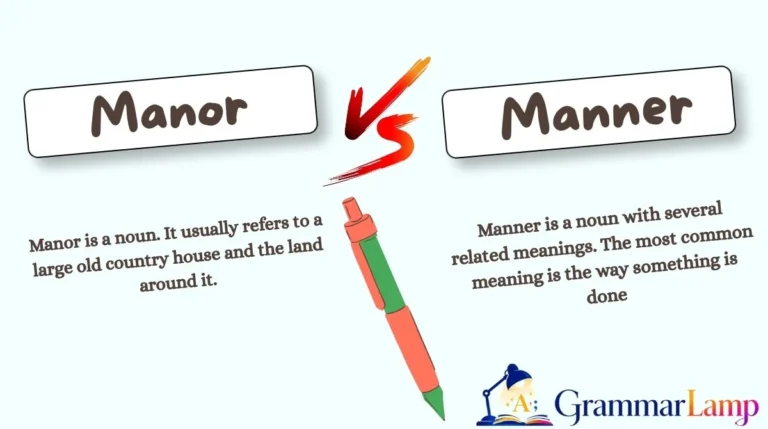
Manor vs manner vs manir can be confusing because the words look and sound very similar.
For many English learners, the problem becomes even harder when they hear these words in conversation and then try to spell them later.
The pronunciation of manor and manner is very similar, especially in common English accents, but their meanings are completely different.
Manor is a noun related to a large country house or an estate. It is something connected with a place, land, or an old house. Manner, on the other hand, is also a noun, but it usually describes the way something is done or the way a person behaves.
Then there is manir. If you are trying to write standard English, you normally should not use this spelling for either of these meanings. In English-learning contexts, manir is generally treated as a misspelling of manor or manner.
Some dictionaries do list manir in other languages, so it is not meaningless everywhere, but it is not the standard English spelling learners need for these two common English words.
Once you understand what each word means, the difference becomes much easier. You will know when to use manor, when to use manner, and why manir is usually the wrong choice in an English sentence.
More Useful posts
Sun vs Son: Meaning, Difference, Rules, and Examples (2026)
A Majority of vs The Majority of: Easy Grammar Guide for 2026
Tomatoes or Tomatos: Which Spelling Is Correct? [2026]
In the Morning vs On the Morning: Complete Grammar Guide for 2026
What Does “Manor” Mean?
Manor is a noun. It usually refers to a large old country house and the land around it. The word often appears when people are talking about history, traditional estates, old buildings, wealthy families, or the English countryside. Cambridge and Oxford both define manor in connection with a large country house and its surrounding land.
Think of a manor as a big house on an estate.
A manor is not simply another word for any house. In general use, it has a historical or estate-related feeling. You may hear manor house, which means the main large house on a manor estate.
When Should You Use “Manor”?
Use manor when you are talking about:
- A large old country house
- An estate with land around it
- A historic property
- A manor house
- A place connected with an old estate
For example:
- The family lives in an old manor in the countryside.
- We visited a beautiful manor house last summer.
- The manor was surrounded by hundreds of acres of land.
- The old manor dates back several centuries.
- A small village grew around the manor.
- The tourists stopped to photograph the historic manor.
- The manor has a large garden behind it.
- They bought the ruined manor and restored it.
Notice how all these sentences are about a place or property.
That is the easiest clue. When you see a sentence describing a large house, estate, or historic property, manor is probably the word you need.
Grammar Rule for “Manor”
Because manor is a countable noun, you can normally use an article such as a or the before it.
Examples:
- a manor
- the manor
- an old manor
- the manor house
- two manors
You can also add adjectives before it:
a beautiful manor
an ancient manor
a large country manor
A Common Confusion With “Manor”
Some learners use manor when they really mean “way” or “behavior.”
For example:
❌ He spoke in a polite manor.
✅ He spoke in a polite manner.
The first sentence is wrong because the speaker is not talking about a building. He is talking about how someone spoke.
Remember:
Manor = place
Manner = way
That one small difference can save you from a very common spelling mistake.
What Does “Manner” Mean?
Manner is a noun with several related meanings. The most common meaning is the way something is done. It can also mean the way a person behaves or speaks, especially when describing someone’s attitude or social behavior. Oxford and Cambridge both give these meanings.
For example, compare these two sentences:
She answered in a calm manner.
This means she answered in a calm way.
His manner was friendly.
This means his behavior or way of dealing with people was friendly.
So, manner is often connected with way, style, behavior, or method.
When Should You Use “Manner”?
Use manner when you are talking about:
- The way something is done
- The way someone behaves
- Someone’s speaking style
- A method or style
- Polite or social behavior when used as manners
Here are some examples:
- She spoke to the child in a gentle manner.
- Please complete the form in the correct manner.
- He handled the problem in a professional manner.
- Her friendly manner made everyone feel comfortable.
- The teacher explained the lesson in a simple manner.
- His manner changed when the manager entered the room.
- She has a very confident manner.
- Children should learn good manners at home.
In the last example, manners is plural. Here it means polite behavior, such as saying “please,” saying “thank you,” waiting your turn, and treating people respectfully. Cambridge and Oxford both describe this plural use.
Grammar Rule for “Manner”
Manner is usually a noun. One very common structure is:
in + a/the + manner
Examples:
- in a polite manner
- in a professional manner
- in the same manner
- in a calm manner
- in an orderly manner
Another common structure is:
manner of + noun
For example:
the manner of his speech
the manner of her response
You can also say:
the manner in which + clause
Example:
I disliked the manner in which he spoke to the waiter.
This means you disliked the way he spoke to the waiter.
Manner and Manners Are Not Always the Same
This is another useful point for learners.
Manner often means a way or style.
Manners often means polite behavior.
Compare:
She answered in a friendly manner.
Here, manner means the way she answered.
Her manners are excellent.
Here, manners means polite behavior.
That small -s changes the usual meaning.
Difference Between Manor and Manner
The main difference is very simple:
Manor is about a place or property.
Manner is about a way, style, or behavior.
They may sound very similar, but their meanings are unrelated in everyday English. Cambridge lists manor as a large country house with its land, while manner is used for the way something is done and the way a person behaves.
Comparison Table
| Word | Part of Speech | Main Meaning | Easy Meaning | Example |
|---|---|---|---|---|
| Manor | Noun | Large country house or estate | Big old house/property | We visited an old manor. |
| Manner | Noun | Way something is done | Way or style | She spoke in a polite manner. |
| Manner | Noun | Way someone behaves | Behavior/style | His manner was friendly. |
| Manners | Plural noun | Polite behavior | Good social behavior | Children need good manners. |
| Manir | — | Not standard English for these meanings | Usually a misspelling | ❌ Use manor or manner instead. |
Usage Difference
The easiest way to choose the right word is to ask a question.
Ask yourself:
Am I talking about a house, estate, or property?
Use manor.
Am I talking about a way, method, style, or behavior?
Use manner.
For example:
The king lived in a beautiful manor.
What are we talking about? A large house. So we use manor.
The king spoke in a serious manner.
What are we talking about? The way he spoke. So we use manner.
Grammar Logic
Both words are nouns, but they belong to different meaning groups.
Manor belongs to the world of buildings, land, estates, and places.
Manner belongs to the world of actions, behavior, communication, and methods.
That is why replacing one with the other can completely change the sentence.
Consider:
She entered the manor quietly.
Here, manor means the place she entered.
Now:
She entered in a quiet manner.
Here, manner describes how she entered.
The words may look close, but the grammar and meaning around them are different.
Sentence Structure Difference
With manor, common structures include:
a/the + manor
manor + noun
Examples:
- a large manor
- the old manor
- a manor house
- the manor estate
With manner, common structures include:
in + a/the + manner
manner of + noun
the manner in which + clause
Examples:
- in a polite manner
- in the same manner
- the manner of his reply
- the manner in which she answered
This sentence pattern is a strong clue when you are writing.
Meaning Comparison
You can remember the basic contrast like this:
Manor answers “What place?”
Manner answers “How?”
Example:
Where did they live?
They lived in a manor.
How did they behave?
They behaved in a polite manner.
That is the heart of the difference.
What About “Manir”?
Manir is the spelling that causes the third part of this confusion.
For normal English writing, such as school assignments, emails, articles, websites, and everyday communication, you should not use manir when you mean manor or manner.
English dictionaries such as Cambridge and Oxford provide entries for manor and manner. The similar-looking form manir is found in dictionaries for other languages; for example, Spanish manir is a verb with meanings related to hanging or keeping meat to soften it.
So, if your English sentence is something like:
❌ He behaved in a strange manir.
You probably mean:
✅ He behaved in a strange manner.
Or:
❌ They bought a beautiful manir.
If you mean a large old house:
✅ They bought a beautiful manor.
The important lesson is that manir is not the normal English spelling for either word.
Explore More Posts
Collaborate vs Corroborate: Meaning, Difference, and Examples in 2026
Sleeve vs Sleave: Which Is Correct? Meaning, Difference, and Examples in 2026
Time off vs time-off: The Complete Grammar Guide for 2026
I’m vs I Am: Complete Difference, Rules, Examples & Usage Guide 2026
Grammar Rules You Must Remember
Rule 1: Use “manor” for a large house or estate
When the sentence is about an old country house or the land connected with it, use manor.
Example:
The family restored the old manor.
Here, manor is a physical property.
Rule 2: Use “manner” for the way something happens
When you mean how something is done, use manner.
Example:
The problem was handled in a careful manner.
Here, manner means “way.”
Rule 3: Use “manners” for polite behavior
When you are talking about social behavior and politeness, the plural manners is common.
Example:
Good manners are important at the dinner table.
This does not mean a house or a method. It means polite behavior.
Rule 4: Do not use “manir” as the English spelling you need here
If you mean the building, write manor.
If you mean the way or behavior, write manner.
Example:
❌ She answered in a respectful manir.
✅ She answered in a respectful manner.
This is especially important in formal writing because spelling errors can make a sentence look unclear or careless.
Common Mistakes Students Make
Many learners make these mistakes because manor and manner sound so similar. When you learn mainly through listening, it is easy to guess the wrong spelling.
Another reason is that the word manner is used in several ways. A learner may know that manner means “way,” but still accidentally type manor.
Mistake 1: Using “manor” for behavior
❌ His manor was rude.
✅ His manner was rude.
Why? Because we are describing his behavior, not his house.
Mistake 2: Using “manner” for a building
❌ We stayed in a beautiful manner.
✅ We stayed in a beautiful manor.
The first sentence sounds like you stayed “in a way,” which does not make sense.
Mistake 3: Writing “manir”
❌ She spoke in a kind manir.
✅ She spoke in a kind manner.
The sentence describes how she spoke, so manner is correct.
Mistake 4: Forgetting the plural “manners”
❌ He has good manner.
✅ He has good manners.
When referring to general polite behavior, manners is normally plural.
Mistake 5: Confusing “manner” with “method”
Sometimes learners think manner can only describe behavior. That is not true.
You can use manner for the way an action is performed:
The machine operates in a simple manner.
You can also use it for personal behavior:
The doctor had a calm manner.
Easy Correction Tip
Before typing the word, stop for one second and ask:
House or how?
House → manor
How → manner
That simple question works in many sentences.
Easy Trick to Remember the Difference
Here is an easy memory trick:
Manor = Mansion
Both words are connected with a big place.
Think:
MANOR → MANSION
A manor is a large country house or estate.
Manner = Method
Both begin with the idea of how something is done.
Think:
MANNER → METHOD
For example:
She completed the job in a careful manner.
That means:
She completed the job in a careful way.
Manir = Stop and Check
When you are about to write manir, stop and ask:
“Do I mean a house?”
Then write manor.
“Do I mean a way or behavior?”
Then write manner.
This trick is useful because it connects spelling with meaning instead of asking you to memorize three separate words.
You can also imagine two pictures in your mind:
MANOR = 🏠
MANNER = HOW?
Even without memorizing a complicated grammar rule, this visual idea can help you choose correctly.
Daily Life Examples
These examples show how the words appear in natural English.
Example 1: Talking about a property
A: Did you visit the old building outside the town?
B: Yes. It was a beautiful manor with a huge garden.
Here, manor is a place.
Example 2: Talking about behavior
A: Why didn’t you like the new employee?
B: His manner was a little rude.
Here, manner means behavior.
Example 3: Talking about speaking
A: How did Sara answer the customer?
B: She answered in a very polite manner.
Here, manner means the way she answered.
Example 4: Talking about history
A: What is that large building near the river?
B: It is an old manor built hundreds of years ago.
The word describes a historic property.
Example 5: Good manners
A: Your son is very polite.
B: Thank you. We always teach him good manners.
Here, manners means polite social behavior.
Example 6: A professional manner
A: How did the manager handle the complaint?
B: She handled it in a professional manner.
The word describes how the action was performed.
Example 7: A friendly manner
A: Did the doctor seem kind?
B: Yes, she had a warm and friendly manner.
The word describes her behavior.
Example 8: Visiting a manor
A: Where did you go on Sunday?
B: We visited an old manor in the countryside.
Again, we are talking about a location.
Example 9: The wrong spelling
A: How should I spell this word: “manir”?
B: First decide what you mean. A large house is manor, while a way of doing something is manner.
This is exactly how you should solve the problem.
Example 10: Talking about a process
A: How should the documents be prepared?
B: They should be prepared in an organized manner.
Here, the meaning is “organized way.”
Practice Section
Choose the correct option: manor, manner, or manir.
1. The family lives in a beautiful old ______.
a) manner
b) manor
c) manir
2. She spoke to the customer in a polite ______.
a) manor
b) manir
c) manner
3. Children should learn good ______.
a) manners
b) manors
c) manirs
4. We visited a historic ______ in the countryside.
a) manner
b) manor
c) manir
5. The problem was handled in a professional ______.
a) manor
b) manner
c) manir
Answers
1. b) manor
It means a large old country house or estate.
2. c) manner
It means the way she spoke.
3. a) manners
Here, manners means polite behavior.
4. b) manor
The sentence is about a historic property.
5. b) manner
The sentence describes how the problem was handled.
More Helpful posts
A MA or an MA Degree? The Correct Grammar Rule in 2026
A or an: Easy Rules, Examples, and Common Mistakes in 2026
From My End or From My Side? Which Is Correct in English? (2026 Guide)
Honor or Honour: What Is the Difference? A Simple Guide for 2026
FAQs
What is the difference between manor and manner?
Manor is a large country house or estate, often an old or historic property. Manner means the way something is done or the way someone behaves.
For example, “They visited a manor” talks about a place, while “She spoke in a polite manner” talks about the way she spoke.
Is “manir” a correct English word?
For normal English writing, manir is not the standard spelling you should use when you mean manor or manner. It is usually a spelling mistake in this context.
The spelling may appear in other languages. For example, Spanish dictionaries list manir as a Spanish verb, but that is a different word from English manor and manner.
Can “manner” be used in a sentence about behavior?
Yes. This is one of its common uses. Manner can describe the way a person behaves or speaks toward other people.
For example: “The teacher had a calm manner.”
For general polite behavior, the plural manners is common: “He has good manners.”
Is “manner” formal or informal?
Manner can be used in everyday English, but it is especially common in formal writing and expressions such as “in a professional manner” or “in an orderly manner.”
In casual conversation, people often use way instead: “She spoke in a friendly way.” Both are natural, but manner can sound more formal.
How can I remember manor vs manner?
Use the memory trick “manor = mansion” and “manner = method.”
A manor is a place. A manner is a way. Before choosing the word, ask yourself: Am I talking about a house or about how something happens?
Are manor and manner pronounced the same?
They are pronounced very similarly, and in many English accents they are effectively homophones. That is one important reason learners confuse their spelling.
Because their meanings are different, it is better to remember them through meaning rather than sound: manor = property; manner = way or behavior.
Final Conclusion
The difference between manor vs manner vs manir becomes much easier when you connect each spelling with its meaning.
Manor is a noun for a large country house or estate, often an old or historic property. Manner is a noun meaning the way something is done or the way a person behaves.
Its plural form, manners, commonly refers to polite social behavior.
The spelling manir should normally not be used in standard English when you mean either of these words. If you are talking about a large house, choose manor. If you are talking about a way, style, or behavior, choose manner.
A simple trick can help: manor = mansion, manner = method. Once you start noticing these words in books, conversations, emails, and everyday writing, the correct spelling will become much more natural.
Keep practicing with short sentences. A few examples each day can make confusing words much easier to remember.

Liam Derren is a language writer at GrammarLamp, creating simple, helpful content about grammar, words, and everyday English. He makes language learning clear, practical, and easy to understand.
1 thought on “Manor vs Manner vs Manir: Meaning, Difference & Correct Usage in 2026”