
“A majority of” and “the majority of” look almost the same. They both talk about more than half of a group, so it is easy to think they can always be used in exactly the same way.
For example:
- A majority of students passed the test.
- The majority of students passed the test.
Both sentences are grammatically correct. But there is a small difference in meaning and focus. That difference can be confusing, especially for English learners who are still learning how articles such as a and the work.
The good news is that you do not need a complicated grammar rule to understand this topic.
The main idea is simple: “a majority of” usually presents one majority as a result or amount, while “the majority of” usually points to the larger part of a particular group.
You may see both forms when people talk about students, voters, customers, workers, employees, families, or members of a group.
By the end of this guide, you will know when to use each expression, how they work with nouns and verbs, which mistakes to avoid, and how native speakers commonly use them in real sentences.
What Does “A Majority of” Mean?
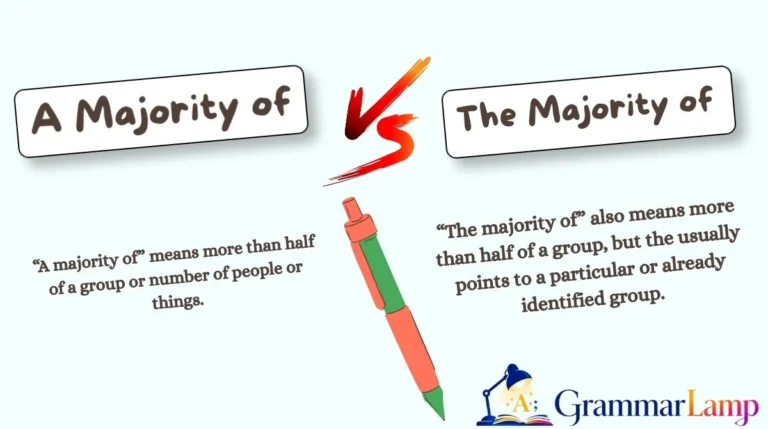
“A majority of” means more than half of a group or number of people or things.
The word a gives the expression an indefinite meaning. It often presents the majority as an amount or result, without making it sound like the only clearly identified majority being discussed.
Basic grammar rule
The usual structure is:
a majority of + plural noun + plural verb
Examples:
- A majority of students passed the exam.
- A majority of voters supported the proposal.
- A majority of employees agreed with the new policy.
- A majority of customers preferred the cheaper product.
- A majority of parents said that the school needs better facilities.
- A majority of people use their phones every day.
- A majority of members voted in favor of the plan.
- A majority of residents supported the new park.
In these sentences, the speaker is focusing on the fact that more than half of the group had a particular opinion, action, or result.
When should you use “a majority of”?
Use “a majority of” when you want to emphasize the number, result, or proportion.
For example:
A majority of voters chose Candidate A.
The important point is that more than half of the voters chose that person.
You could also say:
A majority of voters rejected the proposal.
Again, the sentence reports a result. It does not necessarily suggest that the group has already been strongly established as a particular group in the conversation.
“A majority of” often sounds natural in reports
This expression is common when reporting the results of surveys, votes, studies, or polls.
For example:
A majority of teenagers said they prefer online learning.
A majority of workers supported the four-day workweek.
A majority of respondents agreed with the statement.
Here, a majority works almost like saying more than half.
Common learner confusion
Some students think “a majority of” means only a small majority.
It does not.
A majority can be 51%, 60%, 75%, or even 90%. The word simply means more than half.
For example:
A majority of the class voted for the trip.
The majority could be 51% or 90%. The sentence itself does not tell us the exact percentage.
Another common mistake is thinking that “a majority of” must always be followed by “the.”
That is not true.
You can say:
A majority of students passed.
You can also say:
A majority of the students passed.
Both are possible. The second one refers more clearly to a particular group of students.
What Does “The Majority of” Mean?
“The majority of” also means more than half of a group, but the usually points to a particular or already identified group.
The speaker often expects the listener to understand which group is being discussed.
Basic grammar rule
The common structure is:
the majority of + plural noun + plural verb
Examples:
- The majority of students passed the exam.
- The majority of voters supported the proposal.
- The majority of employees agreed with the decision.
- The majority of customers were happy with the service.
- The majority of parents attended the meeting.
- The majority of people in the room agreed.
- The majority of members voted against the plan.
- The majority of residents opposed the change.
The expression often refers to the larger part of a known group.
When should you use “the majority of”?
Use “the majority of” when the group is specific, known, or already mentioned.
Imagine a teacher is talking about a class:
“There are 30 students in my class. The majority of the students want an extra holiday.”
Here, the students clearly refers to the particular students in the teacher’s class.
Or imagine two people are discussing a company:
“Our company has 500 employees. The majority of employees work from home.”
The context tells us which employees are being discussed.
“The majority of” can focus on the larger part
Consider:
The majority of the audience left before the end of the show.
The audience is a specific group. The sentence focuses on the larger part of that audience.
Compare it with:
A majority of the audience left before the end of the show.
This is also correct. Here, the speaker may be emphasizing the result: more than half of the audience left.
So the difference is not always a strict right-or-wrong choice. In many sentences, both forms are grammatical, but the speaker’s focus can be slightly different.
Common learner confusion
Many learners believe that “the majority of” is always more correct than “a majority of.”
That is not true.
For example:
A majority of voters supported the plan.
This is perfectly correct.
And:
The majority of voters supported the plan.
This is also correct.
The choice depends partly on whether you are presenting a majority as a result or referring to the larger part of a particular group.
Difference Between “A Majority of” and “The Majority of”
The biggest difference is the use of the articles a and the.
A is indefinite. It introduces something as one example or one amount.
The is definite. It points to something specific or identifiable.
With majority, this creates a difference in focus.
| Expression | Basic meaning | Main focus | Typical use |
|---|---|---|---|
| a majority of | More than half | A result or amount | Surveys, votes, reports |
| the majority of | More than half | The larger part of a known group | Specific groups and situations |
| a majority of the students | More than half of those students | The result/number | Reporting a result |
| the majority of the students | The larger part of those students | The group as a whole | Referring to a particular group |
1. “A majority of” presents a majority as a result
Suppose a newspaper reports the results of a poll:
A majority of voters support the new law.
The writer is giving you a result. More than half of the voters support it.
This is especially natural in statistical and survey language.
2. “The majority of” points to the larger part
Now imagine you are already discussing a group:
The majority of the voters in this district support the new law.
The phrase points to the larger part of the particular voters in this district.
The group is clearly defined.
3. Both can be correct
This is one of the most important points.
Do not assume that one is correct and the other is wrong.
For example:
A majority of students passed the test.
Correct.
The majority of students passed the test.
Correct.
A majority of the students passed the test.
Correct.
The majority of the students passed the test.
Correct.
The difference is mainly about specificity and emphasis, not a completely different mathematical meaning.
4. “More than half” can help you understand the basic meaning
If you replace either expression with “more than half of,” the basic meaning usually remains.
A majority of students passed.
= More than half of the students passed.
The majority of students passed.
= More than half of the students passed.
This is a useful way to check whether you understand the sentence.
Grammar Rules You Must Remember
Rule 1: “A majority of” means more than half
A majority is greater than 50%.
A majority of students voted for the trip.
If there are 40 students, at least 21 students must have voted for it for the sentence to describe a majority.
Do not use majority when exactly half of a group has something.
For example, if 20 out of 40 students agree, that is half, not a majority.
Rule 2: “The majority of” usually refers to a particular group
Use the when the group is clear from the context.
The majority of the employees in our office work remotely.
We know which employees are meant: the employees in our office.
Another example:
The majority of the books on this shelf are novels.
The phrase points to the particular books on this shelf.
Rule 3: Use a plural noun after “of” when you mean individual members
When talking about people or countable things, we normally use a plural noun:
A majority of students are happy.
The majority of workers are experienced.
A majority of houses need repairs.
The majority of customers were satisfied.
Avoid:
❌ A majority of student are happy.
Use:
✅ A majority of students are happy.
Rule 4: The verb is usually plural when “majority of” refers to people or things
When majority of + plural noun refers to the individual members of a group, a plural verb is very common.
The majority of students are ready.
A majority of employees have agreed.
The majority of customers were satisfied.
However, majority can sometimes be treated as a singular collective noun, especially when the majority itself is viewed as one group or decision.
For example:
The majority was in favor of the proposal.
This is possible because the majority is being treated as one voting group.
For learners, the easiest rule is:
majority of + plural noun → usually use a plural verb when you are talking about the people or things individually.
Common Mistakes Students Make
Understanding the rules is useful, but knowing the common mistakes can make them much easier to remember.
Mistake 1: Thinking “a majority of” is wrong
Some learners see:
A majority of people agree.
and think it should be:
❌ The majority of people agree.
There is nothing wrong with the first sentence.
A majority of people agree is completely natural.
Easy correction
Remember:
a majority = more than half
You can use it when reporting a result.
Mistake 2: Thinking “the majority of” always refers to exactly 51%
It does not.
A majority simply means more than half.
For example:
The majority of students passed.
Maybe 55% passed. Maybe 80% passed. The sentence does not tell us the exact number.
Mistake 3: Using a singular noun after “of”
Incorrect:
❌ The majority of student passed.
Correct:
✅ The majority of students passed.
When you mean many individual people, use the plural noun.
Mistake 4: Using a singular verb with a plural group
Incorrect in the usual meaning:
❌ The majority of students is happy.
Better:
✅ The majority of students are happy.
Here, students are individual people, so are is the natural choice.
But remember that the majority is can be correct when majority itself is the subject:
The majority is against the proposal.
Mistake 5: Thinking “the” always means more than “a”
English learners sometimes believe that the majority means a bigger percentage than a majority.
It does not.
Both can refer to 51%, 60%, 70%, or another percentage above 50%.
The article does not change the mathematical size of the majority.
Mistake 6: Using “majority” when you mean “most” in every situation
Majority and most are related, but they are not always interchangeable.
Majority specifically means more than half.
Most often means the greater number or amount, but its exact meaning depends on context.
For example:
The majority of students passed.
This clearly means more than half passed.
Most students passed.
This also normally suggests more than half in this context, but most is a more general word and is often more natural in everyday speech.
Easy Trick to Remember the Difference
Here is a simple classroom trick.
Think of “A” as “a result.”
A majority of often sounds natural when you are announcing or reporting a result.
A majority of voters chose option A.
Think:
“Here is a result: more than half chose A.”
Think of “The” as “the group.”
The majority of often points to the larger part of a particular group.
The majority of the students in my class are quiet.
Think:
“I know this group. I am talking about the larger part of this group.”
There is also an even easier trick:
Replace the phrase with “more than half.”
If the sentence makes sense, you understand the basic meaning.
A majority of workers agreed.
→ More than half of the workers agreed.
The majority of workers agreed.
→ More than half of the workers agreed.
Then ask yourself:
Am I reporting a result?
Try a majority of.
Am I talking about the larger part of a known group?
Try the majority of.
This is not an absolute rule, because native speakers use both forms in many of the same situations. But it is a helpful guide.
Daily Life Examples
These examples show how a majority of and the majority of can appear in normal spoken and written English.
1. Talking about a class
Teacher: Did the students like the new activity?
Student: Yes. A majority of the students said they enjoyed it.
The speaker is reporting a result.
2. Talking about a family
The majority of my family lives in the same city.
Here, the speaker is talking about a particular family.
3. Talking about customers
A majority of customers prefer online shopping.
This sounds like a general survey or business finding.
4. Talking about employees
The majority of the employees in our department work from home.
The department gives us a clear, specific group.
5. Talking about a vote
A majority of members voted against the proposal.
The sentence reports the result of a vote.
6. Talking about a school
The majority of students at this school walk to class.
The school identifies the group being discussed.
7. Talking about a survey
A majority of respondents said that the service was easy to use.
This is a natural sentence for a survey report.
8. Talking about a meeting
The majority of people at the meeting agreed with Sarah.
The meeting identifies the particular group.
9. Talking about a product
A majority of customers gave the product a positive review.
This sounds like a report based on customer feedback.
10. Talking casually
The majority of my friends prefer tea to coffee.
The speaker is referring to a particular group: their friends.
In casual conversation, you might also simply say:
Most of my friends prefer tea to coffee.
That is often shorter and more natural.
Practice Section
Choose “a majority of” or “the majority of” in each sentence.
1.
_____ students in the class passed the final exam.
2.
_____ voters in the survey supported the new policy.
3.
_____ employees in our office arrive before 9 a.m.
4.
_____ customers said they were satisfied with the service.
5.
_____ members voted in favor of changing the rules.
Answers
1. The majority of
The majority of students in the class passed the final exam.
The class is a specific group.
2. A majority of
A majority of voters in the survey supported the new policy.
This presents the survey result.
3. The majority of
The majority of employees in our office arrive before 9 a.m.
“Our office” identifies the group.
4. A majority of
A majority of customers said they were satisfied with the service.
This sounds like a customer survey or report.
5. The majority of
The majority of members voted in favor of changing the rules.
The members are a particular group in the situation.
Remember, some of these sentences could use the other expression too. The answers above show the most natural choice based on the context, not an absolute rule that the other form is always incorrect.
FAQs
What is the difference between “a majority of” and “the majority of”?
Both expressions mean more than half of a group. The main difference is focus.
A majority of often presents more than half as a result or amount. The majority of often points to the larger part of a particular or known group.
Can we use “a majority of” in questions?
Yes. It is grammatically correct.
For example:
Did a majority of students support the idea?
You can also ask:
Did the majority of students support the idea?
The choice depends on the context and what group you have in mind.
Is “a majority of” formal or informal?
“A majority of” is neutral and works well in both everyday and formal English.
It is especially common in surveys, reports, news writing, academic writing, and discussions about voting.
In casual speech, however, “most” is often simpler.
Is “the majority of” more correct than “a majority of”?
No. Neither expression is automatically more correct.
Both are standard English. The choice depends on context and meaning.
For example, both are correct:
A majority of voters agreed.
The majority of voters agreed.
Should I use “is” or “are” after “the majority of”?
When majority of + plural noun refers to individual people or things, a plural verb is usually the natural choice.
The majority of students are ready.
The majority of employees have agreed.
But the majority is can be used when the majority is viewed as one group or body:
The majority is against the proposal.
Can “a majority of” and “the majority of” be followed by “the”?
Yes.
You can say:
A majority of the students passed.
and:
The majority of the students passed.
The difference is not about whether the can appear after of. The article before majority changes the focus.
Conclusion
“A majority of” and “the majority of” are both correct expressions that normally mean more than half of a group. The main difference is the way the speaker presents that majority.
Use “a majority of” when you are often reporting a result, amount, survey finding, or voting outcome. Use “the majority of” when you are pointing to the larger part of a particular or already understood group.
For example:
A majority of voters supported the plan.
This sounds like a reported result.
The majority of the voters in our town supported the plan.
This points more clearly to a specific group.
Also remember the verb rule. When majority of is followed by a plural noun referring to individual people or things, a plural verb is usually natural:
The majority of students are happy.
Do not worry if the two expressions still feel similar. They really are similar, and native speakers sometimes use either one without a major change in meaning.
The best way to learn the difference is to read real sentences, notice the context, and practice making your own examples.
Once you understand a = an amount/result and the = a particular group, choosing between them becomes much easier.

Liam Derren is a language writer at GrammarLamp, creating simple, helpful content about grammar, words, and everyday English. He makes language learning clear, practical, and easy to understand.
2 thoughts on “A Majority of vs The Majority of: Easy Grammar Guide for 2026”