
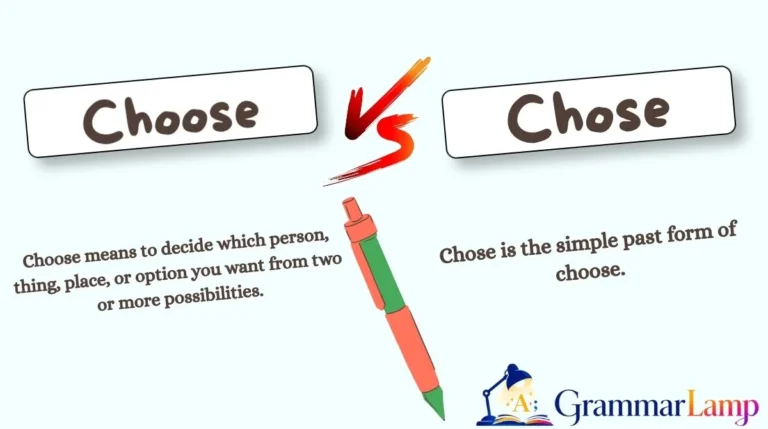
Choose vs chose is a common problem for English learners because both words come from the same verb.
They have almost the same meaning, but they are used at different times. The main difference is simple: choose is the present form, while chose is the past form.
For example, you can say, “I choose tea every morning” when talking about a regular or current choice. But if the decision happened yesterday, you should say, “I chose tea yesterday.”
The confusion often happens because the spelling changes completely when the verb moves from the present to the past.
Unlike regular verbs such as play → played or work → worked, choose does not simply add -ed. Its past form is chose, and its past participle is chosen.
Knowing the difference matters in everyday English. We make choices all the time: choosing food, clothes, jobs, schools, friends, plans, or places to visit.
Using the wrong form can make a sentence sound incorrect or unclear.
By the end of this guide, you will know exactly when to use choose, when to use chose, how chosen fits into the picture, and how to avoid the most common mistakes.
The simple rules and real-life examples will make the difference much easier to remember.
A Majority of vs The Majority of: Easy Grammar Guide for 2026
Sun vs Son: Meaning, Difference, Rules, and Examples (2026)
Tomatoes or Tomatos: Which Spelling Is Correct? [2026]
In the Morning vs On the Morning: Complete Grammar Guide for 2026
What Does “Choose” Mean?
Choose means to decide which person, thing, place, or option you want from two or more possibilities.
It is the present form of the verb. We use it when the action is happening now, happens regularly, or is being discussed as a general fact.
The basic verb forms are:
- Present: choose
- Past: chose
- Past participle: chosen
The word choose can be used for a decision that is happening right now.
For example:
I need to choose a shirt for the party.
The decision has not been completed yet. The person still needs to make the decision.
We can also use choose for habits and repeated actions.
I usually choose coffee in the morning.
Here, the speaker is talking about a regular choice, not one specific choice in the past.
Common examples with “choose”
- I choose tea instead of coffee.
- Please choose one answer.
- We need to choose a restaurant for dinner.
- She usually chooses healthy food.
- They choose a different route every morning.
- You can choose any color you like.
- I will choose my clothes after breakfast.
- He wants to choose the movie tonight.
Notice that choose does not always appear exactly as choose. With he, she, or it in the simple present, we normally use chooses.
For example:
She chooses the blue dress.
The base form is still choose, but the third-person singular form is chooses.
Can “choose” be used for the future?
Yes. We can use choose after future words and modal verbs.
For example:
I will choose later.
You can choose any seat.
We may choose another hotel.
The word after will, can, may, might, or similar modal verbs stays in its base form. Therefore, we say will choose, not will chose.
A common confusion
Some learners think choose means “a choice happening now” only. That is not quite right.
It can describe:
- a current decision,
- a repeated decision,
- a general habit,
- an instruction,
- or a future decision when used with words such as will or can.
The important point is that choose is not the simple past form.
What Does “Chose” Mean?
Chose is the simple past form of choose.
We use chose when someone made a decision in the past.
For example:
I chose the red shirt yesterday.
The decision happened in the past, so chose is correct.
Unlike regular verbs, choose changes its spelling to make its past form. This makes it an irregular verb.
The three main forms are:
choose → chose → chosen
Common examples with “chose”
- I chose the blue jacket yesterday.
- She chose a seat near the window.
- We chose pizza for dinner last night.
- They chose the cheaper option.
- He chose to stay at home.
- My brother chose computer science.
- Sarah chose a beautiful gift for her mother.
- The team chose a new captain.
In each example, the decision was completed in the past.
Words that often appear with “chose”
Certain time expressions make the past meaning especially clear.
For example:
- yesterday
- last night
- last week
- last month
- last year
- two days ago
- when I was young
- earlier
- this morning, when the action is already finished
Consider these sentences:
I chose this book yesterday.
We chose a new apartment last month.
She chose chocolate cake last night.
These choices are finished, so chose works naturally.
“Chose” does not mean “chosen”
Another important point is that chose and chosen are not interchangeable.
We say:
I chose this phone yesterday.
But with forms of have, has, or had, we normally use chosen:
I have chosen this phone.
She has chosen a dress.
They had chosen a different plan.
So, remember the full pattern:
choose → chose → chosen
A common confusion
Learners sometimes use chose after will, can, or did.
These are incorrect:
I will chose a book.
Did you chose this one?
The correct versions are:
I will choose a book.
Did you choose this one?
Why? Because will and did already show the grammar information needed. The main verb returns to its base form after these words.
Difference Between Choose and Chose
The easiest way to understand choose vs chose is to focus on time.
Choose is the present form.
Chose is the past form.
Here is a quick comparison:
| Feature | Choose | Chose |
|---|---|---|
| Verb form | Present/base form | Simple past |
| Time | Present, general, or future with auxiliaries | Past |
| Meaning | Make or decide on a choice | Made a choice |
| Example | I choose tea. | I chose tea yesterday. |
| Common helper | will, can, may, should, do, does | did, was/were in some structures |
| Verb family | choose → chose → chosen | choose → chose → chosen |
Usage difference
Compare these sentences:
I choose chicken when I eat here.
This describes a habit or general preference.
I chose chicken yesterday.
This describes one completed decision in the past.
The meaning of the verb is almost the same. The main difference is when the choice happened.
Sentence structure difference
With a simple present sentence:
Subject + choose/chooses + object
Examples:
I choose the blue one.
She chooses the blue one.
With the simple past:
Subject + chose + object
Examples:
I chose the blue one.
She chose the blue one.
Notice something useful: chose stays the same with all subjects.
We say:
- I chose
- You chose
- He chose
- She chose
- We chose
- They chose
There is no choses in the past tense.
Meaning comparison
The difference becomes very clear when we place the sentences side by side:
I choose my clothes every morning.
This is a repeated action.
I chose my clothes before I left yesterday.
This is one completed action in the past.
Another pair:
We choose a movie every Friday.
We chose a movie last Friday.
Again, the first sentence talks about a regular activity, while the second talks about a finished event.
What about “chosen”?
There is a third form that learners should know:
choose → chose → chosen
Chosen is the past participle. It is often used with have, has, or had, and in passive structures.
Examples:
I have chosen a new course.
She has chosen the red dress.
They had chosen a different route.
He was chosen for the team.
So if you are learning these words, do not memorize only choose → chose. Learn the complete verb family.
Collaborate vs Corroborate: Meaning, Difference, and Examples in 2026
Sleeve vs Sleave: Which Is Correct? Meaning, Difference, and Examples in 2026
Time off vs time-off: The Complete Grammar Guide for 2026
I’m vs I Am: Complete Difference, Rules, Examples & Usage Guide 2026
Grammar Rules You Must Remember
Rule 1: Use “choose” for the present
When the choice is current, repeated, or generally true, use choose or chooses.
I choose fruit for breakfast.
She chooses fruit for breakfast.
Remember the -s with he, she, and it in the simple present.
Rule 2: Use “chose” for a completed past choice
When the decision happened in the past, use chose.
We chose the smaller room yesterday.
The word yesterday makes the past time obvious.
Another example:
He chose a new laptop last week.
The action is complete, so chose is correct.
Rule 3: After “did,” use “choose,” not “chose”
This is one of the most important rules.
Correct:
Did you choose this dress?
Incorrect:
Did you chose this dress?
The word did already marks the sentence as past tense. Therefore, the main verb uses its base form.
The same rule applies to negative sentences:
I did not choose this color.
Not:
I did not chose this color.
Rule 4: After “will,” use “choose,” not “chose”
When talking about a future decision, use choose after will.
Correct:
I will choose a gift tomorrow.
Incorrect:
I will chose a gift tomorrow.
The same idea applies to modal verbs:
You can choose any option.
We may choose another date.
She should choose carefully.
Never use chose immediately after these helping verbs.
Common Mistakes Students Make
Many mistakes with these words come from one simple problem: learners remember the meaning but forget the tense.
Mistake 1: Using “chose” for the present
Incorrect:
I chose tea every morning.
If you mean this is your regular habit, use:
I choose tea every morning.
However, if you are talking about a specific morning in the past, then chose is correct.
Mistake 2: Using “choose” for a finished past action
Incorrect:
Yesterday, I choose the black shoes.
Correct:
Yesterday, I chose the black shoes.
The word yesterday tells us the action happened in the past.
Mistake 3: Saying “did chose”
Incorrect:
Did she chose this dress?
Correct:
Did she choose this dress?
Think of did as carrying the past tense. The main verb goes back to its base form.
Mistake 4: Saying “will chose”
Incorrect:
We will chose a restaurant later.
Correct:
We will choose a restaurant later.
Will is followed by the base form of the verb.
Mistake 5: Confusing “chose” with “chosen”
Incorrect:
I have chose this option.
Correct:
I have chosen this option.
After have, has, or had, use the past participle chosen.
An easy correction tip
When you are unsure, first ask yourself:
“When did the choice happen?”
If it is happening now, happens regularly, or is a future choice with will, think choose.
If it happened and finished in the past, think chose.
If you have have, has, or had before the verb, think chosen.
That small question can prevent many mistakes.
Easy Trick to Remember the Difference
Here is a quick memory trick:
Choose = now or later.
Chose = before.
You can remember it like this:
Today I choose. Yesterday I chose.
That one sentence gives you the main difference.
For example:
Today I choose pizza.
Yesterday I chose pizza.
The spelling changes from choose to chose because the time changes from present to past.
There is another useful trick. Notice the sound:
- choose sounds like “chooz”
- chose sounds like “chohz”
The spelling and pronunciation are different, so it is useful to practice them aloud.
Try saying:
I choose.
I chose.
I have chosen.
Repeat the three forms together:
choose — chose — chosen
This helps you remember the entire verb rather than only two forms.
Real-life logic
Imagine you are standing in a restaurant.
The waiter asks:
Which meal will you choose?
You are deciding now, so choose is appropriate.
Later, your friend asks:
Which meal did you choose?
The decision is already finished, so chose is correct.
The next day, you tell someone:
I have chosen the same meal again.
Now you are using the past participle.
Thinking about the actual situation is often easier than trying to memorize a complicated grammar rule.
Daily Life Examples
Here are some natural examples that you might hear or use in everyday English.
1. At a restaurant
Friend: What will you choose?
You: I think I’ll choose the chicken sandwich.
The decision is about the present or future, so choose is used.
2. Talking about yesterday
Friend: What did you order yesterday?
You: I chose the pasta.
The question uses did, and the answer describes a completed past action.
3. Shopping for clothes
I usually choose comfortable clothes.
This describes a regular preference.
4. Talking about a past shopping trip
I chose the blue jacket last Saturday.
The choice happened in the past.
5. Making plans
We can choose a movie after dinner.
The decision has not been made yet.
6. Talking about a finished decision
We chose a comedy last night.
The decision happened last night.
7. Asking someone about a decision
Did you choose your university?
Even though the question is about the past, choose follows did.
8. Talking about a future decision
I will choose my subjects tomorrow.
The decision is expected in the future.
9. Talking about a habit
My sister always chooses the window seat.
Because my sister is singular, we use chooses in the simple present.
10. Using “chosen”
She has chosen a new career path.
Here, has requires the past participle chosen, not chose.
These examples show that the word before the verb can be just as important as the time expression.
Practice Section
Test yourself. Pick choose, chose, or chosen in each sentence.
1. I usually ______ tea in the morning.
2. We ______ the red car yesterday.
3. Did you ______ this restaurant?
4. She has ______ a new dress.
5. I will ______ a gift for my brother tomorrow.
Answers
1. choose
I usually choose tea in the morning.
This is a regular habit.
2. chose
We chose the red car yesterday.
The choice happened in the past.
3. choose
Did you choose this restaurant?
Use the base form after did.
4. chosen
She has chosen a new dress.
Use the past participle after has.
5. choose
I will choose a gift for my brother tomorrow.
Use the base form after will.
If you got all five correct, you have understood the basic pattern very well.
A MA or an MA Degree? The Correct Grammar Rule in 2026
A or an: Easy Rules, Examples, and Common Mistakes in 2026
From My End or From My Side? Which Is Correct in English? (2026 Guide)
From My End or From My Side? Which Is Correct in English? (2026 Guide)
FAQs
What is the difference between choose and chose?
Choose is the present or base form of the verb, while chose is its simple past form. Use choose for current, regular, or future choices and chose for a completed past choice.
Can we use “choose” in questions?
Yes. We commonly use choose after do, does, and did, as well as modal verbs. For example: “Did you choose this one?” and “Can I choose my seat?”
Is “chose” formal or informal?
Neither. Chose is simply the standard past-tense form of choose. It can be used in casual conversations, school writing, professional communication, and formal writing.
Is “chosen” the past tense of choose?
No. Chose is the simple past form. Chosen is the past participle. For example, “I chose the book yesterday,” but “I have chosen the book.”
Which is correct: “Did you choose” or “Did you chose”?
The correct form is “Did you choose?” After did, use the base form of the verb. The word did already shows that the question is about the past.
Which is correct: “I will choose” or “I will chose”?
The correct form is “I will choose.” After will, use the base form of the verb. Chose is only the simple past form, so it cannot normally follow will.
Conclusion
Choose is the present or base form. Use it for current choices, regular habits, instructions, and after words such as will, can, and did.
Chose is the simple past form. Use it when someone made a choice in the past.
And do not forget the third form: chosen. It is the past participle and is commonly used with have, has, and had, as well as in passive sentences.
The easiest sentence to remember is:
Today I choose. Yesterday I chose. I have chosen before.
Try making your own sentences with these three forms. Talk about what you choose for breakfast, what you chose yesterday, and what you have chosen recently.
A few minutes of daily practice can make the difference feel natural.
Once you remember choose → chose → chosen, you will be much less likely to mix these words up in everyday English.

Liam Derren is a language writer at GrammarLamp, creating simple, helpful content about grammar, words, and everyday English. He makes language learning clear, practical, and easy to understand.