
Sleeve vs sleave is a confusing spelling question because both words are pronounced almost exactly the same.
For most English learners, the problem starts when they hear the word sleeve and try to write it from memory.
The spelling can easily become sleave, especially because English has many words where ea and ee make similar sounds.
There is an important point to remember, though: sleeve and sleave are not simply two spellings of the same everyday word. They have different meanings.
Sleave is a real English word, but it is very uncommon and mainly belongs to old, specialized, or textile-related English.
Dictionaries describe it as untwisted or tangled silk thread, and as a verb meaning to separate silk thread into filaments. Merriam-Webster labels its noun use archaic and its verb use obsolete.
So, if you are writing about clothes, sleeve is the correct spelling.
By the end of this guide, you will know exactly when to use each word, why learners confuse them, how they behave in sentences, and a simple trick that makes the spelling easier to remember.
What Does “Sleeve” Mean?
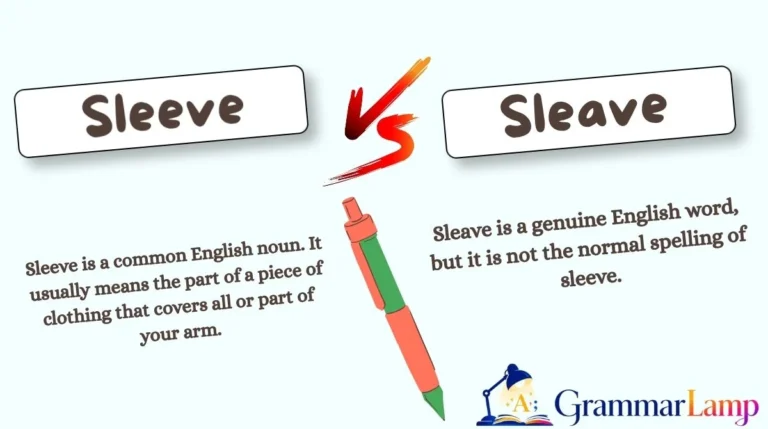
Sleeve is a common English noun. It usually means the part of a piece of clothing that covers all or part of your arm.
For example, a shirt has two sleeves, a jacket has two sleeves, and a long-sleeved dress has sleeves that cover the arms.
The plural form is sleeves.
Simple definition
A sleeve is the part of a garment that covers the arm. This is the everyday meaning English learners are most likely to need.
When should you use “sleeve”?
Use sleeve when you are talking about clothing or something that works like a protective covering.
You can use it with words such as:
- shirt sleeve
- jacket sleeve
- coat sleeve
- long sleeve
- short sleeve
- sleeve length
- rolled-up sleeve
- loose sleeve
The word can also have other meanings. For example, a protective sleeve can cover a document, cable, machine part, or another object.
The word also appears in common expressions. The phrase “up your sleeve” can mean that someone has a secret idea, plan, skill, or surprise ready to use.
Grammar rule
Sleeve is normally a countable noun.
You can say:
- a sleeve
- one sleeve
- two sleeves
- the sleeve
- my sleeve
When you mean the general idea of sleeves, you can use the plural sleeves.
Examples with “sleeve”
- My shirt has long sleeves.
- She rolled up her sleeves before washing the dishes.
- The sleeve of my jacket is too long.
- He tore his sleeve while climbing the fence.
- This dress has short sleeves.
- Please pull your sleeves down.
- The tailor shortened the sleeves of my coat.
- She always keeps a pen in her sleeve pocket.
Notice the spelling in every example: s-l-e-e-v-e.
“Sleeve” can describe more than clothing
Although clothing is the most common meaning, English also uses sleeve for a covering or tube around another object.
For example:
- The cable has a protective sleeve.
- Put the document inside a plastic sleeve.
- The machine needs a metal sleeve.
This meaning is based on the basic idea of something that covers or surrounds another thing.
Common learner confusion
The biggest problem is pronunciation.
Sleeve is pronounced /sliːv/. The word sounds like sleave.
That means you cannot always decide the spelling by listening.
Compare:
Please roll up your sleeves.
Not:
Please roll up your sleaves.
If you mean the part of a shirt, jacket, or dress that covers the arm, sleeve is the spelling you want.
What Does “Sleave” Mean?
Sleave is a genuine English word, but it is not the normal spelling of sleeve.
This is an important distinction. Some spelling guides simply call sleave an incorrect spelling when learners use it to mean a clothing sleeve. That advice is correct for everyday English, but technically sleave does exist as a separate dictionary word.
Simple definition
As a noun, sleave refers to untwisted silk or a tangled or raveled part of silk or thread.
As a verb, to sleave means to separate silk thread into individual filaments. Merriam-Webster describes the verb as obsolete.
This is mainly historical or specialized vocabulary connected with textiles and weaving.
When should you use “sleave”?
For normal modern conversation, you will almost never need sleave.
You may see it in:
- old literature
- historical writing
- poetry
- discussions of textiles
- dictionaries
- older descriptions of silk or thread
One famous example comes from Shakespeare’s Macbeth:
“Sleep that knits up the ravell’d sleave of care.”
Here, sleave does not mean a shirt sleeve. It refers to something tangled or raveled, connected with thread or silk.
Grammar rule
Sleave can function as both a noun and a verb, although these uses are rare or historical.
As a noun:
- a sleave
- the sleave
- sleave silk
As a verb:
- to sleave
- sleaved
- sleaving
- sleaves
The verb was used in textile work to describe separating threads or silk into filaments.
Examples with “sleave”
Because this is an unusual word, the examples below are mainly historical or specialized in style.
- The weaver worked carefully with the tangled sleave.
- The old text describes sleave silk used for embroidery.
- The craftsman separated the silk into fine strands, or sleaved it.
- The poem uses “sleave” as an image of tangled thread.
- The museum display explains how sleave silk was prepared.
- The historical book mentions a bundle of sleave.
- The textile worker separated the threads into filaments.
- Shakespeare used the word “sleave” in a famous poetic expression.
These sentences show why the word is different from sleeve.
Common learner confusion
If you write:
My shirt has a long sleave.
You have used the wrong word for modern everyday English.
The correct sentence is:
My shirt has a long sleeve.
The spelling sleave is not the normal alternative spelling of sleeve. It is a separate and very uncommon word with a textile-related meaning.
Difference Between Sleeve and Sleave
The easiest way to understand sleeve vs sleave is to focus on meaning rather than pronunciation.
| Word | Main meaning | Common today? | Part of speech | Example |
|---|---|---|---|---|
| sleeve | Part of clothing that covers the arm | Yes | Noun, also verb in some uses | My sleeve is too long. |
| sleave | Untwisted/tangled silk or thread | Very rare | Noun and verb | The old text mentions sleave silk. |
1. They have different meanings
Sleeve is normally about clothing or a covering.
The sleeve of my shirt is dirty.
Sleave is related to silk, thread, and weaving.
The book describes sleave silk.
So these words should not be treated as spelling variations.
2. “Sleeve” is common; “sleave” is rare
If you are learning everyday English, sleeve is the word you need.
You will see it in conversations about:
- clothes
- fashion
- washing
- sewing
- shopping
- uniforms
- jackets
- shirts
You may encounter sleave much less often, especially outside historical or textile-related writing.
3. Their pronunciation is the same or very similar
Both are pronounced like “sleev.”
That is one reason learners get confused.
English spelling does not always match pronunciation perfectly. Two words can sound the same while having different spellings and meanings.
4. Sentence structure can be different
With sleeve, common structures include:
possessive + sleeve
My sleeve is wet.
verb + sleeve
She rolled up her sleeve.
adjective + sleeve
He wore a short-sleeved shirt.
With sleave, the structure is usually connected with silk, thread, weaving, or old literary language.
The worker separated the sleave into fine strands.
5. Meaning matters more than sound
When you hear “sleev,” ask yourself:
Am I talking about clothing?
If yes, write:
sleeve
If you are reading a historical or technical text about tangled or untwisted silk, sleave may be the intended word.
Grammar Rules You Must Remember
Rule 1: Use “sleeve” for clothing
If you mean the part of a shirt, jacket, coat, or dress that covers the arm, always use sleeve.
Correct:
She rolled up her sleeves.
Incorrect for this meaning:
She rolled up her sleaves.
This is the most important rule for English learners.
Rule 2: “Sleave” is a separate word, not a common spelling mistake you should use
It is tempting to say that sleave is simply wrong. For everyday English, that is useful advice when someone means a clothing sleeve.
But dictionaries confirm that sleave has its own historical meaning. It refers to silk or thread, especially untwisted or tangled material.
So remember:
Sleeve = clothing
Sleave = rare textile word
Rule 3: The plural of “sleeve” is “sleeves”
Add -s:
sleeve → sleeves
Examples:
This jacket has two sleeves.
My sleeves are too long.
Roll up your sleeves.
Do not change the spelling to sleaves when you mean more than one clothing sleeve.
Rule 4: Do not choose the spelling only from pronunciation
Both words can sound like “sleev.”
That means listening alone is not enough.
For example, if someone says:
“Roll up your sleev.”
You need to think about the meaning.
They are almost certainly talking about clothing, so the spelling is:
sleeve
This is a useful lesson for many English words. Pronunciation can help, but meaning and context often tell you which spelling is correct.
Common Mistakes Students Make
The confusion between these words usually happens because ee and ea can sometimes represent similar vowel sounds in English.
Learners may hear sleeve and spell it as sleave. This is especially common when English is not their first language.
Mistake 1: Writing “sleave” for clothing
❌ My shirt has a short sleave.
✅ My shirt has a short sleeve.
The word for the part of clothing is sleeve.
Mistake 2: Writing “sleaves” as the plural
❌ His shirt sleeves are dirty.
This sentence is actually correct.
But if you spell the word as sleaves, it becomes incorrect for clothing:
❌ His shirt sleaves are dirty.
✅ His shirt sleeves are dirty.
Remember:
sleeve → sleeves
Mistake 3: Assuming “sleave” is just an alternative spelling
❌ “Sleave and sleeve are two spellings for the same thing.”
✅ They are separate words with different meanings.
Sleeve is the everyday clothing word. Sleave has a rare textile-related meaning.
Mistake 4: Avoiding “sleave” completely
There is another side to the problem.
A student may learn that sleave is “wrong” and then believe it is not an English word at all. That is not quite accurate.
It is a dictionary word, but it is rare and specialized.
So the better lesson is:
Do not use “sleave” when you mean the part of a shirt or jacket.
That is more accurate than saying the word never exists.
Easy correction tip
Think about the object first.
If you can point to the part of your shirt covering your arm, the answer is:
SLEEVE
If you are talking about old silk, tangled thread, or historical weaving terminology, then:
SLEAVE
Easy Trick to Remember the Difference
Here is a simple memory trick:
Sleeve has “EE” for your clothing.
Picture a shirt in your mind.
Write:
SL + EE + VE = SLEEVE
The two e’s in the middle can remind you of the two sides of a shirt’s sleeves.
Another easy trick is to connect sleeve with familiar clothing words:
- sleeve
- shirt sleeve
- jacket sleeve
- sleeve length
- long sleeve
- short sleeve
You will see that sleeve is the normal spelling again and again.
What about “sleave”?
Think of sleave as an old word you might find in a dusty book about silk or weaving.
That makes it easier to separate the two:
SLEEVE → shirt, jacket, arm
SLEAVE → old silk, thread, weaving
You do not need to memorize every historical definition of sleave to use English correctly.
For everyday English, remembering sleeve = clothing is enough.
Daily Life Examples
Here are some natural examples you might hear or use in everyday English.
1. Getting dressed
A: Is this shirt too small?
B: No, but the sleeves look a little short.
2. Cooking
Mom: Your sleeves are hanging near the food.
Son: Oh, right. I’ll roll them up.
3. Shopping
Customer: Does this jacket come with long sleeves?
Shop assistant: Yes. It also comes in a short-sleeve style.
4. At school
Teacher: Please roll up your sleeves before you start the art project.
Student: Okay.
5. Talking about a jacket
A: What’s wrong with your jacket?
B: The sleeve is torn.
6. At a tailor’s shop
Customer: Can you make the sleeves shorter?
Tailor: Yes. I’ll adjust them for you.
7. Talking about weather
A: Are you wearing a short-sleeve shirt today?
B: Yes. It’s too warm for a jacket.
8. Washing clothes
A: Why is your sleeve wet?
B: I washed my hands and got water on it.
9. A hidden plan
A: Do you have any ideas for the school event?
B: Don’t worry. I have something up my sleeve.
Here, “up my sleeve” is an expression. It means the person has a secret idea or surprise ready.
10. A protective covering
A: Where should I put this document?
B: Put it in a plastic sleeve so it doesn’t get damaged.
This example shows that sleeve is not limited to clothing. It can also mean a protective covering.
Practice Section
Choose the correct word: sleeve or sleave.
1. My jacket has a torn ______.
2. Please roll up your ______ before you wash the car.
3. The old textile book discusses ______ silk.
4. This shirt has very long ______.
5. The tailor shortened the ______ of my coat.
Try to answer before checking below.
Answers
1. sleeve
A jacket has a sleeve covering the arm.
2. sleeves
You have two arms, so you normally roll up your sleeves.
3. sleave
This is the rare textile meaning connected with silk.
4. sleeves
The plural of sleeve is sleeves.
5. sleeve
A coat has a sleeve covering the arm.
The key idea is simple: clothing = sleeve.
FAQs
What is the difference between sleeve and sleave?
Sleeve is the common word for the part of clothing that covers the arm. It can also mean a protective covering around another object.
Sleave is a rare, mainly historical or specialized word related to untwisted or tangled silk and thread. It can also be used as a verb in textile terminology.
Is “sleave” the correct spelling of “sleeve”?
No, not when you mean the part of a shirt, jacket, coat, or dress.
The correct spelling is sleeve.
Although sleave is a real dictionary word, it has a different and very uncommon meaning connected with silk or thread.
Can we use “sleeve” in questions?
Yes. Sleeve is a normal countable noun and can be used naturally in questions.
For example:
Does this shirt have long sleeves?
Is the sleeve of your jacket torn?
Can you roll up your sleeves?
These are all normal everyday English sentences.
Is “sleeve” formal or informal?
Sleeve is neither especially formal nor especially informal. It is an ordinary everyday English word.
You can use it at home, at school, at work, in conversation, and in formal writing.
For example:
The sleeves of the uniform must be clean.
is perfectly normal in formal writing.
Is “sleave” a real English word?
Yes. Sleave is a real English word, but it is very uncommon in modern everyday English.
Dictionaries define it in relation to silk or thread. Merriam-Webster marks the noun as archaic and the verb as obsolete.
So learners should recognize it when reading older or specialized texts, but they normally do not need it in daily conversation.
Why do people confuse sleeve and sleave?
The main reason is pronunciation.
Sleeve and sleave are pronounced the same or nearly the same in standard English. That makes it easy to choose the wrong spelling when writing from sound.
The best solution is to connect the spelling with the meaning:
sleeve = clothing
sleave = rare silk/thread word
Conclusion
The difference between sleeve vs sleave becomes much easier once you stop thinking about pronunciation and focus on meaning.
For everyday English, sleeve is the word you need. It means the part of a shirt, jacket, coat, or dress that covers the arm.
You can talk about a long sleeve, short sleeves, rolled-up sleeves, or a torn sleeve. The plural form is sleeves.
Sleave, on the other hand, is a real but very uncommon word. It is associated with untwisted, tangled, or separated silk and thread, especially in historical or textile contexts. Dictionaries record these meanings, with modern usage being rare.
So, when you are writing about clothes, remember one simple rule:
Shirt or jacket → SLEEVE.
Once you connect the word with the image of a shirt sleeve, the spelling becomes much easier to remember.
Keep using it in simple sentences, and this common spelling confusion will soon disappear.

Liam Derren is a language writer at GrammarLamp, creating simple, helpful content about grammar, words, and everyday English. He makes language learning clear, practical, and easy to understand.
1 thought on “Sleeve vs Sleave: Which Is Correct? Meaning, Difference, and Examples in 2026”