
English can be confusing because the same word is sometimes written in two different ways. Endeavors and endeavours are a good example.
You may see one spelling in an American website and the other in a British book, and this can make you wonder whether the two words have different meanings.
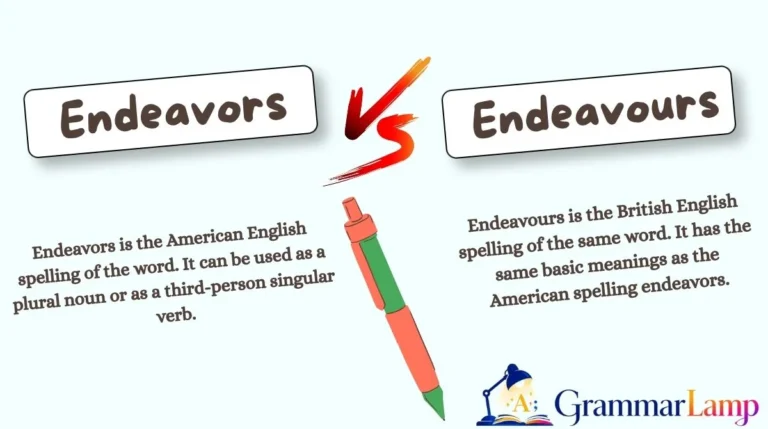
The good news is that there is no major difference in meaning. Endeavors is the American English spelling, while endeavours is the British English spelling.
Both words refer to efforts, attempts, or things someone tries hard to achieve. They can also be used as verbs when talking about making a serious effort to do something.
Cambridge Dictionary lists endeavor as the US spelling of endeavour and gives the same basic meanings for both forms.
This small spelling difference matters when you write for school, work, or an international audience. Choosing one spelling and using it consistently makes your English look more natural.
By the end of this guide, you will know what endeavors and endeavours mean, how they work in sentences, when to use each spelling, what mistakes learners often make, and how to remember the difference without stress.
More Useful posts
Brite vs Bright: Meaning, Difference, Spelling & Correct Usage in 2026
I Ordered vs I Have Ordered: What’s the Difference? Simple Grammar Guide (2026)
Timber vs Timbre (2026): Meaning, Differences, Grammar Rules, Examples, and Easy Guide
On a Call or In a Call (2026): What’s the Difference? Easy Grammar Guide with Examples
What Does “Endeavors” Mean?
Endeavors is the American English spelling of the word. It can be used as a plural noun or as a third-person singular verb.
As a noun, endeavors means efforts, attempts, or activities that someone works hard to complete. For example, a person may have business endeavors, academic endeavors, artistic endeavors, or personal endeavors.
As a verb, endeavors means tries hard to do something. It is normally followed by to + verb. Cambridge Dictionary gives endeavor as a US spelling and defines the verb as “to try to do something.”
When should you use “endeavors”?
Use endeavors when you are writing in American English and you need either:
1. A plural noun
You can talk about several efforts or activities.
- Her business endeavors have been successful.
- His academic endeavors earned him a scholarship.
- We wish you success in all your future endeavors.
- The project required years of research and other scientific endeavors.
- Her creative endeavors include writing, painting, and music.
- Their charitable endeavors helped many families.
- The company supports environmental endeavors.
- His latest endeavors are focused on education.
In these examples, endeavors refers to more than one effort, project, or activity.
“Endeavors” as a verb
The word can also be a verb. In this use, the subject is usually he, she, it, or a singular noun.
The usual structure is:
Subject + endeavors + to + base verb
Examples:
- She endeavors to improve her English every day.
- He endeavors to provide excellent service.
- The company endeavors to protect customer data.
- Our team endeavors to complete the work on time.
- The school endeavors to support every student.
- He endeavors to remain calm under pressure.
- The manager endeavors to solve the problem quickly.
The verb sounds fairly formal. In everyday conversation, many speakers would simply say tries or works hard to.
For example:
Formal: She endeavors to improve her skills.
Everyday: She tries to improve her skills.
Common learner confusion
A common mistake is thinking that endeavors is always a noun. It is not. Its role depends on the sentence.
Compare these two sentences:
- His business endeavors are growing.
- He endeavors to help new employees.
In the first sentence, endeavors is a noun. In the second, it is a verb.
Another point to remember is that endeavors is not a different word from endeavours in meaning. The main difference is spelling based on the variety of English being used.
What Does “Endeavours” Mean?
Endeavours is the British English spelling of the same word. It has the same basic meanings as the American spelling endeavors.
You can use endeavours as a plural noun to describe efforts or attempts. You can also use it as a third-person singular verb meaning “tries hard.”
Cambridge Dictionary identifies endeavour as the UK spelling of endeavor and gives both noun and verb uses.
When should you use “endeavours”?
Use endeavours when writing in British English or when following a style guide that uses British spelling.
Examples as a plural noun:
- Her academic endeavours were highly successful.
- We wish you every success in your future endeavours.
- His creative endeavours have inspired many young people.
- Their scientific endeavours led to an important discovery.
- The charity supports educational endeavours around the world.
- His business endeavours continue to grow.
- She is proud of her artistic endeavours.
- Their latest endeavours have attracted a lot of attention.
Here, the word means efforts, projects, or attempts.
“Endeavours” as a verb
The British spelling can also function as a verb.
The common structure is:
Subject + endeavours + to + base verb
Examples:
- She endeavours to improve the service.
- He endeavours to keep his promises.
- The organisation endeavours to help local communities.
- The company endeavours to reduce waste.
- He endeavours to remain professional.
- The teacher endeavours to make lessons easier.
- The team endeavours to finish the project early.
British dictionaries also describe endeavour as a formal verb meaning to try very hard to do something. Collins gives examples such as “endeavour to arrange it” and notes that American English uses endeavor.
Common learner confusion
Many students see the letters -our and assume that endeavours has a different pronunciation or meaning. It does not.
The difference is mainly in spelling:
American: endeavors
British: endeavours
The same pattern appears in other English words:
color / colour
labor / labour
honor / honour
favor / favour
So, when you see endeavours, do not treat it as a new vocabulary word. It is simply the British spelling.
Difference Between Endeavors and Endeavours
The main difference between endeavors and endeavours is regional spelling, not meaning.
Both forms come from the same word and can be used as nouns or verbs. Cambridge and Collins both identify the American and British spellings as regional forms of the same word.
Comparison Table
| Point | Endeavors | Endeavours |
|---|---|---|
| English variety | American English | British English |
| Singular noun | endeavor | endeavour |
| Plural noun | endeavors | endeavours |
| Third-person verb | endeavors | endeavours |
| Basic meaning | efforts or attempts | efforts or attempts |
| Verb meaning | tries hard | tries hard |
| Typical spelling | -or | -our |
| Register | Often formal | Often formal |
Usage difference
If you are writing for an American audience, endeavors is the natural choice.
For example:
We wish you success in all your future endeavors.
This is normal American spelling.
For a British audience, write:
We wish you success in all your future endeavours.
This is normal British spelling.
The message remains the same.
Grammar logic
The spelling does not change the grammar. Both forms can act as nouns and verbs.
As a noun:
- Her endeavors were successful.
- Her endeavours were successful.
As a verb:
- He endeavors to help others.
- He endeavours to help others.
The grammatical pattern is exactly the same.
The difference is simply that one spelling follows American conventions and the other follows British conventions.
Sentence structure difference
There is no real sentence-structure difference between the two forms.
For the noun, you can use:
possessive + endeavors/endeavours
- His endeavors impressed everyone.
- His endeavours impressed everyone.
You can also use a determiner:
- Their endeavors were successful.
- Their endeavours were successful.
For the verb, use:
subject + endeavors/endeavours + to + verb
- She endeavors to learn quickly.
- She endeavours to learn quickly.
Meaning comparison
Both forms can describe an effort to achieve something.
For example:
American English:
The team’s latest endeavors were successful.
British English:
The team’s latest endeavours were successful.
Both mean that the team’s recent efforts or projects went well.
Collins defines endeavour as an attempt to do something, especially something new or original, and gives endeavor as the American form.
Grammar Rules You Must Remember
Rule 1: Use “endeavors” in American English
When your writing follows American English spelling, choose endeavors.
For example:
- The company has several new business endeavors.
- She endeavors to improve her performance.
This spelling is common in American writing and is listed by Cambridge as the US spelling.
A useful way to think about it is the familiar American -or spelling found in words such as color and labor.
Rule 2: Use “endeavours” in British English
When you are writing in British English, use endeavours.
For example:
- His professional endeavours have been rewarding.
- She endeavours to help every student.
Cambridge identifies endeavour as the UK spelling of endeavor.
British English commonly keeps -our in words such as colour, labour, and favour, so endeavour follows the same spelling pattern.
Rule 3: Both forms can be nouns or verbs
Do not assume the spelling tells you whether the word is a noun or a verb.
Look at the sentence.
Noun:
- Her endeavours have brought positive results.
Verb:
- She endeavours to bring positive results.
The same is true in American English:
- Her endeavors have brought positive results.
- She endeavors to bring positive results.
The sentence structure tells you the grammatical role.
Rule 4: “Endeavor/endeavour” is usually followed by “to”
When you use the word as a verb, the common modern pattern is:
endeavor/endeavour + to + base verb
Examples:
- He endeavours to improve.
- She endeavors to succeed.
- The company endeavours to provide better service.
- The team endeavors to finish early.
Avoid putting an -ing form immediately after the verb in this common structure.
Incorrect: She endeavors improving her English.
Correct: She endeavors to improve her English.
Because the verb is fairly formal, everyday English often uses try to instead.
Explore More Posts
Any Way vs Anyway: What’s the Difference? Complete Guide for 2026
Choose vs Chose: Difference, Meaning, Rules & Examples (2026)
At the Weekend or On the Weekend then? Which Is Correct in 2026?
Similar to vs Similarly to: Meaning, Grammar, and Examples (2026)
Common Mistakes Students Make
Students often make mistakes with this word because they see it in different books, websites, and apps. One source may use the American spelling, while another uses the British spelling.
Mistake 1: Thinking they have different meanings
Some learners think:
endeavors = one meaning
endeavours = another meaning
That is incorrect.
They are regional spelling forms of the same word.
Wrong idea: These are two completely different words.
Correct idea: They have the same basic meaning.
Mistake 2: Mixing spelling styles
A writer may use several British spellings and then suddenly use the American form.
For example:
The colour of the building was beautiful, and the company supported many local endeavors.
This is not a serious grammar error, but the spelling is inconsistent.
A cleaner British version would be:
The colour of the building was beautiful, and the company supported many local endeavours.
An American version would normally use:
The color of the building was beautiful, and the company supported many local endeavors.
Mistake 3: Using the verb incorrectly
Remember the normal pattern:
endeavor/endeavour + to + verb
Incorrect:
He endeavours working harder.
Correct:
He endeavours to work harder.
Incorrect:
The school endeavors helping students.
Correct:
The school endeavors to help students.
Mistake 4: Using the word when “try” sounds better
Although endeavor and endeavour are correct, they can sound formal.
For everyday conversation, this may feel heavy:
I will endeavor to call you later.
A more natural spoken sentence is:
I’ll try to call you later.
The formal version is still correct. Collins marks the word as formal in its dictionary definitions.
Mistake 5: Forgetting that “endeavors” can be plural
The plural form refers to more than one effort, project, or attempt.
- Her artistic endeavors include music and painting.
- His business endeavors involve several companies.
You should not automatically add another plural ending.
Easy Trick to Remember the Difference
Here is a very simple memory trick:
US = -or
UK = -our
So:
American: endeavor → endeavors
British: endeavour → endeavours
Think of other familiar spelling pairs:
color → colour
favor → favour
labor → labour
Once you remember this pattern, endeavors vs endeavours becomes much easier.
There is another useful trick: focus on the meaning first, not the spelling.
Both words are about trying, effort, or achievement.
Imagine someone working hard toward a goal. That effort can be called an endeavor in American English or an endeavour in British English.
For example:
Starting a new business is a challenging endeavor.
Or:
Starting a new business is a challenging endeavour.
Nothing about the situation changes. Only the spelling does.
This is especially helpful for students who read both American and British English. When you see the -our form, simply think, “British spelling.” When you see the -or form, think, “American spelling.”
Daily Life Examples
These examples show how the word can appear in real conversations, emails, school writing, and professional English.
1. Talking about a new business
A: How is your new business going?
B: It’s difficult, but I’m enjoying the new endeavor.
In British English, this would be endeavour.
2. Wishing someone success
A: I’m starting a new job next month.
B: That’s great! I wish you success in all your future endeavors.
This is a very common formal expression.
3. Talking about school
Her academic endeavours have earned her several awards.
In American English, use endeavors.
4. Talking about personal goals
Learning a new language is a worthwhile endeavor.
The sentence means that learning a new language is a valuable effort.
5. Using the verb
The team endeavours to solve every customer complaint quickly.
This is formal and sounds appropriate in professional writing.
6. Everyday alternative
I’ll try to finish it tonight.
This sentence is more natural in casual conversation than:
I’ll endeavor to finish it tonight.
Both are grammatically possible, but the tone is different.
7. Artistic work
Her creative endeavors include photography and painting.
British spelling:
Her creative endeavours include photography and painting.
8. Science and research
Scientific endeavours often require patience and careful planning.
The noun refers to serious efforts or activities related to science.
9. Workplace example
Manager: Can you finish this report today?
Employee: I’ll endeavor to complete it before five.
This reply is correct, but it sounds formal. In normal workplace conversation, “I’ll try to complete it” may sound more natural.
10. Personal encouragement
Every small effort is part of a larger endeavor to become a better student.
The word describes a serious attempt to reach a goal.
Practice Section
Choose the correct option for each sentence. Remember to think about the English variety being used.
1. American English
We wish you success in all your future ______.
A. endeavours
B. endeavors
2. British English
Her creative ______ have received international attention.
A. endeavors
B. endeavours
3. American English
The company ______ to provide better customer service.
A. endeavors
B. endeavours
4. British English
He ______ to finish the project before Friday.
A. endeavors
B. endeavours
5. Grammar choice
She ______ to improve her writing skills.
A. endeavors to improve
B. endeavors improving
Answers
1. B — endeavors
American English uses the -or spelling.
2. B — endeavours
British English uses the -our spelling.
3. A — endeavors
The American spelling is correct here.
4. B — endeavours
The British spelling is correct here.
5. A — endeavors to improve
As a verb, the common structure is endeavor + to + base verb.
More Helpful posts
Is It Correct to Say “Repeat Again”? 2026 Grammar Guide
John and Me vs Me and John: Which Is Correct? 2026 Grammar Guide
As Soon As vs As Early As: Easy Difference, Rules & Examples in 2026
Imbalanced vs Disbalanced: What Is the Difference? (2026)
FAQs
What is the difference between endeavors and endeavours?
There is no meaningful difference in basic meaning. Endeavors is the American English spelling, while endeavours is the British English spelling. Both can be nouns meaning efforts or attempts and verbs meaning to try hard to do something.
Is endeavors American or British English?
Endeavors is the American English spelling. British English normally uses endeavours. The same spelling pattern appears in other words such as color/colour and favor/favour.
Is endeavours a correct word?
Yes. Endeavours is completely correct, especially in British English. It can be the plural noun form of endeavour or the third-person singular form of the verb endeavour.
Can “endeavors” be used as a verb?
Yes. Endeavors can be the third-person singular form of the verb endeavor. For example: “She endeavors to improve her skills.” The usual modern structure is endeavors to + verb.
Is “endeavor” formal or informal?
Endeavor is generally considered a formal word. In everyday conversation, speakers often choose simpler words such as try, effort, or attempt. It is common in professional, academic, and formal writing. Collins marks the word as formal.
Which spelling should I use: endeavors or endeavours?
Choose the spelling that matches your audience and style of English. Use endeavors for American English and endeavours for British English. The most important thing is to stay consistent within the same piece of writing.
Conclusion
Endeavors and endeavours are not two different words with different meanings. They are two spelling forms of the same English word.
The main rule is simple: endeavors is the American English spelling, while endeavours is the British English spelling. Both can work as nouns meaning efforts or attempts, and both can work as verbs meaning to try hard to do something.
For American writing, choose endeavors. For British writing, choose endeavours. Also remember that the verb usually follows the pattern endeavor/endeavour + to + verb.
When you are speaking casually, words like try and effort may sound more natural because endeavor is fairly formal.
Once you remember the simple US -or / UK -our pattern, this spelling difference becomes easy. Keep reading, writing, and noticing these forms in real English, and you will start choosing the right one naturally.

Liam Derren is a language writer at GrammarLamp, creating simple, helpful content about grammar, words, and everyday English. He makes language learning clear, practical, and easy to understand.