
“John and me” and “me and John” can sound very similar, but they are not always used in the same way.
Many English learners become confused because both phrases can be heard in everyday conversation.
You may hear someone say, “John and me went to the store,” while another person says, “Me and John went to the store.” This can make it hard to know which form is grammatically correct.
The confusion becomes even bigger because spoken English and formal written English do not always sound the same.
Native speakers sometimes use forms in casual conversation that are not considered correct in standard grammar.
The good news is that the rule is actually quite simple. You do not need to memorize a long grammar lesson.
You mainly need to understand when to use I and when to use me, and then apply the same rule when another person’s name is included.
Once you understand this, you will know when to say “John and I”, “John and me,” and whether “me and John” is acceptable.
You will also learn why the order of the names matters in natural English and how to avoid common mistakes in speaking and writing.
What Does “John and Me” Mean?
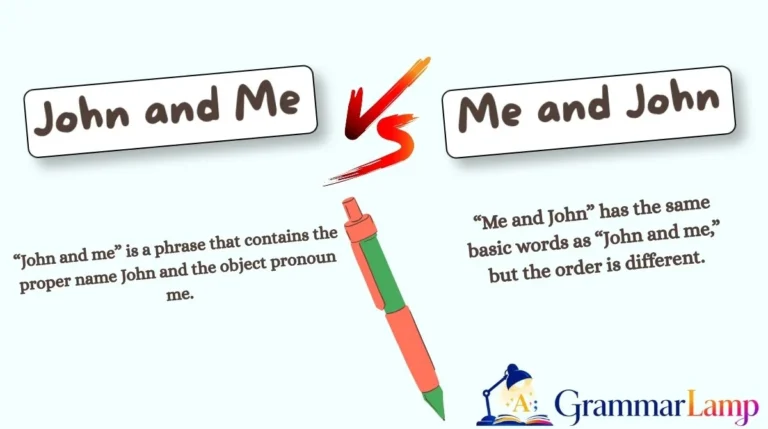
“John and me” is a phrase that contains the proper name John and the object pronoun me.
The word me is the object form of the pronoun I. We use me when the person is receiving an action or comes after a preposition.
For example:
- She called me.
- He gave the book to me.
- The teacher helped me.
- They invited me.
- My friend sat next to me.
When we add another person, we can say “John and me.”
For example:
- The teacher talked to John and me.
- She invited John and me to dinner.
- The manager gave John and me some advice.
- He was sitting between John and me.
- The teacher asked John and me to stay after class.
- Sarah sent the message to John and me.
- They gave John and me two tickets.
- Nobody told John and me about the change.
Notice something important in these examples: “John and me” is used as an object.
For instance:
She invited John and me.
Who did she invite? John and me.
The phrase receives the action of the verb invited, so me is correct.
Another example is:
He spoke to John and me.
The word to is a preposition. After to, we normally use the object pronoun me, not I.
So we say:
He spoke to John and me.
Not:
He spoke to John and I.
A Simple Test
If you are unsure about “John and me,” remove John from the sentence.
For example:
She invited John and me.
Remove John:
She invited me.
That sounds correct.
So:
She invited John and me.
is also correct.
This little test is very useful for beginners.
However, remember that “John and me” is not normally correct when the whole phrase is the subject of the sentence.
For example:
John and me went shopping.
In standard English, this should be:
John and I went shopping.
Why? Because John and I are doing the action. They are the subject.
What Does “Me and John” Mean?
“Me and John” has the same basic words as “John and me,” but the order is different.
In casual spoken English, especially in some varieties of everyday speech, you may hear people say:
Me and John went to school together.
or:
Me and John watched the game.
Native speakers do use this structure in informal conversation. So it is not strange or difficult to understand.
However, in standard English, especially in formal writing, “me and John” should generally be avoided when the phrase is the subject.
Instead, use:
John and I went to school together.
and:
John and I watched the game.
There is also an important point about word order.
English speakers usually put the other person first and themselves second.
So instead of:
Me and John went shopping.
standard English uses:
John and I went shopping.
This is not because putting yourself first is always grammatically impossible. It is mainly a matter of standard grammar and natural English style.
When the phrase is an object, however, me can be correct:
The teacher called John and me.
Here, John and me is the object.
In casual speech, you may also hear:
The teacher called me and John.
This is understandable and can occur in everyday conversation, but John and me is generally the more traditional and polished order in careful English.
Examples
Here are some examples where me and John may be heard in casual speech:
- Me and John went to the market.
- Me and John played football.
- Me and John are working on the project.
- Me and John saw the same movie.
- Me and John talked about the problem.
- Me and John grew up together.
- Me and John usually travel together.
- Me and John were waiting outside.
For formal or standard English, change these to:
- John and I went to the market.
- John and I played football.
- John and I are working on the project.
- John and I saw the same movie.
- John and I talked about the problem.
- John and I grew up together.
- John and I usually travel together.
- John and I were waiting outside.
The key lesson is simple: “me and John” is common in casual speech, but “John and I” is the safer choice when the phrase is the subject.
Difference Between John and Me and Me and John
The biggest difference is not simply the order of the words. The more important question is whether me is being used as an object.
Here is a quick comparison:
| Phrase | Common Use | Standard? | Example |
|---|---|---|---|
| John and I | Subject | Yes | John and I went home. |
| John and me | Object | Yes | She called John and me. |
| Me and John | Subject in casual speech | Informal | Me and John went home. |
| Me and John | Object in casual speech | Possible but less polished | They invited me and John. |
John and I
Use John and I when the two people are the subjects of the sentence.
Example:
John and I work together.
Both people are doing the action.
You can test it by removing John:
I work together.
The structure tells you that I is needed.
More examples:
John and I went to Lahore.
John and I finished the project.
John and I are good friends.
John and I visited our teacher.
John and Me
Use John and me when the two people are objects.
Example:
The teacher helped John and me.
Remove John:
The teacher helped me.
That works, so John and me is correct.
Other examples:
She invited John and me.
He spoke to John and me.
They gave John and me some work.
The manager thanked John and me.
Me and John
This form is most often noticed when it is used as a subject:
Me and John went home.
Many people say this in casual conversation, but standard grammar prefers:
John and I went home.
So if you are writing an email, school assignment, application, report, website content, or other formal text, choose John and I.
Does the Meaning Change?
Usually, the basic meaning does not change simply because you switch the order.
For example:
John and I went shopping.
and:
Me and John went shopping.
Both tell us that John and the speaker went shopping.
The difference is grammar and style, not the basic idea.
The first sentence is standard English.
The second is common in informal speech but is not the preferred form in careful standard English.
Grammar Rules You Must Remember
Rule 1: Use “I” as the subject
When you and another person are doing the action, use I.
Example:
John and I went to the restaurant.
Not:
John and me went to the restaurant.
A quick test is to remove the other person:
I went to the restaurant.
Because I works by itself, John and I works too.
Rule 2: Use “me” as the object
When the action happens to you, use me.
Example:
The teacher called John and me.
Remove John:
The teacher called me.
So the complete sentence is:
The teacher called John and me.
Another example:
She gave the documents to John and me.
The preposition to is followed by the object form me.
Rule 3: In standard English, put the other person before yourself
When talking about yourself and another person, standard English usually puts the other person first.
So use:
John and I
rather than:
Me and John
when they are the subject.
Similarly, use:
John and me
rather than making “me” the first part of the phrase in careful formal English.
For example:
John and I went to the meeting.
The manager spoke to John and me.
This order sounds more natural and polite in standard English.
Rule 4: Test the sentence without the other person’s name
This is one of the easiest grammar tricks.
Take:
John and I finished the work.
Remove John:
I finished the work.
Correct.
Now take:
The boss thanked John and me.
Remove John:
The boss thanked me.
Correct.
But:
The boss thanked John and I.
Remove John:
The boss thanked I.
That sounds wrong.
So John and me is correct.
This simple test can help you make the right choice quickly.
Common Mistakes Students Make
Many learners make mistakes with these phrases because they hear informal English every day.
A person may hear:
Me and John went there.
After hearing this many times, the learner may think it is the correct grammar for all situations.
But spoken English is not always the same as formal standard English.
Mistake 1: Using “me” as the subject
❌ Me and John went to the office.
✅ John and I went to the office.
Why?
Because John and I are doing the action of going.
Mistake 2: Using “I” as the object
❌ She called John and I.
✅ She called John and me.
Why?
Because John and me receive the action of called.
Test it:
She called me.
Not:
She called I.
Mistake 3: Saying “John and I” after a preposition
❌ He spoke to John and I.
✅ He spoke to John and me.
The word to is a preposition, so we need the object form.
Compare:
He spoke to me.
Not:
He spoke to I.
Mistake 4: Thinking “I” is always more correct
Some learners learn that I sounds more formal, so they use it everywhere.
That is not correct.
For example:
❌ The teacher helped John and I.
✅ The teacher helped John and me.
The word me is correct because it is the object.
Being formal does not mean using I all the time.
Mistake 5: Always putting yourself first
You may hear:
Me and John…
in casual speech, but standard English normally places the other person’s name first.
Instead of:
Me and John are going to dinner.
Use:
John and I are going to dinner.
This sounds more natural in standard English.
Easy Trick to Remember the Difference
Here is a very simple trick:
Remove John.
Whenever you are confused, temporarily remove the other person’s name.
Look at this sentence:
John and me went to the store.
Remove John:
Me went to the store.
That sounds wrong.
So John and me cannot be the correct subject.
Try:
John and I went to the store.
Remove John:
I went to the store.
Correct.
Therefore:
John and I went to the store.
Now try an object:
The teacher called John and me.
Remove John:
The teacher called me.
Correct.
Therefore:
The teacher called John and me.
Think About Action
Another easy trick is to ask:
Who is doing the action?
If you are doing the action, use I.
John and I played football.
Who played? John and I.
Who is receiving the action?
If you are receiving the action, use me.
The coach called John and me.
Who was called? John and me.
So remember:
Doing the action → I
Receiving the action → me
This works in many sentences, not only with John.
Daily Life Examples
Here are some natural examples you may hear or use in everyday English.
Example 1: Talking about going somewhere
Ali: Who is going to the store?
Sara: John and I are going.
Here, John and I are doing the action, so I is correct.
Example 2: Talking about an invitation
Ali: Who did the manager invite?
Sara: He invited John and me.
The manager invited us, so me is correct.
Example 3: Talking about school
Teacher: Who finished the project?
Student: John and I finished it.
The students did the work, so I is used.
Example 4: Talking about a phone call
Sara: Who did the boss call?
Ali: He called John and me.
The boss called us, so me is correct.
Example 5: Casual conversation
Friend: Who went with you?
Ali: Me and John went together.
You may hear this in casual speech. It is understandable and common in some varieties of spoken English.
For careful standard English, say:
John and I went together.
Example 6: Asking someone to join
Sara: Should I invite John?
Ali: Yes. The teacher asked John and me to join the meeting.
Here, John and me is the object of asked.
Example 7: Talking about a trip
Tom: Who went to Islamabad with you?
Ali: John and I went together.
This is standard English because John and I are the subjects.
Example 8: Talking about help
Tom: Who did the manager help?
Ali: She helped John and me.
Here, John and me receive the action.
Example 9: Everyday informal speech
Friend: Who bought the tickets?
Ali: Me and John bought them.
This can be heard in casual conversation. However, in standard English, especially writing, use:
John and I bought them.
Example 10: Talking about a teacher
Student: Who did the teacher speak to?
Ali: She spoke to John and me.
The preposition to is followed by me, so this is correct.
Practice Section
Choose the correct option in each sentence.
1. ___ went to the cinema yesterday.
A. John and me
B. John and I
2. The teacher called ___ after class.
A. John and I
B. John and me
3. The manager spoke to ___ about the problem.
A. John and I
B. John and me
4. ___ are working on the new project.
A. Me and John
B. John and I
5. They invited ___ to the party.
A. John and I
B. John and me
Answers
1. B — John and I
John and I went to the cinema yesterday.
They are doing the action.
2. B — John and me
The teacher called John and me after class.
They receive the action.
3. B — John and me
The manager spoke to John and me.
The phrase comes after the preposition to.
4. B — John and I
John and I are working on the new project.
They are the subjects.
5. B — John and me
They invited John and me to the party.
They receive the action of invited.
FAQs
What is the difference between “John and me” and “me and John”?
The main difference is grammar and word order. John and me is normally used when the phrase is an object, such as “She called John and me.” Me and John is often heard in casual speech, but standard English prefers John and I when the phrase is the subject.
Is “me and John” grammatically correct?
It can be heard frequently in informal spoken English, especially when people say “me and John” as the subject. However, in standard English, the preferred form is John and I. For formal writing, school work, professional communication, and careful English, use John and I as the subject.
Should I say “John and I” or “John and me”?
Use John and I when you and John are doing the action: “John and I went home.” Use John and me when you and John receive the action: “She invited John and me.” The verb and sentence structure decide which one is correct.
Can I use “John and me” in a question?
Yes. You can use John and me when the phrase is an object.
For example:
Did the teacher call John and me?
But if you are asking who performed an action, use John and I:
Did John and I win the game?
Is “me and John” formal or informal?
“Me and John” is generally informal. You may hear it in everyday conversations, but it is not the best choice for formal writing. In standard English, use John and I when the phrase is the subject.
Why do people say “me and John” if it is not standard grammar?
Language changes in everyday speech, and native speakers often use informal structures that differ from traditional grammar rules. “Me and John” is easy to understand and is common in casual conversation. However, learners should know the standard form so they can use correct English in formal situations.
Conclusion
The difference between John and me and me and John becomes much easier once you understand the difference between I and me.
Use I when you are part of the subject and are doing the action:
John and I went shopping.
Use me when you are part of the object and receive the action:
She called John and me.
You may hear me and John in casual conversation, but John and I is the safer and more standard choice when the phrase is the subject. In formal writing, school work, professional emails, and careful English, avoid using “me and John” as the subject.
When you are unsure, use the simple remove-the-name test. Take John out of the sentence and see whether I or me sounds right. With a little practice, this will become automatic.
Do not worry if you have made this mistake before. Many English learners—and even native speakers in casual speech—use these forms differently.
The important thing is to understand the rule and practice using it naturally.

Liam Derren is a language writer at GrammarLamp, creating simple, helpful content about grammar, words, and everyday English. He makes language learning clear, practical, and easy to understand.