
Choosing between formal and informal usage can be difficult, especially for English learners.
You may know all the words in a sentence but still wonder, “Is this the right way to say it?” The answer often depends on who you are talking to, where you are, and why you are communicating.
For example, you might say, “Could you please send me the document?” to your teacher or manager.
But with a close friend, you may simply say, “Can you send me the document?” Both sentences are correct. The difference is the level of formality.
English changes depending on the situation. We use different words, greetings, sentence structures, and expressions when speaking to a friend, writing an email to a company, answering a teacher, or talking to a stranger.
Understanding this difference helps you sound more natural and confident. It also helps you avoid sounding too casual in a serious situation or unnecessarily formal in a friendly conversation.
By the end of this guide, you will understand what formal and informal English mean, when to use each style, how grammar and vocabulary can change, common mistakes learners make, and how to choose the right style in everyday situations.
Explore More Posts
Is It Correct to Say “Repeat Again”? 2026 Grammar Guide
John and Me vs Me and John: Which Is Correct? 2026 Grammar Guide
As Soon As vs As Early As: Easy Difference, Rules & Examples in 2026
Imbalanced vs Disbalanced: What Is the Difference? (2026)
What Does “Formal” Mean?
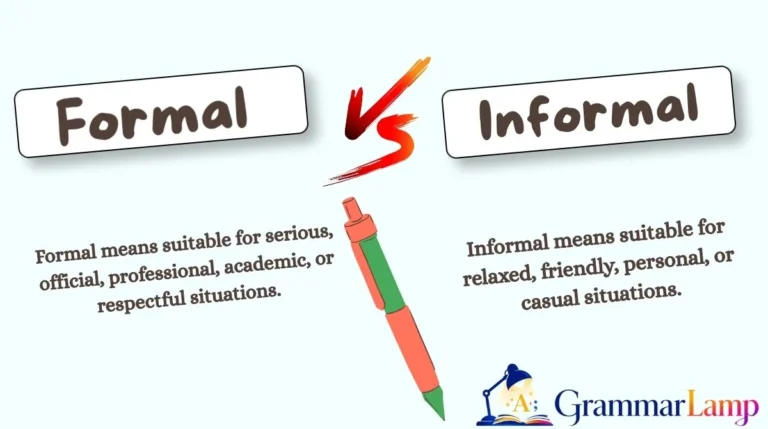
Formal means suitable for serious, official, professional, academic, or respectful situations.
Formal English is often used when you do not know someone well, when you are communicating with someone in an official position, or when the situation requires careful and respectful language.
You may use formal English when writing:
- A business email
- A job application
- A university assignment
- An official letter
- A complaint
- A report
- A professional message
You may also use it when speaking to a professor, interviewer, manager, customer, or someone you have just met.
Formal English and Grammar
Formal English often uses complete sentences and avoids very casual expressions. It may also use more polite structures.
For example:
Can you help me?
This is perfectly correct, but a more formal version is:
Could you please help me?
The second sentence sounds more polite and respectful.
Formal English does not mean using complicated words all the time. This is an important point for learners. A sentence can be formal while still being simple.
For example:
Please contact me if you need any further information.
The words are not difficult, but the sentence has a professional tone.
Examples of Formal Usage
- Could you please explain this question?
- I would like to ask about the application process.
- Thank you for your assistance.
- I am writing to request further information.
- Please accept my apologies for the delay.
- Would you mind sending me the report?
- I look forward to hearing from you.
- Unfortunately, I will not be able to attend the meeting.
Notice that these sentences sound careful, polite, and respectful.
When Should You Use Formal English?
Use formal language when the situation is professional, academic, official, or serious.
For example, imagine you are emailing your university professor. You probably should not write:
Hey! I need this answer ASAP. Can you help me?
A better version would be:
Dear Professor Ahmed, I would appreciate your help with this question when you have time.
The second version is more appropriate for the relationship and situation.
A Common Learner Confusion
Many students think that formal English means long English or difficult English. That is not true.
Compare:
I am writing to inform you that the meeting has been canceled.
This is formal.
But it is also clear and easy to understand.
You do not need to use impressive vocabulary just to sound formal. In fact, using very complicated words can make your writing less clear.
The goal is appropriate and respectful communication, not difficult communication.
What Does “Informal” Mean?
Informal means suitable for relaxed, friendly, personal, or casual situations.
Informal English is common when talking to:
- Close friends
- Family members
- Classmates
- People you know well
- People in relaxed social situations
It is also common in text messages, casual online conversations, and everyday speech.
Informal English usually sounds more natural and relaxed. People may use contractions, shorter sentences, common expressions, phrasal verbs, and casual vocabulary.
Informal English and Grammar
Informal English often allows shorter and more relaxed sentence structures.
For example:
I am going to call you later.
This is neutral and fairly standard.
In casual speech, you may hear:
I’m gonna call you later.
“Gonna” is very informal and is common in speech, but it should generally be avoided in formal writing.
Another example:
I would like to ask you something.
A friend might simply say:
Can I ask you something?
Both are grammatical. The second one is more natural in a casual conversation.
Examples of Informal Usage
- Hey, how are you doing?
- Can you give me a hand?
- I’ll call you later.
- Thanks for helping me out.
- Sorry I’m late.
- Do you want to grab some food?
- I can’t make it today.
- That’s a great idea!
These expressions are perfectly normal in everyday conversations.
When Should You Use Informal English?
Informal English is useful when you are relaxed and talking to people you know.
For example, you might text a friend:
Hey! Are you free tonight? Want to grab coffee?
There is no need to write:
Hello. Would you be available this evening? Would you like to have coffee together?
The second version is grammatically correct, but it sounds unnecessarily formal between close friends.
A Common Learner Confusion
Some learners believe informal English is “bad English.” It is not.
Informal English is a normal part of the language. Native speakers use it every day.
The important thing is context.
For example, “Thanks!” is completely natural when a friend helps you. But if you are writing a very formal business letter, “Thank you for your assistance” may be more suitable.
Informal does not mean incorrect. It simply means less formal and more relaxed.
Difference Between Formal and Informal Usage
The main difference is the situation and relationship between the speakers or writers.
Formal English creates a more respectful, professional, or official tone. Informal English creates a friendly, relaxed, and personal tone.
| Formal Usage | Informal Usage |
|---|---|
| Used in professional situations | Used in casual situations |
| Common in academic writing | Common in everyday conversation |
| More polite and careful | More relaxed and personal |
| Often uses complete forms | Often uses contractions |
| Avoids slang | May include casual expressions |
| Common with strangers or officials | Common with friends and family |
| Suitable for formal emails | Suitable for texts and casual messages |
| More controlled sentence structure | More flexible sentence structure |
1. Greetings
A greeting is one of the easiest places to see the difference.
Formal:
Dear Mr. Khan,
Dear Professor Smith,
Good morning.
Informal:
Hi Ahmed!
Hey!
Hi there!
“Hey” is friendly and natural, but it may not be the best opening for a formal business letter.
2. Requests
Requests also change depending on the situation.
Formal:
Could you please send me the information?
Informal:
Can you send me the info?
The informal version is shorter and more relaxed.
3. Thanking Someone
Formal:
Thank you for your assistance.
Informal:
Thanks for your help.
Both communicate gratitude. The first simply has a more professional tone.
4. Saying Sorry
Formal:
I apologize for the inconvenience.
Informal:
Sorry about that.
Again, both are correct. The situation determines which one sounds natural.
5. Vocabulary
Formal and informal English can use different vocabulary.
| Formal | Informal |
|---|---|
| purchase | buy |
| assistance | help |
| obtain | get |
| require | need |
| request | ask for |
| commence | start |
| approximately | about |
| children | kids |
| residence | home |
| inform | tell |
This does not mean the formal word is always better. Usually, simple words are better when the situation allows them.
For example, “We need more information” is often clearer than “We require additional information.”
6. Sentence Structure
Formal writing often uses more complete and carefully organized sentences.
Formal:
I would appreciate it if you could provide the requested documents by Friday.
Informal:
Could you send me those documents by Friday?
The informal sentence is shorter and more direct.
More Helpful Posts
Any Way vs Anyway: What’s the Difference? Complete Guide for 2026
Choose vs Chose: Difference, Meaning, Rules & Examples (2026)
At the Weekend or On the Weekend then? Which Is Correct in 2026?
Similar to vs Similarly to: Meaning, Grammar, and Examples (2026)
Grammar Rules You Must Remember
Rule 1: Choose the Style Based on the Situation
Do not decide that formal English is always better.
Ask yourself:
Who am I talking to?
Why am I communicating?
Where am I communicating?
For example:
Hey, Mom! Can you pick me up?
This is appropriate in a family conversation.
But:
Dear Sir or Madam, could you please provide further information?
is more appropriate in an official situation.
Rule 2: Contractions Are More Common in Informal English
Contractions include:
- I am → I’m
- You are → you’re
- We are → we’re
- Cannot → can’t
- I will → I’ll
- Do not → don’t
- It is → it’s
Contractions are very common in everyday English.
For example:
I’m sorry I’m late.
In formal writing, you may choose:
I am sorry that I am late.
However, contractions are not automatically incorrect in formal writing. Modern professional English often uses them. The choice depends on the level of formality you want.
Rule 3: Avoid Slang in Formal Situations
Words such as “cool,” “awesome,” “gonna,” “wanna,” and “stuff” are common in casual speech.
For example:
That movie was awesome!
This is natural with friends.
In a formal review, you might write:
The film was highly impressive.
Similarly:
I wanna talk to you.
is very informal.
A more formal version is:
I would like to speak with you.
Rule 4: Formal Does Not Mean Complicated
Never use difficult words simply to sound intelligent.
For example:
We need to start the meeting.
is clear and correct.
You could write:
We need to commence the meeting.
“Commence” is more formal, but it does not necessarily make the sentence better.
Good formal English is usually clear, polite, precise, and appropriate.
Common Mistakes Students Make
Mistake 1: Using Informal Language in Formal Emails
A student may write:
Hey teacher, I need some help with my homework. Send me the answer.
This sounds too casual and direct.
A better version is:
Dear Professor, I need some help with my assignment. Could you please explain this question?
Mistake 2: Making Every Situation Formal
The opposite mistake is also common.
Imagine your best friend asks:
“Do you want to go out for dinner?”
You reply:
I would be delighted to accompany you for dinner this evening.
The sentence is grammatical, but it sounds strange in a normal friendship.
A natural response would be:
Sure! I’d love to.
The lesson is simple: match your English to the situation.
Mistake 3: Thinking Informal Means Incorrect
Consider:
Thanks a lot!
This is informal, but it is not wrong.
Similarly:
How’s it going?
is a natural informal greeting.
Learners should understand the difference between incorrect English and informal English.
Mistake 4: Using Slang in Academic Writing
A student might write:
The results were super good and the experiment was pretty cool.
This sounds conversational.
A more suitable academic version would be:
The results were highly positive, and the experiment produced useful findings.
Mistake 5: Using Very Formal Words Everywhere
Some learners memorize formal vocabulary and then use it in every sentence.
For example:
I purchased some food from the supermarket.
This is grammatically fine, but in ordinary conversation, most people would say:
I bought some food from the supermarket.
“Purchase” is not wrong. It is simply more formal.
Easy Correction Tip
Before speaking or writing, quickly ask:
“Would I say this to my best friend, my teacher, or my boss?”
That question can help you choose the right style.
Easy Trick to Remember the Difference
Here is a simple memory trick:
Formal = official
Informal = friendly
Think about a job interview.
You would probably say:
Good morning. Thank you for meeting with me.
You would not normally say:
Hey! Thanks for having me!
Now think about meeting your best friend.
You might say:
Hey! What’s up?
You would not normally say:
Good afternoon. It is a pleasure to see you again.
The words are not necessarily right or wrong. The relationship and situation decide what sounds natural.
Another useful trick is to imagine a dress code.
Formal English is like wearing a suit to a job interview. Informal English is like wearing comfortable clothes at home.
You do not wear a suit everywhere, and you do not wear pajamas to a job interview. In the same way, you should change your language according to the situation.
Daily Life Examples
Here are some everyday examples that show how the same message can change.
1. Asking for Help
Formal:
Could you please help me with this?
Informal:
Can you help me with this?
2. Asking Someone to Wait
Formal:
Would you mind waiting for a moment?
Informal:
Can you wait a second?
3. Saying You Are Busy
Formal:
Unfortunately, I am unavailable this afternoon.
Informal:
Sorry, I’m busy this afternoon.
4. Canceling a Meeting
Formal:
I apologize, but I will be unable to attend the meeting.
Informal:
Sorry, I can’t make the meeting.
5. Asking for Information
Formal:
Could you please provide further information?
Informal:
Can you tell me more about it?
6. Thanking Someone
Formal:
Thank you very much for your assistance.
Informal:
Thanks for helping me!
7. Saying Goodbye
Formal:
It was a pleasure speaking with you. Goodbye.
Informal:
Nice talking to you. See you!
8. Starting an Email
Formal:
Dear Mr. Ahmed,
Informal:
Hi Ahmed,
9. Asking About Plans
Formal:
Do you have any plans for this weekend?
Informal:
Got any plans this weekend?
10. Giving Good News
Formal:
I am pleased to inform you that your application has been accepted.
Informal:
Good news! You got accepted!
These examples show why context matters. You are not learning two completely different versions of English. You are learning how English changes its tone.
Practice Section
Choose the better option for each situation.
1. You are emailing your university professor.
A. Hey! Can you send me the notes?
B. Could you please send me the notes?
2. You are texting your close friend.
A. Would you be available for dinner this evening?
B. Are you free for dinner tonight?
3. You are writing a business complaint.
A. I’m really annoyed about this.
B. I am writing to express my concern about this matter.
4. Your friend helps you carry a heavy bag.
A. Thank you for your assistance.
B. Thanks for helping me!
5. You are speaking to an interviewer.
A. Yeah, I really wanna get this job.
B. Yes, I am very interested in this position.
Answers
- B — A professor usually requires a more respectful tone.
- B — A close friend is an informal situation.
- B — A formal complaint should sound calm and professional.
- B — The situation is friendly and casual.
- B — A job interview is a formal or professional setting.
More Helpful Posts
Brite vs Bright: Meaning, Difference, Spelling & Correct Usage in 2026
I Ordered vs I Have Ordered: What’s the Difference? Simple Grammar Guide (2026)
Timber vs Timbre (2026): Meaning, Differences, Grammar Rules, Examples, and Easy Guide
On a Call or In a Call (2026): What’s the Difference? Easy Grammar Guide with Examples
FAQs
1. What is the difference between formal and informal usage?
Formal usage is appropriate for professional, academic, official, or serious situations. Informal usage is common in relaxed conversations with friends, family, and people you know well. The main difference is the tone and situation, not whether the English is correct.
2. Can informal English be used in questions?
Yes. Informal questions are very common in everyday speech.
For example:
What’s up?
Got any plans?
Can you help me?
These are natural in casual conversations. For formal situations, you may choose more polite structures such as “Could you please help me?”
3. Is formal English always better than informal English?
No. The best choice depends on the situation. Formal English is useful at work, school, and in official communication. Informal English is often more natural with friends and family. Using formal language in every situation can make you sound distant or unnatural.
4. Are contractions informal?
Contractions such as I’m, you’re, don’t, can’t, and I’ll are especially common in informal English. However, they are not automatically wrong in formal writing. Many modern professional texts use contractions. If you need a very formal tone, using the full forms can make your writing sound more careful.
5. Is slang formal or informal?
Slang is generally very informal. Expressions such as “awesome,” “gonna,” “wanna,” and other slang terms may sound natural among friends but can be unsuitable in academic, professional, or official writing. Always think about your audience before using slang.
6. How can I know whether a sentence is formal or informal?
Think about the person you are speaking or writing to and the purpose of your message. Ask yourself whether you would use the sentence with a close friend, a teacher, a manager, or a stranger. Also look for contractions, slang, casual expressions, and polite structures. These clues can help you identify the level of formality.
Conclusion
Understanding formal vs informal usage is an important part of becoming a confident English speaker and writer.
You do not need to memorize two separate English languages. Instead, you need to learn how to change your words and sentence style according to the situation.
Use formal English when you are communicating in professional, academic, official, or serious situations. Use informal English when you are talking with friends, family, classmates, or people you know well.
Remember that informal English is not bad English. A phrase can be completely correct and still be informal. In the same way, formal English does not have to contain difficult words.
The best English is the English that fits the situation. Pay attention to how native speakers communicate in different settings, and practice changing simple sentences from formal to informal and back again.
With regular practice, choosing the right tone will become much easier. Soon, you will naturally know when to say “Could you please help me?” and when “Can you help me?” sounds better.

Liam Derren is a language writer at GrammarLamp, creating simple, helpful content about grammar, words, and everyday English. He makes language learning clear, practical, and easy to understand.
1 thought on “Formal vs Informal Usage: Complete Guide to English in 2026”