
English learners often get confused when they want to use the verb consult with a person or a topic.
You may hear phrases such as consult with a doctor, consult a lawyer about the problem, or consult an expert on this matter.
Then another question appears: Can we say consult to someone? Is consult about correct? Should we use with, on, or about after consult?
These questions are common because the verb consult can be used in more than one sentence pattern. The correct preposition depends on what you are talking about and whether you mention a person, a topic, or both.
For example, we can say:
- I consulted with my doctor.
- I consulted my doctor about my problem.
- We consulted an expert on the issue.
- She consulted with her manager about the project.
But consult to my doctor is not normally correct in standard English.
Understanding these small differences can make your English sound much more natural. It can also help you avoid common mistakes in emails, conversations, school writing, and professional communication.
By the end, you will know when to use consult with, consult on, and consult about, why consult to is usually wrong, and how to build natural sentences with consult.
Explore More Posts
Instructions on vs Instructions for: Meaning, Difference, and Correct Usage in 2026
Role vs Roll: Meaning, Difference, Rules & Examples (2026)
John and I or John and Me? The Easy Grammar Guide for 2026
Formal vs Informal Usage: Complete Guide to English in 2026
What Does “Consult With” Mean?
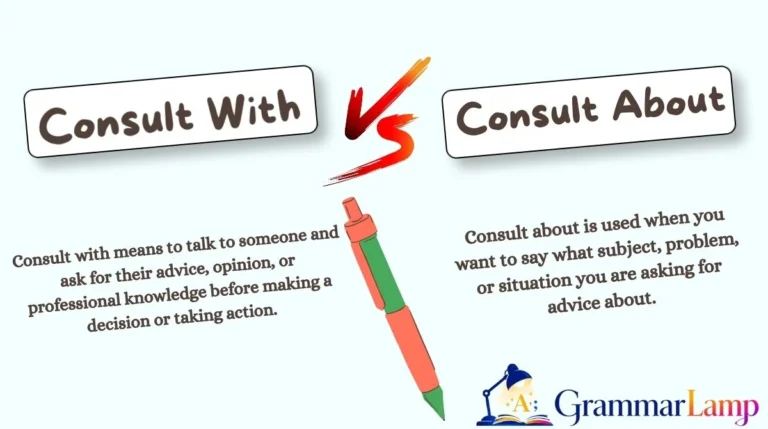
Consult with means to talk to someone and ask for their advice, opinion, or professional knowledge before making a decision or taking action.
The person you consult is usually someone who has useful knowledge or experience. This could be a doctor, lawyer, teacher, manager, engineer, financial adviser, or another expert.
The basic pattern is:
consult with + person
For example:
- I need to consult with my doctor.
- She consulted with her teacher.
- We consulted with a lawyer.
- He consulted with his manager.
The word with is used because the idea is that you communicate with another person. You are not simply receiving information. You are discussing something with that person.
When Should You Use “Consult With”?
Use consult with when you want to focus on the person you are speaking to for advice or guidance.
For example, imagine you are planning a large business project. You may say:
We should consult with our financial adviser before making a decision.
The important point here is the financial adviser. You are going to speak with that person and get advice.
Here are more examples:
- I consulted with my doctor before starting the treatment.
- She consulted with her parents before accepting the job.
- We need to consult with the manager first.
- He consulted with a lawyer about the contract.
- The teacher consulted with the principal about the student.
- They consulted with an engineer before building the house.
- I should consult with an expert before buying this machine.
- The company consulted with its employees before changing the policy.
“Consult With” and “Consult” Can Sometimes Mean the Same Thing
One important point is that consult with someone and consult someone can often have the same meaning.
Compare:
I consulted with my doctor.
and:
I consulted my doctor.
Both can mean that you asked your doctor for advice.
The version with with puts more focus on the discussion or communication. The version without with is shorter and very common, especially in formal writing.
So, both are possible:
I consulted with my lawyer.
I consulted my lawyer.
However, do not add to after consult when you mean “ask someone for advice.”
What Does “Consult About” Mean?
Consult about is used when you want to say what subject, problem, or situation you are asking for advice about.
The basic pattern is:
consult + person + about + topic
or:
consult with + person + about + topic
For example:
I consulted my doctor about my headache.
Here, my doctor is the person, and my headache is the subject.
You can also say:
I consulted with my doctor about my headache.
This sentence is also correct.
The word about introduces the subject that you want advice or information about.
Examples of “Consult About”
- I consulted my teacher about my grades.
- She consulted a lawyer about the contract.
- We consulted with an expert about the problem.
- He consulted his doctor about his back pain.
- They consulted an engineer about the building design.
- I need to consult my manager about my schedule.
- She consulted with her parents about her future.
- The company consulted lawyers about the new agreement.
Why Do Learners Get Confused?
Learners often think that because consult with is followed by a person, consult about must also be followed directly by a person.
But about normally introduces the topic, not the person.
For example:
I consulted my doctor about my health.
Here:
- my doctor = person
- my health = topic
You can remember it as:
with = who you talk to
about = what you talk about
That simple idea will help you build many correct sentences.
What Does “Consult On” Mean?
Consult on is used when someone gives advice, knowledge, or expert help about a particular subject, project, issue, or decision.
The pattern is commonly:
consult + someone + on + topic
or:
consult with + someone + on + topic
For example:
The company consulted an expert on the project.
This means the company asked an expert for advice or expert knowledge concerning the project.
You may also hear:
The company consulted with an expert on the project.
Both are possible.
On often sounds a little more professional or formal when talking about a specific subject, area of work, project, or issue.
For example:
- She was consulted on the design.
- He was consulted on the legal matter.
- We consulted an expert on environmental issues.
- The manager consulted with the team on the new plan.
Examples of “Consult On”
- We consulted an expert on the new project.
- She was consulted on the design of the building.
- The company consulted lawyers on the legal issue.
- He consulted a specialist on the technical problem.
- They consulted with an adviser on the new policy.
- The manager consulted the team on the proposed changes.
- I consulted my teacher on the best way to prepare.
- The government consulted experts on the issue.
“On” vs “About”
There is some overlap between on and about.
For example:
I consulted a lawyer about the contract.
and:
I consulted a lawyer on the contract.
Both can be understood, but about is often more natural in everyday English when you simply mean “concerning” or “regarding.”
On is especially common when the topic is a professional area, project, issue, or subject on which someone provides expert advice.
For everyday conversation, about is often the easier choice.
What Does “Consult To” Mean?
This is the part that causes the most confusion.
In standard modern English, we generally do not use “consult to” when we mean asking someone for advice.
For example:
❌ I consulted to my doctor.
This is not the normal English pattern.
Instead, say:
✅ I consulted my doctor.
or:
✅ I consulted with my doctor.
You should also not normally say:
❌ She consulted to her lawyer about the problem.
Use:
✅ She consulted her lawyer about the problem.
or:
✅ She consulted with her lawyer about the problem.
Why Is “Consult To” Wrong?
The verb consult already has the meaning of asking someone for advice or discussing something with an expert. It does not normally need to before the person.
Some verbs naturally take to:
- speak to someone
- talk to someone
- listen to someone
- explain something to someone
- write to someone
Because learners know these patterns, they sometimes transfer to to the verb consult.
For example:
I spoke to my doctor.
So they may think:
I consulted to my doctor.
But English does not normally work that way.
With consult, use:
consult someone
or
consult with someone
not:
consult to someone
Difference Between Consult With, To, On and About
The easiest way to understand these expressions is to look at what comes after consult.
| Expression | Main Use | Example |
|---|---|---|
| consult with | Talk to a person for advice | I consulted with my doctor. |
| consult + person | Ask a person for advice | I consulted my doctor. |
| consult about | Ask advice concerning a topic | I consulted my doctor about my problem. |
| consult on | Ask for or give expert advice concerning a subject/project | We consulted an expert on the project. |
| consult to | Normally not used in this meaning | ❌ I consulted to my doctor. |
1. Consult With Focuses on the Person
When you say:
I consulted with my lawyer.
The main idea is the communication between you and your lawyer.
You can think:
Who did I speak with? → My lawyer.
2. Consult About Focuses on the Topic
When you say:
I consulted my lawyer about the contract.
The word about tells us what you discussed.
Think:
What did I ask about? → The contract.
3. Consult On Often Sounds Professional
For example:
The company consulted an expert on the project.
The expert is being asked for specialist knowledge about a particular project or subject.
This form is common in professional, academic, business, and technical English.
4. Consult To Is Normally Incorrect
Do not use to simply because you are naming the person you asked for advice.
Instead of:
❌ I consulted to my teacher.
Say:
✅ I consulted my teacher.
or:
✅ I consulted with my teacher.
Explore More Posts
If There Is Any vs If There Are Any: Meaning, Difference, and Examples (2026)
Also Have or Have Also: Which Is Correct? Complete Grammar Guide 2026
Sneaked vs Snuck: What Is the Difference? 2026 Guide
Wether vs Weather vs Whether: What’s the Difference? 2026 Guide
Grammar Rules You Must Remember
Rule 1: Use “Consult With” Before a Person
When you want to emphasize talking to someone for advice, use consult with + person.
Example:
I need to consult with my manager before making a decision.
You can also remove with:
I need to consult my manager before making a decision.
Both structures are correct.
Rule 2: Use “About” for the Topic or Problem
Use about to introduce the thing you need advice about.
Example:
I consulted my doctor about my headache.
Here, my doctor is the person and my headache is the topic.
Another example:
She consulted with her teacher about her exam results.
The teacher is the person, while the exam results are the subject.
Rule 3: Use “On” for a Subject, Project, or Area of Expertise
Use on when talking about a particular subject, project, issue, or professional area.
Example:
The company consulted an expert on the new technology.
This sounds natural in a professional setting.
Another example:
We consulted with a specialist on the design.
Rule 4: Do Not Normally Use “Consult To”
Avoid consult to when you mean asking someone for advice.
Incorrect:
I consulted to my doctor.
Correct:
I consulted my doctor.
or:
I consulted with my doctor.
Remember that consult is different from verbs such as talk to and speak to.
Common Mistakes Students Make
Many mistakes happen because learners translate directly from their first language. Another reason is that English has many verbs that use different prepositions.
Mistake 1: Using “Consult To”
❌ I consulted to my teacher.
✅ I consulted my teacher.
✅ I consulted with my teacher.
The easiest correction is to remove to.
Mistake 2: Using “With” Before the Topic
Some learners write:
❌ I consulted with my problem.
This is incorrect because the problem is not the person you are consulting.
Say:
✅ I consulted with my doctor about my problem.
Here, doctor is the person and problem is the topic.
Mistake 3: Forgetting the Person
Learners sometimes say:
I consulted about my problem.
This may be possible in special contexts, but if you are talking about asking a particular person for advice, it is clearer to mention that person.
For example:
I consulted my doctor about my problem.
This sentence clearly tells us who gave the advice.
Mistake 4: Confusing “Consult” With “Talk”
The verb talk normally needs to or with when a person follows it.
I talked to my doctor.
But consult works differently:
I consulted my doctor.
Not:
❌ I consulted to my doctor.
This is one of the most useful differences to remember.
Easy Trick to Remember the Difference
Here is a simple classroom trick:
WITH = WHO
Think:
Who did I consult with?
- a doctor
- a lawyer
- a teacher
- a manager
- an expert
Examples:
I consulted with my doctor.
She consulted with her teacher.
ABOUT = WHAT
Think:
What did I consult someone about?
- my health
- the contract
- the problem
- the project
- my career
Examples:
I consulted my doctor about my health.
She consulted her lawyer about the contract.
ON = SUBJECT
Think:
What subject or project was the expert consulted on?
Examples:
We consulted an expert on the project.
She was consulted on the design.
TO = STOP
When you see consult to, stop and check the sentence.
Usually, you need:
consult someone
or:
consult with someone
not consult to someone.
A very short memory formula is:
WITH → person
ABOUT → topic
ON → subject/project
TO → usually don’t use it after consult
Daily Life Examples
Example 1: At the Doctor
Ali: I don’t feel well today.
Ahmed: You should see a doctor.
Ali: Yes, I think I should consult with my doctor.
Here, with introduces the person Ali plans to speak to.
Example 2: About a Contract
Sara: Did you sign the contract?
Mina: Not yet. I want to consult my lawyer about it first.
The lawyer is the person. The contract is the topic.
Example 3: At Work
Manager: Can we change the design?
Designer: We should consult with the client first.
The designer wants to speak with the client before making the change.
Example 4: Asking a Teacher
Student: I don’t know which course to choose.
Friend: Why don’t you consult your teacher?
This is a natural way to say that the student should ask the teacher for advice.
Example 5: A Professional Project
Manager: Who can help us with this technical problem?
Assistant: We should consult an engineer on the project.
The engineer has specialist knowledge related to the project.
Example 6: Family Decision
John: Are you going to accept the job?
David: I’m not sure. I want to consult with my family first.
Here, with focuses on the people David wants to discuss the decision with.
Example 7: Legal Advice
Customer: Can I cancel this agreement?
Employee: You should consult a lawyer about the agreement.
About introduces the topic.
Example 8: School Work
Student: I’m having trouble with my research project.
Teacher: You can consult with me about it after class.
The teacher is the person, while it refers to the project or problem.
Example 9: Business Decision
Director: Should we launch the product next month?
Manager: We should consult the marketing team before deciding.
Here, consult the marketing team means ask the team for advice or information.
Example 10: Design Project
Architect: We need another opinion about the building.
Engineer: Let’s consult an expert on the design.
The expert is being asked for professional knowledge about the design.
Practice Section
Choose the correct option in each sentence.
1. I need to consult ___ my doctor before making a decision.
A. to
B. with
C. on
2. She consulted her lawyer ___ the contract.
A. about
B. to
C. with
3. We should consult an expert ___ this technical issue.
A. to
B. on
C. with
4. He ___ his teacher before choosing the course.
A. consulted to
B. consulted
C. consulted to with
5. They consulted ___ their manager about the new plan.
A. with
B. to
C. on
Answers
- B — with
I need to consult with my doctor. - A — about
She consulted her lawyer about the contract. - B — on
We should consult an expert on this technical issue. - B — consulted
He consulted his teacher before choosing the course. - A — with
They consulted with their manager about the new plan.
More Helpful posts
Into or Onto: Complete Difference, Rules, and Examples for 2026
Sole vs Soul: What’s the Difference? Easy Guide With Examples 2026
May or May Not: Meaning, Grammar Rules, Examples, and Common Mistakes in 2026
Peaked vs Peeked vs Piqued: Meaning, Differences, Examples, and Grammar Rules (2026)
FAQs
What is the difference between “consult with” and “consult about”?
Consult with normally identifies the person you talk to for advice. Consult about identifies the topic or problem you want advice about.
For example: “I consulted with my doctor about my headache.” The doctor is the person, and the headache is the topic.
Is “consult to someone” correct?
Usually, no. Consult to someone is not the normal standard English pattern when you mean asking someone for advice.
Say “I consulted my doctor” or “I consulted with my doctor.” Do not normally say “I consulted to my doctor.”
Should I say “consult with” or simply “consult”?
Both can be correct when a person follows the verb.
You can say “I consulted my lawyer” or “I consulted with my lawyer.” The version with with emphasizes the discussion or communication with the person.
Can I use “consult about”?
Yes. About is commonly used to introduce the subject or problem.
For example: “She consulted her doctor about her health.” You can also say, “She consulted with her doctor about her health.”
Is “consult on” grammatically correct?
Yes. Consult on is correct when referring to a subject, project, issue, or area where someone gives expert advice.
For example: “The company consulted an engineer on the project.” This structure is especially common in professional or technical English.
Is “consult with” formal or informal?
Consult with can be used in both everyday and professional English. It is especially common when talking about doctors, lawyers, teachers, managers, experts, and other advisers.
For casual speech, ask, talk to, or speak with may sometimes sound simpler.
Conclusion
The verb consult becomes much easier when you remember what each word is doing in the sentence.
Use consult with when you want to mention the person you talk to for advice. You can also simply say consult someone.
Use about when you want to introduce the problem, question, or topic you need advice about. Use on when talking about a subject, project, issue, or area of expert advice.
The biggest mistake to avoid is consult to. In standard English, we normally do not say “I consulted to my doctor.” Instead, say “I consulted my doctor” or “I consulted with my doctor.”
A quick way to remember everything is:
WITH = person
ABOUT = topic
ON = subject or project
TO = usually not used after consult
Once you start using these patterns in real conversations, they will feel natural.
Try making a few sentences about your own work, studies, health, or daily decisions. That is one of the easiest ways to make the grammar stick.

Liam Derren is a language writer at GrammarLamp, creating simple, helpful content about grammar, words, and everyday English. He makes language learning clear, practical, and easy to understand.
1 thought on “Consult With, To, On or About: Which Is Correct? 2026”