
English learners often see the phrase “may or may not” in emails, conversations, news, school writing, and everyday speech. It looks simple, but many students are unsure about what it really means and how to use it correctly.
The main confusion comes from the word “may.” It can show possibility, permission, or sometimes a polite way of talking about something that could happen.
When we add “not,” the meaning becomes negative. When we put the two ideas together as “may or may not,” we are saying that something is possible, but we do not know whether it will happen or not.
For example:
She may or may not come to the party.
This means she might come, but she might also not come. The speaker does not know which one will happen.
You will often hear this expression when someone is unsure about a future event. It can also be used when the speaker does not want to give a definite answer.
Understanding this phrase is useful because native and fluent English speakers use it naturally.
Once you understand the basic grammar, it becomes easy to use in conversations, emails, messages, and formal writing.
More Helpful posts
On a Call or In a Call (2026): What’s the Difference? Easy Grammar Guide with Examples
Any Way vs Anyway: What’s the Difference? Complete Guide for 2026
Choose vs Chose: Difference, Meaning, Rules & Examples (2026)
At the Weekend or On the Weekend then? Which Is Correct in 2026?
What Does “May” Mean?
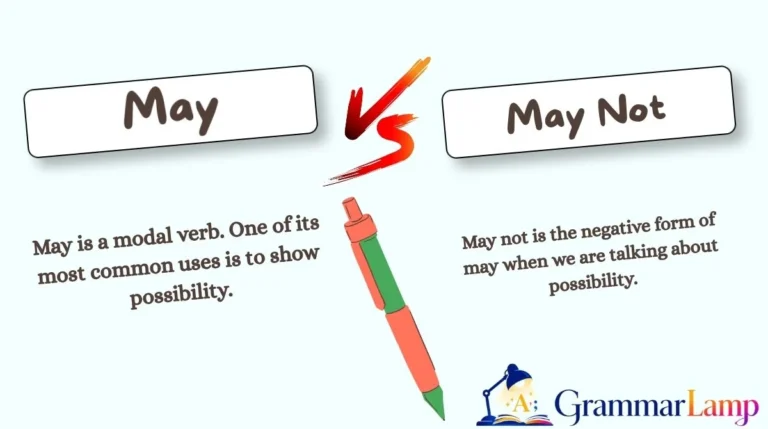
May is a modal verb. One of its most common uses is to show possibility.
When we say that something may happen, we mean that it is possible. We are not saying that it will definitely happen.
For example:
It may rain tonight.
This means rain is possible. The speaker is not certain.
When Do We Use “May”?
We commonly use may when:
- Something is possible.
- We are talking about a possible future event.
- We want to ask for or give permission.
- We want to make a statement less certain.
The most important use for understanding “may or may not” is the first one: possibility.
Basic Grammar Rule
The usual structure is:
Subject + may + base verb
Examples:
- I may go.
- She may come.
- They may arrive late.
- He may call you.
- We may need more time.
Notice that the verb after may stays in its base form.
We say:
She may come.
Not:
She may comes.
We also do not use to after may.
Correct:
He may leave early.
Incorrect:
He may to leave early.
Examples of “May”
- I may visit my friend tomorrow.
- She may call you later.
- It may rain this evening.
- They may arrive after lunch.
- We may need a bigger room.
- He may be busy right now.
- The teacher may give us homework.
- You may find the answer in this book.
In all these examples, may expresses possibility.
“May” Can Also Mean Permission
There is another common use of may.
For example:
May I come in?
Here, may is not about possibility. It is asking for permission.
Similarly:
You may leave now.
This can mean that someone has permission to leave.
This second meaning is important because learners sometimes think every use of may means “maybe.” It does not.
Compare:
She may come tomorrow.
Here, may means it is possible that she will come.
May I come tomorrow?
Here, may is asking for permission.
For the phrase “may or may not,” however, we are normally talking about possibility or uncertainty.
What Does “May Not” Mean?
May not is the negative form of may when we are talking about possibility.
It means that something might not happen or might not be true.
For example:
He may not come today.
This means it is possible that he will not come.
It does not always mean that he definitely will not come.
When Do We Use “May Not”?
We use may not when we want to say that a negative possibility exists.
For example:
She may not have enough money.
This means it is possible that she does not have enough money.
Another example:
The shop may not be open tomorrow.
This means the shop might be closed tomorrow.
Basic Grammar Rule
The normal structure is:
Subject + may not + base verb
Examples:
- I may not go.
- He may not come.
- She may not understand.
- They may not agree.
- We may not finish today.
Again, the verb after may not stays in its base form.
Correct:
She may not come.
Incorrect:
She may not comes.
Examples of “May Not”
- I may not go to the office tomorrow.
- She may not answer the phone.
- He may not understand the question.
- They may not agree with us.
- We may not finish the work today.
- It may not rain tonight.
- The bus may not arrive on time.
- You may not need this information.
Each sentence shows a possibility that something will not happen or may not be true.
An Important Point About “May Not”
The phrase “may not” can sometimes have another meaning: lack of permission.
For example:
You may not enter this room.
Here, it means:
You are not allowed to enter this room.
But:
He may not enter the room.
Depending on context, this can mean either “perhaps he will not enter” or “he is not permitted to enter.”
Context tells us which meaning is intended.
Difference Between “May” and “May Not”
The easiest way to understand the difference is to think about positive possibility and negative possibility.
| Expression | Basic meaning | Example |
|---|---|---|
| may | Something is possible | She may come. |
| may not | Something may not happen | She may not come. |
| may or may not | Either possibility is open | She may or may not come. |
1. “May” Shows One Possible Result
When you say:
John may come to the meeting.
You are saying that John’s attendance is possible.
You are not saying that he definitely will come.
The sentence leaves the result open, but the focus is on the possibility that he will come.
2. “May Not” Shows the Negative Possibility
Now consider:
John may not come to the meeting.
This focuses on the possibility that John will not come.
Again, it does not necessarily mean that you know he will stay away.
3. “May or May Not” Includes Both Possibilities
Now we have:
John may or may not come to the meeting.
This is broader.
It means:
- John may come.
- John may not come.
- The speaker does not know which will happen.
This expression is useful when you want to make your uncertainty very clear.
The Grammar Logic
Think of the phrase as two possible doors:
Door 1: It may happen.
Door 2: It may not happen.
When you say “may or may not,” you are saying that either door is possible.
For example:
The manager may or may not approve the request.
There are two possible results:
- The manager approves it.
- The manager does not approve it.
The speaker does not know the final result.
Sentence Structure
The basic structure is:
Subject + may + verb + or may not + verb
Examples:
She may come or may not come.
They may agree or may not agree.
He may attend or may not attend.
However, in natural English, we often shorten this structure:
She may or may not come.
They may or may not agree.
He may or may not attend.
The shorter version is very common and sounds natural.
Meaning Comparison
Compare these three sentences:
Sarah may come.
The speaker thinks Sarah coming is possible.
Sarah may not come.
The speaker thinks Sarah not coming is possible.
Sarah may or may not come.
The speaker openly says that both outcomes are possible.
This small difference is important.
Grammar Rules You Must Remember
Rule 1: Use the Base Verb After “May”
After may, use the base form of the verb.
Correct:
He may go home early.
Incorrect:
He may goes home early.
Correct:
She may visit us tomorrow.
Incorrect:
She may visits us tomorrow.
The modal verb may does not take -s with he, she, or it.
Rule 2: “May Not” Means a Negative Possibility
When may not is used to talk about possibility, it means something is possible but may not happen.
For example:
We may not finish the project today.
The speaker does not know for certain. Finishing today is uncertain.
Another example:
He may not answer your message.
It is possible that he will not answer.
Do not automatically understand may not as “definitely not.”
Rule 3: “May or May Not” Shows Uncertainty About Both Outcomes
Use may or may not when both possibilities are open.
For example:
I may or may not go to the party.
This means:
Maybe I will go, and maybe I will not go.
The speaker has not made a definite decision or does not know what will happen.
Rule 4: Do Not Use “Will” After “May”
A common mistake is combining modal verbs incorrectly.
Incorrect:
She may will come tomorrow.
Correct:
She may come tomorrow.
If you want to use will, use it separately:
She may come tomorrow.
Here, may already expresses the uncertain future possibility.
Similarly:
Incorrect:
He may will not come.
Correct:
He may not come.
More Helpful posts
Similar to vs Similarly to: Meaning, Grammar, and Examples (2026)
Is It Correct to Say “Repeat Again”? 2026 Grammar Guide
John and Me vs Me and John: Which Is Correct? 2026 Grammar Guide
As Soon As vs As Early As: Easy Difference, Rules & Examples in 2026
Common Mistakes Students Make
Many learners understand the general meaning but make small grammar mistakes when using this expression.
Mistake 1: Adding “-s” to the Verb
Wrong:
She may comes tomorrow.
Correct:
She may come tomorrow.
Why? Because may is a modal verb, and modal verbs are followed by the base form of the verb.
Easy Tip
Whenever you see may, think:
May + simple verb
- may go
- may come
- may work
- may call
- may help
Mistake 2: Using “To” After May
Wrong:
He may to come later.
Correct:
He may come later.
Do not put to between may and the main verb.
The same rule applies to:
- may go
- may stay
- may leave
- may arrive
- may happen
Mistake 3: Thinking “May Not” Always Means “Not Allowed”
Consider:
Tom may not come to school tomorrow.
This can mean Tom might not come.
But:
You may not enter this room.
Here, it means you do not have permission.
The surrounding situation gives us the meaning.
A useful tip is to ask:
Is the sentence talking about possibility or permission?
If it is about what might happen, may not means a negative possibility.
Mistake 4: Using “May or May Not” When a Definite Answer Is Known
Suppose someone has already confirmed:
“I am definitely going to the meeting.”
It would be strange to say:
He may or may not attend the meeting.
If you know the answer, you should give the definite information.
May or may not is useful when the result is uncertain.
Mistake 5: Thinking “May or May Not” Is Wrong Because It Repeats “May”
Some learners think the phrase sounds strange because may appears twice.
But this is completely normal English.
For example:
She may or may not agree.
The two parts represent two possible outcomes.
The expression is especially useful when you want to clearly show uncertainty.
Easy Trick to Remember the Difference
Here is a simple classroom trick.
Think of MAY as:
Maybe YES
Think of MAY NOT as:
Maybe NO
Now put them together:
MAY OR MAY NOT = Maybe YES, maybe NO.
For example:
Ali may come.
Think:
Maybe yes.
Ali may not come.
Think:
Maybe no.
Ali may or may not come.
Think:
Maybe yes, maybe no.
That is the whole idea.
Real-Life Logic
Imagine your friend asks:
“Are you going to the restaurant tonight?”
You are not sure.
You can say:
I may go.
Maybe you will go.
If you think you probably will not go, you can say:
I may not go.
But if you simply do not know what you will decide, you can say:
I may or may not go.
This makes the uncertainty very clear.
Daily Life Examples
The expression “may or may not” is common in everyday English. Here are some natural conversations.
Example 1: Going to a Party
A: Are you going to Sarah’s party tonight?
B: I may or may not go. I have a lot of work to finish.
Here, B has not made a final decision.
Example 2: Weather
A: Will it rain tomorrow?
B: It may or may not rain. The weather is changing quickly.
The speaker is not certain about the weather.
Example 3: A Phone Call
A: Will James call us tonight?
B: He may or may not call. He is very busy today.
Both possibilities are open.
Example 4: A School Test
Student: Do you think the teacher will give us a test tomorrow?
Friend: She may or may not give us a test.
The friend does not know.
Example 5: Weekend Plans
A: Are you coming with us on Saturday?
B: I may or may not come. I need to check my schedule.
This is a very natural use in spoken English.
Example 6: Work
A: Will the manager approve the plan?
B: He may or may not approve it. We need to wait for his decision.
The result is still uncertain.
Example 7: Shopping
A: Are you buying that phone?
B: I may or may not buy it. I want to compare a few other phones first.
The person has not decided.
Example 8: Visiting Someone
A: Will your brother visit us this weekend?
B: He may or may not visit. He has some work to do.
The speaker does not know whether the visit will happen.
Example 9: Travel
A: Are you going to Lahore next week?
B: I may or may not go. It depends on my work.
The travel plan is uncertain.
Example 10: Dinner
A: Are you eating dinner with us tonight?
B: I may or may not eat with you. I might be late.
Again, both outcomes are possible.
Practice Section
Choose the correct option in each sentence.
1. She ___ come to the meeting tonight.
A. may
B. may comes
2. I ___ go to the party. I am still deciding.
A. may or may not
B. may or may
3. He ___ not understand the question.
A. may
B. may not
4. They ___ arrive late because of traffic.
A. may
B. may to
5. We ___ or may not need more time.
A. may
B. mights
Answers
1. A — may
She may come to the meeting tonight.
2. A — may or may not
I may or may not go to the party.
3. B — may not
He may not understand the question.
4. A — may
They may arrive late because of traffic.
5. A — may
We may or may not need more time.
Notice that the verb after may remains in its base form.
More Useful posts
Imbalanced vs Disbalanced: What Is the Difference? (2026)
Orientated vs Oriented: What’s the Difference? [2026 Guide]
Do You vs Are You: What’s the Difference? Complete Guide for 2026
Dateline vs Deadline: Meaning, Difference, Examples & Easy Rules (2026)
FAQs
1. What is the difference between “may” and “may not”?
May shows that something is possible.
May not shows that something is possibly not true or may not happen.
For example, “She may come” means she could come, while “She may not come” means she could stay away.
2. What does “may or may not” mean?
May or may not means that both possibilities are open.
Something could happen, or it could fail to happen. The speaker does not know which result will occur.
For example:
He may or may not join us.
This means he could join, but he could also decide not to join.
3. Can we use “may or may not” in questions?
Yes, but it is more common in answers and statements.
For example:
Will she come?
You could answer:
She may or may not come.
It clearly tells the listener that you do not know the final result.
4. Is “may or may not” formal or informal?
May or may not can be used in both everyday and formal English.
You can hear it in conversations, but you can also see it in emails, reports, business writing, and other formal contexts.
Its level of formality depends more on the rest of the sentence than on the expression itself.
5. Is “may not” the same as “might not”?
When may and might are used to express possibility, they are often very similar.
For example:
She may not come.
and
She might not come.
Both suggest that her coming is uncertain.
There can be small differences in style and context, but beginners can usually understand both as expressions of possibility.
6. Can I say “may or may not” about the past?
Yes, but the grammar changes when you are talking about a past possibility.
For example:
He may or may not have seen your message.
This means it is possible that he saw the message, but it is also possible that he did not.
The structure is:
may or may not + have + past participle
Another example:
She may or may not have forgotten the meeting.
This talks about an uncertain past situation.
Conclusion
The expression “may or may not” is a simple but useful part of everyday English. It tells us that there are two possible results: something can happen, or it may not happen.
Remember the basic difference. May expresses possibility, while may not expresses a negative possibility. When you combine them as may or may not, you show that you are uncertain about which result will happen.
The grammar is also easy to remember. Use the base form of the verb after may:
may come, not may comes
And do not put to after may:
may go, not may to go
Try using the expression in real conversations about plans, work, school, weather, travel, and daily decisions. The more you hear and use it, the more natural it will feel.
A simple memory trick is: may = maybe yes, may not = maybe no, may or may not = maybe yes or maybe no.

Liam Derren is a language writer at GrammarLamp, creating simple, helpful content about grammar, words, and everyday English. He makes language learning clear, practical, and easy to understand.
2 thoughts on “May or May Not: Meaning, Grammar Rules, Examples, and Common Mistakes in 2026”