
If you have ever seen both orientated and oriented, you may have wondered whether one of them is wrong.
This is a common question for English learners because the two words look almost identical and usually have the same basic meaning.
The good news is that both “orientated” and “oriented” are correct English words. The main difference is connected to regional usage and style.
Oriented is much more common, especially in American English, while orientated is used more often in British English and some other varieties of English.
Both words come from the verb orient, which means to help someone understand where they are, what they should do, or what something is focused on.
For example, you can say, “The training is oriented toward new employees.”
You may also see these words in phrases such as career-oriented, goal-oriented, customer-oriented, and family-oriented. These expressions are common in everyday English, education, business, and professional writing.
Understanding the difference is useful because it helps you choose the form that sounds natural to your audience.
By the end of this guide, you will know what orientated means, what oriented means, how they differ, which one is more common, and how to use both correctly in sentences.
What Does “Orientated” Mean?
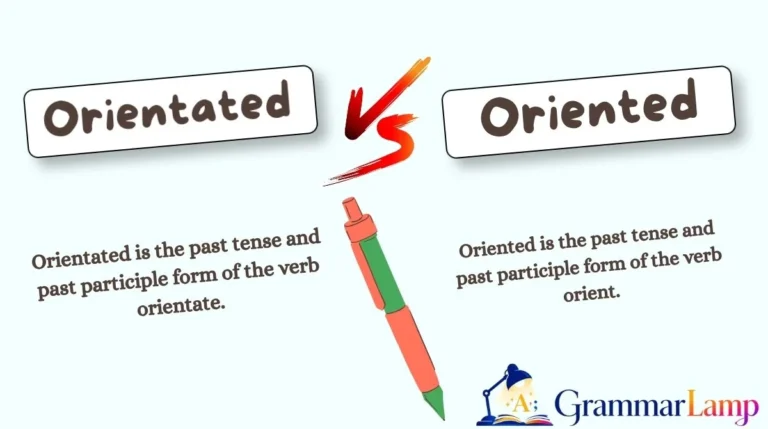
Orientated is the past tense and past participle form of the verb orientate. It means to help someone become familiar with a place, situation, activity, or subject.
It can also describe something that is directed toward a particular goal, person, group, or purpose.
For example:
The new students were orientated to the school during their first week.
This means the students were introduced to the school and helped understand how things worked.
Orientated is especially common in British English. It is also used in other varieties of English influenced by British usage. However, many speakers still prefer oriented, even in British English.
The basic grammar pattern is:
orientate → orientated
Here are some examples:
- The new employees were orientated to the company’s procedures.
- The nurse orientated the patient to the hospital.
- The students were quickly orientated to their new classroom.
- The training course is orientated toward practical skills.
- The program is orientated toward helping young people.
- New workers need time to become orientated to their responsibilities.
- The guide helped us become orientated in the new building.
- The course is strongly orientated toward professional development.
Is “Orientated” Correct English?
Yes. Orientated is a real and grammatically correct English word. It is not simply a spelling mistake.
The confusion comes from the fact that oriented is much more widely used. If you are writing for an international audience, “oriented” will usually sound more natural and familiar.
For example, both of these sentences can be correct:
The course is oriented toward practical skills.
The course is orientated toward practical skills.
The first version is generally more common.
When Should You Use “Orientated”?
You can use orientated when you are following British English usage or when it fits the style of the English variety you are writing in.
However, if you are unsure which form to choose, oriented is normally the safer choice, especially in international writing.
What Does “Oriented” Mean?
Oriented is the past tense and past participle form of the verb orient. It has the same basic meaning as orientated.
It can mean helping someone understand a new place or situation.
For example:
The teacher oriented the new students to the school.
It can also mean being focused on or directed toward something.
For example:
She is very career-oriented.
Here, career-oriented means that her career is an important focus for her.
The basic grammar pattern is:
orient → oriented
Examples:
- The new employees were oriented to the company.
- The students were oriented to the new system.
- The training is oriented toward practical work.
- He is very goal-oriented.
- She is career-oriented and works hard.
- Our services are customer-oriented.
- The program is oriented toward young learners.
- The company has a family-oriented culture.
“Oriented” in Modern English
Oriented is the more common form in modern English, particularly in American English.
You will often see it in education, business, technology, psychology, advertising, and everyday speech.
Some common expressions include:
- goal-oriented
- career-oriented
- customer-oriented
- results-oriented
- family-oriented
- detail-oriented
- service-oriented
- research-oriented
- community-oriented
These phrases are very common, so English learners should become familiar with oriented.
Difference Between Orientated and Oriented
The most important point is simple: orientated and oriented usually have the same meaning.
The difference is mainly about the form of the verb and regional preference.
| Point | Orientated | Oriented |
|---|---|---|
| Basic meaning | Directed toward or made familiar with something | Directed toward or made familiar with something |
| Base verb | Orientate | Orient |
| Common usage | More common in British English | More common in American English and widely used internationally |
| Correct? | Yes | Yes |
| Past form | Orientated | Oriented |
| Common compounds | Less common | Very common |
| Best for international writing | Acceptable | Usually the safer choice |
Usage Difference
The biggest practical difference is frequency.
If you read American websites, textbooks, business documents, and online content, you will probably see oriented much more often.
In British English, you may see both forms. Some British speakers use orientated, while others strongly prefer oriented.
For example:
The course is oriented toward beginners.
and
The course is orientated toward beginners.
Both can communicate the same idea.
Grammar Logic
The two forms come from two related verbs:
orient → oriented
orientate → orientated
The shorter verb orient is older and is now extremely common. Orientate developed as another form and is particularly associated with British usage.
There is therefore no grammar rule saying that “orientated” is wrong or that “oriented” is the only correct form.
Sentence Structure
Both words can appear in similar sentence structures.
With “oriented”:
The company is oriented toward customer needs.
With “orientated”:
The company is orientated toward customer needs.
They can also describe a person or thing:
He is goal-oriented.
The program is education-oriented.
The same type of construction can be formed with orientated, although it is much less common in compound adjectives.
Meaning Comparison
In most cases, there is no important difference in meaning.
Consider:
The program is oriented toward children.
The program is orientated toward children.
Both mean that the program is designed or directed mainly for children.
So, when choosing between them, you usually do not need to worry about changing the meaning. Instead, think about which variety of English you are using and which form sounds more natural.
Grammar Rules You Must Remember
Rule #1: Both Forms Are Correct
Do not assume that orientated is automatically wrong.
It is a legitimate form derived from orientate.
The students were orientated to the new environment.
However, oriented is more common:
The students were oriented to the new environment.
Rule 2: Use “Oriented” for the Most Widely Recognized Form
If your audience comes from different English-speaking countries, oriented is usually the better choice.
For example:
The course is oriented toward improving communication skills.
This sentence is natural and widely understood.
Rule 3: Match the Verb and Its Past Form
Do not mix the two forms incorrectly.
The verb orient becomes:
orient → oriented
The verb orientate becomes:
orientate → orientated
For example:
The teacher oriented the students.
or:
The teacher orientated the students.
Do not write:
The teacher orientated the students yesterday and has oriented them today.
unless you intentionally mean the two different verbs. In normal writing, it is better to choose one form and stay consistent.
Rule 4: “Oriented” Is Very Common in Compound Adjectives
English frequently uses oriented to create compound adjectives.
Examples include:
She is very career-oriented.
He is a goal-oriented person.
We need a customer-oriented business.
This is a results-oriented approach.
These expressions are standard and natural.
Common Mistakes Students Make
Many mistakes happen because learners see oriented much more often than orientated and begin to think that one must be incorrect.
Mistake 1: Thinking “Orientated” Is Always Wrong
Incorrect idea:
“Orientated is not an English word.”
That is false.
Orientated is correct English, although it is less common in many contexts.
A better understanding is:
“Both are correct, but oriented is more common.”
Mistake 2: Thinking They Have Completely Different Meanings
Some learners think orientated means one thing while oriented means another.
Usually, this is not true.
Compare:
The training is oriented toward new workers.
The training is orientated toward new workers.
The meaning is essentially the same.
Mistake 3: Using “Orientated” Everywhere
Because the word is correct, some learners may think it is always the best choice.
For example, common expressions normally use oriented:
He is goal-oriented.
This sounds much more natural than:
He is goal-orientated.
The second form can be found, especially in British usage, but the first is much more familiar internationally.
Mistake 4: Confusing “Oriented” With “Orientation”
The noun orientation is also related to the same word family.
For example:
The company held an orientation for new employees.
Here, orientation means an introduction or training session that helps people understand a new environment.
You can also say:
The employees were oriented to the company.
These words are related but serve different grammatical roles.
Easy Correction Tip
When you are unsure, ask yourself:
“Am I talking about something being directed toward a goal, or am I talking about helping someone understand a new situation?”
If yes, oriented will usually work.
If you are writing British English and prefer orientated, that form can also be correct.
Easy Trick to Remember the Difference
Here is a simple trick:
Think: “Oriented = Ordinary Choice”
The word oriented is the form you will see most often.
So, when you are unsure, remember:
Oriented is the common choice.
You do not need to think that orientated is wrong. Just remember that it is less common.
Another useful trick is to remember the two base verbs:
Orient → oriented
Orientate → orientated
The ending stays connected to the original verb.
Think of it like this:
Short verb = short past form
orient → oriented
Longer verb = longer past form
orientate → orientated
This is not a rule that applies to every English verb, but it is a useful way to remember these two forms.
Real-Life Logic
Imagine that you have started a new job.
On your first day, your manager explains where the office is, how the computer system works, and what your responsibilities are.
You are being oriented to the workplace.
You could also say that you are being orientated to the workplace, particularly in British English.
The idea is the same: you are being helped to understand your new situation.
Daily Life Examples
Here are some natural examples that show how these words work in everyday English.
1. At School
Teacher: Have the new students been oriented to the school yet?
Student: Yes, they had an introduction this morning.
The students are being helped to understand their new school.
2. At Work
Manager: Has Sarah been oriented to the new software?
Employee: Yes. I showed her how everything works.
This is a common workplace use.
3. Talking About a Career
My brother is very career-oriented.
This means his career is a major focus in his life.
4. Talking About Goals
She is a very goal-oriented student.
This means she focuses strongly on achieving her goals.
5. Talking About Customers
Our company is highly customer-oriented.
This means the company focuses on customers and their needs.
6. Talking About a Course
This course is oriented toward beginners.
It means the course is designed mainly for beginners.
7. British English Example
The new workers were orientated to the company’s safety rules.
This is acceptable, especially in British English.
8. Talking About a New Place
I was completely lost until someone helped me get oriented.
Here, “get oriented” means becoming familiar with a place or situation.
9. Talking About a Business
The company has become more results-oriented.
The company is focusing strongly on results.
10. Talking About a Program
The program is orientated toward helping local families.
This version is grammatically correct and may sound natural in some British English contexts.
Practice Section
Choose oriented or orientated in each sentence.
1.
The new employees were ______ to the company’s computer system.
2.
She is very ______ toward achieving her goals.
3.
The course is ______ toward beginners.
4.
The students were ______ to the new school during their first week.
5.
Our business is strongly customer-______.
Answers
1. oriented / orientated
Both forms can work because both can mean that the employees were introduced to or made familiar with the system.
2. oriented
She is very goal-oriented toward achieving her goals.
More naturally, you would simply say:
She is very goal-oriented.
3. oriented / orientated
Both are possible:
The course is oriented toward beginners.
The course is orientated toward beginners.
The first is more common internationally.
4. oriented / orientated
Both forms are grammatically possible.
5. oriented
Our business is strongly customer-oriented.
This compound adjective is much more common with oriented.
FAQs
What is the difference between orientated and oriented?
In most situations, there is little or no difference in meaning. Both can mean directed toward something or made familiar with a new situation.
Oriented is more common, especially in American English and international writing. Orientated is also correct and is more strongly associated with British English.
Is “orientated” grammatically correct?
Yes. Orientated is grammatically correct English. It comes from the verb orientate.
However, it is less common than oriented in many forms of modern English. If you want the most widely recognized form, oriented is usually the better choice.
Is oriented American English?
Oriented is very common in American English, but it is not exclusively American.
British English also uses oriented, and it is widely understood around the English-speaking world. British speakers may also use orientated.
Is orientated British English?
Orientated is strongly associated with British English, although it is not used by every British speaker.
Both oriented and orientated can appear in British English. Personal preference, region, and writing style can influence which form a speaker chooses.
Which is better: oriented or orientated?
For most learners, oriented is the safer and more common choice.
It is especially useful in international English and common compound adjectives such as goal-oriented, customer-oriented, and career-oriented.
Use orientated if it fits the variety or style of English you are following.
Can I use oriented in formal writing?
Yes. Oriented is completely acceptable in formal writing.
It is common in academic, business, professional, and educational contexts. For example:
The study uses a customer-oriented approach.
There is no need to avoid oriented in formal English.
Conclusion
The difference between orientated and oriented is much easier than it first appears. Both forms are correct, and in most cases, they have the same basic meaning.
Oriented is the more common choice, particularly in American English, international English, and common expressions such as goal-oriented, career-oriented, and customer-oriented.
Orientated is also correct and is more closely associated with British English. You may see it in sentences such as “The new employees were orientated to the workplace.”
The important thing is not to treat one word as correct and the other as incorrect. Instead, think about your audience and the style of English you are using.
If you are still unsure, oriented is usually the easiest and safest option.
You will see it frequently in everyday conversations, workplaces, schools, websites, and professional writing.
The more you read and listen to natural English, the easier this choice will become. Pay attention to phrases such as goal-oriented and customer-oriented, and soon the difference will feel completely natural.

Liam Derren is a language writer at GrammarLamp, creating simple, helpful content about grammar, words, and everyday English. He makes language learning clear, practical, and easy to understand.