
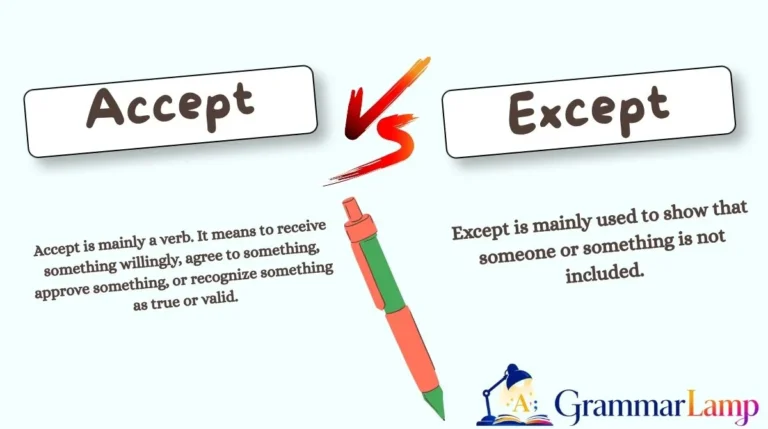
Accept and except are two English words that confuse many learners because they look and sound almost the same.
The spelling is different by only one letter, and both words are common in everyday English. However, their meanings are completely different.
This small difference can cause big mistakes in writing and speaking. For example, “I accept everyone except Tom” is correct, but “I except everyone accept Tom” is wrong.
When you are speaking quickly, the mistake may be easy to miss. In writing, however, it can make your sentence confusing.
The good news is that the difference is actually simple once you understand the basic idea behind each word. Accept is usually a verb.
It means to receive, agree to, approve, or take something as true. Except usually means excluding or not including someone or something.
These words appear in school, work, emails, conversations, forms, notices, and daily speech. Knowing how to use them correctly can make your English much clearer.
By the end of this guide, you will understand what accept means, what except means, how their grammar works, where learners make mistakes, and how to remember the difference without memorizing difficult rules.
More Useful posts
Orientated vs Oriented: What’s the Difference? [2026 Guide]
Do You vs Are You: What’s the Difference? Complete Guide for 2026
Dateline vs Deadline: Meaning, Difference, Examples & Easy Rules (2026)
Whole vs Hole: Meaning, Difference, Examples, and Easy Rules (2026)
What Does “Accept” Mean?
Accept is mainly a verb. It means to receive something willingly, agree to something, approve something, or recognize something as true or valid.
The exact meaning depends on the sentence, but the general idea is that you are taking something in or agreeing to it.
For example:
- You can accept a gift.
- You can accept an invitation.
- You can accept a job offer.
- You can accept an apology.
- You can accept responsibility.
- You can accept a fact.
The opposite of accept is often reject, refuse, or deny, depending on the situation.
When Do You Use “Accept”?
Use accept when someone receives or agrees to something.
You might use it when talking about an offer:
She accepted the job offer.
You can also use it when someone agrees to an idea or suggestion:
I accept your suggestion.
Another common use is receiving something:
He accepted the package from the delivery driver.
It can also mean admitting that something is true:
I accept that I made a mistake.
In this sentence, the speaker is not physically receiving anything. Instead, the speaker is recognizing the truth.
Grammar Rule for “Accept”
Because accept is usually a verb, it normally comes after a subject and can be followed by a noun, pronoun, or clause.
Common patterns include:
Subject + accept + noun
She accepted the invitation.
Subject + accept + pronoun
I accept it.
Subject + accept + that-clause
He accepted that he was wrong.
You can also use forms such as accepting and accepted:
Thank you for accepting my offer.
They accepted our proposal yesterday.
8 Examples of “Accept”
- I accepted the invitation to the wedding.
The speaker agreed to attend. - She refused to accept the gift.
Here, accept means receive willingly. - Will you accept this offer?
The speaker is asking whether someone will agree to an offer. - The shop does not accept credit cards.
Here, accept means allow or take as payment. - He finally accepted the truth.
He recognized that the fact was true. - Please accept my apology.
This is a very common expression. - We should accept responsibility for the mistake.
It means admitting that you are responsible. - The university accepted her application.
The university approved the application.
Common Learner Confusion With “Accept”
A common problem is choosing accept when the sentence actually means excluding something.
For example:
Everyone was invited except John.
Some learners write:
Everyone was invited accept John.
That is incorrect because the meaning is not “receive” or “agree.” The sentence means John was not included.
Another mistake happens because accept and except sound very similar in many accents. Learners sometimes choose the word by sound instead of meaning.
A useful question is:
Am I receiving or agreeing to something?
If the answer is yes, accept is probably the word you need.
What Does “Except” Mean?
Except is mainly used to show that someone or something is not included.
Its basic meaning is excluding, apart from, or with one person or thing left out.
Look at this sentence:
Everyone came except Ahmed.
This means everyone came, but Ahmed did not come.
The sentence does not tell us that Ahmed rejected anything. It simply tells us that Ahmed was excluded from the group.
When Do You Use “Except”?
Use except when you want to point out an exception.
For example:
I like all fruits except bananas.
This means the speaker likes all fruits, but bananas are not included.
It is also common after words such as all, every, everyone, everything, no one, and nothing.
Examples:
Everyone passed except Jack.
I eat everything except seafood.
The store is open every day except Sunday.
In all these examples, except removes one person, thing, or time from a larger group.
“Except” as a Preposition
One of the most common uses of except is as a preposition.
Pattern:
except + noun/pronoun
Examples:
Everyone except Sara was ready.
I invited all my friends except him.
The room was empty except for a small table.
Here, except shows what is left out.
“Except” as a Conjunction
Except can also connect a complete idea to another clause, especially in expressions such as:
I would help you, except I am busy.
The second part explains the exception or reason that changes the first idea.
Another example:
I would have called you, except my phone was dead.
This use is common in everyday English.
“Except for”
You will often see except for, which is very similar to except.
The house was perfect except for the small kitchen.
Everyone was ready except for Tom.
It means one person or thing is the exception.
8 Examples of “Except”
- Everyone passed the test except Maria.
Maria was the only person who did not pass. - I like all vegetables except spinach.
Spinach is not included. - The office is open every day except Sunday.
Sunday is the exception. - Nobody knew the answer except Daniel.
Daniel was the one person who knew it. - The box contains everything except batteries.
Batteries are not included. - I would go with you, except I have work to finish.
The second clause gives the exception. - The car looks perfect except for a small scratch.
Everything is fine apart from the scratch. - We enjoyed the trip except for the bad weather.
The weather was the negative exception.
Common Learner Confusion With “Except”
The biggest mistake is using accept instead of except when the sentence means excluding.
For example:
❌ Everyone was there accept me.
✅ Everyone was there except me.
The second mistake is using except when you mean receive or agree.
❌ I except your apology.
✅ I accept your apology.
Remember that except does not normally mean “receive.” It usually means leave out or apart from.
Difference Between Accept and Except
The easiest way to understand the difference is to focus on their core meanings.
| Word | Part of Speech | Main Meaning | Common Use | Example |
|---|---|---|---|---|
| Accept | Verb | Receive, agree, approve, recognize | Offers, gifts, invitations, facts | I accept your offer. |
| Except | Preposition / conjunction | Excluding, apart from | Exceptions and exclusions | Everyone came except Ali. |
Usage Difference
Accept is about taking or agreeing.
She accepted the invitation.
She said yes to the invitation.
Except is about leaving something out.
Everyone accepted the invitation except Ali.
Ali did not accept it, and he is the exception in the group.
Notice how both words can even appear in the same sentence:
Everyone accepted the invitation except Ali.
This is a great sentence to remember because it shows the difference clearly.
Grammar Logic
The grammar is also different.
Accept is a verb:
I accept the offer.
The word accept shows an action.
Except normally introduces the person or thing that is left out:
Everyone came except Ali.
The word except does not show an action like “receive.” It tells us about an exception.
That is why these words cannot normally be swapped.
Sentence Structure Difference
With accept, common sentence structures include:
accept + noun
She accepted the award.
accept + pronoun
I accepted it.
accept + that-clause
He accepted that he was wrong.
With except, common structures include:
everyone/everything/all + except + noun
Everyone except John was ready.
all + except + noun
I ate all the food except the salad.
sentence + except + clause
I would stay, except I have another meeting.
Meaning Comparison
Compare these two sentences:
I accept your answer.
This means I agree to or approve your answer.
Everyone answered the question except Tom.
This means Tom is the only person who did not answer.
One word is about accepting. The other is about excluding.
A very simple way to think about them is:
Accept = say yes or receive.
Except = leave out.
Explore More Posts
Farther vs Further: The Easy Difference Explained for 2026
In Development vs Under Development: Meaning, Differences, and Examples (2026)
Non-Restrictive Clauses: Meaning, Rules, Examples & Differences in 2026
Conform With vs Conform To (2026): What’s the Difference? Easy Grammar Guide for English Learners
Grammar Rules You Must Remember
Rule 1: Use “Accept” as a Verb
When you need an action meaning receive, agree, approve, or recognize, use accept.
She accepted the job.
Not:
She excepted the job.
The first sentence means she agreed to take the job.
Another example:
I cannot accept this gift.
The speaker is talking about receiving something.
Rule 2: Use “Except” for an Exception
When one person or thing is excluded from a group, use except.
Everyone came except David.
This means David was not part of the group that came.
More examples:
I work every day except Friday.
All the lights were on except one.
Nobody complained except Sarah.
In each sentence, something is left out.
Rule 3: “Accept” Can Be Used With Offers, Apologies, and Responsibility
English often uses accept with specific nouns.
Common combinations include:
- accept an offer
- accept an invitation
- accept a gift
- accept an apology
- accept responsibility
- accept payment
- accept a decision
- accept the truth
For example:
Please accept my apology.
He accepted responsibility for the mistake.
Learning these common word combinations can make your English sound more natural.
Rule 4: “Except” Often Follows Words Such as Everyone and Everything
Watch for words that describe a whole group.
Everyone except me.
Everything except the red box.
All except two students.
Every room except Room 4.
This is one of the easiest patterns to recognize.
When you see a whole group followed by one person or thing that is not included, except is usually correct.
Common Mistakes Students Make
These two words are often mixed up because their pronunciation is close. In fast speech, the difference may not feel obvious. Learners may also remember the letters instead of the meaning.
The safest solution is to stop for a moment and ask what the sentence means.
Mistake 1: Using “Accept” for an Exception
❌ Everyone came accept John.
✅ Everyone came except John.
Why?
John is excluded from the group. You are not saying that John received or agreed to something.
Mistake 2: Using “Except” for Receiving Something
❌ She excepted the award.
✅ She accepted the award.
Here, she received the award, so accept is needed.
Mistake 3: “Accept My Apology”
❌ Please except my apology.
✅ Please accept my apology.
This is a very common phrase. The person is asking you to receive or agree to the apology.
Mistake 4: “Everyone Except…”
Learners sometimes write:
❌ Everyone accept me was invited.
✅ Everyone except me was invited.
The phrase everyone except me means everybody was included, but I was not.
Mistake 5: Confusing “Accept” With “Except for”
Consider:
The room was clean except for one chair.
This means the chair was the only problem.
You could not replace except for with accept for.
Easy Correction Tips
When you are unsure, use these questions:
Does the sentence mean receive, agree, approve, or recognize?
Use accept.
Does the sentence mean excluding, apart from, or leaving out?
Use except.
For example:
Will you accept the offer?
Yes. The person is asking whether you will agree to an offer.
Everyone came except Mark.
Yes. Mark is excluded.
That simple meaning test can solve most everyday problems.
Easy Trick to Remember the Difference
Here is an easy memory trick:
Accept = “A” for Agreement
Think of the A in accept as Agreement.
When you accept, you may say:
“Yes, I agree.”
You can accept an offer.
You can accept an invitation.
You can accept an apology.
You can accept responsibility.
So remember:
Accept = Agree or Receive.
Except = “Exclude”
Think of except as connected with exclude.
When something is excluded, it is left out.
Everyone except Sara.
Sara is left out.
All colors except black.
Black is left out.
So remember:
Except = Exclude or Leave Out.
There is another helpful classroom trick.
Imagine your teacher says:
Everyone can leave except Ali.
Ali must stay. He is excluded.
Now imagine the teacher says:
I accept your homework.
The teacher is receiving it.
That real-life difference makes the two words much easier to remember.
Daily Life Examples
These examples show how accept and except can appear naturally in conversations.
Example 1: At Work
A: Did everyone accept the new schedule?
B: Yes, everyone accepted it except Maria.
Here, accepted means agreed to the schedule, while except shows the one person who did not.
Example 2: At School
Teacher: Did everyone finish the homework?
Student: Everyone did except Ahmed.
Ahmed is the exception.
Example 3: Receiving a Gift
A: Did Sarah accept your gift?
B: Yes, she thanked me for it.
Here, accept means receive willingly.
Example 4: A Dinner Invitation
A: Did you invite everyone?
B: Yes, everyone except my cousin.
The cousin was not included.
Example 5: Online Shopping
Customer: Do you accept credit cards?
Employee: Yes, we accept Visa and Mastercard.
The store receives credit-card payments.
Example 6: Talking About Food
A: Do you eat everything?
B: Almost everything except seafood.
Seafood is excluded from the list.
Example 7: Saying Sorry
A: I made a mistake. I am really sorry.
B: I accept your apology.
The second speaker agrees to receive the apology.
Example 8: A Meeting
A: Is everyone in the meeting?
B: Yes, except our manager.
The manager is not included among the people present.
Example 9: Accepting Responsibility
A: Who broke the printer?
B: I did. I accept responsibility.
The speaker openly admits responsibility.
Example 10: Talking About a Problem
A: How was your holiday?
B: It was great except for the rain.
The holiday was mostly good, but the rain was one negative exception.
Practice Section
Choose accept or except in each sentence.
1. I cannot ______ this offer.
Answer: accept
The sentence means the speaker cannot agree to or receive the offer.
2. Everyone was ready ______ Tom.
Answer: except
Tom was the person who was not ready.
3. Please ______ my apology.
Answer: accept
The expression means “receive or agree to my apology.”
4. I like all these shirts ______ the blue one.
Answer: except
The blue shirt is not included.
5. Will they ______ our invitation?
Answer: accept
The question asks whether they will agree to the invitation.
More Helpful posts
Who’s vs Whose (2026): What’s the Difference? Easy Grammar Rules, Examples, and Common Mistakes
Compare to vs Compare with: Easy Grammar Guide for 2026
Apportion vs Portion vs Proportion: Meaning, Differences, and Easy Examples (2026)
Case in Point vs Case and Point: Which Is Correct? (2026)
FAQs
What is the difference between accept and except?
Accept is mainly a verb meaning to receive, agree to, approve, or recognize something. Except means excluding someone or something. For example, “I accept the offer” shows agreement, while “Everyone came except John” shows an exception.
Can we use “accept” in questions?
Yes. Accept can be used in both questions and statements. For example, “Will you accept this offer?” and “Did she accept your invitation?” Both sentences ask whether someone agreed to or received something.
Can we use “except” in questions?
Yes. Except can appear naturally in questions when you are asking about something that is excluded. For example, “Did everyone come except Sara?” or “Do you eat everything except fish?” The word still has its usual meaning of excluding.
Is “accept” formal or informal?
Accept is a normal everyday English word. It is used in casual conversations, business writing, school English, emails, and formal situations. Expressions such as “Please accept my apology” can sound polite and formal depending on the context.
Is “except” formal or informal?
Except is also a very common English word and works in both formal and informal situations. You can use it in everyday conversation, academic writing, work emails, and official documents. The meaning remains the same: something is not included.
Why do people confuse accept and except?
The main reason is that the words look and sound very similar. Their spelling differs by only one letter, and many learners remember the sound before they remember the meaning. A good way to avoid the mistake is to remember accept = receive or agree and except = leave out.
Conclusion
Accept and except may look almost the same, but they do very different jobs.
Use accept when you mean receive, agree, approve, or recognize something. You can accept a gift, an offer, an invitation, an apology, or responsibility.
Use except when you mean excluding, leaving out, or apart from someone or something. You can say, “Everyone came except Ali” or “I like all fruit except bananas.”
The easiest memory trick is simple: accept = agree or receive, while except = exclude or leave out.
Do not worry if these words felt confusing before. They become much easier when you learn them through real sentences instead of trying to memorize spelling alone.
Notice them when you read, and try making a few sentences of your own. With regular practice, choosing between accept and except will start to feel natural.

Liam Derren is a language writer at GrammarLamp, creating simple, helpful content about grammar, words, and everyday English. He makes language learning clear, practical, and easy to understand.
1 thought on “Accept vs Except: Meaning, Difference, Rules, and Examples (2026)”