
Many English learners mix up who’s and whose because they sound exactly the same. These two words are perfect examples of homophones.
Homophones are words that have the same pronunciation but different meanings and spellings.
Even native English speakers sometimes use the wrong one when writing quickly. You may have seen mistakes in text messages, social media posts, emails, or even school assignments. That is why learning the difference is so important.
The good news is that this grammar point is much easier than it looks. Once you understand one simple rule, choosing the correct word becomes almost automatic.
Knowing when to use these words helps you write better emails, essays, stories, messages, and exams.
It also makes your English look more natural and professional. Whether you are a beginner or an advanced learner, mastering this small grammar rule can improve your writing.
By the end of this guide, you will know exactly what each word means, how to use it correctly, the grammar rules behind it, common mistakes to avoid, and an easy trick that helps you remember the difference forever.
What Does “Who’s” Mean?
Simple Definition
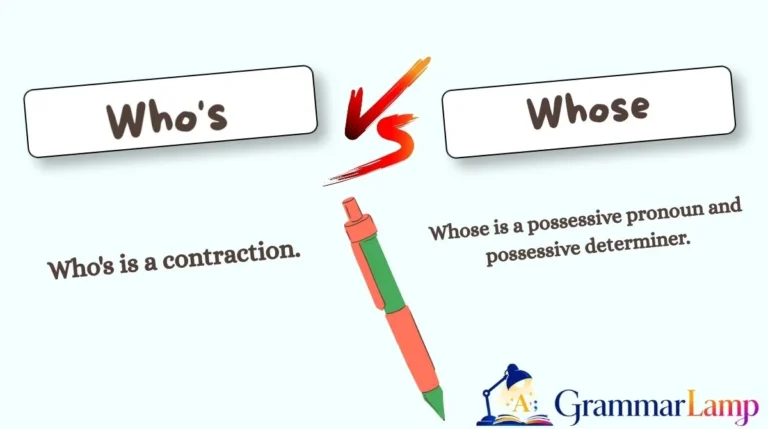
Who’s is a contraction.
It is the short form of:
- Who is
- Who has
An apostrophe (‘) shows that letters have been left out.
Think of it like these examples:
- I’m = I am
- She’s = She is
- They’re = They are
- Who’s = Who is or Who has
Whenever you see who’s, try replacing it with who is or who has. If the sentence still makes sense, then who’s is correct.
When to Use “Who’s”
Use who’s when talking about:
- someone’s identity
- asking a question
- describing someone
- saying someone has done something
Grammar Rule
Who’s = Who is / Who has
Sentence pattern:
Who’s + verb…?
or
Who’s + adjective/noun…?
Examples of “Who’s”
- Who’s at the door?
- Who’s your English teacher?
- Who’s coming with us today?
- Who’s ready for the game?
- Who’s been using my laptop?
- Who’s going to help me?
- Who’s the tallest student here?
- Who’s interested in joining the club?
In every example above, you can replace who’s with who is or who has.
Example:
Who’s coming?
Who is coming?
The meaning stays the same.
Common Learner Confusion
Many learners see the apostrophe and think it shows possession.
That is not true here.
The apostrophe in who’s does not show ownership.
Instead, it simply replaces missing letters.
What Does “Whose” Mean?
Simple Definition
Whose is a possessive pronoun and possessive determiner.
It asks or tells us who owns something.
It answers the question:
“Who does this belong to?”
When to Use “Whose”
Use whose whenever you talk about ownership, possession, or relationships.
Grammar Rule
Whose + noun
Examples:
- whose bag
- whose phone
- whose shoes
- whose idea
- whose house
Examples of “Whose”
- Whose bag is this?
- Whose phone is ringing?
- I know the girl whose brother is a doctor.
- Whose keys are on the table?
- Whose notebook did you borrow?
- We met a man whose car broke down.
- Whose jacket are you wearing?
- Do you know whose bicycle this is?
Notice that whose always talks about ownership.
Common Learner Confusion
Many students think every possessive word needs an apostrophe.
That is incorrect.
Examples:
- his ✅
- her ✅
- their ✅
- your ✅
- whose ✅
None of these possessive words use an apostrophe.
Difference Between Who’s and Whose
| Feature | Who’s | Whose |
|---|---|---|
| Meaning | Who is / Who has | Belonging to whom |
| Part of Speech | Contraction | Possessive pronoun/determiner |
| Apostrophe | Yes | No |
| Talks about | Identity or action | Ownership |
| Replace with “Who is”? | Yes | No |
Usage Difference
Compare these examples.
Example 1
Who’s knocking?
Meaning:
Who is knocking?
Example 2
Whose dog is barking?
Meaning:
Which person’s dog is barking?
Example 3
Who’s your friend?
Correct.
Example 4
Whose friend are you?
Correct if asking about ownership.
Grammar Logic
Think about the meaning first.
Ask yourself:
Am I asking who someone is?
Use who’s.
Example:
Who’s outside?
Ask yourself:
Am I asking who owns something?
Use whose.
Example:
Whose umbrella is this?
Sentence Structure Difference
Who’s
Who’s + verb
Who’s coming?
Who’s calling?
Who’s waiting?
Whose
Whose + noun
Whose bag
Whose house
Whose laptop
Whose bicycle
Meaning Comparison
Who’s here?
= Who is here?
Whose book is this?
= This book belongs to whom?
The meanings are completely different.
Grammar Rules You Must Remember
Rule 1
Use who’s only when it means who is or who has.
Example:
Who’s been eating my cookies?
Who has been eating my cookies?
Rule 2
Use whose to ask about ownership.
Example:
Whose wallet is this?
The wallet belongs to someone.
Rule 3
Never replace whose with who is.
Wrong:
Who is book is this?
This makes no sense.
Correct:
Whose book is this?
Rule 4
The apostrophe does not always show possession.
Many learners believe:
Apostrophe = ownership
That rule is not always true.
Who’s = contraction
Whose = possession
Remember this difference.
Common Mistakes Students Make
Mistake 1
Wrong:
Who’s shoes are these?
Correct:
Whose shoes are these?
Reason:
The sentence asks about ownership.
Mistake 2
Wrong:
Whose coming tomorrow?
Correct:
Who’s coming tomorrow?
Meaning:
Who is coming tomorrow?
Mistake 3
Wrong:
Whose your teacher?
Correct:
Who’s your teacher?
Mistake 4
Wrong:
Who’s notebook is on the desk?
Correct:
Whose notebook is on the desk?
Why These Mistakes Happen
Students usually write according to pronunciation.
Since both words sound the same, they choose one without thinking about the meaning.
Instead of listening to the sound, think about the sentence.
Ask:
Can I replace it with who is?
If yes, use who’s.
If not, think about ownership.
Easy Correction Tips
- Check for ownership.
- Look for the noun after the word.
- Replace who’s with who is.
- Read the sentence aloud.
- Think about the meaning, not the pronunciation.
Easy Trick to Remember the Difference
Here is a simple memory trick.
Trick One
If you can say:
Who is
or
Who has
then use who’s.
Example:
Who’s calling?
Who is calling.
Works perfectly.
Trick Two
If the next word is a thing someone owns, use whose.
Examples:
Whose phone
Whose shoes
Whose jacket
Whose laptop
Ownership means whose.
Real-Life Logic
Imagine you find a backpack at school.
You ask:
Whose backpack is this?
You are asking about ownership.
Now imagine someone knocks on the classroom door.
You ask:
Who’s there?
Now you are asking about identity.
One asks who someone is.
The other asks who owns something.
That is the whole difference.
Daily Life Examples
Here are some natural conversations.
A: Who’s outside?
B: It’s my cousin.
A: Whose water bottle is this?
B: It’s mine.
A: Who’s calling you?
B: My brother.
A: Whose phone keeps ringing?
B: Sarah’s.
A: Who’s your best friend?
B: Ahmed.
A: Whose seat is this?
B: It belongs to Ali.
A: Who’s ready to leave?
B: We are.
A: Whose homework is missing?
B: Mine.
A: Who’s speaking now?
B: The principal.
A: Whose idea was this?
B: It was my sister’s idea.
Practice Section
Choose the correct answer.
1.
______ coming with us?
A. Who’s
B. Whose
2.
______ pencil is this?
A. Who’s
B. Whose
3.
______ been using my computer?
A. Who’s
B. Whose
4.
______ backpack is on the chair?
A. Who’s
B. Whose
5.
______ your science teacher?
A. Who’s
B. Whose
Answers
- A — Who’s
- B — Whose
- A — Who’s
- B — Whose
- A — Who’s
FAQs
1. What is the difference between who’s and whose?
Who’s means who is or who has. Whose shows ownership or possession. Even though they sound the same, they have different meanings and grammar rules.
2. Can we use who’s in questions?
Yes. Who’s is very common in questions such as “Who’s there?” or “Who’s calling?” It simply means who is or who has.
3. Is whose only used in questions?
No. It can also connect two parts of a sentence.
Example:
I met a woman whose daughter is a pilot.
Here, whose introduces extra information about the woman.
4. Why doesn’t whose have an apostrophe?
Because it is already a possessive word. Similar possessive words like his, her, its, their, and your also do not use apostrophes.
5. Can whose refer to animals or things?
Yes. Whose can refer to people, animals, and sometimes even things.
Example:
The company whose products are famous worldwide continues to grow.
6. How can I remember which one to use?
Replace who’s with who is or who has. If the sentence still makes sense, use who’s. If you are talking about ownership, choose whose.
Conclusion
The difference between who’s and whose becomes much easier once you focus on meaning instead of pronunciation.
Although they sound exactly alike, they do completely different jobs in a sentence.
Who’s is simply a shortened form of who is or who has, while whose asks or tells us who owns something.
A quick test can save you from mistakes. Try replacing who’s with who is or who has. If the sentence still sounds correct, you have the right word. If the sentence is about possession, whose is the correct choice.
The best way to remember this grammar point is through practice. Read English books, notice how these words are used, and write your own example sentences every day.
Before long, choosing the correct word will become natural. Small grammar improvements like this make your writing clearer, more accurate, and more confident.

Liam Derren is a language writer at GrammarLamp, creating simple, helpful content about grammar, words, and everyday English. He makes language learning clear, practical, and easy to understand.
1 thought on “Who’s vs Whose (2026): What’s the Difference? Easy Grammar Rules, Examples, and Common Mistakes”