
Are “courtesy” and “curtesy” the same word? They look almost identical, and their pronunciation is very similar. However, their meanings and everyday uses are quite different.
The most important thing to remember is that courtesy is the correct and common spelling when you are talking about politeness, good manners, or showing respect to other people.
Curtesy, on the other hand, is a rare legal term. It refers to a historical right that a husband could have in certain property owned by his deceased wife under traditional English common law. It is not a normal alternative spelling of the everyday word courtesy.
Understanding this difference can help you avoid spelling mistakes in emails, school assignments, conversations, and professional writing. It is especially useful for English learners because a single letter can change the meaning of a word completely.
Both spellings have a place in English, but they do not belong in the same everyday situations. One is used when discussing good behavior, while the other belongs mainly to historical and legal discussions.
By understanding their meanings, grammar, spelling patterns, and real-life examples, you can choose the correct word with confidence.
More Useful posts
Conform With vs Conform To (2026): What’s the Difference? Easy Grammar Guide for English Learners
Who’s vs Whose (2026): What’s the Difference? Easy Grammar Rules, Examples, and Common Mistakes
Compare to vs Compare with: Easy Grammar Guide for 2026
Apportion vs Portion vs Proportion: Meaning, Differences, and Easy Examples (2026)
What Does “Courtesy” Mean?
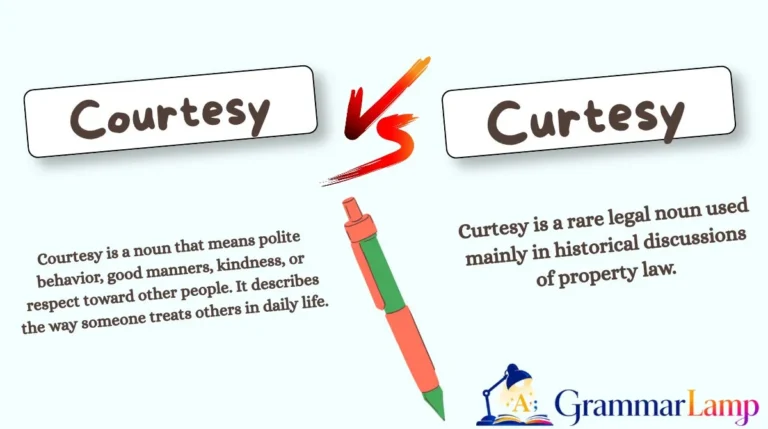
Courtesy is a noun that means polite behavior, good manners, kindness, or respect toward other people. It describes the way someone treats others in daily life.
When you show courtesy, you think about other people’s feelings. You speak politely, listen when someone is talking, and try not to make others uncomfortable.
For example, saying “please” when asking for something and “thank you” when receiving help are simple acts of courtesy.
Courtesy is an important part of everyday English. You can use it at home, at school, at work, in shops, and when speaking with strangers.
When Should You Use Courtesy?
Use this word when you are talking about:
- Good manners: Treating people with respect.
- Polite behavior: Speaking kindly and avoiding rude actions.
- Kind actions: Helping someone or doing something thoughtful.
- Respectful communication: Listening carefully and speaking calmly.
- Free services: Something provided without payment, often as a kind service.
- Permission or favor: Something given as a favor rather than as a legal right.
For example, a hotel may provide a free bus to take guests to the airport. This can be called a courtesy bus.
You may also hear the expression courtesy of. It means that something is provided by someone or happens because of something.
According to standard English dictionary usage, the word can describe both polite behavior and a polite action. definition in the Cambridge English Dictionary+1
Grammar Rules for Courtesy
The word courtesy is mainly used as a noun. It can be countable or uncountable, depending on the sentence.
1. Uncountable noun
When talking about politeness in general, use it as an uncountable noun.
- Courtesy is important in every workplace.
- Good teachers treat their students with courtesy.
- We should show courtesy to older people.
2. Countable noun
When talking about individual polite actions, you can use its plural form, courtesies.
- She thanked us for our many courtesies.
- The guests exchanged polite courtesies.
- He showed small courtesies to everyone.
3. Use it with common verbs
Some verbs often appear with this word:
- Show courtesy
- Extend courtesy
- Treat someone with courtesy
- Return a courtesy
- Expect courtesy
- Have the courtesy
For example:
- Please show courtesy to your customers.
- I appreciate your courtesy.
- He did not have the courtesy to call me.
8 Example Sentences with Courtesy
Here are eight simple examples that show how to use the word naturally.
- Courtesy is one of the most important qualities of a good person.
- Please show some courtesy when speaking to your teachers.
- The shopkeeper treated every customer with courtesy.
- She thanked her neighbor for his kindness and courtesy.
- Good manners and courtesy can make a strong first impression.
- The hotel offers a free courtesy bus for its guests.
- We received the photographs courtesy of our school.
- He was upset because his friend did not have the courtesy to reply.
Notice that the spelling stays the same in all these sentences. Whether you are talking about manners, kindness, or a free service, you should write courtesy.
Common Learner Confusion About Courtesy
Many English learners write curtesy when they actually mean courtesy. This mistake happens because both words look and sound very similar.
Some learners also confuse courtesy with curtsy. Although these words have a historical connection, they have different meanings in modern English.
A curtsy is a movement in which someone bends their knees slightly as a sign of respect. A courtesy is polite behavior or a respectful action.
Remember that when you want to talk about kindness, manners, or respect, the correct spelling is courtesy.
What Does “Curtesy” Mean?
Curtesy is a rare legal noun used mainly in historical discussions of property law. It describes an old common-law right that could allow a surviving husband to hold a life interest in certain land belonging to his deceased wife.
In simple words, under traditional common law, a husband could sometimes have the right to use or benefit from his wife’s qualifying land during the rest of his life after her death.
This right was generally connected to conditions such as a valid marriage, the wife’s ownership of qualifying land, and the birth of a child who could inherit that land.
The exact legal requirements depended on the applicable legal system and historical period.
The term is also found in older legal books under expressions such as tenancy by the curtesy and estate by curtesy. LII / Legal Information Institute+2
When Should You Use Curtesy?
You should use this spelling when discussing:
- Historical English property law.
- Old common-law inheritance rules.
- The property rights of a surviving husband.
- Legal history involving marriage and land ownership.
- Historical legal documents and court records.
- The expression tenant by curtesy.
It is not a normal word for everyday conversations about politeness.
For example, a law student studying old property rules may come across the phrase estate by curtesy. However, someone writing a message to thank a friend should use courtesy.
Grammar Rules for Curtesy
Like its more familiar-looking counterpart, curtesy is a noun. However, its meaning is legal and specialized.
It does not work as a general word for good manners.
1. Use it as a legal noun
- The lawyer explained the historical law of curtesy.
- The document discussed an estate by curtesy.
2. Use the common legal expression
One of the most familiar expressions is tenancy by curtesy. It refers to the historical property arrangement associated with this right.
- The historical record mentioned tenancy by curtesy.
- The professor explained the rules of curtesy.
3. Use its plural form when needed
The plural form is curtesies, although the singular form is much more common in legal discussions.
- The book compared different historical curtesies.
- The legal text discussed curtesy and other old property rights.
8 Example Sentences with Curtesy
The following examples show how this uncommon word may appear in historical or legal writing.
- The law student studied the meaning of curtesy in traditional property law.
- The old legal document mentioned an estate by curtesy.
- The professor explained how curtesy worked under historical common law.
- The husband claimed a right known as curtesy after his wife’s death.
- The textbook compared curtesy with the historical property right called dower.
- The court examined the old rules of tenancy by curtesy.
- The historian discussed the development of curtesy in English legal history.
- The legal dictionary described curtesy as a historical right involving a husband’s interest in his deceased wife’s land.
These examples are mainly useful for understanding legal history. You are unlikely to need this word in normal conversations, school essays about manners, or everyday emails.
Common Learner Confusion About Curtesy
The biggest mistake is assuming that curtesy is simply a shorter or alternative spelling of courtesy.
That is not how the two words work in modern everyday English.
For example:
- Incorrect: Thank you for your curtesy.
- Correct: Thank you for your courtesy.
The first sentence uses a legal term where a word about good manners is needed.
Another problem occurs when learners see curtesy in an old book and assume it is a spelling error. It may actually be a correct legal term.
The best approach is to look at the context. If the subject is politeness, use courtesy. If the subject is historical property law, curtesy may be the correct choice.
Difference Between Courtesy and Curtesy (Detailed Explanation)
The main difference is their meaning and area of use.
Courtesy refers to politeness, kindness, and respectful behavior. Curtesy refers to a historical legal right connected to a husband’s interest in certain property owned by his deceased wife.
Although the words look similar, they cannot normally replace each other.
Courtesy vs Curtesy: Comparison Table
| Feature | Courtesy | Curtesy |
|---|---|---|
| Part of speech | Noun; also an adjective | Noun |
| Main meaning | Politeness and good manners | Historical property right |
| Common use | Everyday English | Legal and historical English |
| Frequency | Very common | Very rare |
| Context | Social and professional situations | Property law and inheritance |
| Example | Show courtesy to others. | The case discussed curtesy. |
| Related expression | Courtesy of | Tenancy by curtesy |
| Modern relevance | Widely used | Mainly specialized or historical |
1. Difference in Meaning
The first difference is what each word communicates.
When you use courtesy, you are usually talking about how people behave toward each other. It may describe kindness, respect, or a polite action.
For example:
- She showed courtesy to the visitors.
- Please treat everyone with courtesy.
When you use curtesy, you are discussing an old legal right involving property and inheritance.
For example:
- The lawyer explained the history of curtesy.
- The old document referred to an estate by curtesy.
The meanings are not interchangeable.
2. Difference in Usage
The second difference is where these words are used.
Courtesy belongs to ordinary English. You can use it when talking to friends, writing business emails, thanking someone, or explaining the importance of good manners.
Curtesy belongs mainly to legal history. You may find it in old property records, legal dictionaries, law textbooks, or discussions of common-law inheritance.
Think about the situation before choosing your spelling.
If you are writing a thank-you message, you need courtesy. If you are reading a historical property-law document, you may need curtesy.
3. Difference in Grammar
Both words are nouns, but they do not have the same grammatical role in everyday writing.
The word courtesy can be used as an uncountable noun.
Example:
– Courtesy makes communication easier.
It can also be a countable noun when referring to a polite action.
Example:
– She showed us several small courtesies.
The word curtesy is a specialized legal noun.
Example:
– The legal historian studied curtesy.
You should not use it to describe a person’s manners.
4. Difference in Sentence Structure
Both words can appear after articles, adjectives, and prepositions, but their surrounding expressions are different.
Common structures with courtesy include:
- Show + courtesy
- With + courtesy
- A matter of + courtesy
- Courtesy of + person or organization
- Have the courtesy to + verb
Examples:
- He treated the visitors with courtesy.
- It is a matter of courtesy to say thank you.
- The gift was courtesy of my uncle.
- Please have the courtesy to listen.
Common structures with curtesy include:
- Estate by curtesy
- Tenancy by curtesy
- Right of curtesy
- Law of curtesy
Examples:
- The book explained tenancy by curtesy.
- The court considered the historical right of curtesy.
The surrounding words often help you recognize which meaning is intended.
5. Difference in Everyday Importance
Courtesy is useful for almost everyone learning English. You need it when speaking politely, communicating professionally, and showing respect.
Curtesy is not an everyday vocabulary word. Most English learners can communicate naturally without using it. However, it is useful to recognize it when reading legal or historical material.
This is why spelling matters. Choosing the wrong word can make an otherwise good sentence confusing.
6. Are Courtesy and Curtesy Pronounced the Same?
The two words are generally pronounced alike or very similarly in English.
This means you may not notice the spelling difference when someone speaks. You need to understand the meaning and context to choose the correct written form.
For example, if someone says a sentence about good manners, the intended spelling is courtesy. If a legal historian discusses an old inheritance rule, the intended spelling may be curtesy.
Explore More Posts
Whole vs Hole: Meaning, Difference, Examples, and Easy Rules (2026)
Farther vs Further: The Easy Difference Explained for 2026
In Development vs Under Development: Meaning, Differences, and Examples (2026)
Non-Restrictive Clauses: Meaning, Rules, Examples & Differences in 2026
Grammar Rules You Must Remember
Learning a few simple rules can help you avoid confusing these two spellings. You do not need to memorize complicated legal definitions. Just remember what each word means and where it belongs.
Rule 1: Use Courtesy When Talking About Good Manners
Whenever you want to describe politeness, kindness, or respectful behavior, write courtesy.
This is the correct word for normal conversations and everyday writing.
Examples:
- Please show courtesy to your classmates.
- Her courtesy made everyone feel welcome.
- We should treat older people with courtesy.
Remember: Good manners always call for courtesy, not curtesy.
Rule #
2: Use Curtesy Only in Its Legal Meaning
Use curtesy when discussing the historical property right associated with a surviving husband under traditional common law.
Do not use it when thanking someone or describing polite behavior.
Examples:
- The lawyer explained the historical right of curtesy.
- The book discussed tenancy by curtesy.
- The students learned about curtesy in their property law class.
Remember: Property law and historical inheritance discussions may require curtesy.
Rule 3: Do Not Treat Curtesy as a Normal Alternative Spelling
Some words have different accepted spellings in British and American English. For example, colour and color have the same basic meaning.
However, courtesy and curtesy are not ordinary British and American spelling alternatives.
You should not write curtesy simply because you prefer a shorter spelling.
Examples:
- Correct: Thank you for your courtesy.
- Incorrect: Thank you for your curtesy.
- Correct: The hotel offers a courtesy car.
- Incorrect: The hotel offers a curtesy car.
The context and meaning determine the spelling.
Rule 4: Learn the Correct Related Words
Learning related words makes spelling easier.
The word courtesy is connected to:
- Courteous: Showing good manners.
- Courteously: In a polite or respectful way.
- Discourtesy: Rude or impolite behavior.
- Courtesies: Polite actions or expressions.
For example:
- She is always courteous to customers.
- He spoke courteously to his teacher.
- His discourtesy surprised everyone.
These related words help you recognize the correct spelling family.
Remember that curtesy belongs to a separate specialized legal use, even though the two words have a shared historical connection.
Common Mistakes Students Make
English learners often make spelling mistakes when two words look almost the same. This is especially true when the words have similar sounds but different meanings.
The confusion between these two spellings is a good example. Many students know the word for good manners but accidentally replace its spelling with the less common legal term.
Let’s look at the mistakes more closely.
Mistake 1: Using Curtesy When Thanking Someone
This is one of the most common mistakes.
Wrong: Thank you for your curtesy and support.
Correct: Thank you for your courtesy and support.
Why?
You are thanking someone for being kind and respectful. Therefore, you need the everyday word courtesy.
Easy tip: Whenever you write a thank-you message, check that you have used the spelling with the letter O after the C.
Mistake 2: Writing Curtesy in a Business Email
Professional emails should use correct and clear English.
Wrong: I appreciate your curtesy during the meeting.
Correct: I appreciate your courtesy during the meeting.
Why?
You are describing polite behavior during a professional meeting. The legal meaning of curtesy has nothing to do with the situation.
Easy tip: If you are writing about customers, colleagues, managers, or business communication, you will usually need courtesy.
Mistake 3: Assuming Both Words Have the Same Meaning
Some students think the two spellings are interchangeable.
Wrong: Please show me some curtesy.
Correct: Please show me some courtesy.
Why?
The second spelling refers to politeness. The first refers to a historical property-law concept.
Easy tip: Never choose a word only because it looks similar to another word. Always check its meaning.
Mistake 4: Thinking Curtesy Is an Incorrect Word
Another common mistake happens when students see curtesy in an old legal document.
They may believe the writer made a spelling error.
However, curtesy is a recognized legal term.
Example:
– The textbook explained the historical rules of curtesy.
This is a correct use of the specialized term.
Easy tip: Do not automatically correct an unfamiliar word. Check the subject of the sentence first.
Mistake 5: Confusing Courtesy with Curtsy
There is another similar-looking word that can create confusion: curtsy.
A curtsy is a respectful movement in which someone bends their knees and lowers their body slightly.
Examples:
- The young dancer performed a curtsy.
- The princess gave a small curtsy.
- The performer ended the show with a curtsy.
A curtsy is a physical movement, while courtesy means polite behavior.
Easy tip: If you are describing a polite action or good manners, use courtesy. If you are describing someone bending their knees as a formal greeting, use curtsy.
Easy Trick to Remember the Difference
A simple memory trick can save you from making the same spelling mistake again.
You do not need to memorize a long legal explanation every time you write one of these words. Just connect each spelling with its main meaning.
The O in Courtesy Stands for Others
Think of the letter O in courtesy as a reminder of Others.
When you show courtesy, you think about other people. You respect their feelings, listen to them, and speak politely.
For example:
- You say please when asking for help.
- You say thank you when someone helps you.
- You allow someone else to speak.
- You hold the door open for another person.
These are all examples of courtesy.
Curtesy Is Connected to Court and Property Law
Think of curtesy as a word you might find in an old law book.
It is connected to historical rules about marriage, land, and inheritance.
You probably will not use it when chatting with friends or writing a normal email.
A Simple Comparison to Remember
COURTESY
Good manners and respect.
Think: kindness, politeness, and other people.
Example: Please show courtesy to everyone.
CURTESY
An old legal property right.
Think: historical law, marriage, and inheritance.
Example: The historian studied curtesy.
The easiest rule is this: if you are writing about good behavior, choose courtesy. If you are discussing a historical property-law right, choose curtesy.
With a little practice, you will remember the difference without needing to check a dictionary every time.
Daily Life Examples: Courtesy vs Curtesy
Real-life examples make confusing vocabulary easier to understand. The following sentences show how the two words work in different situations.
Most of these examples use courtesy because it is the word you are most likely to need in everyday English.
Examples Using Courtesy
1. At Home
“Please show some courtesy to your parents when they are speaking.”
Here, courtesy means listening politely and showing respect to family members.
2. At School
“Our teacher always treats students with courtesy.”
This sentence describes a teacher who speaks kindly and respects students.
3. At Work
“Good customer service begins with courtesy.”
This means employees should treat customers politely and respectfully.
4. With Friends
“Thank you for your courtesy and understanding.”
You can use this sentence when a friend has been patient or helpful.
5. At a Hotel
“The hotel provides a courtesy car for its guests.”
Here, courtesy describes a service provided free of charge.
6. During a Conversation
“Please have the courtesy to let me finish speaking.”
This sentence asks someone to show respect by listening.
7. On the Road
“Drivers should show courtesy to pedestrians.”
This means drivers should behave respectfully and consider the safety of people walking.
8. In a Professional Email
“I appreciate your time and courtesy during our discussion.”
This is a polite way to thank someone after a business conversation.
Examples Using Curtesy
The following examples are different because they belong to historical legal writing.
9. In a Law Class
“Our professor explained the historical meaning of curtesy.”
The sentence refers to an old property-law concept.
10. In a History Book
“The book described the rules of tenancy by curtesy.”
Here, the writer is discussing historical inheritance and property rights.
These examples show why the surrounding context matters. The two words may look similar, but they serve different purposes.
Practice Section: Test Your Understanding
Now it is time to check what you have learned. Read each sentence carefully and choose the correct spelling.
Remember, courtesy is about politeness, while curtesy is a historical legal term.
Choose the Correct Word
1. We should always show ______ to our teachers.
- A. Courtesy
- B. Curtesy
2. The lawyer explained the historical right of ______.
- A. Courtesy
- B. Curtesy
3. Thank you for your kindness and ______.
- A. Courtesy
- B. Curtesy
4. The old property document mentioned tenancy by ______.
- A. Courtesy
- B. Curtesy
5. Good manners and ______ make communication better.
- A. Courtesy
- B. Curtesy
Your practice test
0/5 answered
1. We should always show ______ to our teachers.CourtesyCurtesy
2. The lawyer explained the historical right of ______.CourtesyCurtesy
3. Thank you for your kindness and ______.CourtesyCurtesy
4. The old property document mentioned tenancy by ______.CourtesyCurtesy
5. Good manners and ______ make communication better.CourtesyCurtesy
Check my answers
Practice Answers and Explanations
Here are the correct answers with simple explanations.
- A. Courtesy – Teachers deserve politeness and respect.
- B. Curtesy – This is a historical property-law term.
- A. Courtesy – The sentence talks about kindness and good manners.
- B. Curtesy – Tenancy by curtesy is an old legal expression.
- A. Courtesy – Courtesy helps people communicate respectfully.
If you got all five answers correct, excellent work! If you made a mistake, read the explanations again and try the questions once more.
More Helpful posts
Imbalanced vs Disbalanced: What Is the Difference? (2026)
Orientated vs Oriented: What’s the Difference? [2026 Guide]
Do You vs Are You: What’s the Difference? Complete Guide for 2026
Dateline vs Deadline: Meaning, Difference, Examples & Easy Rules (2026)
FAQs
Here are answers to six common questions that English learners ask about these two spellings.
1. What Is the Difference Between Courtesy and Curtesy?
Courtesy means politeness, kindness, or good manners. It is a common English word used in everyday conversations and writing.
Curtesy is a rare legal term referring to a historical property right that could belong to a surviving husband under traditional common law.
2. Is Curtesy a Correct English Word?
Yes, curtesy is a correct English word. However, it is mainly used in legal and historical discussions.
It describes an old property right involving a husband’s interest in certain land owned by his deceased wife. It is not a normal alternative spelling of courtesy.
3. Can I Use Courtesy in Everyday Conversations?
Yes! Courtesy is commonly used in everyday English.
You can use it when discussing good manners, kindness, respect, and polite behavior. For example, “Thank you for your courtesy” is a natural and correct sentence.
4. Is Courtesy Formal or Informal?
Courtesy can be used in both formal and informal English.
In formal situations, you might say, “I appreciate your courtesy.” In everyday conversation, you might say, “Please show some courtesy.” Both sentences are correct.
5. Is Curtesy an Alternative Spelling of Courtesy?
No, not in modern everyday English. The two spellings have different uses and meanings.
Although they share a historical connection, curtesy is a specialized legal term. You should not use it when talking about kindness or politeness.
6. Which Spelling Should I Use in an Email: Courtesy or Curtesy?
Use courtesy in a normal email.
For example:
“Thank you for your time, support, and courtesy.”
This sentence is polite and professional. You should use curtesy only if your email is specifically discussing the historical legal concept.
Conclusion
Understanding the difference between courtesy and curtesy is easier when you remember their meanings. Although these words look and sound very similar, they are not interchangeable in modern English.
Courtesy is the correct and common word for politeness, kindness, good manners, and respect. You can use it in everyday conversations, school assignments, business emails, and professional communication.
Curtesy is a rare legal term connected to historical property and inheritance laws. You will mainly find it in legal dictionaries, old documents, and discussions of common law.
The easiest way to remember the difference is to connect courtesy with good manners and curtesy with historical property law.
Keep practicing with simple sentences, pay attention to spelling, and always consider the meaning before choosing a word. A small spelling difference can change the meaning of a sentence.
Good English is not only about using difficult words. It is also about choosing the right word at the right time!

Liam Derren is a language writer at GrammarLamp, creating simple, helpful content about grammar, words, and everyday English. He makes language learning clear, practical, and easy to understand.