
English has many words that sound exactly the same but have completely different meanings. Whole and hole are two common examples.
They are pronounced the same way, so learners often mix them up when writing.
When you hear someone say, “The whole cake is gone,” and “There is a hole in the cake,” the words may sound very similar, but their meanings are completely different.
This confusion is especially common for beginners because English spelling does not always match pronunciation.
A student may know the meaning of both words but still choose the wrong spelling when writing a sentence. That small spelling mistake can change the meaning of the sentence.
The good news is that the difference is actually easy to understand. Whole usually means something that is complete, entire, or not divided. Hole means an empty space or an opening in something. One is about completeness; the other is about an opening.
This difference appears in everyday English. You may talk about a whole day, a whole pizza, a whole family, or a whole story. You may also talk about a hole in your shirt, a hole in the wall, or a hole in the ground.
By the end of this guide, you will know when to use each word, how they work in sentences, what mistakes to avoid, and a simple trick that can help you remember the difference.
What Does “Whole” Mean?
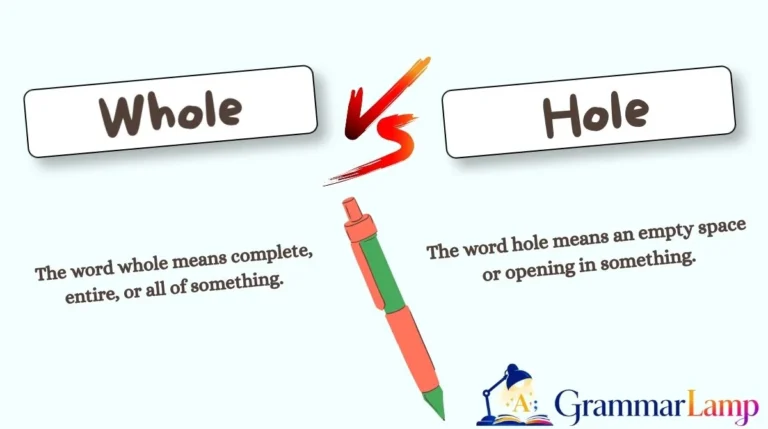
The word whole means complete, entire, or all of something. It is used when we are talking about something as one complete unit rather than a part of it.
For example, if you eat an entire apple, you can say:
I ate the whole apple.
This means you ate all of the apple, not just one piece.
Whole is most commonly used as an adjective, but it can also be used as a noun and, in some expressions, as an adverb.
As an adjective, it describes something complete or entire.
When should you use “whole”?
Use whole when you mean:
- all of something
- complete
- entire
- not divided
- the full amount or group
The basic pattern is often:
whole + singular countable noun
For example:
- the whole book
- the whole day
- the whole house
- the whole team
- the whole story
Notice that whole normally comes before the noun it describes.
Examples of “whole”
- I watched the whole movie last night.
I watched the movie from beginning to end. - She ate the whole sandwich.
She ate all of the sandwich. - We spent the whole day at the beach.
We spent the entire day there. - The whole class was quiet.
Every student in the class was quiet. - He told me the whole story.
He told me everything about what happened. - I cleaned the whole kitchen.
I cleaned all parts of the kitchen. - The whole family came to the wedding.
Everyone in the family came. - It took the whole week to finish the project.
It took all seven days of the week.
Common learner confusion with “whole”
A common mistake is using whole when the speaker really means an opening or empty space.
For example:
❌ There is a whole in my shirt.
✅ There is a hole in my shirt.
Another common mistake is using whole incorrectly with plural nouns.
For example, learners may say:
❌ whole students
✅ the whole class
✅ all the students
We usually use whole with a singular noun when we are describing one complete thing.
You can say:
- the whole book
- the whole house
- the whole team
But for plural nouns, all is often more natural:
- all the books
- all the houses
- all the students
What Does “Hole” Mean?
The word hole means an empty space or opening in something. It can be a small opening, such as a hole in a shirt, or a large opening, such as a hole in the ground.
Unlike whole, which is usually connected to completeness, hole is connected to a space, gap, or opening.
For example:
There is a hole in my sock.
This means the sock has a damaged area with an opening in it.
When should you use “hole”?
Use hole when you mean:
- an opening
- an empty space
- a gap in something
- a cavity
- a space that goes through or into something
The word hole can be used as a noun. It is often followed by in, on, or through, depending on the sentence.
Common patterns include:
a hole in + object
- a hole in the wall
- a hole in my jeans
- a hole in the roof
a hole in + surface
- a hole in the ground
- a hole in the road
Examples of “hole”
- There is a hole in my shirt.
My shirt has an opening in it. - The dog dug a hole in the garden.
The dog made an opening in the ground. - I found a small hole in the wall.
There is a small opening in the wall. - Be careful! There is a hole in the road.
There is an empty or damaged space in the road. - The mouse ran into a hole.
The mouse went into an opening. - We need to fix the hole in the roof.
The roof has an opening that needs repair. - He drilled a hole in the wood.
He made an opening in the wood using a drill. - The ball went through the hole.
The ball passed through an opening.
Common learner confusion with “hole”
The biggest problem is spelling. Hole sounds just like whole, but the meanings are not related.
Compare:
- whole = complete
- hole = opening
A learner may hear:
“There is a hole in the wall.”
and think about the spelling whole because both words have the same pronunciation. This is why it helps to connect each spelling with a picture or idea.
Think of hole as a physical opening. You can usually imagine something being missing from a place.
Difference Between Whole and Hole
The easiest way to understand the difference is to focus on the core idea behind each word.
Whole means something is complete.
Hole means something has an opening.
They are homophones. That means they have the same pronunciation but different spellings and meanings.
Comparison Table
| Word | Meaning | Common use | Example |
|---|---|---|---|
| Whole | Complete or entire | Describes all of something | I read the whole book. |
| Hole | An opening or empty space | Describes a gap or opening | There is a hole in the wall. |
Usage difference
Use whole when you can replace it with words such as:
- entire
- complete
- all of
For example:
I worked the whole day.
You can understand this as:
I worked the entire day.
Now look at hole:
There is a hole in the door.
You cannot replace hole with “entire” or “complete.” The sentence would not make sense. Here, hole refers to an opening.
Grammar logic
Whole usually describes a noun.
For example:
the whole house
Here, whole is describing the house as one complete unit.
Hole, on the other hand, is itself a noun.
For example:
a hole in the house
Here, hole is the thing being talked about. It is an opening in the house.
That is an important grammar difference.
Sentence structure difference
With whole, a common structure is:
the + whole + noun
Examples:
- the whole day
- the whole story
- the whole book
- the whole team
With hole, common structures include:
a + hole + in + noun
Examples:
- a hole in the wall
- a hole in my shoe
- a hole in the roof
You can also use hole after verbs:
- dig a hole
- make a hole
- fill a hole
- find a hole
- fall into a hole
Meaning comparison
Compare these two sentences:
I ate the whole cake.
This means I ate all of the cake.
I found a hole in the cake.
This means there is an opening or empty space in the cake.
The pronunciation is almost identical, but the images in your mind should be completely different.
Grammar Rules You Must Remember
Rule 1: Use “whole” for something complete
When you mean the entire thing, use whole.
✅ She read the whole book.
✅ We cleaned the whole house.
✅ He spent the whole day working.
A useful replacement test is to try entire.
If “entire” works, whole is probably the correct choice.
the whole morning = the entire morning
Rule 2: Use “hole” for an opening or empty space
When you mean a gap or opening, use hole.
✅ There is a hole in the wall.
✅ The rabbit disappeared into a hole.
✅ He dug a hole in the garden.
A useful mental image is a space where something is missing.
Rule 3: “Whole” usually describes a noun
Whole commonly appears before a noun.
Examples:
- the whole country
- the whole story
- the whole meal
- the whole team
It tells us that we are talking about all of that thing.
Rule 4: “Hole” is a noun for an opening
Hole names the opening itself.
Examples:
- a deep hole
- a small hole
- a dark hole
- a hole in the wall
You can describe the hole with adjectives or talk about what is inside it.
For example:
The hole is very deep.
There is water in the hole.
Common Mistakes Students Make
Students often make mistakes with these two words because they hear the same sound. Pronunciation gives no clue about spelling, so you must use meaning to choose the right word.
Mistake 1: Using “whole” for an opening
❌ There is a whole in my trousers.
✅ There is a hole in my trousers.
Why? Because the sentence describes an opening in the trousers.
Mistake 2: Using “hole” for “entire”
❌ I watched the hole movie.
✅ I watched the whole movie.
Why? The meaning is “the entire movie,” so whole is correct.
Mistake 3: Confusing “whole day” and “hole day”
❌ I worked the hole day.
✅ I worked the whole day.
A day cannot be an opening. The speaker means the entire day.
Mistake 4: Forgetting the meaning when spelling
Sometimes students know the correct word when they see it, but they choose the wrong spelling while writing.
A good habit is to stop for one second and ask:
Am I talking about something complete, or am I talking about an opening?
That simple question can prevent many mistakes.
Easy correction tips
Remember these two ideas:
Whole → complete
Hole → opening
Try to create a mental picture.
When you see whole, imagine a complete pizza.
When you see hole, imagine a hole in the center of that pizza.
That picture makes the difference much easier to remember.
Easy Trick to Remember the Difference
Here is a simple memory trick that works well for beginners.
Think about the word hole. It has an “h” at the beginning.
Now imagine the h as part of a house. A house can have a hole in its wall or roof.
So:
H → house → hole
This is only a memory trick, but it can help you remember the spelling.
For whole, think:
whole = all = complete
You can also remember it with a sentence:
The whole apple has no hole.
The first word means the complete apple. The second word means an opening.
Another useful sentence is:
I ate the whole pizza, but there was a hole in the box.
That gives you both words in one real-life situation.
Daily Life Examples
These words are common in everyday conversation, so hearing and using them often will help you learn faster.
Example 1
A: Did you eat the cake?
B: Yes, I ate the whole cake.
Here, whole means all of it.
Example 2
A: Why are you changing your shirt?
B: There is a hole in it.
Here, hole means an opening.
Example 3
A: How long did you study?
B: I studied the whole evening.
The speaker means the entire evening.
Example 4
A: Why is the car moving slowly?
B: There is a hole in the road.
The road has a damaged opening or gap.
Example 5
A: Did you watch the movie?
B: Yes, I watched the whole thing.
“Whole thing” means everything or the entire movie.
Example 6
A: What happened to the garden?
B: The dog made a big hole.
The dog dug an opening in the ground.
Example 7
A: Did everyone come to the meeting?
B: Yes, the whole team was there.
“Whole team” means all members of the team as one group.
Example 8
A: Why is there water on the floor?
B: There is a hole in the pipe.
The pipe has an opening that is allowing water to escape.
Example 9
A: How much of the sandwich did you eat?
B: I ate the whole sandwich.
This means none of it was left.
Example 10
A: Where did the cat go?
B: It went into a hole under the fence.
The cat entered an opening in the ground or another surface.
Practice Section
Choose the correct word: whole or hole.
1.
I read the ______ book in one day.
2.
There is a small ______ in my sock.
3.
She spent the ______ morning cleaning.
4.
The rabbit jumped into a ______.
5.
He ate the ______ pizza.
Answers
- whole
- hole
- whole
- hole
- whole
Try saying the sentences aloud. Reading and speaking at the same time can help connect spelling, pronunciation, and meaning.
FAQs
What is the difference between whole and hole?
Whole means complete, entire, or all of something. Hole means an opening, gap, or empty space. They sound the same but have different spellings and meanings.
Can we use “whole” in questions?
Yes. Whole can be used naturally in questions.
For example:
Did you eat the whole pizza?
Did you watch the whole movie?
It is useful when asking whether someone experienced or used all of something.
Is “whole” formal or informal?
Whole is neither strongly formal nor informal. It is a normal everyday English word. You can use it in conversations, school writing, emails, and most general situations.
Is “hole” only used for physical openings?
No. Hole is often used for physical openings, but it can also have figurative meanings.
For example:
He is in a financial hole.
This does not mean he is literally inside a hole. It means he has serious financial problems.
Another example is:
The company has a hole in its budget.
Here, hole refers to a missing amount of money.
Why do whole and hole sound the same?
They are homophones. Homophones are words that have the same pronunciation but different meanings and spellings.
Other common homophones include:
- right / write
- sea / see
- to / too / two
- pair / pear
Because whole and hole sound the same, you must use the meaning of the sentence to choose the spelling.
Is “whole” the same as “all”?
They can have a similar meaning, but they are not always used in exactly the same way.
We often say:
the whole book
and
all the books
We usually use whole with a singular thing viewed as one complete unit, while all is common with plural nouns and uncountable nouns.
For example:
I read the whole book.
I read all the books.
Conclusion
The difference between whole and hole is simple once you connect each word with its meaning.
Whole means complete, entire, or all of something. You can use it when talking about the whole day, the whole book, the whole family, or the whole meal.
Hole means an opening, gap, or empty space. You can find a hole in a shirt, wall, road, pipe, roof, or the ground.
The main challenge is that both words sound the same. That means you cannot depend on pronunciation when writing. Instead, focus on meaning.
Ask yourself one quick question: Am I talking about something complete, or am I talking about an opening?
If it is complete, choose whole. If it is an opening, choose hole.
A little practice will make this difference automatic. Pay attention when you read, write your own sentences, and try to use both words in daily conversation.
Once you remember whole = complete and hole = opening, this common English confusion becomes much easier.

Liam Derren is a language writer at GrammarLamp, creating simple, helpful content about grammar, words, and everyday English. He makes language learning clear, practical, and easy to understand.
1 thought on “Whole vs Hole: Meaning, Difference, Examples, and Easy Rules (2026)”