
Many English learners get confused by the words before and by because both can talk about time.
They may look similar in some sentences, but they do not always express the same idea. Choosing the wrong word can change the meaning of a sentence or make your message unclear.
For example, imagine your teacher asks you to submit your homework by Friday. Does this mean you can submit it on Saturday? No. You must finish and submit it no later than Friday.
Now imagine your teacher says, “Finish your homework before Friday.” This usually means you should complete it earlier than Friday, not on Friday itself.
These small differences matter in daily English. You will hear these words at school, at work, while making plans, and during everyday conversations. You may also see them in emails, instructions, exam questions, and deadlines.
The good news is that you do not need to memorize many difficult grammar rules to understand them. You only need to learn what each word means, how it works in a sentence, and when to use it.
By understanding their meanings and common uses, you will be able to talk about deadlines, schedules, events, and actions more clearly. You will also learn how to avoid common mistakes and choose the correct word in both spoken and written English.
More Useful posts
Dateline vs Deadline: Meaning, Difference, Examples & Easy Rules (2026)
Whole vs Hole: Meaning, Difference, Examples, and Easy Rules (2026)
Farther vs Further: The Easy Difference Explained for 2026
In Development vs Under Development: Meaning, Differences, and Examples (2026)
What Does “Before” Mean?
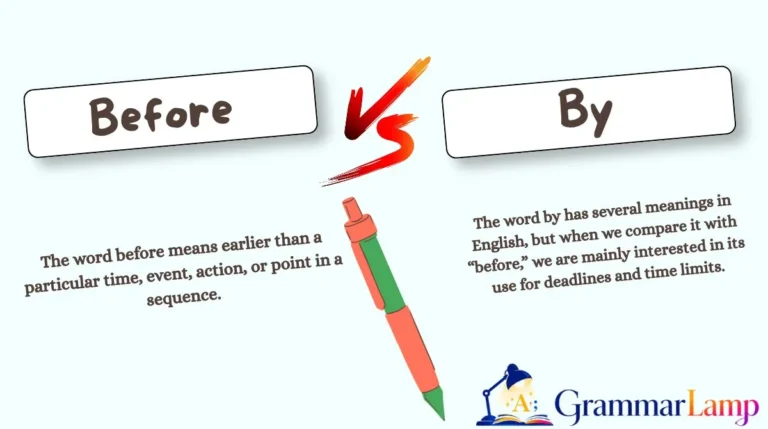
The word before means earlier than a particular time, event, action, or point in a sequence. It helps us explain that something happens first or that one thing takes place earlier than another.
For example:
- Please call me before dinner.
- I arrived before my teacher.
- Wash your hands before eating.
In these sentences, the word shows that one action or event happens earlier than another.
When Should You Use “Before”?
There are several common situations in which you can use this word.
1. Before a Specific Time
Use “before” when something needs to happen earlier than a stated time.
For example:
- I need to leave before 8 a.m.
- Please reach the office before noon.
- We must finish the meeting before 5 p.m.
These sentences focus on an action happening earlier than a particular time. If someone says, “Come before 9,” the safest interpretation is to arrive earlier than 9.
2. Before an Event
You can use this word when one event happens earlier than another event.
For example:
- I had breakfast before school.
- She called me before the meeting.
- We cleaned the room before the guests arrived.
Notice that the word connects two events. It helps the reader or listener understand their order.
3. Before Doing Something
“Before” can also come before a noun or an action ending in -ing.
For example:
- Check your answers before submitting the test.
- Think carefully before speaking.
- I always drink water before exercising.
In these examples, “before” explains what should happen first.
4. Before in the Past
You can use “before” to describe something that happened earlier in the past.
For example:
- I had seen that movie before.
- She had never visited Lahore before.
- We met once before.
Here, the word refers to an earlier time or experience. It does not necessarily name an exact date or hour.
Grammar Rules for “Before”
“Before” can function as a preposition, a conjunction, or an adverb.
Before + noun or noun phrase
Use this structure when you name a time, person, or event.
- I arrived before sunset.
- She finished before her brother.
Before + subject + verb
Use this structure when you include a complete clause.
- I left before the rain started.
- Please eat before you go.
Before + verb ending in -ing
This structure is common when the same person performs both actions.
- Wash your hands before eating.
- Read the instructions before starting.
Before as an adverb
Sometimes, the word appears without a noun or clause after it.
- I have heard this story before.
- Have we met before?
Eight Examples of “Before”
- I always have tea before breakfast.
- Please finish the report before Monday.
- She arrived before everyone else.
- Call me before you leave home.
- We should check the weather before traveling.
- He had never driven a car before.
- Finish your work before lunchtime.
- Think before you answer the question.
Common Confusion About “Before”
One common mistake is thinking that “before” means the same as “by.” They are not always interchangeable.
For example:
- Please finish the work before Friday.
- Please finish the work by Friday.
The first sentence normally asks you to finish earlier than Friday. The second gives Friday as the deadline, so finishing on Friday can be acceptable.
Remember that the exact interpretation can sometimes depend on the situation, especially when people use informal language. However, this distinction is a useful and reliable rule for everyday English.
What Does “By” Mean?
The word by has several meanings in English, but when we compare it with “before,” we are mainly interested in its use for deadlines and time limits.
In this context, “by” means not later than a particular time. It tells us the latest acceptable time for an action to happen.
For example:
- Please submit your assignment by Friday.
- I will be home by 7 p.m.
- You must pay the bill by the end of the month.
These sentences give a deadline. The action may happen earlier, but it should not happen later than the stated time.
When Should You Use “By”?
1. By a Deadline
Use “by” when something must be completed no later than a particular date or time.
For example:
- Submit your application by November 10.
- Please send me the document by tomorrow.
- We need to finish the project by Friday.
In each case, the named time is the deadline. You can complete the task earlier, but you should not wait until after the deadline.
2. By a Specific Hour
This use is common when making plans or giving instructions.
For example:
- I will arrive by 6 p.m.
- Please be ready by 8 o’clock.
- The children should be home by sunset.
The sentences do not necessarily mean the action will happen at the exact stated time. It may happen earlier.
For example, “I will arrive by 6 p.m.” could mean that you arrive at 5:30 p.m. or 5:55 p.m. Arriving at 6:15 p.m. would usually be too late.
3. By the End of a Period
“By” is useful when a deadline refers to the end of a day, week, month, or another period.
For example:
- I will complete the course by the end of this year.
- Please return the books by the end of the week.
- The company hopes to finish the work by December.
These examples set a limit without requiring the action to happen at one exact moment.
4. By in Questions
You can use “by” to ask about a deadline.
For example:
- By when do you need the report?
- Can you finish this by tomorrow?
- Do we have to arrive by 9 a.m.?
In everyday conversation, people often ask, “When do you need it by?” This is natural spoken English, although some formal writers may prefer “By when do you need it?”
Grammar Rules for “By”
By + noun or time expression
Use “by” before a deadline.
- Please finish by Friday.
- I need the money by noon.
By + the end of + time period
Use this pattern to give a deadline connected to a period.
- We must finish by the end of the month.
- She hopes to graduate by the end of next year.
By + time expression with a future action
You can use “by” with future forms to show when an action will be completed.
- I will finish the assignment by tomorrow.
- They will have arrived by 8 p.m.
The future perfect tense is especially useful when you want to emphasize that an action will be complete before or at a future point.
By + a deadline in questions
- Can you send the file by Monday?
- When must we pay by?
The second question is common in conversation. In more formal English, you can say, “By when must we pay?”
Eight Examples of “By”
- Please finish your homework by 7 p.m.
- I will send you the details by tomorrow.
- We need to submit the form by Friday.
- She should arrive by noon.
- Can you complete this task by Monday?
- The package should reach us by next week.
- Please pay the fee by the end of the month.
- I hope to learn basic English by next summer.
Common Confusion About “By”
Learners sometimes think that “by” means “at.” However, these words do not always mean the same thing.
Compare:
- I will arrive at 6 p.m.
- I will arrive by 6 p.m.
The first sentence gives the planned arrival time as 6 p.m. The second gives 6 p.m. as the latest expected arrival time.
This difference is important when arranging meetings, planning travel, or agreeing on deadlines.
Difference Between Before and By (Detailed Comparison)
Both words can refer to time, but they express different ideas. “Before” emphasizes that something happens earlier than a particular point. “By” emphasizes a deadline or the latest time by which something should happen.
Comparison Table
| Feature | Before | By |
|---|---|---|
| Main meaning | Earlier than a time or event | Not later than a deadline |
| Main purpose | Shows order or an earlier time | Sets a time limit |
| Can the action happen earlier? | Yes | Yes |
| Is the stated day usually included? | Usually not when a clear deadline comparison is intended | Yes, it is normally included |
| Example | Finish before Friday. | Finish by Friday. |
| Main focus | What happens earlier | The latest acceptable time |
| Common use | Events, actions, and time order | Deadlines, schedules, and completion times |
1. Difference in Meaning
The most important difference is the relationship between an action and the stated time.
Consider these sentences:
- I need the report before Monday.
- I need the report by Monday.
In the first sentence, the speaker normally wants the report earlier than Monday. In the second, Monday is the deadline, so the report may be submitted on Monday.
This small difference can affect work plans, school assignments, and personal arrangements.
2. Difference in Usage
“Before” is often used when you want to explain the order of actions.
For example:
- Eat breakfast before leaving home.
- Check your email before starting work.
- I spoke to him before the meeting.
Here, the word tells us which action happens first.
“By” is often used when you need to set a limit.
For example:
- Finish the report by noon.
- Return the keys by Friday.
- Please arrive by 10 a.m.
In these sentences, the speaker is setting a deadline or latest acceptable time.
3. Difference in Grammar
Both words can be followed by time expressions and noun phrases, but “before” has a wider range of uses involving clauses and the order of actions.
Examples with “before”:
- Before dinner
- Before sunrise
- Before I leave
- Before making a decision
Examples with “by”:
- By dinner
- By sunrise
- By Friday
- By the end of the week
You can also use “by” in other ways, such as “written by the author” or “travel by bus.” These meanings are unrelated to the deadline comparison, so you should understand the context.
4. Difference in Sentence Structure
Here are common sentence patterns.
Before + time expression
- We must leave before 5 p.m.
Before + subject + verb
- We must leave before the shop closes.
By + time expression
- We must arrive by 5 p.m.
By + the end of + period
- We must finish by the end of the day.
Notice that “before” can introduce a complete clause, while a time-related “by” usually introduces a deadline or time expression.
5. Difference in Real-Life Situations
Imagine that your manager gives you a task on Tuesday.
If the manager says, “Finish this before Friday,” you should aim to complete it earlier than Friday.
If the manager says, “Finish this by Friday,” you normally have until Friday to complete it.
Now imagine that a friend asks you to meet at a restaurant.
- “Please come before 7 p.m.” means you should arrive earlier than 7.
- “Please come by 7 p.m.” means 7 is the latest acceptable arrival time.
The difference may seem small, but it helps you understand exactly what someone expects.
Explore More Posts
Non-Restrictive Clauses: Meaning, Rules, Examples & Differences in 2026
Conform With vs Conform To (2026): What’s the Difference? Easy Grammar Guide for English Learners
Who’s vs Whose (2026): What’s the Difference? Easy Grammar Rules, Examples, and Common Mistakes
Compare to vs Compare with: Easy Grammar Guide for 2026
Grammar Rules You Must Remember
Rule 1: Use “Before” for an Earlier Time
When you want to say that something happens earlier than a particular time, use “before.”
Examples:
- I need to leave before 8 a.m.
- Please finish your lunch before the meeting.
The focus is on completing an action earlier than the named time or event.
Rule 2: Use “By” for Deadlines
When a task must be completed no later than a certain time, use “by.”
Examples:
- Submit your application by Friday.
- Please call me by 9 p.m.
The stated time is the deadline. Completing the task earlier is fine, but going past the deadline may not be.
Rule 3: Use “Before” to Connect Two Actions
When one action should happen earlier than another, “before” is often the right choice.
Examples:
- Lock the door before you leave.
- Read the instructions before starting the test.
You can place the “before” clause at the beginning or end of the sentence.
- Before you leave, lock the door.
- Lock the door before you leave.
Both sentences are correct. When the clause comes first, a comma is normally used after it.
Rule 4: Remember That “By” Does Not Always Mean “At”
“By” sets a time limit rather than necessarily naming the exact moment an action will happen.
Examples:
- I will be there by 4 p.m.
- I will be there at 4 p.m.
The first sentence allows arrival before 4 p.m. The second presents 4 p.m. as the expected arrival time.
This rule is especially useful when you discuss appointments, deliveries, and deadlines.
Explore More Posts
Dateline vs Deadline: Meaning, Difference, Examples & Easy Rules (2026)
Whole vs Hole: Meaning, Difference, Examples, and Easy Rules (2026)
Farther vs Further: The Easy Difference Explained for 2026
In Development vs Under Development: Meaning, Differences, and Examples (2026)
Common Mistakes Students Make
Even learners who understand both words can make mistakes when speaking quickly or translating directly from their first language. The best way to improve is to notice what each sentence is trying to express.
Mistake 1: Using “By” When You Mean an Earlier Action
Incorrect: Wash your hands by eating.
Correct: Wash your hands before eating.
Why? The sentence explains that washing your hands should happen earlier than eating. It is not giving a deadline.
Correction tip: When two actions must happen in order, consider using “before.”
Mistake 2: Using “Before” for a Deadline
Incorrect for a deadline that includes Friday: Please submit the form before Friday. You can submit it on Friday.
Correct: Please submit the form by Friday.
Why? “Before Friday” normally means earlier than Friday, while “by Friday” generally allows Friday itself.
Correction tip: If the stated day is the last acceptable day, use “by.”
Mistake 3: Confusing “By 5 p.m.” With “At 5 p.m.”
Incorrect interpretation: “I will finish by 5 p.m.” means I will finish exactly at 5 p.m.
Better understanding: It means the task will be complete no later than 5 p.m.
Why? “By” sets a limit, whereas “at” identifies a particular time.
Correction tip: Think of “by” as a deadline and “at” as a specific time.
Mistake 4: Using “Before” Without Checking the Intended Meaning
Sentence: You must arrive before 10 a.m.
This normally means you should arrive earlier than 10 a.m.
If the speaker is happy for you to arrive at 10 a.m., a clearer sentence is:
Correct: You must arrive by 10 a.m.
Correction tip: Ask yourself whether the exact stated time is allowed. If it is the deadline, “by” is usually clearer.
Mistake 5: Forgetting the Meaning of “Before” in a Clause
Incorrect: Call me by you leave.
Correct: Call me before you leave.
Why? “Before” can connect the call with the later action of leaving. The sentence needs a word that expresses the order of these actions.
Correction tip: Learn complete phrases, such as “before you leave,” “before going to bed,” and “before the meeting starts.”
Mistake 6: Assuming “By” Always Refers to Time
Incorrect understanding: “The book was written by Friday” must mean the book was completed before Friday.
The sentence could express that meaning in a suitable context, but it is unusual without more information. “By” has several meanings, including the person who performs an action.
For example:
- The book was written by Sarah.
- We traveled by train.
Correction tip: Look at the words around “by.” It can identify an agent, a method, a location, or a deadline, depending on the sentence.
Easy Trick to Remember the Difference
Here is a simple trick that can help you remember these words.
Before = earlier than a point.
By = a deadline or latest time.
Imagine that you have to submit your homework on Friday.
Your teacher says, “Submit it before Friday.” You should plan to finish it earlier, such as Thursday.
Your teacher says, “Submit it by Friday.” You can finish it on Thursday or Friday, as long as you meet the deadline.
Think of “before” as looking backward from a time point to something earlier. Think of “by” as a boundary that you should not pass.
You can also remember the difference with two short questions:
- Before: Does it need to happen earlier?
- By: What is the latest time allowed?
For example, if your mother says, “Brush your teeth before bed,” she is telling you the order of two actions. If your teacher says, “Bring your notebook by Monday,” the teacher is setting a deadline.
Once you connect each word with its main purpose, choosing the correct one becomes much easier.
Daily Life Examples of Before vs By
The following examples show how these words appear in everyday conversations. Pay attention to what the speaker wants to express.
1. Talking About Homework
Ali: When should I submit my homework?
Teacher: Please submit it by Thursday.
The teacher is setting a deadline. Thursday is normally included.
2. Getting Ready for School
Mother: Have you packed your schoolbag?
Son: Not yet. I will pack it before going to bed.
The son will pack the bag earlier than the time he goes to bed.
3. Making an Appointment
Sara: Can you come to my office tomorrow?
Ahmed: Yes, I will be there by 10 a.m.
Ahmed promises to arrive no later than 10 a.m.
4. Preparing Dinner
Father: When should we leave for the restaurant?
Daughter: We should leave before 7 p.m.
The daughter suggests leaving earlier than 7 p.m.
5. Sending an Email
Manager: When can you send me the report?
Employee: I can send it by the end of the day.
The employee promises to send it no later than the end of the day.
6. Catching a Bus
Friend A: What time does the bus leave?
Friend B: It leaves at 8 a.m., so we should get there before 7:45.
The word “before” shows that arriving earlier than 7:45 is the plan.
7. Paying a Bill
Customer: When do I need to pay this bill?
Staff Member: Please pay it by the 15th of this month.
The 15th is the deadline.
8. Going to Bed
Brother: Why are you turning off your phone?
Sister: I always turn it off before sleeping.
The action of turning off the phone happens earlier than sleeping.
9. Completing a Project
Team Leader: Can we finish the project by Wednesday?
Team Member: Yes, if we start today.
The team leader wants the project completed no later than Wednesday.
10. Visiting a Friend
Friend A: Should I visit you before lunch?
Friend B: Yes, please come before noon.
The visitor should arrive earlier than noon.
Practice Section
Test your understanding by choosing either before or by for each sentence.
- Please send me the file ___ Friday. Friday is the final deadline.
- Wash your hands ___ eating dinner.
- I need to finish this assignment ___ 6 p.m. at the latest.
- We should leave ___ the movie starts.
- Can you return my book ___ Monday? You may return it on Monday.
Answers and Explanations
- By — Friday is the final deadline.
- Before — Washing your hands should happen earlier than eating.
- By — 6 p.m. is the latest acceptable time.
- Before — Leaving should happen earlier than the movie’s start.
- By — Monday is included as the deadline.
If you got all five correct, you understand the main difference well. If you made a mistake, review the memory trick and try writing your own sentences with both words.
More Helpful posts
Apportion vs Portion vs Proportion: Meaning, Differences, and Easy Examples (2026)
Case in Point vs Case and Point: Which Is Correct? (2026)
Work Alongside You vs Work Alongside With You (2026): Which One Is Correct in English?
Lets vs Let’s (2026): What’s the Difference? Easy Grammar Guide with Examples
FAQs
1. What is the main difference between before and by?
“Before” means earlier than a particular time or event. “By” means not later than a stated deadline. For example, “Finish before Friday” normally means finish earlier than Friday, while “Finish by Friday” allows you to finish on Friday.
2. Can I use “before” and “by” interchangeably?
No, not in every sentence. They can both refer to time, but they express different relationships with that time. Use “before” for an earlier action and “by” for a deadline. Replacing one with the other can change the meaning.
3. Does “by Friday” include Friday?
Yes, in ordinary deadline instructions, “by Friday” generally includes Friday. It means the task should be completed no later than Friday. However, if the exact cutoff time matters, such as Friday at 5 p.m., it is best to state it clearly.
4. Does “before Friday” include Friday?
Usually, no. “Before Friday” normally means earlier than Friday, so Thursday or an earlier day would be appropriate. If Friday itself is acceptable, “by Friday” is generally the clearer choice.
5. Can I use “by” in questions?
Yes. You can ask, “Can you finish this by tomorrow?” or “By when do you need the report?” In casual conversation, “When do you need it by?” is also common. These questions ask about a deadline.
6. Is “before” more formal than “by”?
Neither word is always more formal than the other. Both are common in spoken and written English. “Before” is often used to describe the order of events, while “by” is especially useful in deadlines, instructions, work emails, and schedules.
Conclusion
Understanding the difference between “before” and “by” can help you speak and write English more clearly. Although both words can refer to time, they serve different purposes.
“Before” tells us that something happens earlier than a particular time or event. “By” gives us a deadline and tells us the latest acceptable time for an action.
Remember these two simple ideas: use “before” when you want something to happen earlier, and use “by” when something must happen no later than a stated time.
For example, “Finish the work before Friday” normally means finishing earlier than Friday, while “Finish the work by Friday” allows Friday as the deadline.
You can improve your understanding by paying attention to these words in conversations, emails, school instructions, and daily activities. Try making your own sentences and explaining why you chose each word. A little practice every day will help you use both words naturally and confidently.
Keep learning, keep practicing, and do not worry about making small mistakes. Every correct sentence brings you one step closer to better English.

Liam Derren is a language writer at GrammarLamp, creating simple, helpful content about grammar, words, and everyday English. He makes language learning clear, practical, and easy to understand.