
Many English learners feel confused when they see conform with and conform to. Both expressions use the same verb, conform, and both seem to talk about following rules or matching something.
Because of this, students often wonder if they mean the same thing or if one is more correct than the other.
The confusion becomes even greater because both expressions appear in books, newspapers, business writing, and everyday English.
Sometimes native speakers say conform to the rules, while other times they write the results conform with the data.
If you translate directly from your first language, it can be difficult to know which preposition sounds natural in English.
Learning the difference is important because choosing the right preposition makes your English sound clearer and more natural.
It also helps you understand grammar books, official documents, and conversations with native speakers.
A small change in a preposition can slightly change the meaning of a sentence, so it is worth taking the time to understand how each expression works.
By the end of this guide, you will know when to use conform with and conform to, how their meanings differ, which one is more common in different situations, and how to avoid the mistakes that many English learners make.
You’ll also see plenty of simple examples that you can use in your own speaking and writing.
What Does Conform Mean?
The word conform is a verb. It means to behave, act, or be similar to a rule, standard, pattern, expectation, or accepted way of doing something.
In simple words, conform means to fit, to follow, or to match.
People, objects, ideas, and even information can conform to or conform with something depending on the context.
Simple Definition
Conform = to follow a rule, match a standard, or be in agreement with something.
When Do We Use “Conform”?
We use conform when talking about:
- Following rules
- Following laws
- Meeting standards
- Matching expectations
- Being consistent with facts
- Fitting into a group
- Obeying accepted behavior
The verb is quite common in formal English, but you will also hear it in everyday conversations.
For example:
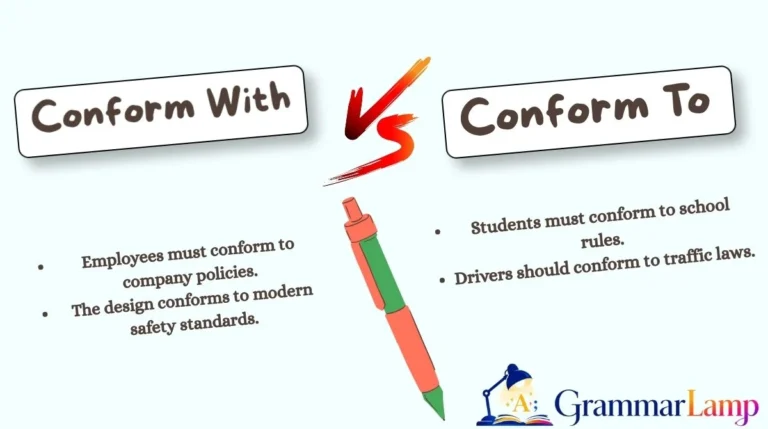
- Employees must conform to company policies.
- The design conforms to modern safety standards.
- His behavior conforms to social expectations.
Grammar Rule for “Conform”
The verb conform is normally followed by a preposition, not directly by an object.
Correct Pattern
Conform + to + noun
or
Conform + with + noun
For example:
- conform to the law
- conform to standards
- conform with the evidence
- conform with expectations
Notice that we do not usually say:
❌ conform the rules
Instead, we say:
✅ conform to the rules
Common Uses of “Conform”
1. Following Rules
When someone obeys rules or regulations.
Examples:
- Students must conform to school rules.
- Drivers should conform to traffic laws.
- Every worker has to conform to company policies.
2. Meeting Standards
When something satisfies official standards or requirements.
Examples:
- The product conforms to international safety standards.
- This machine conforms to industry regulations.
- The building conforms to fire safety rules.
3. Matching Expectations
Sometimes conform means that something matches what people expect.
Examples:
- His behavior conforms to cultural traditions.
- Their decision conforms to public expectations.
- The report conforms to professional guidelines.
4. Agreeing With Facts or Evidence
This meaning is often seen with conform with.
Examples:
- The results conform with previous research.
- His explanation conforms with the available evidence.
- The numbers conform with the official report.
8 Example Sentences Using “Conform”
Here are some easy examples to help you understand the verb.
- All students must conform to the classroom rules.
- The company conforms to government regulations.
- Her behavior does not conform to social expectations.
- These figures conform with last year’s report.
- The new policy conforms to international law.
- His actions did not conform with what he promised.
- The design conforms to modern engineering standards.
- Their explanation conforms with the facts we already know.
Common Learner Confusion About “Conform”
Many students think conform simply means agree.
That is not always true.
Look at these examples:
Agree
- I agree with your idea.
Here, you share the same opinion.
Conform
- I conform to the rules.
Here, you follow the rules. You may not even like them.
This is an important difference.
For example:
I conform to the dress code, but I don’t like wearing formal clothes.
You are following the rule, not expressing your opinion.
Another common mistake is confusing conform with confirm.
These two words look similar, but they have completely different meanings.
| Word | Meaning | Example |
|---|---|---|
| Conform | Follow or match something | We conform to school rules. |
| Confirm | Say something is true | Please confirm your booking. |
Compare these sentences:
- We conform to company policies. ✅
- Please confirm your email address. ✅
Mixing these words can completely change the meaning.
What Does With Mean?
The word with is one of the most common prepositions in English. It has many meanings, but when used with the verb conform, it has a special purpose.
In the expression conform with, the preposition with usually means:
- in agreement with
- consistent with
- matching
- not conflicting with
Instead of focusing on following a rule, with often focuses on whether two things match each other.
Simple Definition
With = in agreement or harmony with something.
When Do We Use “With”?
The preposition with has many everyday uses.
For example:
Showing Company
- I went with my friend.
- She lives with her parents.
Showing a Tool
- He cut the paper with scissors.
- She wrote with a pencil.
Showing Agreement or Relationship
This is the meaning that matters for our topic.
Examples:
- Your answer agrees with mine.
- The information matches with the report.
- His explanation conforms with the facts.
Here, with shows that two things are consistent with each other.
Grammar Rule for “With” After “Conform”
Pattern:
Conform with + noun
This structure is often used when talking about:
- facts
- evidence
- reports
- information
- observations
- expectations
- findings
- previous research
Examples:
- The results conform with earlier studies.
- His statement conforms with the evidence.
- The report conforms with government data.
- Their explanation conforms with the facts.
Notice that these examples are about agreement or consistency, not obedience.
8 Example Sentences Using “Conform With”
Here are some simple examples.
- The report conforms with the available evidence.
- His story conforms with what the witnesses said.
- The results conform with earlier research.
- Your explanation conforms with the facts.
- The data conform with the official records.
- Her opinion conforms with the team’s decision.
- These numbers conform with last month’s report.
- The evidence conforms with the doctor’s findings.
Common Learner Confusion About “With”
Many learners think conform with and conform to are always interchangeable.
They are similar, but experienced English speakers often choose them for different reasons.
For example:
- The product conforms to safety standards. ✅
- The results conform with previous studies. ✅
The first sentence is about meeting a standard or requirement.
The second sentence is about being consistent with existing information.
Although some dictionaries accept both forms in certain situations, choosing the more natural one makes your English sound smoother and more accurate.
Another mistake is replacing with with to in every sentence simply because conform to is more common. While conform to is the preferred choice for rules, laws, and standards, conform with is often better when comparing facts, evidence, reports, or research.
Understanding this small difference will make both your writing and speaking sound much more natural. In the next part, you’ll learn what to means after conform and see a detailed comparison of conform with and conform to, including grammar rules, sentence structures, and a clear comparison table.
What Does “To” Mean?
The word to is one of the most common prepositions in English. It has many uses, but after the verb conform, it has a very specific meaning.
When we say conform to, the preposition to usually means:
- follow
- obey
- meet
- fit into
- act according to
In other words, to points toward a rule, standard, law, expectation, or requirement that someone or something must follow.
Simple Definition
Conform to = to follow or meet a rule, standard, law, or accepted way of doing something.
This is the most common and widely accepted form in both British and American English.
When Do We Use Conform To?
We usually use conform to when talking about:
- Rules
- Laws
- Standards
- Regulations
- Requirements
- Policies
- Traditions
- Expectations
- Social norms
In these situations, the idea is that someone or something follows an established rule or requirement.
Examples
- Everyone must conform to the law.
- The building conforms to safety regulations.
- Students are expected to conform to school rules.
- The product conforms to international standards.
Grammar Rule for Conform To
The basic sentence pattern is:
Subject + conform(s) + to + noun
Examples:
- The machine conforms to industry standards.
- Employees must conform to company policies.
- The design conforms to modern safety requirements.
- All applicants should conform to the admission rules.
Notice that conform is followed directly by to, and then by a noun or noun phrase.
8 Example Sentences Using Conform To
Here are some easy examples you can use in everyday English.
- Drivers must conform to traffic laws.
- The product conforms to international standards.
- Every employee should conform to company policies.
- Children learn to conform to classroom rules.
- This building conforms to local building codes.
- The software conforms to security requirements.
- The company conforms to environmental regulations.
- His behavior does not conform to social expectations.
Common Learner Confusion About Conform To
Many students believe conform to only refers to people. That is not true.
Both people and things can conform to something.
People
- We conform to school rules.
- Citizens conform to the law.
Things
- The machine conforms to safety standards.
- The report conforms to company guidelines.
Another common mistake is using conform with when talking about laws or rules.
For example:
❌ Employees must conform with company rules.
Although some native speakers may use it, conform to company rules is much more natural and is the preferred choice in grammar books and formal writing.
Difference Between Conform With and Conform To
This is the part that causes the most confusion.
The good news is that both expressions are correct. The difference is mainly about what comes after the preposition and the relationship being expressed.
A simple way to remember it is this:
- Conform to = follow or meet
- Conform with = match or agree with
Quick Comparison Table
| Feature | Conform To | Conform With |
|---|---|---|
| Main meaning | Follow or obey | Match or agree with |
| Common after | Rules, laws, standards, regulations | Facts, evidence, reports, research |
| Focus | Obedience or meeting requirements | Consistency or agreement |
| Frequency | Very common | Less common |
| Formal writing | Extremely common | Common in academic and technical writing |
| Everyday English | Very common | Used less often |
Usage Difference
Although both expressions involve the idea of “matching,” they are used in slightly different ways.
Conform To = Following Something
Here, there is usually a rule or requirement that must be followed.
Examples:
- The workers conform to safety rules.
- The school conforms to government regulations.
- The product conforms to quality standards.
In these examples, someone or something is meeting a requirement.
Conform With = Matching Something
Here, two things are being compared.
Examples:
- The evidence conforms with the witness’s statement.
- The report conforms with previous research.
- The data conform with the official records.
These examples show agreement or consistency, not obedience.
Grammar Logic
Think about the meaning behind each preposition.
Why To?
The preposition to often points toward a goal or requirement.
Examples outside this topic:
- Listen to your teacher.
- Go to school.
- Stick to the plan.
Similarly:
- Conform to the rules.
The idea is moving toward or following a standard.
Why With?
The preposition with often connects two things together.
Examples:
- Agree with someone.
- Compare with another report.
- Match with the description.
Likewise:
- Conform with the evidence.
The emphasis is on the relationship between two pieces of information.
Sentence Structure Difference
Structure 1
Subject + conform + to + rule/standard/law
Examples:
- The equipment conforms to safety standards.
- The company conforms to government regulations.
- Students conform to classroom rules.
Structure 2
Subject + conform + with + facts/evidence/report
Examples:
- The results conform with earlier findings.
- His explanation conforms with the evidence.
- The survey conforms with previous studies.
Meaning Comparison
Compare these pairs carefully.
Pair 1
The product conforms to safety standards.
Meaning:
The product meets the required standards.
The test results conform with earlier research.
Meaning:
The results match what previous research found.
Pair 2
Employees must conform to company policies.
Meaning:
Employees are expected to follow the policies.
His explanation conforms with the official report.
Meaning:
His explanation agrees with the report.
Pair 3
The building conforms to local building codes.
Meaning:
The building satisfies the legal requirements.
The measurements conform with the engineer’s calculations.
Meaning:
The measurements match the calculations.
Can They Sometimes Replace Each Other?
Sometimes, yes.
For example:
- The design conforms to the specifications.
- The design conforms with the specifications.
Many dictionaries accept both.
However, native speakers usually make a natural choice depending on what they want to emphasize.
- Conform to emphasizes meeting the specification.
- Conform with emphasizes agreement with the specification.
The meaning changes only slightly, but the preferred expression often depends on the context.
Which One Is More Common?
If you search newspapers, grammar books, business documents, or official websites, you’ll notice a clear pattern.
Conform to is much more common than conform with.
It is the standard choice for:
- laws
- rules
- regulations
- standards
- policies
- requirements
- guidelines
On the other hand, conform with appears more often in:
- academic writing
- scientific papers
- legal documents
- research reports
- technical writing
This is because these fields frequently compare facts, evidence, and data rather than describing obedience to rules.
Grammar Rules You Must Remember
Remembering a few simple rules will help you choose the correct expression almost every time.
Rule 1: Use Conform To for Rules, Laws, and Standards
When someone or something follows a requirement, use conform to.
Correct:
- Drivers must conform to traffic laws.
- The product conforms to safety standards.
Incorrect:
- Drivers must conform with traffic laws.
Tip: If you can replace conform with follow, conform to is usually the right choice.
Rule 2: Use Conform With for Facts, Evidence, and Information
When two pieces of information agree with each other, conform with sounds more natural.
Correct:
- The evidence conforms with the report.
- The data conform with previous research.
Less natural:
- The evidence conforms to the report.
Tip: If you can replace conform with agree, use conform with.
Rule 3: Never Use Conform Without a Preposition
The verb conform almost always needs to or with.
Wrong:
- She conforms the rules.
Correct:
- She conforms to the rules.
Correct:
- Her explanation conforms with the facts.
Rule 4: Choose the Preposition Based on the Meaning
Ask yourself one simple question:
Am I talking about following a rule or matching information?
- Following a rule? → Conform to
- Matching information? → Conform with
Examples
Following:
- The company conforms to government regulations.
- Students conform to school policies.
Matching:
- The report conforms with the available evidence.
- The witness’s statement conforms with the facts.
This simple question will help you choose the correct expression in most situations without memorizing long grammar rules.
Common Mistakes Students Make
Even advanced English learners sometimes confuse conform with and conform to. The reason is simple: both expressions use the same verb, and both suggest that something “fits” or “matches.” However, they are not always used in the same situations.
The good news is that once you understand the common mistakes, they become much easier to avoid.
Mistake 1: Using Conform With for Rules and Laws
This is probably the most common mistake.
Many learners think they can use with after conform in every sentence. While conform with is grammatically possible in some contexts, conform to is the natural and preferred choice when talking about rules, laws, standards, policies, and regulations.
Wrong
❌ We must conform with school rules.
Correct
✅ We must conform to school rules.
Why?
School rules are something you follow, not something you compare with. That is why to is the better choice.
Mistake 2: Using Conform To When Comparing Information
Sometimes learners use conform to even when they are talking about facts or evidence.
Less Natural
The results conform to the previous report.
More Natural
The results conform with the previous report.
Why?
Here, the results are being compared with another report. The focus is on agreement, not obedience.
Mistake 3: Forgetting the Preposition
The verb conform almost always needs a preposition.
Wrong
❌ The product conforms safety standards.
Correct
✅ The product conforms to safety standards.
Correct
✅ The report conforms with the evidence.
Whenever you use conform, pause for a moment and ask yourself which preposition fits the meaning.
Mistake 4: Confusing Conform and Confirm
These two words look very similar, but they have completely different meanings.
| Word | Meaning | Example |
|---|---|---|
| Conform | Follow or match | We conform to company rules. |
| Confirm | Verify or make certain | Please confirm your reservation. |
Wrong
❌ Please conform your email address.
Correct
✅ Please confirm your email address.
Wrong
❌ Employees must confirm to company policies.
Correct
✅ Employees must conform to company policies.
Mistake 5: Translating Directly from Your First Language
Many languages use one word for both follow and match. Because of this, learners often choose the wrong English preposition.
Instead of translating word by word, think about the meaning.
Ask yourself:
- Am I following a rule?
- Or am I comparing two things?
That simple question usually gives you the correct answer.
Easy Correction Tips
Here are some quick tips that make choosing the right expression much easier.
Tip 1
If you see words like:
- rules
- laws
- regulations
- standards
- policies
- requirements
Use conform to.
Example:
✅ The company conforms to environmental regulations.
Tip 2
If you see words like:
- facts
- evidence
- research
- report
- information
- data
- findings
Use conform with.
Example:
✅ The evidence conforms with the witness’s statement.
Tip 3
Read your sentence naturally.
If follow sounds right, use conform to.
If agree with sounds right, use conform with.
Example:
Follow the rules.
↓
Conform to the rules.
Agree with the evidence.
↓
Conform with the evidence.
Easy Trick to Remember the Difference
Grammar becomes much easier when you have a simple memory trick.
Here is one that many students find helpful.
Remember This:
TO = Target
Think of to as pointing toward a target.
The target is usually:
- a rule
- a law
- a policy
- a standard
- a requirement
You are moving toward that target by following it.
Example:
- conform to the law
- conform to company rules
- conform to safety standards
Whenever you hear rule, think to.
WITH = Together
Think of with as putting two things together.
You compare:
- two reports
- two sets of data
- two ideas
- two pieces of evidence
If they match, they conform with each other.
Example:
- The report conforms with the evidence.
- The data conform with earlier research.
Whenever two pieces of information agree, think with.
A Real-Life Example
Imagine you are taking a driving test.
The examiner says:
“You must follow the traffic rules.”
You are obeying the rules.
So you say:
“I must conform to the traffic laws.”
Now imagine your friend tells you about an accident.
Later you read a newspaper article.
The newspaper says exactly the same thing.
You can say:
“The newspaper report conforms with what my friend told me.”
One sentence is about following.
The other is about matching.
A One-Line Memory Formula
Keep this sentence in your mind:
Follow a rule → Conform to
Match information → Conform with
This small formula is enough for most everyday situations.
Daily Life Examples
Here are some simple examples you might hear in conversations, at school, at work, or while reading English.
1.
Teacher:
Everyone must conform to the classroom rules.
2.
Manager:
Our company conforms to international safety standards.
3.
Student:
Your answer conforms with mine.
4.
Police Officer:
Drivers must conform to traffic laws.
5.
Doctor:
The test results conform with the earlier diagnosis.
6.
Engineer:
The bridge conforms to modern construction standards.
7.
Scientist:
Our findings conform with previous research.
8.
Parent:
Children should learn to conform to family rules.
9.
Journalist:
The witness’s statement conforms with the available evidence.
10.
Office Worker:
All employees must conform to the company’s dress code.
Mini Conversation 1
Ali: Why can’t I wear sandals to work?
Sara: Because you have to conform to the company’s dress code.
Mini Conversation 2
Tom: Does this report look accurate?
Emma: Yes. It conforms with the official data.
Mini Conversation 3
Teacher: Did your project follow the assignment instructions?
Student: Yes, it conforms to all the requirements.
Mini Conversation 4
Lawyer: Does the witness’s story match the evidence?
Assistant: Yes, it conforms with everything we found.
Practice Section
Choose the correct answer.
1.
The new product conforms _____ international safety standards.
A) with
B) to
2.
His explanation conforms _____ the available evidence.
A) with
B) to
3.
All employees must conform _____ company policies.
A) with
B) to
4.
The research findings conform _____ earlier studies.
A) with
B) to
5.
Students should conform _____ school rules.
A) with
B) to
Answers
1.
✅ B) to
The product follows safety standards.
2.
✅ A) with
The explanation matches the evidence.
3.
✅ B) to
Employees follow company policies.
4.
✅ A) with
The findings agree with earlier studies.
5.
✅ B) to
Students follow school rules.
FAQs
1. What is the difference between conform with and conform to?
The main difference is in their meaning and use. Conform to usually means to follow or obey a rule, law, standard, or requirement. Conform with usually means to be in agreement or consistent with facts, evidence, reports, or other information. Although both expressions can sometimes be used in similar contexts, choosing the right one makes your English sound more natural.
2. Which is more common: conform with or conform to?
Conform to is much more common in both spoken and written English. Native speakers regularly use it when talking about rules, laws, company policies, safety standards, and regulations. Conform with is less common and is more often found in academic writing, research papers, technical documents, and legal contexts where information or evidence is being compared.
3. Can conform with and conform to be used interchangeably?
Sometimes they can, but not always. For example, both may be acceptable when talking about specifications or requirements. However, conform to is generally preferred when the meaning is follow or meet a requirement, while conform with is preferred when the meaning is match or agree with information. Paying attention to the context will help you choose the better option.
4. Can we use conform in questions?
Yes. The verb conform can be used in questions just like other English verbs.
Examples:
- Does this product conform to international standards?
- Do these results conform with previous research?
- Why don’t some people conform to social expectations?
- Does your report conform with the available evidence?
Questions with conform are common in business, education, science, and everyday conversations.
5. Is conform formal or informal?
The verb conform is generally considered neutral to formal. It appears frequently in official documents, workplace communication, academic writing, legal texts, and news articles. In casual conversations, people often choose simpler verbs like follow, fit, match, or agree with instead. Even so, native speakers still use conform in everyday situations, especially when discussing rules or expectations.
6. What are some common collocations with conform?
Learning common word combinations helps you sound more natural. Here are some of the most frequent collocations:
With conform to
- conform to the law
- conform to the rules
- conform to regulations
- conform to company policy
- conform to safety standards
- conform to expectations
- conform to requirements
- conform to guidelines
- conform to social norms
- conform to industry standards
With conform with
- conform with the evidence
- conform with the facts
- conform with the data
- conform with previous research
- conform with the report
- conform with official records
- conform with the findings
- conform with observations
Practicing these collocations will make your speaking and writing more fluent and accurate.
Conclusion
Understanding the difference between conform with and conform to is easier than it first appears. The key is to focus on the idea behind each expression rather than trying to memorize long grammar rules.
Use conform to when someone or something follows a rule, law, policy, standard, or requirement.
This is the most common form and the one you’ll see most often in everyday English, business communication, and official writing.
Use conform with when two things match or agree with each other, such as facts, evidence, research, reports, or data.
Although it is less common than conform to, it is still an important expression, especially in academic and professional English.
A simple memory trick can help: follow a rule → conform to; match information → conform with.
Keeping this idea in mind will help you choose the correct expression in most situations.
The best way to remember the difference is through regular practice. Read English articles, notice how native speakers use these expressions, and create your own example sentences.
Over time, using the correct preposition will become natural, and you’ll feel more confident in both speaking and writing.

Liam Derren is a language writer at GrammarLamp, creating simple, helpful content about grammar, words, and everyday English. He makes language learning clear, practical, and easy to understand.
3 thoughts on “Conform With vs Conform To (2026): What’s the Difference? Easy Grammar Guide for English Learners”