
English learners often get confused by “in the books” and “on the books” because the only visible difference is one small preposition: in or on.
Both phrases contain the word “books,” and both can be connected with records, so it is easy to think they mean the same thing.
However, they usually focus on different ideas.
“In the books” is often used when something has been completed, finished, or placed in the record of past events.
You may hear it after a sports match, a busy work project, a school year, or another important event.
For example, “Another successful season is in the books” means the season is finished and can now be looked back on as a completed event. The phrase is especially common in informal English.
“On the books” usually means something is officially recorded, listed, registered, or still present in an official record. It is common when talking about employees, members, clients, laws, rules, accounts, and other official records.
The difference becomes much easier when you focus on the main idea:
In the books = completed or part of the record.
On the books = officially listed or recorded.
Once you understand that small difference, choosing the correct phrase becomes much more natural.
More Useful posts
Conform With vs Conform To (2026): What’s the Difference? Easy Grammar Guide for English Learners
Who’s vs Whose (2026): What’s the Difference? Easy Grammar Rules, Examples, and Common MistakesCompare to vs Compare with: Easy Grammar Guide for 2026Apportion vs Portion vs Proportion: Meaning, Differences, and Easy Examples (2026)
What Does “In the Books” Mean?
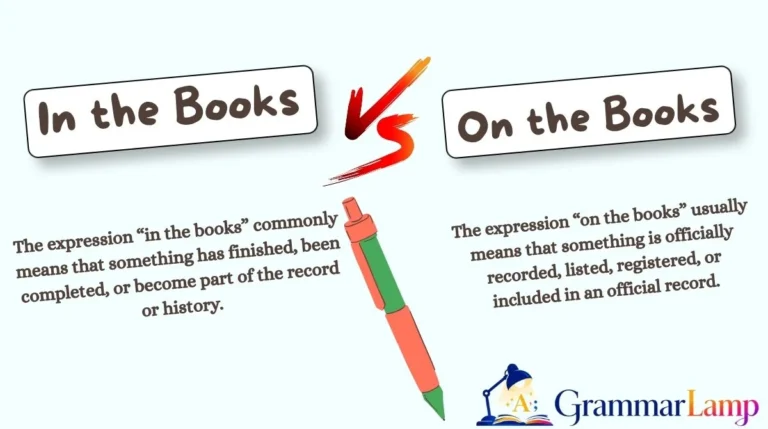
The expression “in the books” commonly means that something has finished, been completed, or become part of the record or history. It often looks back at something rather than describing something that is currently active.
For example:
The school year is finally in the books.
This means the school year has ended.
Another example is:
Our biggest project is now in the books.
This means the project has been completed and is now something the speaker can look back on.
The phrase is frequently heard in sports and everyday conversation. A game, season, tournament, event, or achievement can be described as in the books after it has ended.
When Should You Use “In the Books”?
Use “in the books” when you want to show that an event, task, period, or achievement is finished or concluded.
It works especially well with things such as:
- a game
- a match
- a season
- a school year
- a project
- an event
- a trip
- an achievement
- a difficult period
- a completed experience
The expression often has a feeling of looking backward.
You are saying, in simple terms, “That is finished now. It is part of the past.”
Grammar Rule for “In the Books”
The basic pattern is:
Subject + be + in the books
For example:
The tournament is in the books.
Another busy week is in the books.
The project is now in the books.
You can also use it with words such as now, finally, or already.
The final exam is finally in the books.
Another year is now in the books.
The long trip is finally in the books.
The phrase normally follows a form of be, although natural sentences can vary depending on the context.
Examples of “In the Books”
Here are some easy examples:
- The football season is finally in the books.
The season has ended. - Our annual meeting is now in the books.
The meeting is finished. - That was a difficult week, but it is in the books now.
The difficult week has passed. - The final exam is in the books.
The exam is over. - We completed the project, so another job is in the books.
The project has been completed. - The championship game is in the books.
The game has finished and the result is final. - After six months of work, the new building project is in the books.
The project has been completed. - Our family vacation is officially in the books.
The vacation is over.
A Common Learner Confusion
A learner may see the word “books” and assume the expression means that something is simply written inside a book.
Sometimes a literal meaning is possible, but when people use “in the books” as an idiom, they often mean finished, concluded, or recorded as part of past events.
For example:
The match is in the books.
This does not mean the match is physically inside a book. It means the match is finished and can now be regarded as part of the record.
There is also another expression you should not confuse with this one:
He is in my good books.
Here, “in my good books” means that the person has your approval or a good opinion of them. That is a different idiom.
What Does “On the Books” Mean?
The expression “on the books” usually means that something is officially recorded, listed, registered, or included in an official record.
This expression is very common in business, organizations, employment, administration, and law.
For example:
She is still on the books at the company.
This means the company still officially lists her as an employee.
Another example:
There are several laws on the books about workplace safety.
Here, the phrase means those laws are officially part of the legal record. Cambridge lists “officially employed” and, in U.S. usage, “officially recorded, especially as a law” among the meanings of “on the books.”
When Should You Use “On the Books”?
Use “on the books” when the important idea is official listing or official record.
You might use it for:
- employees
- members
- clients
- customers
- laws
- rules
- regulations
- accounts
- projects
- contracts
- debts
- official records
For example:
The company has 200 employees on the books.
This means 200 employees are officially listed by the company.
Similarly:
The old law is still on the books.
This means the law remains officially recorded in the legal system.
Collins also defines the expression as meaning recorded, listed, or enrolled.
Grammar Rule for “On the Books”
A common sentence pattern is:
Subject + be + on the books
For example:
The employee is on the books.
The law is still on the books.
Several clients are on the books.
You can also place the phrase after verbs such as have, keep, or put, depending on the sentence.
The company has 50 workers on the books.
The agency keeps hundreds of clients on the books.
The new rule is now on the books.
Examples of “On the Books”
- The company has 150 employees on the books.
They are officially listed as employees. - She is still on the books, even though she is on leave.
She remains officially employed. - The club has more than 300 members on the books.
They are officially registered members. - There are several old laws still on the books.
Those laws remain officially recorded. - The hospital has dozens of specialists on the books.
They are officially connected with or listed by the hospital. - We have three major clients on the books this month.
Those clients are officially recorded by the business. - The new regulation is now on the books.
It has officially been added to the legal record. - The organization has several volunteers on the books.
They are officially registered with the organization.
Common Learner Confusion
Many learners think “on the books” means something is physically sitting on top of a book.
That is only a literal interpretation of the words. As an idiom, “on the books” usually has nothing to do with the physical position of an object.
When a manager says:
We have 25 employees on the books.
the manager is talking about an official list or record.
The same is true when someone says:
That law is still on the books.
The law is officially recorded. It is not sitting on top of a pile of books.
Difference Between “In the Books” and “On the Books” (Detailed)
The easiest way to understand the difference is to ask one simple question:
Are you talking about something that has been completed, or something that is officially listed?
If the focus is completion or looking back at a finished event, “in the books” often fits.
If the focus is official listing, registration, or an existing record, “on the books” usually fits.
Comparison Table
| Expression | Main Meaning | Common Use | Example |
|---|---|---|---|
| In the books | Finished, completed, or part of the past record | Events, games, seasons, projects, achievements | The season is in the books. |
| On the books | Officially recorded, listed, or registered | Employees, members, laws, rules, clients | She is on the books. |
Usage Difference
Compare these two sentences:
The football season is in the books.
The football club has 24 players on the books.
The first sentence talks about a finished season.
The second sentence talks about people officially listed by the club.
That is the central difference.
Grammar Logic
The prepositions help create two different ideas.
In often gives the feeling of being inside a record or completed history.
On in “on the books” is linked with being entered on a list, register, or official record.
This is not a rule that you can apply to every use of the words in and on in English. These are established expressions, so it is best to learn each phrase as a complete unit.
Sentence Structure Difference
For “in the books,” the subject is often a completed event or period:
The tournament is in the books.
Another year is in the books.
The project is finally in the books.
For “on the books,” the subject is often a person, organization, law, account, rule, or other item that is officially listed:
She is on the books.
The new law is on the books.
We have 100 members on the books.
Meaning Comparison
Think of the expressions this way:
In the books looks backward.
On the books usually points to an official record.
For example:
The 2026 tournament is in the books.
The tournament is finished.
The team has 22 players on the books.
The players are officially listed with the team.
Both expressions are connected to records, but the speaker is focusing on a different part of that idea.
Explore More Posts
Imbalanced vs Disbalanced: What Is the Difference? (2026)
Orientated vs Oriented: What’s the Difference? [2026 Guide]
Do You vs Are You: What’s the Difference? Complete Guide for 2026
Dateline vs Deadline: Meaning, Difference, Examples & Easy Rules (2026)
Grammar Rules You Must Remember
Rule 1: Use “In the Books” for Completed Events
When something has ended or been completed, “in the books” can show that it is now part of the past record.
The school year is in the books.
The school year has ended.
Another successful season is in the books.
The season is finished.
Rule 2: Use “On the Books” for Official Lists and Records
When someone or something is officially listed, recorded, or registered, use “on the books.”
The company has 80 employees on the books.
They are officially listed as employees.
The club has 500 members on the books.
They are officially registered members.
Rule 3: Laws and Rules Commonly Use “On the Books”
When talking about laws, especially in American English, “on the books” can mean officially recorded in law.
The law is still on the books.
Several safety regulations are on the books.
The focus is not that the law has finished. The focus is that it exists as an official legal record.
Rule 4: Do Not Choose the Preposition by Translation Alone
Many learners translate in and on from their first language and then choose the phrase that sounds logical.
That can cause mistakes.
Instead, remember the complete expressions:
In the books → finished or recorded as part of history
On the books → officially listed or recorded
For example:
The event is in the books.
The employee is on the books.
Learning the whole phrase is much more useful than trying to translate each word separately.
Common Mistakes Students Make
These mistakes usually happen because the two phrases are so similar.
Mistake 1: Using “On the Books” for a Finished Event
Incorrect:
The match is on the books.
When you mean the match has ended, this is usually not the natural expression.
Better:
The match is in the books.
The second sentence clearly gives the idea of completion.
Mistake 2: Using “In the Books” for an Official Employee Record
Incorrect:
She is in the books at the company.
Better:
She is on the books at the company.
Here, you are talking about official employment records, so “on the books” fits the meaning.
Mistake 3: Saying “The Law Is in the Books”
A learner might say:
The law is in the books.
That can be understood in a literal context, but when you mean that the law is officially part of the legal system, the standard idiomatic expression is:
The law is on the books.
The phrase “on the books” is especially common for laws and regulations.
Mistake 4: Thinking the Phrases Are Interchangeable
They are related, but they are not normally interchangeable.
Compare:
The conference is in the books.
Meaning: the conference is finished.
The conference is on the books.
This could suggest that the conference is officially scheduled or recorded, depending on context, but it does not normally give the same “finished” meaning.
Easy Correction Tip
Before choosing the phrase, ask:
“Is it finished?”
If yes, in the books may be the right choice.
Then ask:
“Is it officially listed or recorded?”
If yes, on the books is usually the better choice.
Easy Trick to Remember the Difference
Here is a simple memory trick:
IN = It has ended and is IN the record.
Think:
IN the books = IN the past record.
For example:
The 2026 season is in the books.
You are looking back at a season that has finished.
ON = It is ON an official list.
Think:
ON the books = ON the official record/list.
For example:
The employee is on the books.
The employee’s name is officially listed.
You can also remember the difference with two questions:
In the books: “What has been completed?”
On the books: “What is officially listed?”
This works well because it focuses on the meaning rather than the individual prepositions.
Imagine a football team.
At the end of the year, you can say:
Another season is in the books.
But when talking about the people officially registered with the club, you can say:
The club has 25 players on the books.
One is about a finished event. The other is about an official record.
Daily Life Examples (Very Important)
These expressions become much easier when you see them in ordinary conversations.
1. Talking About a Sports Season
A: Did your team finish the season yesterday?
B: Yes. The final game ended last night.
A: So another season is in the books.
Here, “in the books” means the season has finished.
2. Talking About a Work Project
A: How is the new office project going?
B: We finished everything on Friday.
A: Great. Another big project in the books.
The project is complete.
3. Talking About Employees
Manager: How many people work for us now?
Assistant: We have 75 employees on the books.
This means 75 employees are officially listed.
4. Talking About a Law
A: Can this old law still be enforced?
B: Yes, as far as I know, it is still on the books.
The speaker is talking about its official legal status.
5. Talking About a School Year
Student: How do you feel after the final exam?
Friend: Relieved! Another school year is in the books.
The year has ended.
6. Talking About Members
A: How many members does the club have?
B: We have about 400 people on the books.
The members are officially registered.
7. Talking About a Difficult Week
A: That week looked stressful.
B: It was, but it is finally in the books.
The difficult week is over.
8. Talking About Clients
A: How many active clients does the agency have?
B: We currently have 60 clients on the books.
The clients are officially listed in the agency’s records.
9. Talking About an Event
A: Did the conference go well?
B: Yes, and now it is in the books.
The conference is finished.
10. Talking About a Team
A: Is Daniel still working with the club?
B: Yes. He is still on the books.
He remains officially listed with the club.
Practice Section
Choose the correct option: in the books or on the books.
1.
The final match is finally ______.
A. in the books
B. on the books
2.
The company has 120 workers ______.
A. in the books
B. on the books
3.
That old regulation is still ______.
A. in the books
B. on the books
4.
After months of work, the project is ______.
A. in the books
B. on the books
5.
Our club has more than 500 members ______.
A. in the books
B. on the books
Answers
1. A — in the books
The match is finished.
2. B — on the books
The workers are officially listed.
3. B — on the books
The regulation is officially recorded.
4. A — in the books
The project has been completed.
5. B — on the books
The members are officially registered or listed.
More Helpful posts
Whole vs Hole: Meaning, Difference, Examples, and Easy Rules (2026)
Farther vs Further: The Easy Difference Explained for 2026
In Development vs Under Development: Meaning, Differences, and Examples (2026)
Non-Restrictive Clauses: Meaning, Rules, Examples & Differences in 2026
FAQs
What is the difference between “in the books” and “on the books”?
“In the books” commonly means something has been completed or is now part of the record of past events. “On the books” usually means something is officially listed, registered, or recorded. The first often looks backward at something finished, while the second focuses on an official record.
Can “in the books” be used in questions?
Yes. You can use it naturally in questions when asking whether something has been completed or recorded as finished.
Is the project in the books yet?
Is the season already in the books?
The exact meaning depends on the context, but the idea is usually completion.
Is “on the books” formal or informal?
“On the books” can be used in both everyday and formal settings. It is common in business, organizations, employment, and legal discussions. For laws and official records, it can sound quite natural in serious or professional English.
Can I say “The law is in the books”?
People may understand the sentence, especially in a literal context, but “the law is on the books” is the normal idiomatic expression when you mean that a law is officially recorded or remains part of the legal code.
Does “in the books” always mean finished?
No. The phrase can have other meanings in different contexts, especially when the word books appears in another idiom. For example, “in my good books” means being liked or approved of. But the common expression “in the books” meaning an event is finished refers to something concluded and now part of the record.
Why do “in” and “on” change the meaning so much?
English has many fixed expressions where a small preposition changes the whole meaning. You cannot always understand these expressions by translating each individual word. With these phrases, it is better to learn the full pattern: “in the books” = completed/part of the record, while “on the books” = officially listed or recorded.
Final Conclusion
The difference between “in the books” and “on the books” is small in spelling but important in meaning.
Use “in the books” when you are talking about something that has been completed, finished, or placed in the record of past events.
It is common after a game, season, project, school year, or major event.
Use “on the books” when you mean something is officially listed, registered, or recorded. This is common for employees, members, clients, laws, rules, and other official records.
A simple memory trick can help:
In the books = finished.
On the books = officially listed.
Once you start noticing these phrases in sports, business, news, and everyday conversations, the difference will feel much more natural.
Practice making your own sentences, and soon you will not need to stop and think about which preposition to choose.

Liam Derren is a language writer at GrammarLamp, creating simple, helpful content about grammar, words, and everyday English. He makes language learning clear, practical, and easy to understand.
2 thoughts on “In the Books vs On the Books: Meaning, Difference & Examples (2026)”