
Many English learners get confused when they see or hear “you is” and “you are.” The confusion often comes from a simple idea: “is” sounds singular, while “you” can talk about one person. So why can’t we say “you is”?
It is a good question, especially for beginners.
The important rule is that Standard English uses “are” after “you,” whether “you” means one person or more than one person.
We say “You are my friend” when talking to one person, and we also say “You are my friends” when talking to several people. Cambridge and the British Council both show “you” with the verb form are in standard English grammar.
This small grammar rule matters a lot in everyday English. You use you are when describing someone, asking questions, talking about feelings, explaining where someone is, and much more.
By the end of this guide, you will know exactly when to use you are, why you is is usually not correct in Standard English, how to form questions and negative sentences, and why you may sometimes hear “you is” in songs, dialogue, or some varieties of English.
More Useful posts
In the Books vs On the Books: Meaning, Difference & Examples (2026)
Promulgate vs Propagate: Meaning, Difference & Examples (2026 Guide)
Sneek vs Sneak: Which Spelling Is Correct in 2026?
In vs Into vs On vs Onto: Easy Grammar Rules and Examples in 2026
What Does “You Is” Mean?
Simple Definition
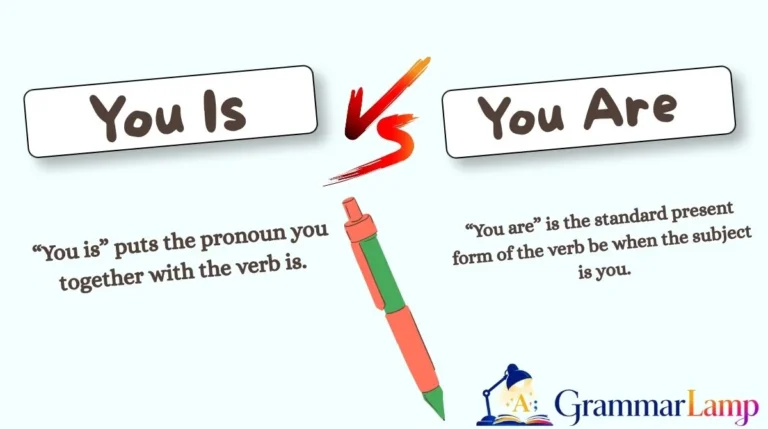
“You is” puts the pronoun you together with the verb is.
For example:
You is happy.
However, this is not the standard form used in modern Standard English. In standard grammar, the correct sentence is:
You are happy.
The form is normally goes with third-person singular subjects such as he, she, and it.
We say:
- He is tired.
- She is ready.
- It is cold.
But with you, we use are:
- You are tired.
- You are ready.
- You are cold.
The British Council gives the same basic pattern: I am, you are, he/she/it is, we are, they are.
When Would You Hear “You Is”?
A learner may hear “you is” in certain kinds of speech. It can appear in some nonstandard varieties of English or in dialogue where a writer wants to reproduce a particular way of speaking. Linguistic sources also note that some nonstandard varieties use different patterns for the verb be.
That does not make it the normal form for learners to use in Standard English.
For school writing, exams, work emails, professional conversations, and normal formal English, use you are.
Examples of “You Is” and Their Standard Forms
Here are some examples:
- Nonstandard: You is very kind.
Standard: You are very kind. - Nonstandard: You is late today.
Standard: You are late today. - Nonstandard: You is my best friend.
Standard: You are my best friend. - Nonstandard: You is doing a great job.
Standard: You are doing a great job. - Nonstandard: You is ready for school.
Standard: You are ready for school. - Nonstandard: You is very funny.
Standard: You are very funny. - Nonstandard: You is at the wrong door.
Standard: You are at the wrong door. - Nonstandard: You is responsible for this.
Standard: You are responsible for this.
Common Learner Confusion
The biggest reason learners make this mistake is that they connect singular “you” with is.
For example, a learner may think:
He is a student.
She is a student.
You is a student.
But English does not work that way.
Although you can refer to only one person, it still takes are.
So:
You are a student.
The number of people does not change the verb from are to is.
What Does “You Are” Mean?
Simple Definition
“You are” is the standard present form of the verb be when the subject is you.
It can describe a person, a group, a condition, a location, an identity, or a situation.
For example:
You are happy.
Here, you is the subject and are is the verb.
When to Use “You Are”
Use you are when talking directly to one person or more than one person in the present.
You can use it with:
A noun:
You are a teacher.
An adjective:
You are tired.
A place or prepositional phrase:
You are in the office.
A condition or situation:
You are in trouble.
The verb be is commonly used with noun phrases, adjectives, prepositional phrases, and other structures.
Eight Easy Examples
- You are my friend.
- You are very helpful.
- You are late for class.
- You are a good student.
- You are in the kitchen.
- You are ready for the test.
- You are stronger than you think.
- You are welcome here.
Notice that are stays the same in every sentence.
It does not matter whether you means one person:
You are my brother.
or several people:
You are my brothers.
In both cases, the verb is are. Cambridge describes you as a second-person pronoun that can be singular or plural.
Common Forms of “You Are”
In everyday speech, you are is often shortened to you’re.
For example:
You are right.
You’re right.
You are busy.
You’re busy.
You are very kind.
You’re very kind.
The contraction you’re is common in spoken and informal English. Cambridge lists ’re as the contracted form of are with you, we, and they.
Difference Between “You Is” and “You Are”
This is where the main grammar rule becomes very clear.
| Phrase | Standard English? | Meaning | Example |
|---|---|---|---|
| You is | Usually no | Nonstandard form or dialectal use | You is late. |
| You are | Yes | Refers to one or more people | You are late. |
| You’re | Yes | Short form of “you are” | You’re late. |
1. The Main Usage Difference
In Standard English, use:
You are
Do not normally replace are with is just because you refers to one person.
Correct:
You are my teacher.
Incorrect in Standard English:
You is my teacher.
Correct:
You are very kind.
Incorrect in Standard English:
You is very kind.
2. The Grammar Logic
This rule may seem strange at first because is is often connected with singular subjects.
For example:
The boy is happy.
The girl is happy.
The dog is hungry.
So learners naturally expect:
You is happy.
But you is special.
Modern English uses you for both singular and plural second-person reference. The same you can refer to one listener or a group.
Because of that, English uses are with you in both cases.
So remember:
One person: You are
Many people: You are
That is the key.
3. Sentence Structure Difference
The standard sentence pattern is:
You + are + information
For example:
You are tired.
You are a student.
You are at home.
You are ready.
For questions, the verb moves before the subject:
Are + you + information?
Examples:
Are you tired?
Are you ready?
Are you at home?
The British Council specifically gives Are you…? as the standard question pattern with you.
4. Meaning Comparison
There is no special standard-English meaning that makes you is correct when speaking to one person.
The standard sentence:
You are smart.
has the same intended basic meaning as the nonstandard:
You is smart.
The difference is grammatical form and variety of English, not the basic idea being expressed.
For a learner, the safe rule is simple: use “you are” in Standard English.
Grammar Rules You Must Remember
Rule 1: “You” Always Takes “Are” in Standard English
When you is the subject and you are using the present form of be, use are.
Examples:
You are happy.
You are my friend.
You are late.
You are a good worker.
Do not let the fact that you are talking to one person confuse you.
One person can still be:
You are…
Rule 2: “You” Can Be Singular or Plural
This is one of the most important things to understand.
When you speak to one person:
Sarah, you are very kind.
When you speak to several people:
Sarah and Ali, you are very kind.
The word you is the same.
The verb is also the same:
You are.
English does not normally change the verb form based on whether you means one person or several people.
Rule 3: Questions Use “Are You,” Not “Is You”
To make a simple present question with you, put are before you.
Correct:
Are you okay?
Are you busy?
Are you coming?
Are you ready?
Incorrect in Standard English:
Is you okay?
Is you busy?
Is you ready?
The question pattern is:
Are + you + rest of sentence?
This is true whether you are talking to one person or a group:
Are you ready, Ahmed?
Are you ready, everyone?
Rule 4: Negative Sentences Use “Are Not” or “Aren’t”
When you make a negative sentence with you, use:
You are not…
or
You aren’t…
Examples:
You are not late.
You aren’t late.
You are not wrong.
You aren’t wrong.
You are not alone.
You aren’t alone.
Do not say:
You is not late.
or
You isn’t late.
In Standard English, the correct forms are you are not, you aren’t, or you’re not. The British Council lists these negative patterns for you.
Explore More Posts
Couple of Hours vs Couple Hours: Which Is Correct in 2026?
Canceled vs Cancelled: Which Spelling Is Correct in 2026?
Ambiance vs Ambience: Meaning, Difference, Usage & Examples in 2026
Compared To vs As Compared To (2026): Meaning, Difference & Correct Usage
Common Mistakes Students Make
Mistake 1: Thinking Singular Means “Is”
This is probably the most common problem.
A student learns:
He is
She is
It is
Then they see one person being addressed as you and think:
You is
But you has its own verb pattern.
Correct:
You are my friend.
Not:
You is my friend.
Mistake 2: Saying “Is You…?” in Questions
Learners may translate directly from their first language and produce:
Is you ready?
The correct form is:
Are you ready?
A useful habit is to memorize common question phrases as complete chunks:
Are you okay?
Are you busy?
Are you ready?
Are you sure?
Are you free?
After hearing these many times, the pattern becomes natural.
Mistake 3: Mixing “You Are” With “He Is”
Look at this comparison:
He is tired.
You are tired.
She is at home.
You are at home.
It is cold.
You are cold.
The noun or pronoun before the verb matters.
He, she, it → is
You → are
Mistake 4: Forgetting the Contraction
Some learners understand you are but get confused by you’re.
Remember:
You’re = You are
Examples:
You’re welcome. = You are welcome.
You’re right. = You are right.
You’re late. = You are late.
Do not confuse you’re with your.
You’re = you are
Your = shows possession
For example:
You’re very kind.
but:
Your car is outside.
Cambridge identifies you as a pronoun and your as a different grammatical form used before a noun.
Easy Correction Tip
Whenever you want to say you + be, quickly ask yourself:
“Is my subject you?”
If the answer is yes, choose:
are
That one small check can prevent many mistakes.
Easy Trick to Remember the Difference
Here is a simple memory trick:
“You and Are Are Best Friends.”
Whenever you see the subject you, connect it with are.
Think:
You → Are
Say it aloud:
You are.
You are.
You are.
Now add different words:
You are happy.
You are busy.
You are ready.
You are right.
You are at home.
This works because you train your brain to remember the two words together instead of thinking about the rule every time.
Real-Life Logic
Imagine you are talking to your friend:
“You are my friend.”
You would not stop and think about whether your friend is one person or not. English simply uses are with you.
Now imagine talking to a whole group:
“You are my friends.”
Again:
You are
Same subject word. Same verb.
One person or ten people, the form stays the same.
A Quick Memory Line
Keep this sentence in your head:
You are — always are.
Then remember the related forms:
I am
You are
He is
She is
It is
We are
They are
This pattern is especially useful for beginners.
Daily Life Examples
Here are natural examples you can hear and use in everyday conversations.
Example 1: At School
Teacher: Are you ready for the test?
Student: Yes, I am.
Notice that the question uses Are you…?
Example 2: Talking to a Friend
Ali: You are very quiet today.
Hamza: I didn’t sleep well last night.
Here, you are describes Hamza’s current condition.
Example 3: Asking About Location
Mother: Where are you?
Son: I’m in my room.
The natural question is Where are you?, not Where is you?
Example 4: Giving Encouragement
Friend: I can’t do this.
You: You are stronger than you think.
This is a very common use of you are.
Example 5: Talking to a Group
Coach: You are ready for the match.
Here you refers to several players, but the verb is still are.
Example 6: At Work
Manager: Are you available this afternoon?
Employee: Yes, I am.
Again, are is used with you.
Example 7: Making a Negative Statement
Friend: Am I late?
You: No, you aren’t.
The negative form is aren’t, not isn’t.
Example 8: Giving Directions
**You are on the wrong street. Turn left at the next corner.
This sentence uses you are to describe someone’s current location.
Example 9: Everyday Compliment
**You are really good at explaining things.
This sounds natural and normal in spoken English.
Example 10: Casual Spoken English
**You’re right. I forgot the meeting.
Here, you’re is simply the short form of you are.
Practice Section
Choose the correct answer in each sentence.
1. ___ very helpful.
A. You is
B. You are
2. ___ ready for dinner?
A. Is you
B. Are you
3. ___ not late.
A. You are
B. You is
4. ___ a good student.
A. You are
B. You is
5. Where ___?
A. is you
B. are you
Answers
1. B — You are
You are very helpful.
2. B — Are you
Are you ready for dinner?
3. A — You are
You are not late.
4. A — You are
You are a good student.
5. B — are you
Where are you?
A good way to improve is to say the complete sentences aloud. Do not only choose the answer. Speaking the correct pattern helps you remember it.
More Helpful posts
Gone to Soon vs Gone Too Soon: Which Is Correct? (2026 Guide)
Stayed vs Staid: Meaning, Difference, Examples & Easy Rules in 2026
Newfound vs New-Found: Which Is Correct in 2026?
Over Time vs Overtime: Meaning, Difference, Examples & Rules in 2026
FAQs
What is the difference between “you is” and “you are”?
In Standard English, you are is the correct form. You is is generally nonstandard and may occur in some dialects or stylized speech. For normal speaking, schoolwork, exams, and professional writing, use you are.
Can we use “you are” for one person?
Yes. This is a very important rule. You can refer to one person or several people, and are is used in both cases.
For example:
You are my brother.
and:
You are my brothers.
Both are correct.
Can we use “you are” in questions?
Yes. In questions, the normal structure is Are you…?
Examples include:
Are you tired?
Are you busy?
Are you ready?
Where are you?
The form “Is you…?” is not standard English.
Is “you’re” the same as “you are”?
Yes. You’re is the contraction of you are.
For example:
You’re late.
means:
You are late.
It is very common in everyday speech and informal writing.
Is “you is” formal or informal English?
“You is” is not the normal Standard English form, so it should not be used as a replacement for “you are” in formal or standard writing. You may hear it in certain nonstandard varieties or see it in dialogue written to represent a particular style of speech.
Why does “you” use “are” even when it means one person?
English uses you for both singular and plural second-person reference. Unlike some languages, Standard English does not normally give singular you a separate form of the present-tense verb be. Therefore, we use you are for both one person and more than one person.
Conclusion
The difference between “you is” and “you are” becomes easy once you remember one basic rule: in Standard English, “you” goes with “are.”
It does not matter whether you are talking to one person or a whole group. You say:
You are my friend.
and:
You are my friends.
The same rule appears in questions:
Are you ready?
and in negative sentences:
You aren’t late.
You may sometimes hear “you is” in songs, character dialogue, or nonstandard varieties of English, but that is different from the standard grammar learners normally need for school, work, and everyday communication.
The best way to remember the rule is simple:
You → are
Practice a few sentences every day, especially common phrases like “You are right,” “Are you okay?” and “You’re welcome.” After enough practice, choosing are will feel automatic.

Liam Derren is a language writer at GrammarLamp, creating simple, helpful content about grammar, words, and everyday English. He makes language learning clear, practical, and easy to understand.
1 thought on “You Is vs You Are: Which Is Correct in 2026? Simple Grammar Guide”