
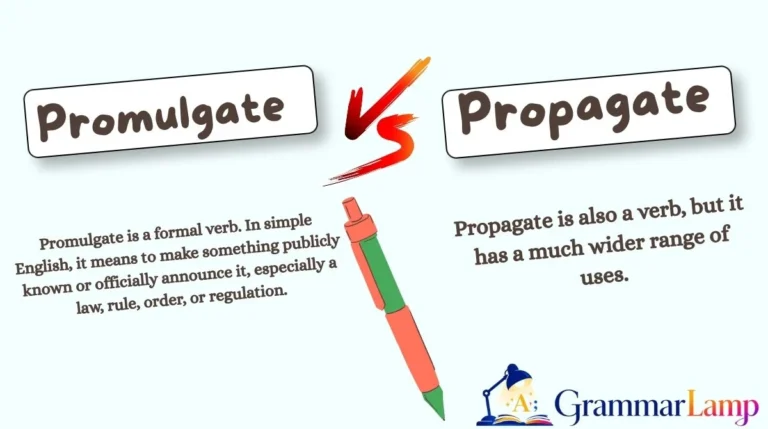
Promulgate and propagate look very similar. Both are formal verbs, and both can be used when talking about spreading something. That is why English learners often mix them up.
The main difference is the kind of “spreading” they describe. Promulgate is commonly used when a government, organization, authority, or person makes a law, rule, idea, or belief known to the public.
Cambridge Dictionary describes promulgate as formally announcing something publicly, especially a new law, and it can also mean spreading beliefs or ideas.
Propagate, on the other hand, has a much wider meaning. It can mean spreading an idea, opinion, rumor, or belief from one person or place to another.
It can also mean producing new plants, reproducing plants or animals, or spreading waves such as sound and light.
This difference becomes much easier when you look at the situation around the word. A government may promulgate a new law, while a social media user may propagate a rumor.
A gardener may propagate a rose plant, but you would not normally use promulgate for that.
By the end of this guide, you will know what each word means, how to use it, how their grammar works, and how to choose the right word in everyday and formal English.
More Useful posts
I’m vs I Am: Complete Difference, Rules, Examples & Usage Guide 2026
Sun vs Son: Meaning, Difference, Rules, and Examples (2026)
A Majority of vs The Majority of: Easy Grammar Guide for 2026
Tomatoes or Tomatos: Which Spelling Is Correct? [2026]
What Does “Promulgate” Mean?
Promulgate is a formal verb. In simple English, it means to make something publicly known or officially announce it, especially a law, rule, order, or regulation.
Cambridge Dictionary lists two closely related uses. One is to announce something publicly, especially a new law. The other is to spread beliefs or ideas among many people.
Think about an official announcement.
A government passes a law. Then the law has to be made known. In formal language, the government can promulgate the law. The focus is on the official act of making it public or formally issuing it.
When should you use “promulgate”?
Use promulgate when the subject is something such as:
- a law
- a regulation
- a rule
- an order
- an official policy
- a doctrine or belief
- an idea that is being publicly spread
It is a formal word, so it is more common in legal, government, academic, and official writing than in casual conversation.
For example, instead of saying:
The government announced the new regulation.
A formal document might say:
The government promulgated the new regulation.
Both sentences can communicate the same basic event, but promulgated sounds much more formal.
Grammar rule for “promulgate”
Promulgate is normally a transitive verb, which means it usually takes an object.
Subject + promulgate + object
Examples:
The government promulgated the new law.
The minister promulgated the regulations.
The agency promulgated new safety rules.
The thing being made public comes after the verb.
8 Examples of “Promulgate”
- The government promulgated a new environmental law last year.
- The court issued an order and later promulgated the rules.
- The agency plans to promulgate new safety regulations.
- The president signed the act before it was officially promulgated.
- The organization promulgated a code of conduct for its members.
- The ministry promulgated the policy after a long review.
- The teacher tried to promulgate the idea that every student could improve.
- The new regulations were promulgated in an official notice.
Common learner confusion with “promulgate”
Many learners think promulgate simply means “to spread.” That is not completely wrong, because spreading ideas is one of its meanings. But the word often carries a sense of formal or public announcement.
Compare these:
The government promulgated the new law.
This sounds natural because a government authority is officially making a law public.
My friend promulgated a funny story at lunch.
This sounds unnatural in normal conversation. Shared, told, or spread would usually be better.
The safest way to remember it is this:
Promulgate often goes with official information.
When you see a law, regulation, order, or formal policy, promulgate may be the word you need.
What Does “Propagate” Mean?
Propagate is also a verb, but it has a much wider range of uses.
In everyday terms, propagate means to spread something from one person, place, or thing to another. It can refer to ideas and beliefs, but it can also refer to plants, animals, sound, light, and other physical processes.
For ideas, propagate means to spread them among many people.
For plants, it can mean to produce a new plant from a parent plant. Cambridge gives examples such as propagating houseplants from stem cuttings.
This gives propagate a much broader meaning than promulgate.
When should you use “propagate”?
You can use propagate when talking about:
- opinions
- beliefs
- ideas
- rumors
- lies
- information
- plants
- animal reproduction
- sound waves
- light waves
- signals or similar things in technical contexts
When propagate means spreading opinions, ideas, lies, or beliefs, it is generally a formal word.
Grammar rule for “propagate”
When it means spreading something, it can work as:
Subject + propagate + object
Examples:
They propagated the rumor.
The group propagated false information.
The campaign propagated a new idea.
But propagate can also be intransitive in some contexts.
For example:
Plants propagate quickly.
And in physics:
Light propagates through space.
Cambridge identifies both transitive and intransitive uses in its plant and physics meanings.
8 Examples of “Propagate”
- Social media can propagate rumors very quickly.
- The group used posters to propagate its message.
- Some websites propagate false information.
- Gardeners often propagate plants from cuttings.
- You can propagate this plant from a healthy stem.
- Under the right conditions, these plants propagate quickly.
- Sound waves propagate through the air.
- The signal can propagate over a long distance.
Common learner confusion with “propagate”
The biggest problem is that learners often connect propagate only with plants.
That is understandable because plant propagation is a common technical use. However, propagate can also mean spread, especially in formal writing.
For example:
The article propagated a false belief.
Here, nobody is growing a plant. The word means that the belief was spread.
Also notice that propagate does not necessarily mean something is officially announced.
The government promulgated the regulation.
The government is officially making the regulation public.
Social media users propagated the rumor.
The users are spreading the rumor from one person to another.
That difference is very important.
Difference Between Promulgate and Propagate
The two words overlap when they both mean spread, but they are not interchangeable in every sentence.
The easiest distinction is this:
Promulgate = officially announce or make public, especially a law or rule.
Propagate = spread or reproduce, often from one source to many others.
Here is a quick comparison.
| Feature | Promulgate | Propagate |
|---|---|---|
| Main idea | Make something public or officially announce it | Spread or reproduce something |
| Common objects | Laws, rules, regulations, policies, doctrines | Ideas, beliefs, rumors, plants, signals, waves |
| Formality | Formal | Often formal when used for ideas |
| Official meaning | Very strong | Not necessary |
| Plants | No | Yes |
| Animals | Rarely/No | Yes |
| Waves/signals | No | Yes |
| Ideas | Yes | Yes |
| Laws | Very common | Possible in a different sense, but not the usual choice |
| Intransitive use | Generally not the usual pattern | Yes, in some meanings |
Usage difference
Imagine that a government creates a new law.
The law needs to be formally announced or issued.
The government promulgated the law.
Now imagine people start sharing an opinion about that law online.
Thousands of users propagated the idea.
The first sentence focuses on the official public announcement. The second focuses on the spread of information or an idea.
Grammar logic
Both words can take a direct object.
With promulgate:
The authority promulgated the regulation.
With propagate:
The website propagated the rumor.
But the verbs do different jobs.
Promulgate tells us that something was formally put before the public.
Propagate tells us that something was spread, reproduced, or carried onward.
That is why these sentences have different natural meanings:
The government promulgated the new regulations.
The newspaper propagated the story.
The government sentence sounds official. The newspaper sentence focuses on transmission or spread.
Sentence structure difference
The most common structure for promulgate is:
Subject + promulgate + official thing
Examples:
The ministry promulgated the rules.
The agency promulgated the policy.
For propagate, the structure depends on the meaning.
For spreading an idea:
Subject + propagate + idea/message/belief
The group propagated its beliefs.
For plants:
Subject + propagate + plant
The gardener propagated the rose from a cutting.
For intransitive use:
Subject + propagate
The plants propagated naturally.
For waves:
Subject + propagate + through/in + place or medium
Sound propagates through the air.
Meaning comparison
There is one sentence type where the two words may look very close:
The organization promulgated a religious belief.
The organization propagated a religious belief.
The first can suggest that the organization officially proclaimed or publicly promoted the belief.
The second focuses more on spreading the belief.
So even when both verbs are possible, the emphasis can change.
A useful question to ask is:
Was it officially announced, or was it mainly spread?
Official announcement → promulgate
General spread → propagate
Explore More Posts
Honor or Honour: What Is the Difference? A Simple Guide for 2026
Collaborate vs Corroborate: Meaning, Difference, and Examples in 2026
Sleeve vs Sleave: Which Is Correct? Meaning, Difference, and Examples in 2026
Time off vs time-off: The Complete Grammar Guide for 2026
Grammar Rules You Must Remember
Rule 1: Use “promulgate” for official laws, rules, and regulations.
This is one of the strongest patterns to remember.
The government promulgated the new law.
The department promulgated new regulations.
The word is especially common in legal and official writing.
Rule 2: Use “propagate” when something is spread from one source to many people or places.
It works naturally with ideas, rumors, opinions, lies, and beliefs.
Social media can propagate rumors within minutes.
The website propagated false information.
The focus is the spread itself rather than an official act.
Rule 3: Use “propagate” for plants and reproduction.
This meaning has nothing to do with laws or official announcements.
She learned how to propagate plants from cuttings.
These plants propagate easily.
Cambridge specifically includes producing a new plant from a parent plant as a meaning of propagate.
Rule 4: In technical English, “propagate” can describe waves and signals.
This use is common in science and engineering.
Sound waves propagate through the air.
The signal propagates along the cable.
Cambridge lists this specialized physics meaning for light, sound waves, and movement.
Common Mistakes Students Make
Because the two verbs look almost alike, students often choose one based on spelling instead of meaning.
Mistake 1: Using “propagate” for a law
Incorrect or unnatural for the intended official meaning:
The government propagated the new tax law.
This could be understood as spreading information about the law, but it does not naturally express the formal act of issuing or publicly announcing the law.
Better:
The government promulgated the new tax law.
Mistake 2: Using “promulgate” for plant growth
Wrong:
I promulgated my rose plant from a cutting.
Correct:
I propagated my rose plant from a cutting.
Plant reproduction is a specific use of propagate.
Mistake 3: Thinking “promulgate” always means “spread”
Students sometimes learn:
promulgate = spread
and then use it everywhere.
That creates problems.
She promulgated a rumor among her friends.
The sentence is grammatically understandable, but spread would be much more natural in casual English.
She spread a rumor among her friends.
Promulgate is more formal and is especially useful when the information is presented publicly or officially.
Mistake 4: Thinking “propagate” only belongs to science
Some learners see the word in gardening or physics and assume it cannot be used for language.
But this is perfectly possible:
The speaker propagated a harmful stereotype.
Here, propagated means spread.
Easy correction tips
Before choosing the verb, look at the noun after it.
If you see:
law / regulation / rule / official policy
→ think promulgate
If you see:
rumor / idea / belief / opinion / false information
→ think propagate
If you see:
plant / cutting / reproduction
→ think propagate
If you see:
sound / light / wave / signal
→ think propagate
This simple noun-based method can help you choose the correct verb much faster.
Easy Trick to Remember the Difference
Here is a simple memory trick:
Promulgate = Public + Official
Think of a government standing before the public and officially announcing something.
Promulgate → public announcement → law/rule
For example:
The government promulgated the new regulation.
Now think about something moving outward from one source.
Propagate = Pass Along
A rumor starts with one person. Then another person hears it. Then another person repeats it.
The information keeps moving.
The rumor propagated across the town.
The same idea works with plants. One plant can produce new plants. The original plant becomes a source for more plants.
So remember:
Promulgate = make officially public.
Propagate = spread, reproduce, or travel onward.
There is also a useful visual trick.
Imagine two scenes.
In the first scene, a government official holds up a new law and announces it. That is promulgate.
In the second scene, one person tells another, then another, then another. The message spreads. That is propagate.
When you picture the action, the difference becomes easier to remember.
Daily Life Examples (Very Important)
Here are natural examples that show how the two words work in context.
1. Talking about a new law
A: Did the government announce the new law?
B: Yes. It was officially promulgated last week.
The focus is the formal public announcement.
2. Sharing a rumor
A: Why does everyone know that rumor?
B: Someone posted it online, and people propagated it very quickly.
The information moved from person to person.
3. Gardening
A: How did you get so many plants?
B: I propagated them from cuttings.
Here, propagate means producing new plants.
4. Workplace rules
A: When did the company issue the new safety rules?
B: The company promulgated them at the start of the month.
The word sounds formal because company rules are being officially issued.
5. False information
A: Is that claim true?
B: I don’t think so. Several websites have propagated it without checking the facts.
The websites are spreading the claim.
6. An official policy
A: Has the new policy been released?
B: Yes, the ministry promulgated the policy yesterday.
This is formal administrative English.
7. A belief
A: Why is that belief so common?
B: It was propagated for years through books and social media.
The focus is long-term spread.
8. Sound in science
A: How does sound reach us?
B: Sound waves propagate through the air.
This is a technical use of propagate.
9. A classroom example
Teacher: Why should we be careful with rumors?
Student: Because one person can start a rumor, and many others can propagate it.
10. Public announcement
A: Why does the document use the word “promulgated”?
B: Because it is talking about an official regulation being formally made public.
These examples show why context matters so much. The words may look similar, but the action is different.
Practice Section
Choose the correct word: promulgate or propagate.
1.
The government plans to ________ the new regulations next month.
2.
Some websites continue to ________ false claims online.
3.
She learned how to ________ her favorite houseplants from cuttings.
4.
The department officially ________ the new workplace rules.
5.
Sound waves ________ through different materials at different speeds.
Answers
- promulgate
- propagate
- propagate
- promulgated
- propagate
The first and fourth sentences involve official rules or regulations. The others describe spreading, reproduction, or wave movement.
More Helpful posts
Afterward or Afterwards? Meaning, Difference, and Correct Usage in 2026
A MA or an MA Degree? The Correct Grammar Rule in 2026
A or an: Easy Rules, Examples, and Common Mistakes in 2026
From My End or From My Side? Which Is Correct in English? (2026 Guide)
FAQs
What is the difference between promulgate and propagate?
Promulgate usually means to officially announce or make something public, especially a law, rule, or regulation. Propagate usually means to spread something, such as an idea, belief, rumor, or false claim. Propagate can also mean producing plants or describing the movement of waves.
Can we use promulgate in questions?
Yes. You can use promulgate in formal questions, especially when asking about a law or regulation. For example: “When was the new regulation promulgated?” This sounds formal and would fit legal, government, or academic writing.
Is promulgate a formal word?
Yes. Cambridge marks promulgate as formal. It is especially useful in legal, government, and official contexts. In ordinary conversation, simpler verbs such as announce, issue, or make public are often more natural.
Is propagate only used for plants?
No. Propagate has several meanings. It can mean spreading opinions, beliefs, rumors, and information. It can also describe plant reproduction and the movement of light or sound waves.
Can promulgate and propagate both be used with ideas?
Yes, sometimes. Both can describe spreading ideas or beliefs. However, promulgate can suggest formally declaring or publicly promoting an idea, while propagate puts more emphasis on spreading it from one person or place to another.
Which word is used for a new law: promulgate or propagate?
For the official act of publicly announcing or formally issuing a new law, promulgate is the natural formal choice. Propagate could describe people spreading information or opinions about the law, but it does not carry the same official meaning.
Conclusion
Promulgate vs propagate becomes much easier once you focus on the action instead of the similar spelling.
Use promulgate when something is being officially announced, especially a law, regulation, rule, order, or formal policy. It is a formal word and is common in legal and government writing.
Use propagate when something is being spread, passed on, reproduced, or carried forward. It can describe ideas, beliefs, rumors, plants, animal reproduction, and even sound or light waves in technical language.
A simple memory line can help: promulgate is about making something public or official; propagate is about spreading or reproducing something.
The best way to learn the difference is to practice with real sentences. Once you notice the kind of noun that follows each verb, choosing the right word becomes much more natural.

Liam Derren is a language writer at GrammarLamp, creating simple, helpful content about grammar, words, and everyday English. He makes language learning clear, practical, and easy to understand.
1 thought on “Promulgate vs Propagate: Meaning, Difference & Examples (2026 Guide)”