
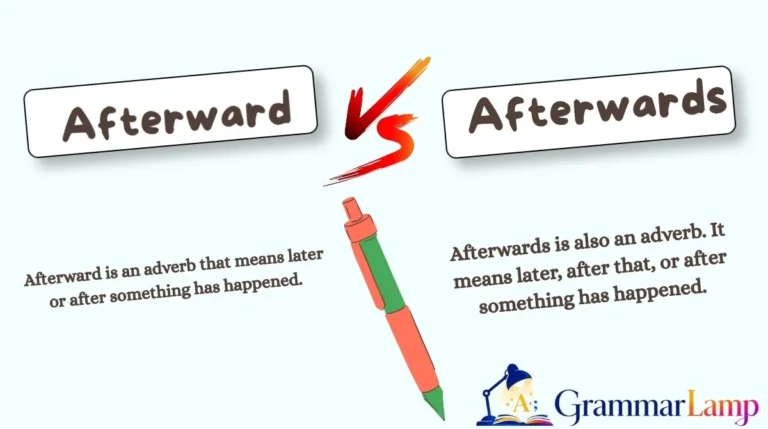
Many English learners become confused when they see afterward in one sentence and afterwards in another.
Both words look almost the same, and both talk about something that happens later. So, is one correct and the other wrong?
The good news is that the difference is much smaller than it may seem. Afterward and afterwards are both adverbs, and they usually have the same meaning: later or after something has happened.
Use up and down arrow keys to resize the meta box pane.
Move upMove downShow or hide panel
Use up and down arrow keys to resize the meta box pane.
Move upMove downShow or hide panel
For example:
- We went home afterward.
- We went home afterwards.
Both sentences are grammatically correct. The main difference is not their meaning but their regional preference.
Afterward is especially common in American English, while afterwards is very common in British English and is also widely used in other varieties of English.
This small difference matters because learners often think that one form must be grammatically wrong. That can lead to unnecessary mistakes when writing emails, school assignments, conversations, or online content.
By the end of this guide, you will understand exactly what afterward and afterwards mean, where to place them in a sentence, how they differ in American and British English, and which one you should choose in different situations.
You will also see simple examples from everyday English so you can start using these words naturally.
The easiest point to remember is this: both forms are correct, and both normally mean “later.”
What Does “Afterward” Mean?
Afterward is an adverb that means later or after something has happened.
It is used when you mention an action or event that happens after another event. You do not usually need to repeat the event after the word because the context already tells us what happened first.
For example:
We had dinner and went for a walk afterward.
Here, afterward means after dinner.
Another example is:
She finished her exam and called her mother afterward.
The word afterward tells us that the phone call happened after the exam.
When should you use “afterward”?
Use afterward when you want to say that something happens later than an earlier event.
It can refer to a short period of time or a longer period. The exact amount of time depends on the situation.
For example:
I felt tired afterward.
This could mean the speaker felt tired immediately after an activity, or it could refer to a later point understood from the conversation.
Afterward is particularly common in American English. It is completely standard and grammatical.
Grammar rule for “afterward”
Afterward is an adverb. It can describe when an action happens.
It can appear at different positions in a sentence, depending on the sentence structure and emphasis.
For example:
We talked afterward.
Afterward, we talked about the problem.
We went to a café afterward.
The basic meaning remains the same.
Examples with “afterward”
- We watched a movie and had dinner afterward.
- She apologized afterward.
- I was very tired afterward.
- They went home afterward.
- We can talk about it afterward.
- He called me afterward to explain what happened.
- Afterward, everyone went back to work.
- I didn’t understand the decision at first, but I understood it afterward.
A common learner confusion
Some learners believe that afterward must be followed by a noun.
That is not true.
You do not say:
❌ We went afterward the meeting.
Instead, you can say:
✅ We went home afterward.
Or, if you want to name the event directly, use after:
✅ We went home after the meeting.
This is an important difference.
After can work as a preposition before a noun:
after school
after dinner
after the meeting
But afterward is an adverb:
We went home afterward.
So, do not treat afterward as a direct replacement for the preposition after.
What Does “Afterwards” Mean?
Afterwards is also an adverb. It means later, after that, or after something has happened.
In most situations, you can replace afterward with afterwards without changing the basic meaning.
For example:
We had dinner and went for a walk afterwards.
This means the same thing as:
We had dinner and went for a walk afterward.
The major difference is regional usage. Afterwards is especially common in British English.
When should you use “afterwards”?
Use afterwards when you want to refer to an action that happens later.
It is useful in everyday conversation, stories, explanations, and general writing.
For example:
I went to the bank and came home afterwards.
The word tells the listener that coming home happened after going to the bank.
You can also use it at the beginning of a sentence:
Afterwards, we went to the park.
Again, it means later or after that.
Grammar rule for “afterwards”
Like afterward, afterwards is an adverb.
It does not normally take a noun immediately after it.
For example:
❌ We went afterwards the class.
Instead:
✅ We went home afterwards.
Or:
✅ We went home after the class.
Examples with “afterwards”
- We had lunch and went shopping afterwards.
- She felt better afterwards.
- They talked about the problem afterwards.
- I called him afterwards.
- We can decide what to do afterwards.
- Afterwards, everyone went home.
- He realized his mistake afterwards.
- She finished the interview and wrote down some notes afterwards.
A common learner confusion
Many students see the -s at the end of afterwards and assume it must be plural.
It is not plural.
The -s does not mean that there are several “afterwards.” It is simply part of the adverb.
The same kind of confusion can happen with other words ending in -s, but grammatical form and meaning are not always connected to plural nouns.
So:
afterward = correct
afterwards = correct
The choice depends mainly on English variety and personal or regional preference.
Difference Between Afterward and Afterwards
The most important fact is simple: afterward and afterwards usually mean exactly the same thing.
Both mean later, after that, or at a later time.
The difference is mainly about regional usage and style rather than grammar or meaning.
| Point | Afterward | Afterwards |
|---|---|---|
| Part of speech | Adverb | Adverb |
| Basic meaning | Later; after that | Later; after that |
| Meaning difference | Usually none | Usually none |
| American English | Very common | Also used |
| British English | Used | Very common |
| Formal writing | Correct | Correct |
| Everyday speech | Correct | Correct |
| Can come at the beginning? | Yes | Yes |
| Can come at the end? | Yes | Yes |
The main usage difference
If you are writing for an American audience, afterward may sound more natural.
For example:
We went home afterward.
This is very natural in American English.
In British English, you are more likely to hear:
We went home afterwards.
But this is a preference, not a strict grammar rule.
A British speaker can use afterward, and an American speaker can use afterwards.
Is one more correct?
No.
It would be incorrect to say:
“Afterwards is wrong.”
It is not wrong.
It would also be incorrect to say:
“Afterward is only American and cannot be used in British English.”
That is too strict.
The better way to understand the difference is:
Afterward is more strongly associated with American English, while afterwards is particularly common in British English.
Sentence structure
Both words can be placed in similar positions.
At the end:
We talked afterward.
We talked afterwards.
At the beginning:
Afterward, we went home.
Afterwards, we went home.
After another action:
She finished her work and rested afterward.
She finished her work and rested afterwards.
The sentence structure does not change just because you choose the version with -s.
Meaning comparison
Consider these two sentences:
I went to the doctor and called my brother afterward.
I went to the doctor and called my brother afterwards.
There is no meaningful difference in time. In both sentences, the phone call happened after the doctor’s visit.
This is why you should not spend too much time trying to find a hidden difference in meaning. There usually isn’t one.
Grammar Rules You Must Remember
Rule 1: Both “afterward” and “afterwards” are correct
You can use either form to mean later or after that.
We had dinner afterward.
We had dinner afterwards.
Both sentences are correct.
The choice is usually based on regional English or personal style.
Rule 2: Do not put a noun directly after “afterward” or “afterwards”
This is one of the most common mistakes.
Do not write:
❌ We went home afterward the meeting.
Instead, use after before a noun:
✅ We went home after the meeting.
Or use afterward without the noun:
✅ We went home afterward.
Think of the difference this way:
after + noun
after the meeting
after lunch
after school
afterward/afterwards + sentence context
We went home afterward.
We went home afterwards.
Rule 3: Both forms can appear at the beginning or end of a sentence
You do not have to place these words in only one position.
For example:
Afterward, we went to a restaurant.
Or:
We went to a restaurant afterward.
The same applies to afterwards:
Afterwards, we went to a restaurant.
We went to a restaurant afterwards.
At the beginning, a comma is commonly used after the introductory adverb.
Rule 4: Choose one form and be consistent
There is no need to use both forms randomly in the same piece of writing.
If you prefer afterward, use it consistently.
If your website or school follows British English, afterwards may fit better.
Consistency makes your writing look cleaner.
For example, if you are writing an article in American English, you might use:
The students finished the test and checked their answers afterward.
There is no reason to switch to afterwards in the next paragraph unless you have a particular reason.
Common Mistakes Students Make
Learners often make mistakes with these words because they look like after, but their grammar is different.
Mistake 1: Using “afterward” before a noun
Incorrect:
❌ We met afterward the class.
Correct:
✅ We met after the class.
Or:
✅ We met afterward.
The problem is that afterward is an adverb, while after can be a preposition.
Mistake 2: Thinking “afterwards” is incorrect
Some students learn afterward first and then assume that afterwards is a mistake.
It is not.
Correct:
We talked afterward.
Correct:
We talked afterwards.
Both are standard English.
Mistake 3: Thinking the two words have different meanings
Usually, they do not.
Incorrect idea:
“Afterward means immediately later, but afterwards means much later.”
There is no general grammar rule like this.
The surrounding context tells us how much time has passed.
For example:
I called her afterward.
The call might have happened five minutes later or several hours later. The word itself does not give an exact amount of time.
Mistake 4: Confusing “after” and “afterward”
Compare:
We went home after the movie.
Here, after is followed by the noun phrase the movie.
Now compare:
We went home afterward.
Here, afterward stands alone as an adverb.
A quick correction tip is to ask:
Am I naming the event after this word?
If yes, use after:
after the meeting
If no, and you mean “later,” use afterward or afterwards:
We left afterward.
Easy Trick to Remember the Difference
Here is a simple memory trick:
AFTER + THING
AFTERWARD(S) = LATER
If you have a noun after the word, use after.
after school
after dinner
after the game
after the meeting
If you mean later, use afterward or afterwards.
We went home afterward.
We went home afterwards.
You can also remember it with a simple question:
“After what?”
If you can answer with a thing or event, use after.
After what?
After the meeting.
If you are simply saying later, use afterward(s).
When did you call?
I called afterward.
Think of afterward as a shortcut for after that.
For example:
We finished dinner. Afterwards, we watched TV.
You can understand it as:
We finished dinner. After that, we watched TV.
This trick is especially useful for beginners.
Daily Life Examples of Afterward and Afterwards
These words are very common in real conversations. Here are examples that you might actually hear or use in daily English.
1. After a meal
A: Are you going home after dinner?
B: Yes. I’ll call you afterward.
Here, afterward means after dinner.
2. After school
A: What are you doing after school?
B: I’m going to the library, and I’ll meet my friends afterwards.
The speaker uses afterwards to mean after going to the library.
3. After a movie
We watched a movie and talked about it afterward.
The conversation happened after the movie.
4. After work
I’m busy right now. Can we talk afterwards?
Here, afterwards means later, after the current activity.
5. After an exam
I was nervous before the exam, but I felt much better afterward.
The feeling happened after the exam.
6. After shopping
We went shopping and had coffee afterwards.
Coffee came later than shopping.
7. After a meeting
We had a long meeting. Afterward, everyone went back to their desks.
The word connects the two events clearly.
8. After an argument
They had an argument, but they apologized to each other afterwards.
The apology happened later.
9. After exercising
I usually drink a lot of water afterward.
The word refers to the exercise session.
10. After visiting someone
We visited our grandparents and went home afterwards.
Going home happened after the visit.
These examples show something important: afterward and afterwards are useful because they help you connect events without repeating the whole phrase.
Instead of saying:
We went to the restaurant, and after we went to the restaurant, we went home.
You can simply say:
We went to the restaurant and went home afterward.
That sounds much more natural.
Practice Section: Choose the Correct Option
Choose afterward or afterwards in each sentence.
Remember: in most cases, both forms are grammatically possible. The purpose of this exercise is to help you become comfortable with both.
1.
We had breakfast and went for a walk ________.
Answer: afterward / afterwards
2.
She finished her homework and watched TV ________.
Answer: afterward / afterwards
3.
________, we talked about what had happened.
Answer: Afterward / Afterwards
4.
I went to the dentist and went back to work ________.
Answer: afterward / afterwards
5.
They finished the meeting. ________, they went home.
Answer: Afterward / Afterwards
Notice that the answers can generally be either form. The important skill is knowing that these words mean later and function as adverbs.
Now try a different type of question.
Choose “after” or “afterward”
6. We went home ________ the movie.
Answer: after
Why? Because the movie is a noun phrase.
7. We went home ________.
Answer: afterward or afterwards
Why? Because there is no noun after the word, and it means later.
This distinction is more important than choosing between afterward and afterwards.
Frequently Asked Questions
What is the difference between “afterward” and “afterwards”?
There is usually no difference in meaning. Both are adverbs meaning later or after that.
The main difference is regional preference. Afterward is especially common in American English, while afterwards is especially common in British English.
Is “afterwards” grammatically correct?
Yes. Afterwards is completely correct standard English.
It is widely used, particularly in British English. You can use it in conversation and writing.
For example:
We went for lunch afterwards.
There is nothing grammatically wrong with this sentence.
Is “afterward” more formal than “afterwards”?
No. The difference is not mainly about formality.
Both words can be used in casual conversation and formal writing. The choice is more closely connected with regional English and personal style.
Can I use “afterward” in British English?
Yes. British speakers can and do use afterward.
However, afterwards is often more familiar and common in British English. If you are following British English style, afterwards may feel more natural.
Can I use “afterwards” in American English?
Yes. American English speakers understand afterwards, and it is not grammatically wrong.
However, afterward is generally more common in American English.
Can “afterward” be used at the beginning of a sentence?
Yes.
For example:
Afterward, we went home.
It can also appear at the end:
We went home afterward.
The same is true for afterwards.
Is “afterward” the same as “later”?
They are often very close in meaning, but they are not always interchangeable.
Later is a broader word meaning at a time after now or after another point.
Afterward specifically connects something to an earlier event or action.
For example:
I’ll call you later.
But:
We finished dinner and went home afterward.
Afterward vs. Afterwards: Which One Should You Use?
If you are still unsure which form to choose, do not worry. You have two correct options.
Choose afterward if you prefer American English or want a shorter form.
Choose afterwards if you prefer British English or naturally use that form.
For an English-learning website, it is helpful to teach both because learners may encounter either one while reading books, watching videos, studying online, or speaking with people from different countries.
The most important thing is not to think of them as two completely different words.
They are simply two forms with the same basic meaning.
Compare:
We went home afterward.
and
We went home afterwards.
Both mean:
We went home after that.
The sentence is correct either way.
What you should focus on is the difference between after and afterward(s).
Compare:
We went home after the party.
We went home afterward.
The first sentence names the event. The second sentence refers back to an event that has already been mentioned or is understood from context.
Once you understand this point, the whole topic becomes much easier.
Conclusion
Afterward and afterwards are both correct English words. They are adverbs that usually mean later or after that. In most sentences, they can replace each other without changing the meaning.
The main difference is regional preference. Afterward is especially common in American English, while afterwards is particularly common in British English. Neither form is automatically more correct.
The bigger grammar lesson is understanding the difference between after and afterward(s).
Use after when it is followed by a noun or noun phrase, such as after school, after dinner, or after the meeting. Use afterward or afterwards when you mean later or after that, as in We went home afterward.
If you are learning English, try using these words in simple daily sentences. Talk about what you did after breakfast, after work, after school, or after a meeting. A little practice will make the choice feel natural.
And remember the easiest rule: after + thing; afterward(s) = later.

Liam Derren is a language writer at GrammarLamp, creating simple, helpful content about grammar, words, and everyday English. He makes language learning clear, practical, and easy to understand.
1 thought on “Afterward or Afterwards? Meaning, Difference, and Correct Usage in 2026”