
Creek vs creak is a common English confusion because these two words sound exactly the same in many varieties of English.
When you hear someone say creek or creak, you cannot always know which word they mean. You have to understand the context.
The spelling and meaning, however, are completely different. Creek is usually a noun for a small stream of water. Creak describes a long, high-pitched, unpleasant sound, often made by something old, heavy, or moving slowly.
A door can creak, a wooden floor can creak, and an old chair can creak when someone sits on it.
This small difference matters in writing. If you write “I heard a creek from the old door,” your reader may wonder why a stream of water is coming from the door. The correct sentence is “I heard a creak from the old door.”
The good news is that the difference is easy once you connect each word with a clear image.
By the end of this guide, you will know what creek means, what creak means, how their grammar works, how to avoid common spelling mistakes, and how to choose the right word quickly in everyday English.
Afterward or Afterwards? Meaning, Difference, and Correct Usage in 2026
A MA or an MA Degree? The Correct Grammar Rule in 2026
A or an: Easy Rules, Examples, and Common Mistakes in 2026
From My End or From My Side? Which Is Correct in English? (2026 Guide)
What Does “Creek” Mean?
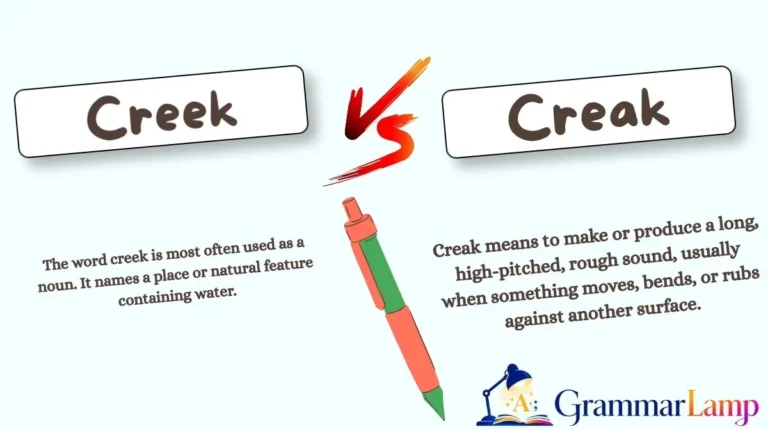
The word creek is most often used as a noun. It names a place or natural feature containing water.
For example:
- We walked beside a creek in the forest.
- There is a small creek behind our house.
- The children played near the creek.
- We crossed the creek using a wooden bridge.
- The water in the creek was very cold.
- Fish were swimming in the creek.
- Heavy rain caused the creek to rise.
- They built a small bridge over the creek.
The easiest way to understand creek is to think of water.
If you can imagine a small stream moving through a forest, field, village, or valley, creek is probably the word you need.
When Should You Use “Creek”?
Use creek when you are talking about a small natural waterway.
It can be used in many situations:
We had lunch beside the creek.
Here, creek refers to the small stream.
The road crosses a creek.
Again, the word describes a body of water.
Be careful near the creek after heavy rain.
The creek may become deeper or faster after rain.
In some places, especially in the United States, creek is also used in names of waterways. For example, a place may be called something like Pine Creek or Clear Creek.
Grammar Rule for “Creek”
Creek is normally a countable noun.
That means you can use a, an, the, numbers, and plural forms with it.
- a creek
- the creek
- two creeks
- several creeks
Examples:
We found a creek near the campsite.
The village has three creeks.
They crossed the creek before sunset.
The plural form is creeks, not creeks with any special change in spelling. Simply add -s.
Common Learner Confusion
The biggest problem is that creek sounds like creak.
Imagine this sentence:
We sat beside the creek.
You hear /kriːk/. Now imagine:
The old door began to creak.
The final sound is also /kriːk/ in many accents.
The meanings are completely different, even though the pronunciation can be the same.
A useful question is:
“Am I talking about water?”
If the answer is yes, choose creek.
What Does “Creak” Mean?
Creak means to make or produce a long, high-pitched, rough sound, usually when something moves, bends, or rubs against another surface.
Unlike creek, creak can be both a verb and a noun.
As a verb, it describes the action of making the sound.
The old door creaked when I opened it.
As a noun, it refers to the sound itself.
I heard a loud creak upstairs.
The sound is often associated with old wooden doors, floors, stairs, beds, chairs, gates, and furniture.
Examples of “Creak” as a Verb
- The door creaked as I opened it.
- The wooden floor creaks at night.
- The stairs creaked under his feet.
- The old chair creaked when she sat down.
- The gate creaked in the wind.
- The bed creaked when he moved.
- The floorboard creaked beneath me.
- The rusty hinge creaked loudly.
Notice that the word changes according to the tense.
- Present: creak
- Third-person singular: creaks
- Past: creaked
- -ing form: creaking
For example:
The door creaks whenever the wind blows.
The door creaked when I pushed it.
I could hear the door creaking upstairs.
Examples of “Creak” as a Noun
When creak is a noun, it means one sound or the sound itself.
- I heard a creak in the hallway.
- There was a strange creak behind me.
- The chair made a loud creak.
- A sudden creak came from the stairs.
- We heard the creak of the wooden door.
- The old floor gave a creak.
- Every movement produced a creak.
- I woke up when I heard a creak downstairs.
Grammar Rule for “Creak”
Creak can be a verb or a noun.
As a verb:
The door creaked.
As a noun:
I heard a creak.
This is an important difference from creek, which is normally used as a noun when it means a small stream.
Common Learner Confusion
Students sometimes use creek when they mean a sound.
For example:
❌ The old door made a creek.
✅ The old door made a creak.
The first sentence suggests a small stream, not a noise.
You can remember that creak is connected with things that make a strange noise when they move.
Difference Between Creek and Creak (Detailed)
The simplest difference is this:
Creek = a small stream of water.
Creak = a long, unpleasant sound.
They may sound the same, but their meanings, spellings, and grammatical uses are different.
Comparison Table
| Feature | Creek | Creak |
|---|---|---|
| Meaning | A small stream of water | A rough, high-pitched sound |
| Main use | Usually a noun | Noun and verb |
| Related to | Water, nature, streams | Doors, floors, chairs, stairs, hinges |
| Example noun | We crossed the creek. | I heard a creak. |
| Example verb | Not normally used as this meaning | The door creaked. |
| Plural | creeks | creaks |
| Past tense | — | creaked |
| -ing form | — | creaking |
| Sound | Usually pronounced like “creak” | Usually pronounced like “creek” |
Usage Difference
Use creek when the subject is a small waterway.
We walked along the creek.
Use creak when the subject is a sound.
We heard a creak from the old house.
Use creak as a verb when something produces that sound.
The wooden floor creaked.
Grammar Logic
This is where the difference becomes especially useful.
Creek usually answers the question:
What place or natural feature is this?
Example:
Where are you going?
I’m going to the creek.
Creak answers questions about sounds or actions.
What did you hear?
I heard a creak.
Or:
What did the door do?
It creaked.
Sentence Structure Difference
With creek, common structures include:
subject + verb + the creek
We crossed the creek.
near/beside/along + the creek
They walked beside the creek.
With creak, common structures include:
subject + creak
The door creaked.
subject + made + a creak
The chair made a creak.
hear + a creak
I heard a creak upstairs.
This difference in sentence structure can help you choose the correct spelling.
To Discuss or Discuss About: Which Is Correct? | Easy Grammar Guide 2026
Upmost vs Utmost: Meaning, Difference, and Correct Usage in 2026
Seam vs Seem: Difference, Meaning, Examples & Grammar Rules (2026)
All the Time vs Every Time: Meaning, Difference, Rules & Examples (2026)
Grammar Rules You Must Remember
Rule 1: Use “creek” for a small stream of water
If you are talking about flowing water, use creek.
We found a beautiful creek in the forest.
Think about rivers, streams, bridges, fishing, water, and nature.
Rule 2: Use “creak” for a strange or rough sound
If you are talking about a noise made by an object, use creak.
The old stairs made a loud creak.
The sound often comes from wood, metal, hinges, or other objects that move.
Rule 3: “Creak” can be a verb
When something produces the sound, creak can describe its action.
The door creaked open.
The floor creaked under my feet.
You can change the verb into different forms:
The floor creaks.
The floor creaked.
The floor is creaking.
Rule 4: “Creek” and “creak” can sound the same
Do not depend only on pronunciation.
In many English accents:
creek = /kriːk/
creak = /kriːk/
They are examples of homophones: words that have the same pronunciation but different meanings and spellings.
Context tells you which word is correct.
We sat beside the creek.
The old chair began to creak.
The surrounding words make the meaning clear.
Common Mistakes Students Make
Mistake 1: Using “creek” for a sound
❌ The door made a loud creek.
✅ The door made a loud creak.
Why does this happen? Both words sound the same, so learners often choose the spelling they remember first.
Correction tip: If it is a noise, think creak.
Mistake 2: Using “creak” for a stream
❌ We walked beside a beautiful creak.
✅ We walked beside a beautiful creek.
The sentence is about water, so creek is correct.
Correction tip: Water = creek.
Mistake 3: Forgetting that “creak” can be a verb
Some learners only use creak as a noun.
They may write:
❌ The door made a creak when I opened it.
This sentence is grammatically correct, but a more natural option can be:
✅ The door creaked when I opened it.
Both forms are possible. The verb often makes the sentence more direct.
Mistake 4: Thinking the spelling should match the sound
English spelling is not always predictable.
Because creek and creak can have the same pronunciation, listening alone cannot tell you which one to write.
When writing, ask yourself what the word means.
Small stream? → creek
Sound? → creak
Mistake 5: Confusing “creak” with other sound words
A creak is not simply any sound.
A door might creak, while a dog might bark and a phone might ring.
Creak is especially common for a rough, high-pitched sound made by something moving or under pressure.
Easy Trick to Remember the Difference
Here is a very simple memory trick:
Creek has water. Creak has a noise.
Imagine the word creek next to a little stream.
Creek → water → stream
Now imagine an old wooden door opening slowly.
Creak → door → noise
There is another useful clue in the spelling.
The “ea” in creak appears in many words connected with sounds or actions, but don’t try to build a complicated spelling rule from this. English has many exceptions.
Instead, use the meaning.
Ask yourself:
Can I put water near this word?
If yes:
We walked beside the creek.
If not, and you are describing a noise:
The door began to creak.
This method is much safer than trying to guess the spelling from pronunciation.
Daily Life Examples
These examples show how the two words work in natural spoken English.
1. Talking about nature
“Where are the children?”
“They’re playing near the creek.”
The word refers to a small stream.
2. Talking about an old house
“Did you hear that?”
“Yes. The stairs creaked.”
Here, creaked is a verb describing the sound.
3. Talking about a walk
“We walked along the creek this morning.”
The sentence is about a natural waterway.
4. Talking about a bedroom door
“Why did you wake up?”
“I heard the door creak.”
The word describes a sound.
5. Talking about a chair
“Be careful with that chair.”
“Why?”
“It creaks whenever someone sits on it.”
6. Talking about a campsite
“There’s a small creek behind the campsite.”
The word refers to water.
7. Talking about an old floor
“This floor is so old. It creaks whenever I walk.”
The word is a verb.
8. Talking about a strange noise
“What was that?”
“I don’t know. I heard a creak downstairs.”
Here, creak is a noun because it names the sound.
9. Talking about a bridge
“We crossed the creek using that little bridge.”
Again, the word means a small stream.
10. Talking about a gate
“The gate creaked when the wind pushed it.”
The gate produces a rough sound, so creaked is correct.
Practice Section
Choose creek or creak to complete each sentence.
1.
We sat beside the small ______ and watched the fish.
2.
The old door began to ______ when I opened it.
3.
I heard a strange ______ from the hallway.
4.
They built a bridge across the ______.
5.
The wooden stairs ______ every time someone walks upstairs.
Answers
- creek
- creak
- creak
- creek
- creak
A quick check can help you remember:
- Water → creek
- Sound → creak
Crews vs Cruise (2026): What’s the Difference? Easy Grammar Guide with Examples
Everything vs Every Thing: Easy Difference, Rules, Examples & Practice (2026)
All Is vs All Are: Which One Is Correct? Complete Grammar Guide for 2026
At the Weekend or On the Weekend? 2026 Guide to British and American English
FAQs
1. What is the difference between creek and creak?
Creek is usually a noun meaning a small stream of water. Creak refers to a rough, high-pitched sound and can be either a noun or a verb. For example, “We crossed the creek” and “The door creaked.”
2. Are creek and creak pronounced the same?
Yes, in many English accents they are pronounced the same: approximately /kriːk/. They are homophones, which means they have the same pronunciation but different meanings and spellings.
3. Can we use “creak” in questions?
Yes. Creak can be used naturally in questions.
For example: “Did you hear that door creak?” You can also use the noun: “Did you hear a creak?” Both are correct, but their sentence structures are different.
4. Is “creak” formal or informal?
Creak is a normal everyday English word. It is neither especially formal nor especially informal. You can use it in conversations, stories, school writing, and general descriptions.
5. Is a creek the same as a river?
Not exactly. A creek is generally a smaller stream or waterway than a river. However, the exact use of creek can vary by country and region, so the boundaries between terms such as creek, stream, and river are not always strict.
6. Why do students confuse creek and creak?
The main reason is pronunciation. In many accents, both words sound exactly alike. Because listening does not reveal the spelling, learners need to use the meaning and context: creek relates to water, while creak relates to a sound.
Conclusion
The difference between creek vs creak is simple once you connect each word with its meaning.
Creek is a small stream or waterway. You might walk beside a creek, fish in a creek, or cross a creek on a bridge.
Creak is connected with sound. A door can creak, a wooden floor can creak, and an old chair can make a creak. Remember that creak can work as both a noun and a verb.
The tricky part is pronunciation. In many accents, creek and creak sound the same. That means you cannot always choose the spelling by listening. You need to think about the meaning.
When you see or hear the word, ask one quick question: “Is this about water or sound?” Water means creek. Sound means creak.
Keep using these words in your own sentences. After a little practice, choosing the correct spelling will become automatic.

Liam Derren is a language writer at GrammarLamp, creating simple, helpful content about grammar, words, and everyday English. He makes language learning clear, practical, and easy to understand.
3 thoughts on “Creek vs Creak: Meaning, Difference, Examples & Easy Rules (2026)”