
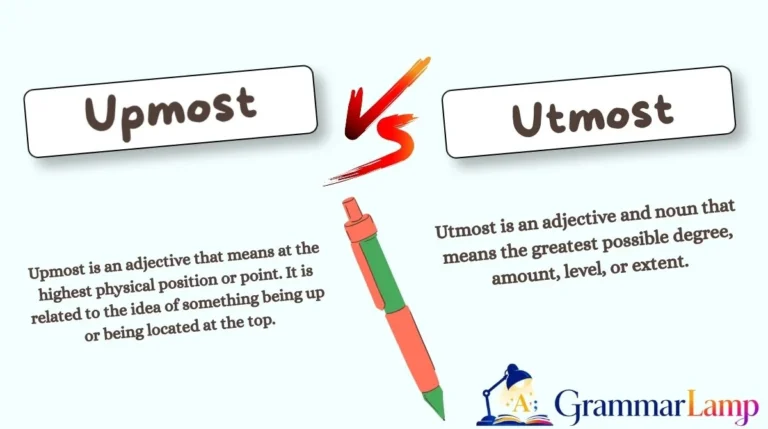
Upmost vs utmost is a common source of confusion for English learners. The two words look almost the same, and both are pronounced in a similar way.
Because of this, many students use upmost when they actually mean utmost.
The confusion becomes even stronger because upmost is a real English word. It is not simply a spelling mistake.
However, it has a much more limited meaning and is far less common than utmost. In everyday English, utmost is usually the word you need when you want to say “the greatest,” “the highest,” or “the maximum.”
You may hear or read expressions such as “with the utmost care,” “to the utmost,” and “the utmost importance.” These phrases are common in formal and everyday writing.
On the other hand, upmost is mainly used when talking about something physically positioned at the top or highest point.
Knowing this small difference can make your English much more accurate. It can also help you avoid a mistake that many learners make in emails, school assignments, business writing, and conversations.
By the end, you will know what upmost means, what utmost means, how their grammar works, and how to choose the correct word without guessing.
What Does “Upmost” Mean?
Upmost is an adjective that means at the highest physical position or point. It is related to the idea of something being up or being located at the top.
The word is much less common than utmost, and native speakers often use other expressions such as uppermost, topmost, or highest instead.
For example, if you are describing objects arranged vertically, you can use upmost to refer to the one at the highest position.
When should you use “upmost”?
Use upmost when you are talking about a physical location or position at the top.
For example:
The book was on the upmost shelf.
Here, the meaning is about physical position. The book is on the shelf at the highest point.
Another example is:
A small flag was attached to the upmost part of the pole.
Again, the word describes a physical location.
However, upmost is not normally used to mean “greatest effort,” “greatest importance,” or “highest level of care.” Those meanings belong to utmost.
Examples of “upmost”
- The bird was sitting on the upmost branch of the tree.
- He placed the box on the upmost shelf.
- A small light was fixed to the upmost part of the tower.
- Snow covered the upmost peaks of the mountain.
- The flag could be seen at the upmost point of the building.
- The climber finally reached the upmost section of the rock.
- The decoration was hanging from the upmost branch of the Christmas tree.
- The eagle flew toward the upmost part of the cliff.
These examples all involve the idea of physical height or position.
A common learner confusion
Many students think upmost means “the greatest” because the word contains up, which can suggest something high or important.
For example, a learner might write:
We must give this matter our upmost attention.
This sentence is incorrect in standard modern English. The correct expression is:
We must give this matter our utmost attention.
The problem is that attention is not a physical object with a position. You are talking about the greatest possible level of attention, so utmost is required.
A useful question is:
“Am I talking about physical position, or am I talking about degree or intensity?”
If it is physical position, upmost may work. If it is degree, effort, importance, care, or intensity, choose utmost.
What Does “Utmost” Mean?
Utmost is an adjective and noun that means the greatest possible degree, amount, level, or extent.
It is much more common than upmost.
When you say something deserves your utmost attention, you mean it deserves the greatest possible attention. When you make your utmost effort, you make the greatest effort you can.
The key idea behind utmost is not physical height. Instead, it is about reaching the highest possible degree or limit.
When should you use “utmost”?
Use utmost when you want to describe:
- the greatest effort
- the highest level of care
- the greatest importance
- the maximum degree
- the highest possible seriousness
- the strongest possible attention or respect
It often appears before nouns.
Some very common combinations are:
- utmost care
- utmost importance
- utmost respect
- utmost attention
- utmost effort
- utmost seriousness
- utmost confidence
- utmost caution
Examples of “utmost”
- Please handle this equipment with utmost care.
- She made her utmost effort to finish the project.
- Your safety is of the utmost importance.
- We treated the information with the utmost seriousness.
- He showed the utmost respect for his teacher.
- The doctor advised him to use utmost caution.
- I have the utmost confidence in your ability.
- They tried with their utmost strength to complete the task.
Notice that none of these examples describes a physical location. Instead, utmost expresses the highest possible degree of something.
“Utmost” as a noun
Although utmost is commonly used as an adjective, it can also function as a noun in certain expressions.
For example:
We will do our utmost to help you.
This means:
We will do everything we possibly can to help you.
Another example is:
She tried her utmost to succeed.
This means:
She tried as hard as she possibly could.
These expressions are especially common in formal English.
Common learner confusion
A very common mistake is writing upmost instead of utmost in fixed expressions.
For example:
❌ We will do our upmost to help.
✅ We will do our utmost to help.
Another common mistake is:
❌ Please give this issue your upmost attention.
✅ Please give this issue your utmost attention.
The easiest way to avoid this mistake is to remember that utmost means maximum or greatest possible degree.
Difference Between Upmost and Utmost
The simplest difference is this:
Upmost = highest physical position
Utmost = greatest possible degree or amount
That one rule will solve most cases.
| Feature | Upmost | Utmost |
|---|---|---|
| Main meaning | Highest physical position | Greatest possible degree |
| Common use | Describing location | Describing effort, care, importance, etc. |
| Frequency | Uncommon | Very common |
| Meaning of “highest” | Physical height | Degree or intensity |
| Example | The upmost shelf | The utmost care |
| Common phrase | Upmost point | Utmost importance |
| Can mean “maximum”? | Usually no | Yes |
Usage difference
Consider these two sentences:
The bird was sitting on the upmost branch.
The bird needs our utmost care.
In the first sentence, upmost describes where the bird is physically located.
In the second sentence, utmost describes the greatest possible level of care.
The words are therefore not interchangeable.
You cannot normally replace utmost with upmost simply because both words suggest something “high.”
Grammar logic
The word upmost focuses on position.
Think of a ladder. If something is on the highest part of the ladder, you are describing where it is.
The word utmost, however, focuses on degree.
Think of effort. You cannot physically put “effort” at the top of a ladder. Instead, you can give the greatest amount of effort possible.
That is why we say:
She made her utmost effort.
Not:
She made her upmost effort.
Sentence structure
Upmost generally appears before a noun describing a physical object or position.
the upmost shelf
the upmost branch
the upmost point
the upmost part
Utmost commonly appears before abstract nouns.
the utmost care
the utmost respect
the utmost importance
the utmost effort
the utmost attention
It is also common in phrases such as:
of the utmost importance
and:
to the utmost
and:
do one’s utmost
Meaning comparison
Compare:
The painting was placed on the upmost shelf.
This tells us where the painting was.
Now compare:
The painting was treated with the utmost care.
This tells us how carefully the painting was treated.
A simple way to think about it is:
Upmost answers “Where?”
Utmost answers “How much?” or “To what degree?”
Grammar Rules You Must Remember
Rule 1: Use “upmost” for physical height or position
When the meaning is about something being physically at the top, upmost can be used.
Example:
The vase was placed on the upmost shelf.
The shelf has a physical position, so the word relates to height.
However, remember that uppermost or topmost may sound more natural in many situations.
Rule 2: Use “utmost” for the greatest possible degree
When you mean maximum, greatest, or highest possible level, use utmost.
Example:
Your safety is of the utmost importance.
The sentence does not describe physical height. It describes the highest level of importance.
Rule 3: Learn common expressions with “utmost”
Some expressions are so common that it is best to learn them as complete phrases.
For example:
with the utmost care
with the utmost respect
of the utmost importance
make the utmost effort
do your utmost
Learning these phrases can help you use the word naturally instead of trying to remember the spelling every time.
Rule 4: Do not assume “upmost” is simply another spelling of “utmost”
This is one of the most important rules.
Upmost and utmost are different words.
Although they look similar, they do not have the same normal use.
Compare:
❌ Please use the upmost care.
✅ Please use the utmost care.
And:
❌ He reached the utmost shelf.
✅ He reached the upmost shelf.
The meaning decides which word is correct.
Common Mistakes Students Make
Many mistakes happen because learners see upmost and utmost as spelling variations. They are not.
Mistake 1: Using “upmost” with effort
❌ She gave her upmost effort.
✅ She gave her utmost effort.
Why?
Because effort has a degree. You can give your greatest effort, but effort does not have a physical position.
Correction tip: If you can replace the word with greatest possible, use utmost.
greatest possible effort = utmost effort
Mistake 2: Using “upmost” with attention
❌ This problem needs our upmost attention.
✅ This problem needs our utmost attention.
Attention is measured by degree, not physical height.
Mistake 3: Using “utmost” for a physical location
❌ The box is on the utmost shelf.
If you mean the highest physical shelf, upmost can be used, although uppermost or topmost may be more natural.
Better:
The box is on the uppermost shelf.
Mistake 4: Forgetting fixed phrases
Some students write:
We will do our upmost.
The correct phrase is:
We will do our utmost.
This is a fixed expression meaning that someone will make the greatest possible effort.
Mistake 5: Thinking “utmost” is only formal
Utmost is more common in formal writing, but it is also used in ordinary English.
For example:
I will do my utmost to help you.
This is perfectly natural, although in casual speech someone might simply say:
I’ll do my best to help you.
So utmost is useful in both writing and speech, especially when you want a slightly more serious or formal tone.
Easy Trick to Remember the Difference
Here is a simple memory trick:
UPmost = UP
Think about the word up.
If something is physically up at the top, you may be describing its position.
upmost shelf
upmost point
upmost branch
Now remember:
UTmost = Ultimate
The first part of utmost can remind you of ultimate.
Ultimate means the greatest, highest, or final possible level.
So:
utmost effort = greatest effort
utmost care = greatest care
utmost importance = greatest importance
Another easy trick is to ask yourself:
“Can I touch the thing and point to where it is?”
If yes, you may be talking about upmost.
If you are talking about an idea such as effort, care, respect, importance, or attention, utmost is usually the correct choice.
A quick classroom trick
Imagine two ladders.
On the first ladder, there is a box at the very top.
UP → UPmost
Now imagine the second ladder represents effort. You are trying as hard as you possibly can.
GREATEST → UTmost
So remember:
Upmost = top position
Utmost = greatest degree
That simple contrast is enough for most learners.
Daily Life Examples
The best way to learn these words is to see them in natural situations.
Example 1: At school
Teacher: Please give this assignment your utmost attention.
Here, the teacher wants the student to pay the greatest possible attention.
Example 2: At work
Manager: We need to handle this customer’s complaint with the utmost care.
The manager means that the complaint should be handled very carefully.
Example 3: Helping a friend
Friend: Can you help me move this weekend?
You: Sure. I’ll do my utmost to be there.
This means you will make your greatest possible effort to attend.
Example 4: Talking about a shelf
Child: Where did you put the old photo album?
Parent: It’s on the upmost shelf in the cupboard.
The word refers to physical location.
Example 5: Talking about safety
Teacher: Use the machine with the utmost caution.
The teacher wants the highest possible level of care and caution.
Example 6: Talking about respect
Student: Why does everyone respect Mr. Ahmed?
Friend: Because he treats everyone with the utmost respect.
Here, utmost means the greatest degree of respect.
Example 7: Talking about a mountain
A small cabin stood near the upmost part of the mountain.
The phrase describes a physical location.
Example 8: Talking about importance
Getting enough sleep is of the utmost importance before an exam.
Sleep is being described as extremely important.
Example 9: Making an effort
I did my utmost to finish the work before dinner.
The speaker made the greatest effort possible.
Example 10: Everyday customer service
We will treat your personal information with the utmost care.
This means the information will be handled with the highest level of care.
Practice Section
Choose upmost or utmost in each sentence.
1. Please handle this glass with ______ care.
2. The bird landed on the ______ branch.
3. Your safety is of the ______ importance.
4. I will do my ______ to help you.
5. The box was stored on the ______ shelf.
Answers
1. utmost
Please handle this glass with utmost care.
2. upmost
The bird landed on the upmost branch.
3. utmost
Your safety is of the utmost importance.
4. utmost
I will do my utmost to help you.
5. upmost
The box was stored on the upmost shelf.
Remember, though, that uppermost or topmost may sound more natural than upmost when describing physical position.
FAQs
What is the difference between upmost and utmost?
Upmost refers to the highest physical position or point, while utmost refers to the greatest possible degree or amount.
For example, an upmost shelf is physically at the top. Utmost care means the greatest possible care.
Is “upmost” a correct English word?
Yes, upmost is a real English word. However, it is uncommon in modern everyday English.
When talking about physical position, uppermost or topmost is often more natural. When you mean “greatest” or “maximum,” use utmost.
Is “utmost” formal or informal?
Utmost can be used in both formal and everyday English, but it often sounds more formal than greatest or best.
For example, “I will do my utmost” is correct, while casual speech may use “I will do my best.”
Can we use “utmost” in questions?
Yes. Utmost can appear in questions when the meaning requires the highest possible degree.
For example:
Are you giving this task your utmost attention?
However, the word is more common in statements than in casual questions.
Should I say “utmost effort” or “upmost effort”?
The correct choice is utmost effort.
For example:
She made her utmost effort to pass the exam.
Upmost effort is not the standard expression because effort is about degree, not physical position.
Is “upmost attention” correct?
No, not in standard modern English when you mean “the greatest attention.”
The natural expression is:
Please give this matter your utmost attention.
Remember: attention, care, effort, importance, and respect usually take utmost when you mean the highest possible degree.
Conclusion
The difference between upmost vs utmost is much easier once you focus on meaning instead of spelling.
Upmost relates to physical position. It can describe something located at the highest point, although uppermost and topmost are often more natural choices.
Utmost means the greatest possible degree, amount, or level. It is the word you need in common expressions such as utmost care, utmost effort, utmost respect, utmost attention, and utmost importance.
When you are unsure, ask yourself one simple question: Am I talking about physical height or the greatest possible degree? Physical height points toward upmost; greatest degree points toward utmost.
The most useful thing is to practice these words in complete phrases. Instead of memorizing isolated spellings, remember expressions such as “with the utmost care” and “do your utmost.”
With a little practice, the difference will become natural, and you will stop mixing these two similar-looking words.

Liam Derren is a language writer at GrammarLamp, creating simple, helpful content about grammar, words, and everyday English. He makes language learning clear, practical, and easy to understand.
1 thought on “Upmost vs Utmost: Meaning, Difference, and Correct Usage in 2026”