
English learners often hear people say “Is it worth it?” in movies, conversations, YouTube videos, and everyday life.
Because people speak quickly, learners sometimes hear only part of the sentence and start wondering if “it worth it” is also correct.
This confusion is very common, especially for students who are still learning how English questions are formed.
The two expressions may sound similar when spoken, but they are not grammatically equal. One is a complete and correct question, while the other is missing an important part of the sentence.
The correct expression is “Is it worth it?” when you want to ask whether something is valuable, useful, enjoyable, or good enough for the time, money, or effort you spend on it.
For example, if your friend wants to buy an expensive phone, you might ask, “Is it worth it?”
If someone has spent three hours waiting for a concert, you might also ask, “Was it worth it?”
The good news is that the rule is simple once you understand how “worth it” works.
You will also learn why “it worth it” is incorrect as a complete sentence, how to use this phrase in questions and statements, and how native speakers use it in daily conversations.
More Useful posts
Upmost vs Utmost: Meaning, Difference, and Correct Usage in 2026
Seam vs Seem: Difference, Meaning, Examples & Grammar Rules (2026)
All the Time vs Every Time: Meaning, Difference, Rules & Examples (2026)
Afterward or Afterwards? Meaning, Difference, and Correct Usage in 2026
What Does “It Worth It” Mean?
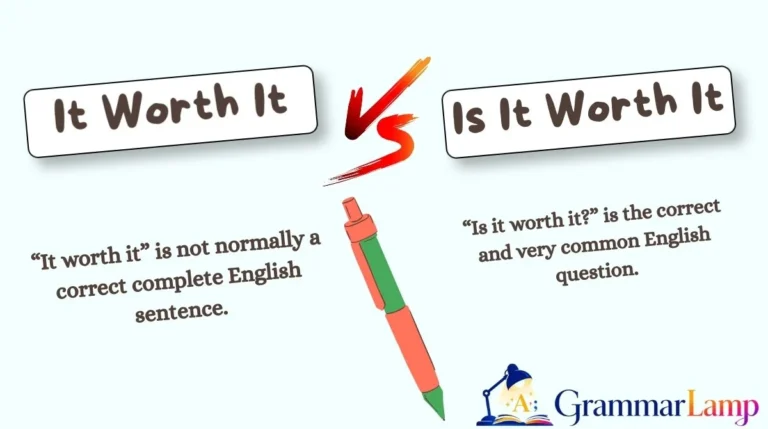
“It worth it” is not normally a correct complete English sentence.
The main problem is that the sentence is missing the verb “is.”
The correct sentence is:
“It is worth it.”
And when you turn it into a question, it becomes:
“Is it worth it?”
Here, it is the subject, is is the verb, and worth it describes the value or benefit of something.
For example:
- It is worth it.
- It is not worth it.
- Is it worth it?
English sentences usually need a verb. In the expression “it worth it,” there is no verb. That is why it cannot normally stand alone as a standard English sentence.
What does “worth it” mean?
The expression “worth it” means that something has enough value or benefit to justify the money, time, effort, trouble, or risk involved.
For example:
I paid $100 for the course, but it was worth it.
This means the course was valuable enough to justify spending $100.
Another example:
The restaurant was expensive, but it was worth it.
The food or experience was good enough to justify the high price.
Why do learners say “it worth it”?
One reason is that learners remember the phrase “worth it” but forget that English needs a linking verb before it.
They may think:
It + worth it
But English requires:
It + is + worth it
This is similar to other sentences:
- She happy. ❌
- She is happy. ✅
- The movie good. ❌
- The movie is good. ✅
- It worth it. ❌
- It is worth it. ✅
Correct examples
Here are some examples using the correct form:
- It is worth it.
- It is not worth it.
- Is it worth it?
- I think it is worth it.
- Do you think it is worth it?
- The trip was expensive, but it was worth it.
- Buying a good laptop is worth it.
- The extra cost is not worth it.
Notice that the verb changes depending on the tense.
- Present: It is worth it.
- Past: It was worth it.
- Future: It will be worth it.
Important point
You may hear someone say “it worth it” in very fast speech, especially if they are speaking unclearly. But that does not make it grammatically correct.
When writing or speaking standard English, use a suitable form of be:
is, was, will be, might be, could be, would be, and so on.
What Does “Is It Worth It” Mean?
“Is it worth it?” is the correct and very common English question.
We use it when we want to ask whether something is valuable or beneficial enough to justify its cost, time, effort, trouble, or risk.
The basic structure is:
Is + it + worth it?
For example:
Is it worth it?
This could mean:
- Is the price reasonable for what I get?
- Is the experience good enough?
- Is the effort worthwhile?
- Is the result good enough?
- Should I spend my time or money on it?
The exact meaning depends on the situation.
Examples in everyday English
- Is it worth it to buy an expensive phone?
- Is it worth it?
- Is the course worth it?
- Is it worth it to wait another hour?
- Is the extra money worth it?
- Is it worth it to travel that far?
- Is this job worth it?
- Is it worth it for you?
The phrase is especially common when people are making decisions.
For example, imagine your friend is thinking about buying a $1,500 laptop.
You could ask:
Is it worth it?
Your friend might answer:
Yes. I use it every day, and it works really well.
Or:
No. I don’t think it is worth it.
Why is “is” placed before “it”?
This is a basic English question rule.
In a normal statement, we say:
It is worth it.
When we make a question with the verb be, we move the verb before the subject:
Is it worth it?
Compare:
Statement:
It is expensive.
Question:
Is it expensive?
Another example:
Statement:
The trip is worth it.
Question:
Is the trip worth it?
So:
It is worth it. → Is it worth it?
This is why “Is it worth it?” is grammatically correct.
Difference Between “It Worth It” and “Is It Worth It”
The biggest difference is simple: “Is it worth it?” is a complete question, while “it worth it” is missing the verb “is.”
| Expression | Correct? | Type | Meaning |
|---|---|---|---|
| It worth it | ❌ | Incomplete | Missing a verb |
| Is it worth it? | ✅ | Question | Asks if something is worthwhile |
| It is worth it. | ✅ | Statement | Says something is worthwhile |
| It was worth it. | ✅ | Past statement | Says something was worthwhile |
| Was it worth it? | ✅ | Past question | Asks if something was worthwhile |
| It will be worth it. | ✅ | Future statement | Says something will be worthwhile |
| Will it be worth it? | ✅ | Future question | Asks if something will be worthwhile |
Usage difference
“Is it worth it?” is used when asking a question.
For example:
I’m thinking about buying this camera. Is it worth it?
You are asking for someone’s opinion about the value of the camera.
“It is worth it” is used to give an answer or make a statement.
Yes, it is worth it.
These two expressions often appear together in conversations.
“Should I take the course?”
“Yes, I think it is worth it.”
“Really? Is it worth it for beginners?”
“Definitely.”
Grammar logic
The word “is” is important because it is the verb in the sentence.
The sentence:
It worth it.
has no main verb.
The sentence:
It is worth it.
has the verb is.
When we make the question:
Is it worth it?
the verb moves to the beginning.
This is the same pattern used with many English questions.
Sentence structure
The basic statement is:
Subject + be + complement
It + is + worth it.
The question is:
Be + subject + complement?
Is + it + worth it?
This is an important pattern for English learners.
Compare:
She is ready.
Is she ready?
He is busy.
Is he busy?
The food is good.
Is the food good?
It is worth it.
Is it worth it?
Once you understand this pattern, the difference becomes much easier.
Meaning comparison
“It is worth it” means you believe something is worthwhile.
“Is it worth it?” means you are asking someone whether they believe something is worthwhile.
The phrase “worth it” itself does not change the meaning much. The sentence form changes because one is a statement and the other is a question.
Explore More Posts
A MA or an MA Degree? The Correct Grammar Rule in 2026
A or an: Easy Rules, Examples, and Common Mistakes in 2026
From My End or From My Side? Which Is Correct in English? (2026 Guide)
Honor or Honour: What Is the Difference? A Simple Guide for 2026
Grammar Rules You Must Remember
Rule 1: Use “is” with “it” in the present
When it is the subject and you are talking about the present, use is.
Correct:
It is worth it.
Incorrect:
It worth it.
The same rule applies to many sentences:
It is good.
It is expensive.
It is difficult.
It is useful.
It is worth it.
Do not remove is just because the sentence sounds short.
Rule 2: Put “is” before “it” to make the question
When you turn “It is worth it” into a question, move is to the beginning.
Statement:
It is worth it.
Question:
Is it worth it?
This is a very common English question pattern.
Rule 3: Change “is” when the time changes
The verb changes when you talk about the past or future.
Present:
Is it worth it?
Past:
Was it worth it?
Future:
Will it be worth it?
For example:
I waited three hours yesterday. Was it worth it?
Or:
I have to work very hard for this exam. Will it be worth it?
Rule 4: “Worth it” talks about value or benefit
“Worth it” usually means that the result is good enough to justify something.
That “something” could be:
- money
- time
- effort
- trouble
- travel
- risk
- waiting
- hard work
For example:
The hotel was expensive, but it was worth it.
Here, the hotel cost a lot of money, but the speaker thinks the experience justified the cost.
Common Mistakes Students Make
Many learners make mistakes with worth it because the expression is short and sounds different from normal adjective structures.
Mistake 1: Removing “is”
Incorrect:
It worth it.
Correct:
It is worth it.
The easiest way to fix this mistake is to remember that “worth” does not replace the verb “is.”
Mistake 2: Saying “Is worth it?”
Incorrect:
Is worth it?
Correct:
Is it worth it?
The question needs a subject.
English questions normally cannot simply begin with is and leave the subject out.
Compare:
Is expensive? ❌
Is it expensive? ✅
And:
Is worth it? ❌
Is it worth it? ✅
Mistake 3: Saying “It is worth?”
Sometimes learners say:
It is worth?
This sounds incomplete when they mean “Is it worth it?”
A natural question is:
Is it worth it?
If you are talking about a specific thing, you can also say:
Is the phone worth the money?
Mistake 4: Confusing “worth it” with “worth”
The word worth can be used in several structures.
For example:
The car is worth $20,000.
Here, $20,000 tells us the value.
We can also say:
The car is worth buying.
Here, buying follows worth.
And:
The car is worth it.
Here, it refers to the money, effort, or other cost already understood from the conversation.
Mistake 5: Using “worth it” without understanding “it”
Consider:
Is it worth it?
The first it and the second it can refer to different things grammatically.
The first it is the subject. It refers to the thing or action being discussed.
The second it refers to the cost, effort, trouble, or sacrifice already understood.
For example:
“Should I spend $500 on this course?”
“Is it worth it?”
The first it refers to the course or purchase. The second it refers to spending the money.
Easy correction tip
When you see “it worth it,” ask yourself:
“Where is the verb?”
If you cannot find one, add the correct form of be.
It is worth it.
Then, if you want a question:
Is it worth it?
Easy Trick to Remember the Difference
Here is a simple trick:
Remember: “Is” asks, “It is” answers.
When you are asking:
Is it worth it?
When you are answering:
It is worth it.
Think of a simple conversation:
Is it worth it?
Yes, it is worth it.
The position of is changes because the sentence changes from a question to a statement.
You can use the same trick with other sentences.
Is it good? → It is good.
Is it expensive? → It is expensive.
Is it useful? → It is useful.
Is it worth it? → It is worth it.
Real-life logic
Imagine your friend is standing in a shop with a $300 pair of headphones.
Your friend asks:
“Should I buy these?”
You might ask:
“Are they worth it?”
Or, if you are talking about the purchase:
“Is it worth it?”
Your friend might answer:
“Yes, I think it is worth it.”
So remember:
Question → Is it worth it?
Answer → It is worth it.
And never use “it worth it” as a complete standard sentence.
Daily Life Examples (Very Important)
Here are some natural examples you may hear in everyday English.
Example 1: Buying a phone
Ali: I’m thinking about buying the new phone.
Hamza: It’s pretty expensive.
Ali: I know. Is it worth it?
Hamza: If you use the camera a lot, I think it is.
Example 2: Taking a course
Sara: I’m thinking about taking an online English course.
Mina: How much does it cost?
Sara: About $200.
Mina: Is it worth it?
Sara: I think so. It has helped me a lot.
Example 3: Waiting for food
A: We’ve been waiting for almost an hour.
B: I know.
A: Do you think the food will be good?
B: I hope so. Otherwise, it won’t be worth it.
Example 4: Traveling
A: The beach is three hours away.
B: That’s a long drive.
A: I know.
B: Do you think it’s worth it?
A: Yes. The beach is beautiful.
Example 5: Buying a cheaper product
A: This one is $20 cheaper.
B: Is the quality the same?
A: Not really.
B: Then the cheaper one may not be worth it.
Example 6: Working late
A: Do you want to stay late and finish the project tonight?
B: I’m not sure.
A: Do you think it’s worth it?
B: Maybe. We can relax tomorrow if we finish today.
Example 7: A long movie
A: Have you watched that new movie?
B: Yes.
A: Is it good?
B: It’s almost three hours long, but it’s worth it.
Example 8: A restaurant
A: This restaurant is quite expensive.
B: Really?
A: Yes, but the food is amazing.
B: So, is it worth it?
A: Definitely.
Example 9: Waiting in line
A: The line is really long.
B: How long have you been waiting?
A: About forty minutes.
B: Do you think it’s worth it?
A: Yes. Everyone says the tickets sell out quickly.
Example 10: Studying hard
A: I’m tired of studying for this exam.
B: Keep going.
A: Do you think all this work will be worth it?
B: Yes. You will be proud when you pass.
Notice that “worth it” can be used for many things. It is not only about money. It can also be about time, effort, patience, travel, or hard work.
Practice Section
Choose the correct option in each sentence.
1. ______ worth it?
A. It worth it
B. Is it worth it
C. It is worth?
2. I bought the expensive ticket, but ______.
A. it worth it
B. is it worth it
C. it was worth it
3. Do you think ______ to wait?
A. it is worth it
B. it worth it
C. is worth it
4. We spent a lot of money, but the trip ______.
A. was worth it
B. worth it
C. is worth
5. I’m working hard now. I hope ______ in the end.
A. it worth it
B. it will be worth it
C. will it worth it
Answers
1. B — Is it worth it?
This is the correct question structure.
2. C — it was worth it.
The speaker is talking about something that happened in the past.
3. A — it is worth it.
After “Do you think,” we use normal statement word order.
4. A — was worth it.
The trip happened in the past, so was is correct.
5. B — it will be worth it.
The speaker is talking about the future.
More Helpful posts
Collaborate vs Corroborate: Meaning, Difference, and Examples in 2026
Sleeve vs Sleave: Which Is Correct? Meaning, Difference, and Examples in 2026
Time off vs time-off: The Complete Grammar Guide for 2026
I’m vs I Am: Complete Difference, Rules, Examples & Usage Guide 2026
FAQs
What is the difference between “it worth it” and “is it worth it”?
“Is it worth it?” is the correct question. “It worth it” is not a complete standard English sentence because it is missing the verb is. The correct statement is “It is worth it.”
Can we use “is it worth it?” in questions?
Yes. In fact, “Is it worth it?” is already a question. It is used to ask whether something is valuable or beneficial enough to justify its cost, time, effort, or trouble.
For example:
Is it worth it to buy this laptop?
Is “worth it” formal or informal?
“Worth it” is common in both everyday and general English. It is especially natural in conversations. In more formal writing, you may sometimes see phrases such as “worthwhile” or “justified,” depending on the context.
Is “it worth it” ever correct?
As a complete standard sentence, “it worth it” is incorrect. You need a verb:
It is worth it.
If you are asking a question:
Is it worth it?
Can I say “it was worth it”?
Yes. “It was worth it” is completely correct. Use it when you are talking about something in the past.
For example:
The trip was tiring, but it was worth it.
What is the correct way to ask about value?
You can say:
Is it worth it?
You can also be more specific:
Is it worth the money?
Is it worth the time?
Is it worth the effort?
Is the course worth taking?
The best choice depends on what you want to ask about.
Conclusion
The main point is simple: “Is it worth it?” is the correct question, while “it worth it” is not a complete standard English sentence.
When you make a statement, say:
It is worth it.
When you ask a question, say:
Is it worth it?
The word “is” is important because it works as the verb in the sentence. Without it, “it worth it” is missing an essential part of the grammar.
You can also change the tense:
It was worth it.
Was it worth it?
It will be worth it.
Will it be worth it?
Remember the easy trick: “Is it worth it?” asks, and “It is worth it” answers.
Once you start noticing this pattern in conversations, movies, and everyday English, it will become much easier to use naturally.
Keep practicing with real situations involving money, time, effort, and decisions, and you will soon feel comfortable using worth it correctly.

Liam Derren is a language writer at GrammarLamp, creating simple, helpful content about grammar, words, and everyday English. He makes language learning clear, practical, and easy to understand.
1 thought on “It Worth It or Is It Worth It? Which One Is Correct in 2026?”