
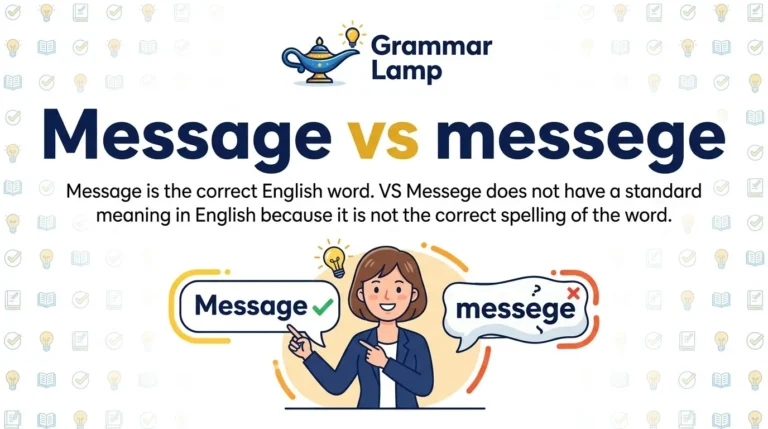
English spelling can be confusing, especially when two words look almost the same. Message and messege are a good example.
They look very similar, and when people type quickly on a phone or computer, it is easy to write the wrong form without noticing.
The important thing to remember is that message is the correct spelling. Messege is not a standard English word. It is simply a common spelling mistake.
This small spelling difference matters because the word message is used everywhere in everyday English.
You may send a message to a friend, receive a message from your teacher, leave a message for someone, or check your messages on your phone. Students also see this word in emails, apps, websites, notices, and school work.
Many learners remember how the word sounds but are unsure about the letters in the middle. The sound can make the spelling seem less obvious than it really is. Once you learn the correct spelling and understand where the confusion comes from, the problem becomes much easier.
By the end of this guide, you will know exactly why message is correct, why messege is wrong, how to use the word naturally in sentences, and how to avoid making this spelling mistake again.
More Useful posts
Is It Worth It vs Does It Worth It? 2026 Grammar Guide
Good for Me vs Good to Me: Meaning, Difference, and Examples (2026)
Whether It Be vs Whether It Is: Meaning, Difference, and Correct Use in 2026
EG vs IE: Easy Difference, Meaning, Rules, and Examples in 2026
What Does “Message” Mean?
Message is the correct English word. It usually means a piece of information, communication, or a note that one person gives or sends to another person.
The word can be used as a noun or a verb.
As a noun, a message is something that is sent or spoken to communicate with someone.
For example:
- I sent you a message.
- Did you get my message?
- She left a message for her brother.
- There is a message on your phone.
- The teacher gave us an important message.
- I received a message from my friend.
- Please read the message carefully.
- He wrote a short message to his mother.
In these sentences, message is a thing that carries information from one person to another.
Message as a Noun
As a noun, message can refer to many kinds of communication. It does not have to be a text message on a phone.
A message can be spoken, written, printed, emailed, or sent through an app.
For example:
My boss left a message for me.
Here, the message could be a phone or voice message.
Another example is:
The sign contains a clear message.
In this sentence, message means an idea or meaning communicated through the sign.
You can also use the word for a main idea that a person wants others to understand:
The main message of the speech was to stay positive.
So, the word has a wider meaning than simply a text on your phone.
Message as a Verb
Message can also be used as a verb. As a verb, it means to send someone a message, usually by phone, computer, or another communication service.
Examples:
- Message me when you arrive.
- I will message you later.
- She messaged her friend after class.
- Please message me the address.
- He messaged his manager this morning.
- I need to message my brother.
- They messaged us about the meeting.
- Can you message me when you are free?
In everyday spoken English, this verb is very common, especially when people are talking about texting or online communication.
Grammar Rule for “Message”
When message is used as a noun, it behaves like a normal countable noun.
You can say:
- a message
- the message
- one message
- two messages
- several messages
The plural form is messages, not messagees or messeges.
When it is used as a verb, you can change its form depending on the tense:
- message
- messages
- messaged
- messaging
For example:
I message my friends every day.
She messages me every morning.
He messaged me yesterday.
They are messaging each other now.
Notice that the spelling remains based on message.
A Common Learner Problem
Many students write messege because they hear the word and try to spell it from the sound.
This is understandable. English pronunciation does not always tell you the exact spelling. However, in standard English, the correct written form is always message.
A useful habit is to remember the middle letters: mes + sa + ge.
Think:
message = correct
messege = incorrect
What Does “Messege” Mean?
Messege does not have a standard meaning in English because it is not the correct spelling of the word.
When someone writes messege, they usually mean message.
For example:
I sent you a messege.
The writer almost certainly means:
I sent you a message.
The incorrect version may appear in casual online writing, social media comments, chat messages, or quick typing. People sometimes make spelling mistakes when they type fast, use a small phone keyboard, or are not sure how a word is spelled.
However, the fact that people use a spelling online does not make it correct English.
Is “Messege” a Real English Word?
No. In standard English, messege is treated as a misspelling of message.
It should not normally be used in:
- school assignments
- exams
- emails
- business writing
- formal documents
- professional communication
- articles and websites
If you see messege somewhere, it usually means that the writer made a spelling error.
Examples of the Incorrect Form
These sentences contain a spelling mistake:
- I got your messege.
- Please send me a messege.
- She left a messege for you.
- I will messege you tonight.
The corrected versions are:
- I got your message.
- Please send me a message.
- She left a message for you.
- I will message you tonight.
The meaning does not change. The problem is simply the spelling.
Why Do People Write “Messege”?
There are several common reasons.
First, English spelling can be difficult because pronunciation and spelling do not always match perfectly.
Second, people often type quickly and do not check every word.
Third, learners may remember the sound of message but not the exact order of the letters.
The two middle sounds can make people guess incorrectly. This is why messege is a common typo.
The solution is not to memorize a long grammar rule. The best solution is to memorize the correct spelling and use it often.
Difference Between Message and Messege
The biggest difference is very simple:
Message is correct. Messege is incorrect.
There is no special difference in meaning between the two. They are not two different words with different uses.
| Word | Correct spelling? | Meaning | Use |
|---|---|---|---|
| message | Yes | Information sent or given to someone | Standard English |
| messege | No | No separate standard meaning | Spelling mistake |
Usage Difference
Because message is the correct form, it can be used naturally in both formal and informal English.
You can write:
Please send me a message.
You can also say:
Message me when you get home.
Both are normal English sentences.
You should not replace message with messege just because the situation is casual. Casual English may use shorter expressions or slang, but incorrect spelling is still incorrect spelling in standard writing.
Grammar Logic
There is an important point here: this is mainly a spelling issue, not a grammar issue.
Grammar tells us how words work in sentences. Spelling tells us how words are written.
For example, in the sentence:
She sent me a message.
The grammar is correct, and message is the correct spelling.
If you change it to:
She sent me a messege.
The sentence structure is still understandable, but the spelling is wrong.
So, the main lesson is:
message = correct word
messege = spelling error
Sentence Structure
Message can appear in different grammatical structures.
As a noun:
I received a message.
As the object of a verb:
She sent a message.
After an article:
He left a message.
In the plural:
I have five messages.
As a verb:
Message me later.
Past tense:
She messaged me yesterday.
Present participle:
He is messaging his friend.
The spelling messege cannot replace the correct form in these structures.
Meaning Comparison
There is no separate dictionary meaning that you need to memorize for messege.
A learner should not think:
“Maybe message and messege have different meanings.”
They do not.
Usually, when you see messege, the writer simply intended to write message.
This makes the choice easy. You do not need to ask which word fits the meaning. You only need to remember which spelling is standard.
Explore More Posts
Dragged vs Drug: What Is the Difference? Easy Guide for 2026
Consult With, To, On or About: Which Is Correct? 2026
Run vs Ran: What Is the Difference? Easy Grammar Guide 2026
It Worth It or Is It Worth It? Which One Is Correct in 2026?
Grammar Rules You Must Remember
Rule 1: Always Spell the Word as “Message”
The standard spelling is:
M-E-S-S-A-G-E
Remember the double s and the a before g.
Correct:
I sent her a message.
Incorrect:
I sent her a messege.
The safest habit is to memorize the whole word rather than trying to spell it only from pronunciation.
Rule 2: “Message” Can Be a Noun
When you are talking about a piece of communication, message is usually a noun.
Examples:
I received a message.
Your message was very clear.
There is a message for you.
I left a message on his phone.
You can make it plural:
I received three messages today.
Rule 3: “Message” Can Also Be a Verb
English often allows nouns to become verbs, and message is one example.
Examples:
Message me tonight.
I messaged him this morning.
She is messaging her sister.
They messaged us about the change.
This usage is especially common in modern digital communication.
Rule 4: “Messege” Is Not an Alternative Spelling
Do not think of messege as a different version that can be used in casual English.
It is simply an incorrect spelling.
For example:
Wrong:
I will messege you later.
Correct:
I will message you later.
Wrong:
I got your messege.
Correct:
I got your message.
The correction is easy: replace messege with message.
Common Mistakes Students Make
One of the most common mistakes is writing messege because it feels closer to the way the word sounds.
For example, a learner may write:
Please check my messege.
The correct sentence is:
Please check my message.
Another common mistake is getting confused when using the word as a verb.
Some learners write:
I will messege you later.
The correct form is:
I will message you later.
The word does not suddenly become messege when it is used as a verb.
Wrong vs Correct Examples
| Wrong | Correct |
|---|---|
| I sent a messege. | I sent a message. |
| Did you get my messege? | Did you get my message? |
| She left a messege. | She left a message. |
| Please messege me. | Please message me. |
| He messeged me yesterday. | He messaged me yesterday. |
| I have two messeges. | I have two messages. |
Why These Mistakes Happen
The problem usually comes from spelling by sound.
English has many words where pronunciation does not give you a perfect spelling guide. Learners may know the word when they hear it but struggle when they have to write it.
Another reason is habit. If you have seen the wrong spelling many times online, your brain may begin to recognize it as familiar.
Fast typing also causes mistakes. On phones, people often send messages without checking spelling.
Easy Correction Tips
When you type messege, stop for a second and check it.
Ask yourself:
“Am I talking about communication sent to someone?”
If yes, the word is message.
Also, remember the spelling visually:
message
Try writing it several times:
message — message — message
After using it regularly, the correct form will begin to feel natural.
Easy Trick to Remember the Difference
Here is a simple memory trick:
Remember: “A” is in Message
Look at the spelling:
messA ge
The correct word contains a before g.
message ✅
messege ❌
You can also break the word into small parts:
mes + sage
This can make the spelling easier to remember.
Another simple trick is to connect the word with something you use every day:
I send a message on my phone.
Think of your phone whenever you see the word message.
Imagine opening your phone and seeing:
New message
Now the correct spelling becomes easier to remember.
A Quick Classroom Trick
Imagine your teacher asks:
“Did you get my message?”
The word on your phone would be:
MESSAGE
Not:
MESSEGE
Write the correct spelling three times in a row and then use it in a sentence:
I sent a message.
This kind of small practice is often more useful than trying to memorize a complicated rule.
Daily Life Examples
Because message is such a common word, you can see and hear it in many everyday situations.
Example 1: Talking to a Friend
Ali: Did you send Sara a message?
Hamza: Yes, I sent her a message this morning.
Here, message is a noun because it means the communication that was sent.
Example 2: Asking Someone to Contact You
Message me when you reach home.
Here, message is a verb. It means “send me a message.”
Example 3: Checking Your Phone
I think I got a message from my brother.
The word refers to communication received on the phone.
Example 4: At School
The teacher gave us a message about tomorrow’s class.
The communication does not have to be a text. It can simply mean important information.
Example 5: At Work
My manager left a message for you.
This could mean a written note, voice message, or another form of communication.
Example 6: Asking for Information
Did you get my message about the meeting?
This is a natural question in both spoken and written English.
Example 7: Giving a Contact Request
Please message me your address.
Here, message is used as a verb.
Example 8: Talking About Multiple Messages
I have several messages to answer.
The plural form is messages.
Example 9: Talking About a Voice Message
She sent me a voice message last night.
This shows that a message can be spoken rather than typed.
Example 10: Talking About the Main Idea
The message of the story is that kindness matters.
Here, message means the main idea or lesson, not a phone text.
These examples show why it is useful to learn the correct spelling. This is a word you will meet again and again in everyday English.
Practice Section
Choose the correct word in each sentence.
1. I received a ______ from my teacher.
A. messege
B. message
2. Please ______ me when you arrive.
A. message
B. messege
3. Did you get my ______ yesterday?
A. message
B. messege
4. She ______ me after work.
A. messeged
B. messaged
5. I have three new ______ on my phone.
A. messeges
B. messages
Answers
1. B — message
I received a message from my teacher.
2. A — message
Please message me when you arrive.
3. A — message
Did you get my message yesterday?
4. B — messaged
She messaged me after work.
5. B — messages
I have three new messages on my phone.
A useful thing to notice is that every correct answer comes from the same spelling family:
message → messages → messaged → messaging
More Helpful posts
Symbol vs Cymbal 2026: Meaning, Difference, Examples, and Easy Grammar Rules
In My Spare Time or On My Spare Time in 2026? The Correct Expression Explained
May or May Not: Meaning, Grammar Rules, Examples, and Common Mistakes in 2026
Peaked vs Peeked vs Piqued: Meaning, Differences, Examples, and Grammar Rules (2026)
FAQs
What is the difference between message and messege?
Message is the correct spelling and a standard English word. It can be a noun or a verb. Messege is not a standard English word; it is a common spelling mistake.
Is “messege” a correct spelling?
No. The correct spelling is message. Although you may see “messege” in texts, comments, or online posts, it is still considered a spelling error in standard English.
Can I use “message” as a verb?
Yes. Message can be used as a verb, especially when talking about digital communication. For example, “Message me when you get home” means “Send me a message when you get home.”
Is “message” formal or informal?
Message is used in both formal and informal English. You can use it in everyday conversation, school writing, work emails, and other normal situations. The word itself is not limited to casual speech.
Why do people spell message as messege?
The mistake usually happens because the pronunciation can make the spelling confusing. Fast typing, unfamiliarity with English spelling, and typing on phones can also lead to this error. The correct form should be memorized as message.
What is the plural of message?
The plural form is messages. For example: “I received five messages today.” Do not write messeges. The correct spelling keeps the a: messages.
Conclusion
The difference between message and messege is easy once you know the main rule. Message is the correct English word, while messege is simply a misspelling.
The word message can be used as both a noun and a verb. As a noun, it means a piece of communication or information, such as “I received a message.” As a verb, it means to send someone a message, as in “Message me later.”
The best way to avoid the mistake is to remember the spelling carefully:
message ✅
messege ❌
Pay special attention to the a in the middle of the word. The more often you read, write, and use message in real sentences, the easier the correct spelling will become.
English spelling takes practice. A small mistake like this is normal for learners, so do not worry about it. Just remember the correct form and use it confidently whenever you write or speak English.

Liam Derren is a language writer at GrammarLamp, creating simple, helpful content about grammar, words, and everyday English. He makes language learning clear, practical, and easy to understand.
1 thought on “Message vs messege: Correct Spelling, Meaning & Usage in 2026”