
Have you ever wondered whether the past tense of drag is dragged or drug? You are not alone. Many English learners see or hear both words and become unsure about which one is correct.
The confusion is easy to understand because dragged and drug sound somewhat similar in some accents, and drug can sometimes be heard as a past form of drag in informal or regional English. However, in standard English, these two words have different jobs.
The correct past tense of drag is dragged. For example, you can say, “He dragged the box across the floor.” The word drug, on the other hand, normally refers to a medicine or substance.
It can also be a verb meaning to give someone a drug or medicine, although this use is less common in everyday beginner English.
There is another important point: drug is sometimes used as a nonstandard or regional past tense of drag.
You may hear it in some varieties of American English, especially in informal speech. But if you are learning standard English, writing for school, taking an exam, or writing professionally, dragged is the safe and standard choice.
Once you understand the basic rule, the difference becomes much easier. You will learn what each word means, how to use it, common mistakes to avoid, and how native speakers use these words in everyday situations.
More Useful posts
All the Time vs Every Time: Meaning, Difference, Rules & Examples (2026)
Afterward or Afterwards? Meaning, Difference, and Correct Usage in 2026
A or an: Easy Rules, Examples, and Common Mistakes in 2026
From My End or From My Side? Which Is Correct in English? (2026 Guide)
What Does “Dragged” Mean?
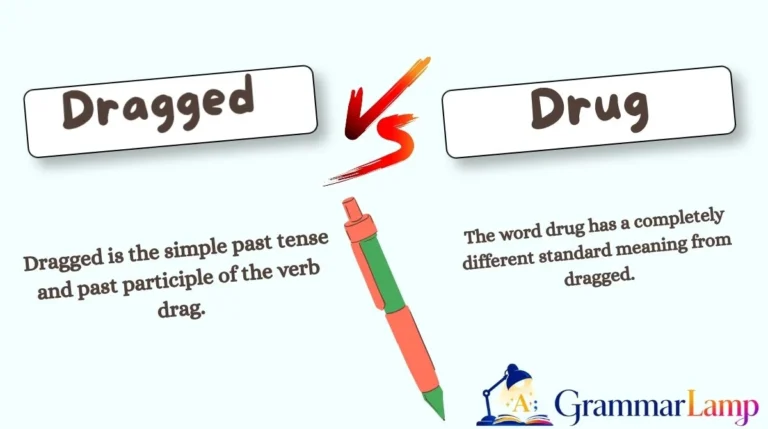
Dragged is the simple past tense and past participle of the verb drag.
The verb drag means to pull something along a surface, usually with some effort. You can drag a heavy box, a chair, a bag, or even a file on a computer screen.
When the action happened in the past, we normally use dragged.
Simple definition
Dragged = pulled something along a surface or moved something with effort.
For example:
- I dragged the chair across the room.
- She dragged the suitcase upstairs.
- He dragged the table outside.
- The dog dragged its toy across the floor.
The word tells us that the pulling or moving action happened in the past.
When should you use “dragged”?
Use dragged when you are talking about a completed action in the past.
The basic pattern is:
Subject + dragged + object
For example:
Sarah dragged the heavy bag.
Here, Sarah is the subject, dragged is the past-tense verb, and the heavy bag is the object.
You can also use dragged in the past perfect:
He had dragged the box into the garage before it started raining.
It can also be used in the passive voice:
The table was dragged across the floor.
Examples of “dragged”
- Tom dragged the chair into the kitchen.
- She dragged her suitcase through the airport.
- The children dragged the old sofa outside.
- I dragged the box across the floor.
- He dragged the broken bicycle home.
- The dog dragged the blanket around the house.
- They dragged the table away from the door.
- She dragged the file to another folder on her computer.
Notice that all these examples describe pulling or moving something.
“Dragged” can also be used with people
The word does not always mean physically pulling an object. It can also describe taking someone somewhere when they do not really want to go.
For example:
My friend dragged me to the shopping mall.
This does not necessarily mean the friend physically pulled the speaker. It can mean the friend strongly persuaded or forced the speaker to go.
Another example:
My brother dragged me to the party.
Here, the speaker probably did not want to go, but the brother convinced or forced them to attend.
“Dragged” in computer English
You may also hear dragged when people talk about computers and phones.
For example:
I dragged the photo into the folder.
This means the person moved the photo by holding it and moving it to another place on the screen.
You might also hear:
Drag the file here.
Past tense:
I dragged the file here.
This is very common in modern English.
A common learner confusion
Some learners think that drug is the past tense of drag because they hear people say it.
You may sometimes hear:
He drug the box across the floor.
This form exists in some regional varieties of English, but it is not the standard form expected in formal English or most English-learning materials.
For learners, the easiest rule is:
Drag → dragged
Not:
Drag → drug
So, if you are writing an exam, school assignment, email, article, or professional document, use dragged.
What Does “Drug” Mean?
The word drug has a completely different standard meaning from dragged.
As a noun, drug usually means a substance used as medicine or a substance that affects the body or mind.
For example:
The doctor prescribed a drug for the infection.
In everyday English, medicine is often more natural when talking about ordinary treatment at home, but drug is a common word in medical and scientific contexts.
Simple definition
Drug = a substance used as medicine or one that changes how the body or mind works.
Examples include medicines used to treat illness, as well as other substances that affect the body.
When should you use “drug”?
Use drug as a noun when you are talking about a medicine or another substance that affects the body.
For example:
The doctor gave him a new drug.
This drug can cause side effects.
Scientists are testing a new drug.
The plural is drugs.
Some drugs require a prescription.
“Drug” can also be a verb
Drug is also a verb, although this use can be confusing for learners.
As a verb, drug can mean to give someone a drug or medicine.
For example:
The patient was drugged before the operation.
The word drugged is much more common in this form.
Another example:
Someone drugged his drink.
This means someone secretly put a drug into his drink.
The verb drug is different from drag.
Examples of “drug”
- The doctor prescribed a new drug.
- This drug is used to treat high blood pressure.
- The researchers are testing the drug.
- The patient was given a powerful drug.
- Some drugs can have serious side effects.
- The company developed a new drug.
- The drug helped control the patient’s symptoms.
- The police found illegal drugs in the vehicle.
Notice that in these examples, drug is related to medicine or substances.
Why “drug” causes confusion
The biggest problem is that drug looks like it could be the past tense of drag.
English has many irregular verbs:
- sing → sang
- drink → drank
- swim → swam
- begin → began
Because of this pattern, learners may naturally think:
drag → drug
But that is not the standard verb pattern.
The standard form is:
drag → dragged → dragged
So remember that drag is a regular verb.
Difference Between Dragged and Drug
The most important difference is simple:
Dragged is the past form of drag.
Drug is usually a noun referring to a medicine or substance. It can also be a verb meaning to give someone a drug.
Here is a quick comparison:
| Word | Main use | Meaning | Example |
|---|---|---|---|
| Dragged | Verb | Pulled or moved something along | She dragged the box. |
| Drug | Noun | Medicine or substance | The doctor prescribed a drug. |
| Drug | Verb | Gave someone a drug | Someone drugged the drink. |
| Drug | Regional/nonstandard past of drag | Pulled something | He drug the box. |
Usage difference
When you mean pulled something, use dragged in standard English.
Correct: She dragged the chair.
Standard English: She dragged the chair.
When you mean medicine or a substance, use drug.
The doctor prescribed a drug.
These sentences have completely different meanings.
Grammar logic
The verb drag is a regular verb.
Regular verbs normally form the simple past by adding -ed.
For example:
- walk → walked
- clean → cleaned
- open → opened
- push → pushed
- drag → dragged
Therefore:
I drag the chair.
becomes:
I dragged the chair.
It does not normally become:
I drug the chair.
Why is “dragged” spelled with “-ged”?
Some learners wonder why the spelling is dragged rather than simply draged.
The answer is connected to English spelling rules.
The verb drag ends in a consonant-vowel-consonant pattern: d-r-a-g. When a one-syllable verb of this type ends in one consonant, we often double the final consonant before adding -ed.
So:
drag + ed = dragged
Similarly:
stop + ed = stopped
plan + ed = planned
drop + ed = dropped
This is why dragged has two g letters.
Sentence structure difference
Look at these examples:
She dragged the bag.
Here, dragged is the verb.
But:
The doctor prescribed a drug.
Here, drug is a noun.
The words may look similar, but their grammar is different.
You can ask:
What did she do?
She dragged the bag.
But you can ask:
What did the doctor prescribe?
A drug.
This simple question can help you identify the correct word.
Explore More Posts
From My End or From My Side? Which Is Correct in English? (2026 Guide)
Honor or Honour: What Is the Difference? A Simple Guide for 2026
Collaborate vs Corroborate: Meaning, Difference, and Examples in 2026
Sleeve vs Sleave: Which Is Correct? Meaning, Difference, and Examples in 2026
Grammar Rules You Must Remember
Rule 1: The standard past tense of “drag” is “dragged”
This is the most important rule.
Use dragged when talking about pulling or moving something in the past.
I dragged the suitcase upstairs.
He dragged the chair outside.
They dragged the old table into the garage.
Remember:
drag → dragged → dragged
Rule 2: “Drug” normally refers to medicine or a substance
Use drug as a noun when talking about a medicine or substance.
The doctor prescribed a new drug.
The drug helped the patient.
Scientists are studying the drug.
Do not use drug simply because you want the past tense of drag.
Rule 3: “Drug” can appear as a regional past form of “drag”
You may hear people say:
He drug the box across the floor.
This usage occurs in some regional varieties, particularly in parts of the United States. It is important to understand it if you hear it in conversation or see it in informal writing.
However, English learners should normally use:
He dragged the box across the floor.
This is the standard form and is appropriate for formal and educational writing.
Rule 4: Do not confuse “drug” with “dragged”
If you are describing movement by pulling, think of dragged.
If you are talking about medicine or a substance, think of drug.
Compare:
He dragged the suitcase.
He took a drug prescribed by his doctor.
The meanings are completely different.
Common Mistakes Students Make
English learners often make this mistake because drug looks like an irregular past tense.
Mistake 1: Using “drug” as the standard past tense
❌ She drug the chair across the room.
✅ She dragged the chair across the room.
For standard English, choose dragged.
Mistake 2: Thinking every verb can have an irregular past form
English has many irregular verbs, but drag is not normally one of them.
For example:
drive → drove
write → wrote
take → took
But:
drag → dragged
You cannot create an irregular form just because another verb has one.
Mistake 3: Confusing “drug” with “dragged” when speaking
Sometimes pronunciation and regional speech make this difficult.
If you hear:
He drug the chair.
Do not immediately assume that this is the form you should use in your own formal English.
Instead, remember the standard form:
He dragged the chair.
Mistake 4: Spelling “dragged” incorrectly
A common spelling mistake is:
❌ draged
The correct spelling is:
✅ dragged
There are two g letters.
Think:
drag + ed = dragged
Mistake 5: Using “drug” when talking about pulling
❌ I drug my suitcase to the car.
For standard English:
✅ I dragged my suitcase to the car.
The word drug would make most readers think about medicine or another substance.
Easy Trick to Remember the Difference
Here is a simple memory trick:
Think: “Drag has an -ed past.”
When you pull something:
Drag → Dragged
Imagine yourself pulling a heavy box.
You say:
I dragged the box.
The word dragged contains the original word drag, so it is easy to connect the two.
Now think about drug.
Drug = medicine or substance.
You might remember it with this simple idea:
Drag a bag. Take a drug.
The first action is about pulling.
The second word is about medicine or a substance.
Another useful trick is to ask yourself:
Am I talking about pulling something?
If yes, use dragged for the past.
Am I talking about medicine or a substance?
If yes, drug may be the correct noun.
This trick is especially useful when you are writing quickly.
Daily Life Examples
These short conversations show how the words work naturally in everyday English.
Example 1: Moving furniture
Ali: Why is the table over there?
Sam: I dragged it closer to the window.
Here, dragged means moved by pulling.
Example 2: Moving a suitcase
Sara: Did you carry your suitcase upstairs?
Mia: No. It was too heavy, so I dragged it.
Again, the meaning is pulling or moving something.
Example 3: Computer use
Ali: Where did you put the photo?
John: I dragged it into the new folder.
Here, dragged describes moving a file on a computer.
Example 4: Going somewhere
Tom: Did you enjoy the party?
Jack: Yes, but my brother dragged me there. I didn’t want to go at first.
Here, dragged me means strongly persuaded or made the speaker go.
Example 5: Talking about medicine
Patient: What is this medicine?
Doctor: It is a new drug used to treat the condition.
Here, drug is a noun referring to medicine.
Example 6: Talking about research
Scientist: Are you testing the new drug?
Researcher: Yes. The tests are still going on.
The word refers to a substance being studied.
Example 7: A heavy box
Mother: Why are you tired?
Son: I dragged a heavy box from the garage.
The action happened in the past, so dragged is correct.
Example 8: A medical question
Patient: Did the doctor give you a new medicine?
Friend: Yes. He prescribed a new drug.
Here, drug means medicine.
Example 9: Cleaning the room
Sarah: How did you move that sofa?
Emma: My brother and I dragged it across the room.
The word describes physical movement.
Example 10: A computer file
Teacher: How did you move the document?
Student: I dragged it into the folder.
This is a common use of dragged in modern technology-related English.
Practice: Choose the Correct Word
Choose dragged or drug in each sentence.
1. I ______ the heavy box into the garage.
2. The doctor prescribed a new ______.
3. She ______ the chair across the floor.
4. The scientists are testing a new ______.
5. He ______ the file into another folder.
Answers
1. dragged
I dragged the heavy box into the garage.
2. drug
The doctor prescribed a new drug.
3. dragged
She dragged the chair across the floor.
4. drug
The scientists are testing a new drug.
5. dragged
He dragged the file into another folder.
A quick check is to look at the meaning. If something is being pulled or moved, use dragged for the past action. If you are talking about medicine or a substance, drug is the usual noun.
More Helpful posts
Time off vs time-off: The Complete Grammar Guide for 2026
I’m vs I Am: Complete Difference, Rules, Examples & Usage Guide 2026
Sun vs Son: Meaning, Difference, Rules, and Examples (2026)
A Majority of vs The Majority of: Easy Grammar Guide for 2026
FAQs
What is the difference between dragged and drug?
Dragged is the standard past tense and past participle of drag, meaning to pull or move something along a surface.
Drug normally means a medicine or substance. In some regional varieties of English, drug is also used as a past form of drag, but dragged is the standard form for learners.
Is “drug” the past tense of “drag”?
In standard English, no. The normal past tense of drag is dragged.
For example:
I dragged the box across the floor.
You may hear drug used as the past tense of drag in some regional or informal varieties, but it is better to use dragged in standard English.
Is “I drug the chair” correct?
You may hear this sentence in some regional varieties of English, especially in parts of the United States.
However, if you are learning standard English or writing for school, work, exams, or formal situations, use:
I dragged the chair.
This is the standard form.
Why do people say “drug” instead of “dragged”?
Some English speakers use drug as a regional or nonstandard past form of drag. This is a real usage that you may hear in conversation.
However, English has different regional varieties, and not every form used by native speakers is the form normally taught in standard written English.
For learners, dragged is the safest choice.
Is “dragged” a regular verb?
Yes. Drag is normally treated as a regular verb.
Its main forms are:
drag – dragged – dragged
For example:
I drag the box.
I dragged the box yesterday.
I have dragged the box before.
This is different from irregular verbs such as go – went – gone.
What is the correct spelling: draged or dragged?
The correct spelling is dragged, with two g letters.
The spelling comes from drag + ed.
So:
❌ draged
✅ dragged
Remember the double g whenever you write the past tense or past participle of drag.
Conclusion
The difference between dragged and drug is much easier once you focus on their meanings and grammar.
Dragged is the standard past tense and past participle of drag. Use it when someone pulled or moved something, such as a box, chair, suitcase, table, or computer file.
She dragged the suitcase upstairs.
Drug normally refers to a medicine or another substance. It can also be a verb in certain contexts, while drug as a past form of drag is found in some regional varieties of English.
If you are learning English, writing an assignment, taking an exam, or using formal English, remember the simple rule:
Drag → dragged
Not drag → drug.
A useful memory sentence is: “I dragged the bag, but I took the drug.” Keep practicing with short sentences, and soon the difference will feel natural.

Liam Derren is a language writer at GrammarLamp, creating simple, helpful content about grammar, words, and everyday English. He makes language learning clear, practical, and easy to understand.
1 thought on “Dragged vs Drug: What Is the Difference? Easy Guide for 2026”