
When you write or speak English, you may sometimes stop at words that look almost the same. Preventive and preventative are a good example.
Both words are commonly used, and both are related to the verb prevent.
The confusing part is simple: one word has an extra “at” in it. This makes many learners wonder whether one spelling is wrong, whether the words have different meanings, or whether one is used only in British English or American English.
The good news is that the difference is much smaller than it first appears.
Modern dictionaries recognize preventive and preventative as forms with the same basic meaning: something intended to stop a problem before it happens.
Cambridge lists preventative as another word for preventive, and Oxford also gives preventative as an alternative form.
Still, there is a useful difference in frequency and style. Preventive is generally the shorter and more widely preferred form, especially in formal, academic, and professional writing.
A 2026 CDC writing guide also recommends preventive in its style guidance.
By the end, you will know exactly when to use each form, how they work in sentences, which one is usually the safer choice, and why both can be correct.
More Useful posts
Is It Worth It vs Does It Worth It? 2026 Grammar Guide
Good for Me vs Good to Me: Meaning, Difference, and Examples (2026)
Whether It Be vs Whether It Is: Meaning, Difference, and Correct Use in 2026
EG vs IE: Easy Difference, Meaning, Rules, and Examples in 2026
What Does “Preventive” Mean?
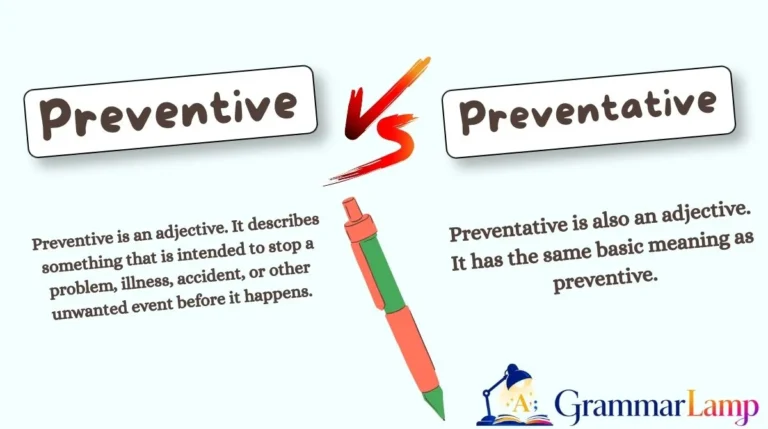
Preventive is an adjective. It describes something that is intended to stop a problem, illness, accident, or other unwanted event before it happens.
Cambridge defines preventive as something intended to stop something before it happens. Oxford gives a very similar meaning and explains that it is used for something intended to stop problems or difficulties from happening.
Think of the basic idea like this:
Preventive = done early to stop a problem later.
For example, if you check your car regularly so it does not break down, that maintenance is preventive maintenance. If you take steps to avoid getting sick, those steps can be called preventive measures.
When should you use “preventive”?
Use preventive when you are talking about an action, treatment, plan, measure, or method designed to prevent something.
It is very common with words such as:
- preventive care
- preventive medicine
- preventive treatment
- preventive action
- preventive measures
- preventive maintenance
- preventive steps
- preventive strategy
The word is especially common in health, education, business, safety, engineering, and everyday discussions about avoiding problems.
Grammar rule for “preventive”
Preventive is an adjective, so it usually describes a noun.
The basic structure is:
preventive + noun
For example:
- preventive care
- preventive action
- preventive measures
- preventive treatment
You can also use it after a linking verb in some contexts, especially when the meaning is clear:
The treatment is preventive.
However, in careful writing, learners will often find the word most naturally placed before a noun, such as preventive treatment or preventive action.
Examples of “preventive”
- Regular exercise can be a preventive measure against some health problems.
- The doctor recommended preventive care for the patient.
- The company introduced preventive measures to reduce workplace accidents.
- Preventive maintenance can help keep the machine working properly.
- Wearing a helmet is an important preventive safety measure.
- The school created a preventive program to reduce bullying.
- Early action can be more effective than waiting until the problem becomes serious.
- The team took preventive steps before starting the project.
Notice that the word does not describe a solution used after a problem has already happened. Its main idea is preparation and protection beforehand.
A common learner confusion
Some learners think preventive means “something that completely guarantees a problem will never happen.”
That is not the meaning.
A preventive action is something intended to reduce the chance of a problem or stop it from happening. It does not always guarantee perfect protection.
For example:
Preventive maintenance reduces the risk of machine failure.
This does not mean the machine can never break. It means the maintenance is done to help prevent failure.
That small difference is important.
What Does “Preventative” Mean?
Preventative is also an adjective. It has the same basic meaning as preventive.
Cambridge directly defines preventative as another word for preventive. Oxford also lists preventative as an alternative form of preventive.
The simple meaning is:
Preventative = intended to stop something bad from happening.
So these two sentences have essentially the same meaning:
The company took preventive measures.
The company took preventative measures.
Both are correct.
When should you use “preventative”?
You can use preventative in the same types of situations in which you would use preventive.
It can describe:
- preventative care
- preventative treatment
- preventative action
- preventative measures
- preventative maintenance
- preventative strategies
- preventative steps
- preventative programs
You may hear or see the word in health care, business, technical writing, safety discussions, and everyday English.
It is not a spelling mistake simply because it contains an extra syllable.
Grammar rule for “preventative”
Like preventive, preventative is an adjective and usually describes a noun.
The normal structure is:
preventative + noun
Examples include:
preventative care
preventative treatment
preventative measures
preventative maintenance
The important thing is that preventative does not automatically change the meaning of the noun that follows it.
Examples of “preventative”
- The doctor explained the benefits of preventative care.
- The factory introduced preventative measures after the accident.
- Preventative maintenance can save money over time.
- The school uses preventative strategies to deal with possible problems.
- Wearing safety equipment is a preventative step.
- The company developed a preventative plan for future emergencies.
- The team took preventative action before the situation became worse.
- These changes are designed to provide preventative support.
You can replace most of these uses with preventive without changing the meaning.
For example:
Preventative measures can reduce accidents.
and
Preventive measures can reduce accidents.
Both are natural and understandable.
A common learner confusion
A common mistake is thinking that preventative must have a different meaning because it is longer.
English does this quite often. A longer word does not always mean a stronger, more detailed, or different meaning.
In this case, the extra “at” does not create a new idea.
Another misunderstanding is that preventative is completely wrong and only preventive is correct. That is also not accurate. Major learner dictionaries recognize the longer form.
The real issue is usually preference, not correctness.
Difference Between Preventive and Preventative
The most important fact is this:
Preventive and preventative usually mean the same thing.
You can normally use either word to describe something intended to prevent a problem.
Cambridge treats preventative as another word for preventive, while Oxford lists it as an alternative form.
So, the difference is not mainly about meaning. It is more about usage, frequency, and style.
Comparison Table
| Feature | Preventive | Preventative |
|---|---|---|
| Part of speech | Adjective | Adjective |
| Basic meaning | Intended to prevent something | Intended to prevent something |
| Meaning difference | No major difference | No major difference |
| Spelling | Shorter | Longer |
| Pronunciation | Usually fewer syllables | Usually one extra syllable |
| Formal writing | Very common | Correct, but less preferred by some writers |
| Medical English | Very common | Also used |
| Everyday English | Very common | Common enough to be understood naturally |
| Can describe “measures”? | Yes | Yes |
| Can describe “maintenance”? | Yes | Yes |
| Can describe “care”? | Yes | Yes |
Usage difference
The biggest practical difference is that preventive is generally more common.
That does not make preventative incorrect. It simply means that preventive is often the more familiar choice, especially in formal and professional writing.
A 2026 CDC writing guide specifically recommends preventive in its writing style.
Dictionary.com also explains that the two forms are essentially interchangeable in most contexts and notes that preventive has traditionally been more common, particularly in medical contexts.
So if you are a student writing an essay, a report, a school assignment, or professional content, preventive is a very safe choice.
Grammar logic
Both words come from the verb prevent.
The verb prevent means to stop something from happening or stop someone from doing something.
From that idea, English developed the adjectives:
prevent → preventive
and
prevent → preventative
The two forms developed side by side and have been used for a long time. Modern dictionaries now accept both.
This is why you should not think:
preventive = correct
preventative = incorrect
A better way to think about them is:
preventive = more common/preferred in many formal contexts
preventative = also correct and widely used
Sentence structure difference
There is no major grammar structure difference between them.
Both work before nouns:
preventive measures
preventative measures
Both can be used in questions:
Are these preventive measures?
Are these preventative measures?
Both can also appear in longer noun phrases:
The hospital introduced a preventive health program.
The hospital introduced a preventative health program.
The grammar stays the same. The main change is the adjective you choose.
Meaning comparison
Compare these:
The company introduced preventive measures.
The company introduced preventative measures.
The meaning is the same: the company introduced measures designed to prevent a problem.
Now compare:
Preventive maintenance is important.
Preventative maintenance is important.
Again, there is no important difference in meaning.
This is why learners should focus less on trying to invent a meaning difference and more on learning the common usage pattern.
Explore More Posts
Dragged vs Drug: What Is the Difference? Easy Guide for 2026
Consult With, To, On or About: Which Is Correct? 2026
Run vs Ran: What Is the Difference? Easy Grammar Guide 2026
It Worth It or Is It Worth It? Which One Is Correct in 2026?
Grammar Rules You Must Remember
Rule 1: Both words are adjectives
Preventive and preventative describe nouns.
Correct:
preventive treatment
preventative treatment
Incorrect idea:
I preventive the problem.
That is wrong because preventive is not the verb.
Use prevent as the verb:
We need to prevent the problem.
Rule 2: Both forms usually have the same meaning
You can normally change one for the other without changing the basic meaning.
The company took preventive action.
The company took preventative action.
Both sentences describe action taken to stop a problem before it happens.
Cambridge and Oxford both support this relationship between the two forms.
Rule 3: “Preventive” is usually the safer choice for formal writing
When you are unsure which word to use, preventive is often the simplest choice.
It is shorter, common, and widely used in professional language. The CDC’s 2026 style guidance recommends preventive in its own writing.
Example:
The report recommends preventive measures.
This is a very natural formal sentence.
Rule 4: Do not confuse “preventive” with “prevention”
These words are related, but they are not the same part of speech.
Prevention is a noun. It means the act of stopping something from happening.
Preventive and preventative are adjectives that describe something intended to prevent a problem.
Compare:
Disease prevention is important.
Here, prevention is a noun.
Preventive medicine can help reduce health risks.
Here, preventive is an adjective.
The same difference applies to preventative.
Common Mistakes Students Make
Learners usually make mistakes here for one simple reason: the words look different, so they assume the meaning or grammar must also be different.
Mistake 1: Thinking “preventative” is always wrong
Wrong belief:
Only preventive is correct.
This is too strong.
Major dictionaries recognize preventative as another form of preventive.
Better understanding:
Both are correct, but preventive is often preferred.
Mistake 2: Thinking “preventative” means stronger prevention
Some learners imagine that:
preventive = helps prevent
while
preventative = strongly prevents
There is no standard meaning difference like this.
The extra “at” does not make the action stronger.
Mistake 3: Using “preventive” as a verb
Incorrect:
We preventive the accident.
Correct:
We prevent the accident.
Correct adjective use:
We took preventive action to avoid the accident.
Remember:
prevent = verb
preventive = adjective
preventative = adjective
Mistake 4: Confusing adjective and noun forms
Incorrect:
Preventative is important for public health.
This sentence may be grammatically possible only if a noun meaning is intended, but it is not the normal beginner use.
A clearer sentence is:
Preventative care is important for public health.
Or:
Prevention is important for public health.
The word prevention is the ordinary noun for the act of stopping something from happening.
Mistake 5: Changing the sentence structure
Some learners think that because the words are different forms, they need different grammar.
They do not.
Correct:
preventive measures
Correct:
preventative measures
Correct:
preventive treatment
Correct:
preventative treatment
The structure stays the same.
Easy correction tips
When you see a sentence with a noun such as care, action, measures, maintenance, treatment, or strategy, ask yourself:
“Am I describing something that is meant to stop a problem before it happens?”
If yes, preventive or preventative may fit.
Then ask:
“Am I writing something formal?”
If yes, preventive is often the easiest choice.
Easy Trick to Remember the Difference
Here is a very simple memory trick:
Think: “Prevent first, preventive second.”
Start with the verb:
prevent
Then remember the common adjective:
preventive
You can picture the word as:
prevent + ive = preventive
For the longer form:
preventative
Think of it as the longer alternative.
You do not need to create a completely new meaning for it.
Real-life logic
Imagine that your phone battery is always dying.
You charge it before leaving home.
That is a preventive action.
You can also call it a preventative action.
Now imagine that your car needs regular servicing to reduce the chance of a breakdown.
That is preventive maintenance.
It can also be called preventative maintenance.
The logic is:
Problem has not happened yet → take action now → try to stop it later.
That is the central meaning behind both forms.
A quick classroom trick
When you are unsure, use this sentence:
“I am doing this before the problem happens.”
If that meaning works, you are probably looking for preventive or preventative.
Then remember:
Preventive = the shorter, more widely preferred form
Preventative = another accepted form
That is enough for most learners.
Daily Life Examples (Very Important)
The best way to understand these words is to hear them in normal situations.
1. At the doctor’s office
Doctor: You should schedule regular checkups.
Patient: Are those preventive visits?
Doctor: Yes. They can help identify problems early.
Here, preventive describes visits designed to help stop or detect health problems early.
2. Talking about a car
Ali: Why are you taking your car to the garage? It seems fine.
Usman: I’m getting some preventative maintenance done.
Ali: So you’re fixing it before something goes wrong?
Usman: Exactly.
Here, preventative maintenance means maintenance performed before a serious problem occurs.
3. At work
Manager: Why did we change the safety rules?
Employee: They are part of our preventive measures.
The company is trying to stop accidents rather than wait for one to happen.
4. At school
Teacher: Why are the students attending this workshop?
Parent: The school says it is a preventive program.
The goal is to deal with possible problems before they become serious.
5. During a computer problem
Sara: Did you install the security update?
Hina: Yes. It is part of our preventative plan.
The plan is meant to reduce the chance of future problems.
6. Talking about home safety
Father: Why did you install a smoke alarm?
Son: It is a preventive safety measure.
The device is there before a fire happens, not after.
7. In a business meeting
Manager: Should we wait until customers complain?
Team member: No. We should take preventive action now.
The speaker wants to deal with the risk before it becomes a bigger issue.
8. Talking about health
Friend 1: Why are you exercising every morning?
Friend 2: Mostly for preventive health reasons.
The person is trying to protect future health, not simply react to an existing illness.
9. About building repairs
Worker: Why are we checking the roof again?
Supervisor: It is preventative maintenance. Small problems are cheaper to fix early.
This is a very natural use of preventative.
10. Choosing between the two forms
Student: Should I write “preventive measures” or “preventative measures”?
Teacher: Both are correct. “Preventive measures” is usually the safer choice in formal writing.
That is the main lesson.
Practice Section
Choose the correct option in each sentence.
1. The hospital introduced ______ care for older patients.
A. preventive
B. prevent
2. The company uses ______ maintenance to reduce equipment failures.
A. prevention
B. preventative
3. We should take ______ action before the problem becomes serious.
A. preventive
B. prevent
4. ______ is often better than dealing with a problem later.
A. Prevention
B. Preventive
5. Are these ______ measures?
A. preventative
B. prevent
Answers
1. A — preventive
“Preventive” is an adjective describing care.
2. B — preventative
“Preventative” is also an adjective, and it correctly describes maintenance. “Preventive” would also be correct.
3. A — preventive
The sentence needs an adjective before action.
4. A — Prevention
The sentence needs a noun. Prevention is the noun form.
5. A — preventative
“Preventative measures” is a correct noun phrase. Preventive measures would also be correct.
More Helpful posts
Symbol vs Cymbal 2026: Meaning, Difference, Examples, and Easy Grammar Rules
In My Spare Time or On My Spare Time in 2026? The Correct Expression Explained
May or May Not: Meaning, Grammar Rules, Examples, and Common Mistakes in 2026
Peaked vs Peeked vs Piqued: Meaning, Differences, Examples, and Grammar Rules (2026)
FAQs
What is the difference between preventive and preventative?
In most modern English, there is no important difference in meaning. Both adjectives describe something intended to stop a problem before it happens. Cambridge lists preventative as another word for preventive, and Oxford gives it as an alternative form.
Is preventative correct English?
Yes. Preventative is a recognized English word and is used in modern writing and speech. It is not automatically a spelling mistake. However, preventive is often the more common or preferred form, especially in formal and professional writing.
Which is more common: preventive or preventative?
Preventive is generally more common. Historical and modern usage discussions have often noted its stronger frequency, and current professional style guidance may prefer it. For example, the CDC’s 2026 writing guidance recommends preventive.
Can I use preventive and preventative in the same sentence types?
Yes. Both can be used before nouns such as measures, care, maintenance, treatment, action, and strategy. For example, both preventive measures and preventative measures are correct. The grammar structure stays the same.
Can preventive or preventative be used in questions?
Yes. They can appear in questions when they describe a noun. For example: “Are these preventive measures?” or “Is this preventative treatment necessary?” For learners, using them before a noun is the clearest and most natural pattern.
Is preventive formal or informal English?
Preventive works well in formal, academic, medical, technical, and everyday English. Preventative is also accepted, but many writers prefer preventive because it is shorter and more common. The choice is usually about style and frequency, not basic correctness.
Conclusion
The difference between preventive and preventative is much easier than it looks.
Both words are adjectives, and both describe something intended to stop a problem before it happens.
You can say preventive measures or preventative measures, preventive care or preventative care, and the basic meaning stays the same.
The main point to remember is usage. Preventive is the shorter form and is generally more common, especially in formal and professional writing. Preventative is also correct, so you do not need to think of it as a grammar error. A 2026 CDC writing guide recommends the shorter form in its style guidance.
For everyday writing, choosing preventive is a simple and reliable habit. But when you see preventative, do not assume the writer is wrong.
Once you understand that both forms carry the same core meaning, this confusing word pair becomes much easier.
Keep practicing with real sentences, and the correct form will start to feel natural.

Liam Derren is a language writer at GrammarLamp, creating simple, helpful content about grammar, words, and everyday English. He makes language learning clear, practical, and easy to understand.