
Many English learners see e.g. and i.e. in emails, books, websites, school notes, and formal writing. The problem is that these two short expressions look almost the same, so it is easy to use the wrong one.
Both e.g. and i.e. come from Latin. However, they do not have the same meaning. E.g. is used when you want to give one or more examples.
I.e. is used when you want to explain something more clearly or say exactly what you mean.
For example, if someone says, “I like outdoor sports, e.g., football and tennis,” the words after e.g. are examples of outdoor sports.
But if someone says, “The meeting is on the last working day, i.e., Friday,” the second part explains exactly which day the speaker means.
This small difference is important because using the wrong abbreviation can change the meaning of a sentence. It can also make your writing less clear.
The good news is that the difference is actually simple once you understand the basic idea. You do not need to remember difficult Latin grammar. You only need to remember whether you are giving an example or an explanation.
By the end, you will know when to use e.g. and i.e., how they work in sentences, how to punctuate them, and how to avoid common mistakes.
More Useful posts
Is It Correct to Say “Repeat Again”? 2026 Grammar Guide
John and Me vs Me and John: Which Is Correct? 2026 Grammar Guide
As Soon As vs As Early As: Easy Difference, Rules & Examples in 2026
Imbalanced vs Disbalanced: What Is the Difference? (2026)
What Does “E.G.” Mean?
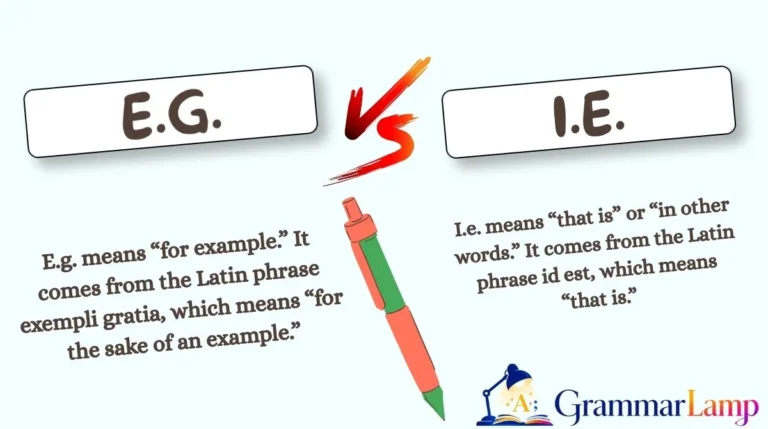
E.g. means “for example.” It comes from the Latin phrase exempli gratia, which means “for the sake of an example.”
We use e.g. when we mention one or more examples of a larger group, idea, or category.
Think of it this way:
E.g. = for example = here are some examples
Suppose someone says:
I enjoy reading different types of books, e.g., novels and biographies.
The person likes different types of books. Novels and biographies are only examples. There may be other types of books they enjoy too.
When Should You Use E.G.?
Use e.g. when you do not want to list everything. You are simply giving examples to make your meaning clearer.
For example:
You can buy fresh fruit, e.g., apples, oranges, and bananas.
The sentence does not mean that apples, oranges, and bananas are the only fruits you can buy. They are examples.
Here are more examples:
- I enjoy outdoor activities, e.g., hiking and cycling.
- You should eat healthy foods, e.g., vegetables and fresh fruit.
- Many countries, e.g., Canada and Australia, use English as an official language.
- Bring something to write with, e.g., a pen or pencil.
- We sell different kinds of electronics, e.g., phones, tablets, and laptops.
- Some animals, e.g., dogs and cats, can live with humans.
- You can learn a new skill, e.g., cooking, painting, or coding.
- I usually drink hot drinks, e.g., tea and coffee, in the morning.
In every example above, the information after e.g. gives examples of a larger idea.
A Simple Grammar Pattern
A common structure is:
General idea + e.g. + examples
For example:
I like sports, e.g., football and cricket.
The general idea is sports. Football and cricket are examples.
Another useful pattern is:
You can visit many places, e.g., museums, parks, and libraries.
The writer is not saying these are the only places you can visit. They are simply examples.
Common Learner Confusion About E.G.
One common mistake is thinking that e.g. means “that is.”
It does not.
If you are giving examples, use e.g.
Some fruits, e.g., apples and mangoes, are rich in vitamins.
If you are explaining exactly what something means, e.g. is not the right choice.
That is where i.e. comes in.
What Does “I.E.” Mean?
I.e. means “that is” or “in other words.” It comes from the Latin phrase id est, which means “that is.”
We use i.e. when we want to explain, clarify, or restate something more specifically.
Think of it this way:
I.e. = that is = in other words = exactly what I mean
For example:
I will meet you on the weekend, i.e., Saturday.
Here, Saturday is not just one possible example. The writer is explaining exactly which day they mean.
When Should You Use I.E.?
Use i.e. when the second part gives a clearer or more exact meaning of the first part.
For example:
She lives in the capital city, i.e., Islamabad.
The second part tells us exactly which city the speaker means.
Here are more examples:
- The shop is closed tomorrow, i.e., Sunday.
- I need one thing from you, i.e., your final answer.
- He works remotely, i.e., from home.
- We need to meet at the usual time, i.e., 9 a.m.
- She is my closest relative, i.e., my sister.
- The office is closed on the next public holiday, i.e., Monday.
- I want to buy the larger model, i.e., the one with more storage.
- Please send the document in digital form, i.e., as a PDF file.
In these examples, the information after i.e. explains or identifies the exact meaning.
E.G. and I.E. Do Not Work the Same Way
Compare these two sentences:
I like citrus fruits, e.g., oranges and lemons.
This gives examples. There are other citrus fruits too.
Now look at this:
My favorite citrus fruit is orange, i.e., the fruit I usually eat at breakfast.
The second part explains what the speaker means.
The basic difference is:
E.g. gives examples.
I.e. gives clarification.
Common Learner Confusion About I.E.
Some learners use i.e. whenever they want to add information. That is not always correct.
Ask yourself:
Am I giving an example, or am I explaining exactly what I mean?
If you are giving examples, use e.g.
If you are explaining or narrowing down the meaning, use i.e.
That simple question can help you choose the correct abbreviation.
Difference Between E.G. and I.E. (Detailed)
The main difference between e.g. and i.e. is the relationship between the first part and the information that follows.
With e.g., the information that follows is only an example.
With i.e., the information that follows explains or identifies the meaning of the first part.
Comparison Table
| Point | E.G. | I.E. |
|---|---|---|
| Meaning | For example | That is / in other words |
| Main purpose | Gives examples | Gives clarification |
| Latin phrase | exempli gratia | id est |
| Does it give all possibilities? | Usually no | It explains the intended meaning |
| Simple question | “Can I give an example?” | “Can I explain exactly what I mean?” |
| Example | I like sports, e.g., football. | I work remotely, i.e., from home. |
Usage Difference
Consider this sentence:
I enjoy watching team sports, e.g., football and basketball.
Football and basketball are examples of team sports.
You could add more examples:
I enjoy watching team sports, e.g., football, basketball, volleyball, and hockey.
The meaning still works.
Now consider:
I work on weekends, i.e., Saturday and Sunday.
Here, Saturday and Sunday explain exactly which days the speaker means.
The two abbreviations therefore have different jobs.
Grammar Logic
The easiest way to understand the grammar is to think about possibilities.
With e.g., the category is usually wider than the examples.
I like Asian food, e.g., sushi and noodles.
Asian food includes many other foods. Sushi and noodles are examples.
With i.e., the second part is meant to make the first part more exact.
I need to speak to the manager, i.e., the person responsible for this store.
The second part explains who “the manager” means in this situation.
Sentence Structure
Both abbreviations can appear in the middle of a sentence.
Some vegetables, e.g., carrots and spinach, are easy to cook.
She works from home, i.e., she does not go to the office.
They can also appear after a statement.
I like simple hobbies. E.g., I enjoy reading and walking.
However, in polished formal writing, many writers prefer to write for example instead of using e.g. at the beginning of a sentence.
Meaning Comparison
Here is a very useful pair:
You can use a payment method, e.g., cash or a card.
This means cash and a card are examples of payment methods.
Now:
You can pay in person, i.e., at the store.
The second part explains what “in person” means.
So remember:
E.G. opens the door to examples.
I.E. closes the meaning down to a clearer explanation.
Explore More Posts
Orientated vs Oriented: What’s the Difference? [2026 Guide]
Do You vs Are You: What’s the Difference? Complete Guide for 2026
Dateline vs Deadline: Meaning, Difference, Examples & Easy Rules (2026)
Whole vs Hole: Meaning, Difference, Examples, and Easy Rules (2026)
Grammar Rules You Must Remember
Rule 1: Use E.G. for Examples
Use e.g. when you want to give examples.
Bring some school supplies, e.g., notebooks and pens.
The sentence does not say that notebooks and pens are the only school supplies.
Rule 2: Use I.E. for Clarification
Use i.e. when you want to explain exactly what you mean.
The store closes early today, i.e., at 5 p.m.
The writer is giving the exact meaning of “early” in this situation.
Rule 3: E.G. Does Not Usually Mean “Only These”
This is an important point.
Many fruits contain natural sugar, e.g., apples, bananas, and grapes.
The sentence does not mean that only these fruits contain natural sugar.
They are examples.
If you want to say that something is a complete list, you should make that clear in another way.
Rule 4: I.E. Usually Restates or Narrows the Meaning
When you see i.e., think:
“In other words, this is exactly what I mean.”
For example:
We need to finish this today, i.e., before midnight.
The second part gives a more exact explanation of “today.”
Common Mistakes Students Make
Many learners confuse e.g. and i.e. because both abbreviations introduce extra information.
The problem is that the extra information has a different purpose.
Mistake 1: Using I.E. for Examples
Incorrect:
I enjoy sports, i.e., football and tennis.
If football and tennis are only examples, i.e. is not the best choice.
Correct:
I enjoy sports, e.g., football and tennis.
Mistake 2: Using E.G. for an Exact Explanation
Incorrect:
I work remotely, e.g., from home.
If “from home” is the exact explanation of what the speaker means by “remotely,” i.e. is better.
Correct:
I work remotely, i.e., from home.
Mistake 3: Thinking E.G. Means “Such As” Every Time
In many sentences, e.g. can be understood as “for example,” and sometimes the sentence can be rewritten with “such as.”
You can eat healthy snacks, e.g., nuts and fruit.
You could also say:
You can eat healthy snacks such as nuts and fruit.
But e.g. and “such as” are not always interchangeable in every sentence. Choose the form that makes your sentence natural and clear.
Mistake 4: Forgetting the Meaning Behind the Abbreviations
Students sometimes try to memorize the spelling without understanding the meaning.
Instead, remember the purpose.
E.G. → Examples
I.E. → Explanation
This is much easier than trying to remember the Latin words.
Easy Correction Tip
Whenever you are unsure, replace the abbreviation with its full meaning.
Read:
I like outdoor activities, e.g., hiking.
Replace it:
I like outdoor activities, for example, hiking.
It makes sense.
Now:
I work remotely, i.e., from home.
Replace it:
I work remotely, that is, from home.
It makes sense.
This quick test can help you choose correctly.
Easy Trick to Remember the Difference
Here is one of the easiest memory tricks for e.g. vs i.e.
E.G. = Example Given
Think:
E = Example
When you see e.g., think example.
I like many fruits, e.g., apples and mangoes.
Apples and mangoes are examples.
I.E. = In Explanation
Think:
I = In other words
When you see i.e., think in other words.
I need a quiet place, i.e., somewhere without loud music.
The second part explains what “a quiet place” means here.
Another useful trick is:
E.G. = many possible things
I.E. = the exact meaning
Imagine someone says:
I like pets, e.g., cats and dogs.
There are many possible pets.
But:
My favorite pet is a dog, i.e., the animal I have at home.
The second part explains exactly what the speaker means.
If you remember example vs explanation, you will usually get the answer right.
Daily Life Examples (Very Important)
Understanding real conversations makes the difference much easier.
Example 1: Talking About Food
Ali: What kind of food do you like?
Sara: I like spicy food, e.g., Mexican and Thai food.
Here, Mexican and Thai food are examples.
Example 2: Explaining a Location
Ali: Where should I meet you?
Sara: At the main entrance, i.e., the door next to the parking area.
The second part explains exactly which entrance.
Example 3: Talking About Hobbies
Friend: What do you do in your free time?
You: I enjoy creative hobbies, e.g., drawing and photography.
Drawing and photography are examples.
Example 4: Giving an Exact Time
Manager: When should we finish the work?
Employee: By the end of the day, i.e., before 6 p.m.
The second part gives a clear explanation of “the end of the day.”
Example 5: Talking About Technology
Teacher: What devices can students use?
Student: They can use electronic devices, e.g., tablets and laptops.
Tablets and laptops are examples of electronic devices.
Example 6: Clarifying a Person
A: Who is coming to the meeting?
B: The team leader, i.e., Maria.
“Maria” identifies exactly who the speaker means.
Example 7: Talking About Travel
A: Where can we go for a short trip?
B: We could visit nearby places, e.g., Lahore, Faisalabad, or Islamabad.
These places are examples of nearby travel options.
Example 8: Explaining a Rule
Teacher: What does “submit online” mean?
Student: It means sending your work digitally, i.e., through the school website.
The second part explains the meaning.
Example 9: Talking About Clothing
Friend: What should I wear?
You: Wear something formal, e.g., a suit or a dress.
A suit and a dress are examples of formal clothing.
Example 10: Clarifying a Problem
Customer: What is the problem with my order?
Employee: There is a delivery issue, i.e., your package has not left the warehouse yet.
The second part explains the exact situation.
Practice Section
Choose e.g. or i.e. in each sentence.
1. I enjoy winter sports, ___ skiing and snowboarding.
2. The meeting is tomorrow, ___ Tuesday.
3. You can use several payment methods, ___ cash or a credit card.
4. I need a digital copy, ___ a PDF file.
5. Some animals, ___ lions and tigers, live in groups.
Answers
1. e.g. — skiing and snowboarding are examples of winter sports.
2. i.e. — Tuesday explains exactly which day “tomorrow” means.
3. e.g. — cash and a credit card are examples of payment methods.
4. i.e. — a PDF file explains exactly what kind of digital copy is needed.
5. e.g. — lions and tigers are examples of animals that live in groups.
A good way to practice is to say the full meaning aloud. If “for example” works, choose e.g. If “that is” or “in other words” works, choose i.e.
More Helpful posts
Farther vs Further: The Easy Difference Explained for 2026
In Development vs Under Development: Meaning, Differences, and Examples (2026)
Non-Restrictive Clauses: Meaning, Rules, Examples & Differences in 2026
Conform With vs Conform To (2026): What’s the Difference? Easy Grammar Guide for English Learners
FAQs
What is the difference between e.g. and i.e.?
E.g. means “for example” and introduces examples. I.e. means “that is” or “in other words” and gives a clearer or more exact explanation.
For example, “I like fruit, e.g., apples” gives an example. “I work remotely, i.e., from home” explains the meaning more exactly.
Can we use e.g. in questions?
Yes, you can use e.g. in questions, especially in writing.
For example:
Which sports do you enjoy, e.g., football or tennis?
However, in everyday spoken English, people often simply say “for example” instead of e.g.
Is e.g. formal or informal?
E.g. is common in written English, especially in academic, business, technical, and professional writing.
In casual messages, writing “for example” may sound more natural. The choice depends on the situation and the style of the writing.
Is i.e. formal or informal?
I.e. is mainly used in writing and can be common in professional, academic, and technical texts.
In everyday conversation, people normally say “that is,” “in other words,” or give the explanation directly instead of saying “i.e.”
Is e.g. the same as “such as”?
They can have similar meanings when examples are being introduced.
For example:
I like fruits, e.g., apples and oranges.
You could also say:
I like fruits such as apples and oranges.
However, e.g. is an abbreviation that directly means “for example,” while “such as” is a normal part of the sentence.
Is i.e. the same as “for example”?
No. This is one of the most important differences.
E.g. means “for example.”
I.e. means “that is” or “in other words.”
Use e.g. when giving examples and i.e. when explaining exactly what you mean.
Conclusion
The difference between e.g. and i.e. is small, but it is very useful in English writing. Once you understand the purpose of each abbreviation, choosing the right one becomes much easier.
Remember the simple rule:
E.g. = for example.
I.e. = that is / in other words.
Use e.g. when you are giving examples from a larger group. For instance, “I enjoy sports, e.g., football and cricket.” Football and cricket are examples.
Use i.e. when you are explaining or making something more exact. For example, “The office closes early, i.e., at 4 p.m.” The second part gives the exact meaning.
You do not need to memorize the Latin expressions to use these correctly. Just ask yourself one question: Am I giving an example, or am I explaining exactly what I mean?
Practice this difference in your emails, notes, and everyday writing. After a little practice, e.g. vs i.e. will become much easier to remember.

Liam Derren is a language writer at GrammarLamp, creating simple, helpful content about grammar, words, and everyday English. He makes language learning clear, practical, and easy to understand.
1 thought on “EG vs IE: Easy Difference, Meaning, Rules, and Examples in 2026”