
English has many words that look almost the same but do not always sound equally natural to native speakers.
Imbalanced vs disbalanced is one of those confusing pairs. Both words can be connected with the idea of something being “not balanced,” so it is easy to think that they can always replace each other.
In everyday English, however, there is an important difference in how commonly and naturally they are used.
The word imbalanced is much more common in modern English. It is widely used when talking about things that lack balance, equality, stability, or the right proportion.
You may see it in sentences about a diet, a relationship, a financial system, a workload, or even a physical object.
Disbalanced is a real word, but it is much less common. Some dictionaries recognize it, and it can mean “thrown out of balance” or “made unbalanced.” However, many speakers prefer unbalanced or imbalanced, depending on the situation.
This distinction matters because knowing a word’s dictionary meaning is not enough. You also need to know whether the word sounds natural in real English.
By the end of this guide, you will understand what imbalanced and disbalanced mean, how they differ, when to use each one, which word is more natural, and how to avoid common mistakes.
The examples are written in simple English so you can use the words confidently in everyday writing and conversation.
What Does “Imbalanced” Mean?
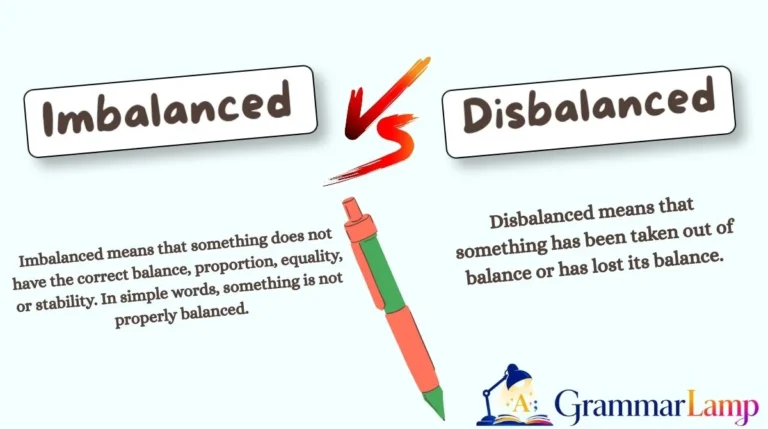
Imbalanced means that something does not have the correct balance, proportion, equality, or stability. In simple words, something is not properly balanced.
It is formed from the word balanced with the prefix im-. The prefix changes the meaning to the opposite or negative form.
For example:
- balanced → properly equal or stable
- imbalanced → not properly equal or stable
Imbalanced is an adjective. It describes a person, thing, situation, system, or condition.
It is especially common when talking about things that have unequal parts or are not working in the right proportion. For example, a diet can be imbalanced if it contains too much of one type of food and not enough of another.
When Should You Use “Imbalanced”?
Use imbalanced when something lacks balance or has an unsuitable proportion.
Here are some common areas where you may see it:
- diet and nutrition
- work and personal life
- relationships
- financial systems
- physical objects
- chemical mixtures
- social situations
- workloads
- teams and competition
Consider these examples:
- He has an imbalanced diet.
This means his diet does not contain the right variety or proportion of nutrients.
- The company has an imbalanced workload.
Some employees may have far too much work while others have much less.
- The machine became imbalanced during operation.
The parts are no longer working with the correct physical balance.
- Their relationship became imbalanced.
One person may be giving much more time, effort, or support than the other.
- The budget is imbalanced.
The money coming in and the money being spent are not in a suitable balance.
- The team has an imbalanced attack.
The team may be very strong in one area but weak in another.
- An imbalanced mixture can affect the final result.
The ingredients are not present in the correct proportions.
A Common Learner Confusion
Many learners believe that imbalanced always means exactly the same thing as unbalanced. Sometimes the two words can be used in similar situations, but their usage can have slightly different shades.
Unbalanced is often the more general and everyday choice.
Imbalanced is especially useful when you want to stress that the parts, amounts, or sides are unequal or not in the right proportion.
For example:
The child has an imbalanced diet.
This sounds natural because the sentence focuses on the proportions of different foods.
You can also say:
The child has an unbalanced diet.
That is also very common.
The important point is that imbalanced is a normal and useful English adjective. It is far more common in modern English than disbalanced.
What Does “Disbalanced” Mean?
Disbalanced means that something has been taken out of balance or has lost its balance. It is also used as an adjective and, less commonly, can appear as a verb form related to disbalance.
The word is understandable, and dictionaries may list it. However, it is much less common than imbalanced and unbalanced in standard modern English.
This is where many English learners become confused. Because dis- is a common English prefix, learners may naturally think that disbalanced is the normal opposite of balanced.
English does not always work that way.
We cannot simply add a negative prefix to any word and assume that the result is the most natural English word.
For example, English commonly uses:
- agree → disagree
- appear → disappear
- connect → disconnect
But with balanced, the forms most commonly preferred are unbalanced and imbalanced, depending on the context.
When Can “Disbalanced” Be Used?
Disbalanced can be used when the meaning is close to thrown out of balance or caused to lose balance.
However, it is relatively uncommon, so it may sound unusual to many native speakers.
Here are examples showing how the word can be understood:
- The sudden movement disbalanced the object.
The movement caused the object to lose its balance.
- The machine became disbalanced after one part was removed.
The machine no longer had its proper balance.
- The heavy load disbalanced the vehicle.
The load caused the vehicle to become uneven or unstable.
- The force of the wind disbalanced the structure.
The wind caused the structure to lose its stable position.
- The new arrangement disbalanced the system.
The change disturbed the previous balance.
- The uneven weight disbalanced the platform.
The unequal weight caused the platform to become unstable.
- The change in pressure disbalanced the equipment.
The equipment was affected by a change that disturbed its balance.
These sentences can be understood, but in many cases a native speaker would choose a different expression.
For example:
The heavy load made the vehicle unbalanced.
or:
The heavy load threw the vehicle off balance.
These alternatives often sound more natural.
The Main Problem With “Disbalanced”
The biggest issue is not that disbalanced is impossible. The issue is natural usage.
A word can exist in English without being the word people normally choose in everyday communication.
For learners, this is an important lesson. When two words have similar dictionary meanings, always consider:
Which one do native speakers commonly use?
In most normal situations, imbalanced or unbalanced is a safer choice than disbalanced.
Difference Between Imbalanced and Disbalanced
The basic difference is simple:
Imbalanced is common and widely accepted in modern English.
Disbalanced is much less common and is often replaced by unbalanced, imbalanced, or thrown off balance.
Both words can relate to a lack of balance, but they are not equally natural.
Comparison Table
| Feature | Imbalanced | Disbalanced |
|---|---|---|
| Part of speech | Adjective | Adjective; related verb use is also possible |
| Basic meaning | Not properly balanced | Made or thrown out of balance |
| Common in modern English | Yes | Much less common |
| Natural for learners | Yes | Usually avoid unless context requires it |
| Common in everyday speech | Fairly common | Rare |
| Common alternatives | Unbalanced | Unbalanced, imbalanced, thrown off balance |
| Can describe a system? | Yes | Possible, but uncommon |
| Can describe physical balance? | Yes | Yes, but unusual |
| Best general choice | Imbalanced / unbalanced | Usually unbalanced / imbalanced |
Usage Difference
The most important difference is frequency and naturalness.
If you want to say that something lacks balance, imbalanced is usually a good choice.
The diet is imbalanced.
If you mean that something has physically lost balance, unbalanced or thrown off balance may sound better.
The sudden movement threw the chair off balance.
Disbalanced can express a similar idea, but it is not the first choice for most speakers.
Grammar Logic
Imbalanced works as an adjective:
an imbalanced system
an imbalanced diet
an imbalanced workload
It can also appear after linking verbs:
The system is imbalanced.
The situation became imbalanced.
Disbalanced can also function as an adjective:
a disbalanced system
But because the word is uncommon, the sentence may sound awkward even when it is grammatically understandable.
Sentence Structure
The common pattern is:
Subject + linking verb + adjective
The system is imbalanced.
Another pattern is:
Adjective + noun
an imbalanced system
With disbalanced, you may see a structure involving an action that causes something to lose balance:
Subject + verb + object
The heavy load disbalanced the vehicle.
However, modern English usually prefers:
The heavy load made the vehicle unbalanced.
or:
The heavy load threw the vehicle off balance.
Meaning Comparison
Think of imbalanced as describing the condition of something.
The budget is imbalanced.
It tells us that the budget is not properly balanced.
Think of disbalanced as focusing more on the idea of causing or creating a loss of balance.
The heavy box disbalanced the platform.
The box caused the platform to lose its balance.
Even here, however, unbalanced or threw off balance is normally more natural.
Grammar Rules You Must Remember
Rule 1: Use “Imbalanced” for a lack of proper balance
When something does not have the correct proportion or equality, imbalanced is a strong choice.
Example:
The company has an imbalanced workload.
Some workers have much more work than others.
Rule 2: “Imbalanced” is an adjective
You can put it before a noun or after a linking verb.
Before a noun:
She follows an imbalanced diet.
After a linking verb:
Her diet is imbalanced.
Both structures are grammatically correct.
Rule 3: Do not assume “dis-” is always the correct opposite prefix
English prefixes are not completely predictable.
Although dis- often creates an opposite meaning, that does not mean every word naturally accepts it.
For this reason, do not automatically change:
balanced
into:
disbalanced
In many situations, unbalanced or imbalanced is more natural.
Rule 4: Choose natural English over unusual English
Even when disbalanced can be understood, another expression may be better.
Instead of:
The sudden movement disbalanced him.
A more natural sentence is:
The sudden movement made him lose his balance.
Or:
The sudden movement threw him off balance.
Good English is not only about whether a word can be understood. It is also about choosing the expression people normally use.
Common Mistakes Students Make
One common mistake is assuming that disbalanced is the direct opposite of balanced.
A learner may think:
balanced → disbalanced
because the prefix dis- often creates an opposite meaning.
But English vocabulary does not always follow a simple mathematical pattern.
Mistake 1: Using “disbalanced” everywhere
Less natural:
I have a disbalanced diet.
Better:
I have an imbalanced diet.
Or:
I have an unbalanced diet.
Mistake 2: Thinking “disbalanced” is always wrong
The opposite mistake is also possible.
Disbalanced is not simply meaningless. It is an established word and can be found in dictionaries and texts.
The better lesson is:
Disbalanced exists, but it is uncommon.
That is more accurate than saying it is always grammatically wrong.
Mistake 3: Confusing “imbalanced” with “imbalance”
Remember the difference between an adjective and a noun.
Imbalance is a noun:
There is an imbalance in the system.
Imbalanced is an adjective:
The system is imbalanced.
A quick test is to ask:
Am I naming the problem or describing something?
If you are naming the problem, use imbalance.
If you are describing something, use imbalanced.
Mistake 4: Using “imbalanced” when “unbalanced” sounds more natural
Not every situation requires imbalanced.
For physical movement, unbalanced is often very natural.
He became unbalanced and fell.
For unequal proportions, imbalanced can be especially useful.
The country has an imbalanced trade relationship.
There is some overlap, so context matters.
Easy Correction Tip
When you are unsure about disbalanced, replace it with one of these:
- imbalanced
- unbalanced
- thrown off balance
- made unbalanced
- lost its balance
Then choose the expression that best matches your meaning.
Easy Trick to Remember the Difference
Here is a simple memory trick:
IMBALANCED = not balanced
Think:
IMbalanced = I’m not balanced.
It is not a perfect word-building rule, but it can help you remember the common adjective.
Now remember:
DISBALANCED = unusual choice
When you see disbalanced, stop for a second and ask:
“Would unbalanced or imbalanced sound more natural here?”
Most of the time, the answer will be yes.
There is another useful trick.
Imagine a weighing scale.
If the two sides are not equal, you can say:
The scale is imbalanced.
If something suddenly pushes one side down, you can say:
The scale was thrown off balance.
This second expression is especially natural in everyday English.
So instead of trying to memorize a complicated grammar rule, remember three useful choices:
imbalanced = lacking proper balance
unbalanced = not balanced
thrown off balance = caused to lose balance
That covers most situations you will meet.
Daily Life Examples
The easiest way to understand confusing words is to see them in normal situations.
1. Talking about food
A: Why are you changing your diet?
B: My doctor said I have an imbalanced diet.
Here, imbalanced means the different parts of the diet are not in the right proportion.
2. Talking about work
My work schedule is imbalanced. I have too much work on some days and almost nothing on others.
This describes an unequal distribution of work.
3. Talking about a relationship
Their relationship became imbalanced because only one person was making an effort.
The word describes an unequal situation.
4. Talking about money
The company’s financial system is imbalanced.
The income, spending, assets, or other financial parts may not be in a suitable relationship.
5. Talking about physical movement
I stepped on the wet floor and became unbalanced.
Here, unbalanced is very natural because the sentence is about physical stability.
6. Talking about a bicycle
The heavy bag on one side threw my bicycle off balance.
This sounds more natural than saying:
The heavy bag disbalanced my bicycle.
7. Talking about a machine
The machine became imbalanced after one of its parts was replaced.
The machine no longer has the proper physical balance.
8. Talking about a team
The team is imbalanced because it has many attacking players but very few defenders.
The team has too many players or strengths in one area and too few in another.
9. Talking about study time
My study schedule is imbalanced. I spend too much time on English and not enough time on math.
The distribution of time is unequal.
10. Talking about an object
The box was unbalanced, so it fell from the shelf.
For a simple physical situation like this, unbalanced is usually the natural choice.
Notice how the context helps you choose the word. You do not need to force imbalanced or disbalanced into every sentence.
Practice Section
Choose the better option in each sentence.
1. She has an ______ diet.
A. imbalanced
B. disbalanced
2. The sudden movement threw the chair ______ balance.
A. off
B. imbalanced
3. The company has an ______ workload.
A. imbalanced
B. disbalanced
4. He became ______ and nearly fell.
A. unbalanced
B. disbalanced
5. There is an ______ between the two sides.
A. imbalance
B. imbalanced
Answers
1. A — imbalanced
“Imbalanced diet” is a common expression.
2. A — off
“Throw something off balance” is a natural English expression.
3. A — imbalanced
“Imbalanced workload” describes unequal distribution of work.
4. A — unbalanced
“Became unbalanced” is natural for physical stability.
5. A — imbalance
“Imbalance” is a noun, so it names the unequal condition.
FAQs
What is the difference between imbalanced and disbalanced?
Both words can refer to something that is not properly balanced. However, imbalanced is much more common and natural in modern English.
Disbalanced is less common and is often replaced by unbalanced, imbalanced, or thrown off balance.
Is “disbalanced” a correct English word?
Yes, disbalanced is a recognized word, but it is uncommon. Its meaning can relate to causing something to lose balance.
For everyday English, learners will usually sound more natural by choosing unbalanced, imbalanced, or thrown off balance, depending on the sentence.
Is imbalanced a formal or informal word?
Imbalanced can be used in both formal and everyday English.
You may see it in discussions about nutrition, economics, business, relationships, science, and other subjects. It is not limited to formal writing.
Can I use imbalanced in a question?
Yes. Imbalanced works normally in questions.
For example:
Is your diet imbalanced?
You can also ask:
Why is the system imbalanced?
The grammar is the same as with other adjectives.
Is “unbalanced” better than “imbalanced”?
Not always. Both are correct, but they can fit different contexts.
Unbalanced is very common for general or physical situations. Imbalanced is often useful when talking about unequal proportions, systems, diets, workloads, or relationships.
For example:
The box is unbalanced.
But:
The diet is imbalanced.
Which is more common: imbalanced or disbalanced?
Imbalanced is much more common in modern standard English.
If you are learning English and need to choose one word, imbalanced is generally the safer choice. In physical situations, unbalanced may be even more natural.
Conclusion
The difference between imbalanced and disbalanced is mainly about common usage and natural English.
Both words can be connected with the idea of something losing or lacking balance, but they are not equally common.
Imbalanced is a normal, useful adjective. It is often used for unequal proportions or situations, such as an imbalanced diet, imbalanced workload, imbalanced system, or imbalanced relationship.
Disbalanced is much less common. Although it can be understood and is recognized in some dictionaries, native speakers often choose unbalanced, imbalanced, or thrown off balance instead.
If you are unsure which word to use, do not worry. Ask yourself what you really mean. Are you describing something that lacks proper balance?
Try imbalanced or unbalanced. Are you describing something that suddenly lost its physical stability? Unbalanced or thrown off balance may be the better choice.
The more examples you read and use, the easier this distinction will become. Practice these words in short, everyday sentences, and soon the natural choice will feel much clearer.

Liam Derren is a language writer at GrammarLamp, creating simple, helpful content about grammar, words, and everyday English. He makes language learning clear, practical, and easy to understand.
1 thought on “Imbalanced vs Disbalanced: What Is the Difference? (2026)”