
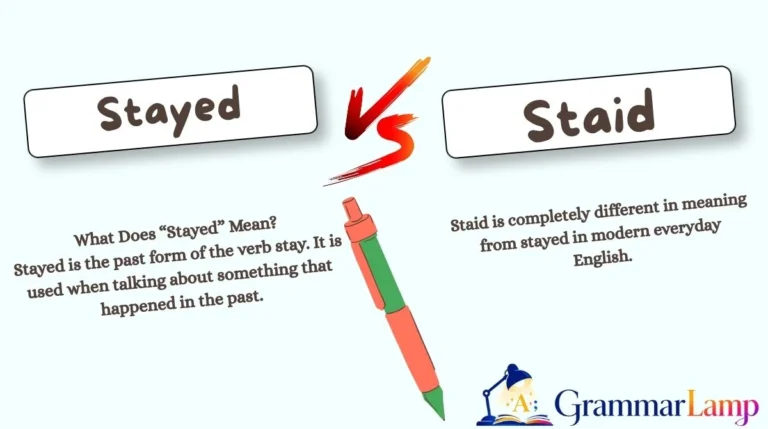
Have you ever seen stayed and staid and wondered why they look almost the same but seem to have completely different meanings?
This is a common problem for English learners. The two words are also pronounced the same in modern English, which can make the confusion even bigger.
The important thing to remember is that stayed and staid do not normally have the same job in a sentence.
Stayed is the past simple and past participle form of the verb stay. It usually means that someone did not leave a place, continued in a situation, or spent some time somewhere.
Staid, on the other hand, is an adjective. It describes a person, lifestyle, place, organization, or style as serious, quiet, traditional, boring, or slightly old-fashioned.
So, although the words sound exactly alike, they have different meanings and different grammatical roles.
Once you understand what each word does, the difference becomes much easier. You will know when to use stayed for actions in the past and when staid is used to describe something with a calm, serious, or old-fashioned character.
More Useful posts
As Soon As vs As Early As: Easy Difference, Rules & Examples in 2026
Imbalanced vs Disbalanced: What Is the Difference? (2026)
Orientated vs Oriented: What’s the Difference? [2026 Guide]
Do You vs Are You: What’s the Difference? Complete Guide for 2026
What Does “Stayed” Mean?
Stayed is the past form of the verb stay. It is used when talking about something that happened in the past. The basic meaning of stay is to remain in a place or situation instead of leaving. It can also mean continuing in a particular condition or spending a period of time somewhere.
For example:
- I stayed at home yesterday.
- We stayed at the hotel for three nights.
- She stayed after work to help me.
- They stayed friends after college.
In each sentence, stayed describes something that happened in the past.
When Do We Use “Stayed”?
We use stayed mainly when we are talking about a past action or past situation.
You can use it when someone:
1. Did not leave a place
We stayed at home because it was raining.
The people did not go outside. They remained at home.
2. Spent time somewhere
He stayed in Lahore for two weeks.
This means he lived or remained there for that period as a visitor or temporary resident.
3. Continued in a situation
She stayed at her job for five years.
Here, stayed means she continued working there instead of leaving the job.
4. Continued in a condition
The door stayed open all night.
The door remained open.
5. Continued to be something
They stayed calm during the problem.
The meaning is that they continued to be calm.
These uses are all connected to the main idea of remaining or continuing. Cambridge and Oxford both describe stay as remaining in a place, continuing in a state, or spending time somewhere.
Grammar Rule for “Stayed”
The basic forms are:
stay → stayed → stayed
The word stayed can be used as:
- the past simple: I stayed there.
- the past participle: I have stayed there.
Oxford lists stayed as both the past simple and past participle of stay.
8 Example Sentences with “Stayed”
- I stayed home because I was tired.
- We stayed at a small hotel near the beach.
- She stayed late at the office.
- They stayed with their grandparents for a week.
- He stayed calm during the meeting.
- The children stayed inside because of the storm.
- I stayed for dinner after the meeting.
- My brother stayed in the same school for six years.
A Common Learner Confusion
The biggest problem is pronunciation. Stayed is pronounced /steɪd/. When you hear it in conversation, you may not know whether the speaker means stayed or staid.
For example:
He stayed at a quiet hotel.
and
He lived a staid life.
Both words sound like “stayed.” The sentence gives you the meaning.
This is why spelling becomes especially important when you are writing.
What Does “Staid” Mean?
Staid is completely different in meaning from stayed in modern everyday English.
Staid is an adjective. It describes something or someone that is serious, calm, traditional, not very exciting, or somewhat old-fashioned. Cambridge defines it as serious, boring, and slightly old-fashioned, while Oxford describes it as not amusing or interesting and old-fashioned.
For example:
The company has a staid image.
This means the company’s image seems serious, traditional, and perhaps a little boring.
Another example:
His staid lifestyle did not appeal to his younger friends.
Here, staid describes his lifestyle. It suggests that his way of living was quiet, serious, and not very exciting.
When Do We Use “Staid”?
Use staid when you want to describe the character or style of something.
It can describe:
- a person
- a lifestyle
- a company
- an organization
- a design
- a building
- a newspaper
- a profession
- a social environment
The word is often used in writing rather than casual everyday speech. It can carry a slightly negative idea because something described as staid may seem too dull, old-fashioned, or lacking excitement.
For example:
The hotel has a staid, traditional style.
The sentence does not tell us that the hotel remained somewhere. It describes the hotel’s appearance or character.
Grammar Rule for “Staid”
Because staid is an adjective, it normally appears with a noun or after a linking verb.
Common patterns include:
staid + noun
a staid lifestyle
a staid company
a staid appearance
or:
be + staid
The town is staid.
His personality seems staid.
You would not normally use staid as the past-tense verb meaning “did not leave.” That job belongs to stayed.
8 Example Sentences with “Staid”
- The magazine has a very staid image.
- His parents preferred a staid lifestyle.
- The old building has a staid appearance.
- She works in a rather staid office.
- The town feels staid and traditional.
- The company is trying to change its staid image.
- He is known for his staid personality.
- The club has a staid, old-fashioned atmosphere.
Common Confusion with “Staid”
Some learners see staid and think it is simply another spelling of the past tense of stay. That is not how modern English normally works.
It is true that staid is historically related to the verb stay. Oxford notes that it comes from an old or archaic past participle of stay. However, in modern English, staid functions as an adjective with its own established meaning.
So, if you want to say that someone remained somewhere, write:
She stayed at home.
Not:
She staid at home.
Difference Between Stayed and Staid
The easiest way to understand the difference is to focus on grammar first and meaning second.
Stayed is a verb form.
Staid is an adjective.
That one difference solves most of the confusion.
| Word | Part of Speech | Main Meaning | Common Use | Example |
|---|---|---|---|---|
| Stayed | Verb | remained, did not leave, continued | Talking about a past action or situation | We stayed at home. |
| Staid | Adjective | serious, traditional, boring, old-fashioned | Describing a person, style, place, or lifestyle | It was a staid hotel. |
Usage Difference
Use stayed when something happened.
I stayed at work until 8 p.m.
The sentence tells us about an action in the past.
Use staid when you describe something.
It was a staid office.
The sentence describes the office as serious, traditional, or not exciting.
A useful question is:
Am I talking about an action, or am I describing something?
If you are talking about an action, stayed may be correct.
If you are describing the character or style of something, staid may be correct.
Grammar Logic
Look at these two examples:
They stayed at the hotel.
They chose a staid hotel.
In the first sentence, stayed is the main verb. It tells us what they did.
In the second sentence, staid is an adjective. It describes the hotel.
This is the grammar logic behind the difference.
Sentence Structure Difference
Stayed can stand as the main verb:
Sarah stayed.
We stayed there all night.
He stayed with us.
But staid normally needs a noun to describe or a linking verb:
a staid man
a staid lifestyle
The man was staid.
You cannot replace stayed with staid just because both words sound the same.
Meaning Comparison
Compare these sentences:
He stayed quiet.
This means he remained quiet.
He was staid.
This describes him as serious, calm, traditional, or somewhat dull.
The meanings are not the same.
Another pair:
We stayed at the house.
This tells us where we remained.
The house looked staid.
This describes the character or appearance of the house.
Explore More Posts
Dateline vs Deadline: Meaning, Difference, Examples & Easy Rules (2026)
Whole vs Hole: Meaning, Difference, Examples, and Easy Rules (2026)
Farther vs Further: The Easy Difference Explained for 2026
In Development vs Under Development: Meaning, Differences, and Examples (2026)
Grammar Rules You Must Remember
Rule 1: Use “Stayed” for the Past Tense of “Stay”
When the verb stay happened in the past, use stayed.
We stayed there last night.
She stayed after class.
Do not use staid for this meaning.
Rule 2: Use “Staid” as an Adjective
Use staid to describe someone or something as serious, traditional, boring, or old-fashioned.
He has a staid personality.
The newspaper has a staid image.
Here, staid is describing a noun.
Rule 3: Check the Job of the Word
Ask yourself: Is the word doing an action, or describing something?
Action:
They stayed at home.
Description:
They lived a staid life.
This small question can prevent many spelling mistakes.
Rule 4: Do Not Trust the Sound Alone
Both stayed and staid are pronounced /steɪd/.
So listening is not enough. You must look at the meaning and grammar.
I stayed with my cousin.
My cousin has a staid personality.
They sound the same, but they are spelled differently because they mean different things.
Common Mistakes Students Make
These words can cause mistakes for several reasons. First, they sound identical. Second, learners may see staid and assume it is a less common spelling of stayed. Third, the word staid is much less common in everyday conversation, so many beginners have not seen it before.
Mistake 1: Using “Staid” for Past Stay
Wrong:
I staid at home yesterday.
Correct:
I stayed at home yesterday.
Why? Because you are talking about the past form of the verb stay.
Mistake 2: Using “Stayed” When Describing Something
Wrong:
The office had a stayed atmosphere.
Correct:
The office had a staid atmosphere.
Here, you are describing the atmosphere as serious, dull, or old-fashioned.
Mistake 3: Thinking They Are Different Forms of the Same Word
They are not simply two modern spellings of one everyday verb.
Stayed is the regular past form of stay. Staid is an adjective with a separate modern meaning.
Easy Correction Tips
When you are unsure, look at the words around the blank.
If the sentence needs a verb, think about stayed.
We ___ at home.
→ stayed
If the sentence needs an adjective, think about staid.
It was a ___ lifestyle.
→ staid
Another useful clue is the meaning.
If you can replace the word with remained, did not leave, or continued, you probably need stayed.
If you can replace it with serious, traditional, or old-fashioned, you probably need staid.
Easy Trick to Remember the Difference
Here is a simple memory trick:
Stayed = Stayed somewhere
Staid = Serious or old-fashioned
Think of stayed as connected to stay.
I stayed at home.
The word contains stay, so it is easy to connect the two.
For staid, imagine an old-fashioned office with serious people sitting quietly at their desks. That image can help you remember that staid describes something serious, traditional, or not very exciting.
Try this pair:
I stayed in the office.
The office was staid.
The first sentence answers “What did I do?”
The second answers “What was the office like?”
That is the real difference.
You can also remember this very simple test:
Stayed = action
Staid = description
Once this becomes automatic, these two words are much easier.
Daily Life Examples (Very Important)
Real conversations are one of the best ways to understand confusing words. Here are some simple examples using both words naturally.
Example 1: Staying Home
Ali: Why didn’t you go out last night?
Bilal: It was raining, so I stayed home.
Here, stayed is the past tense of stay.
Example 2: Describing a Person
Sara: What is your new manager like?
Ayesha: He is very staid and serious.
Here, staid describes the manager’s personality.
Example 3: Hotel
Tom: Where did you sleep during your trip?
Mike: We stayed at a small hotel near the station.
The word describes a past action.
Example 4: Old-Fashioned Style
Tom: What did you think of the hotel?
Mike: It was clean, but the design was a little staid.
Here, staid means traditional and not very exciting.
Example 5: School
Teacher: Why were you still here after class?
Student: I stayed to finish my homework.
Again, this is an action, so use stayed.
Example 6: Business
Employee: Why is the company changing its website?
Manager: People thought the old design looked too staid.
The word describes the design.
Example 7: Family Visit
John: Did your sister leave early?
David: No, she stayed with us until Sunday.
It means she remained with them.
Example 8: Lifestyle
John: Does your uncle enjoy parties?
David: Not really. He has a very staid lifestyle.
The adjective describes his way of living.
Example 9: Waiting
Mother: Why did you stay here so long?
Son: I stayed because I wanted to help Dad.
The past form is stayed.
Example 10: Newspaper
Reader: Has the newspaper changed much?
Editor: Yes. It used to have a very staid image.
The word describes the newspaper’s old character or public style.
Practice Section
Choose the correct word: stayed or staid.
1. We _____ at home all weekend.
2. The old hotel had a very _____ appearance.
3. She _____ after work to finish the report.
4. His lifestyle is quiet and _____.
5. They _____ with their friends during the holiday.
Answers
1. stayed
We stayed at home all weekend.
2. staid
The hotel had a staid appearance.
3. stayed
She stayed after work to finish the report.
4. staid
His lifestyle is quiet and staid.
5. stayed
They stayed with their friends during the holiday.
A good practice method is to explain why each answer works instead of only memorizing the answer. Ask yourself whether the word is an action or a description.
More Helpful posts
Non-Restrictive Clauses: Meaning, Rules, Examples & Differences in 2026
Conform With vs Conform To (2026): What’s the Difference? Easy Grammar Guide for English Learners
Who’s vs Whose (2026): What’s the Difference? Easy Grammar Rules, Examples, and Common Mistakes
Compare to vs Compare with: Easy Grammar Guide for 2026
FAQs
What is the difference between stayed and staid?
Stayed is the past simple and past participle form of the verb stay. It means remained somewhere, did not leave, or continued in a situation. Staid is an adjective meaning serious, traditional, boring, or slightly old-fashioned.
Are stayed and staid pronounced the same?
Yes. In modern English, both are pronounced /steɪd/. This is called a homophone situation because the words sound the same while having different spellings and meanings.
Can I use staid as the past tense of stay?
No, not in normal modern English. The standard past tense of stay is stayed. Staid is now used mainly as an adjective describing something serious, traditional, dull, or old-fashioned.
Is staid formal or informal?
Staid is more common in formal or written English than in everyday casual speech. People may use simpler words such as serious, traditional, quiet, or old-fashioned in normal conversation.
Can stayed be used in questions?
Yes. Since stayed is a verb form, it can easily appear in questions about the past.
For example:
Did you stay at the hotel?
or:
Where did you stay last night?
Notice that after did, we use stay, not stayed.
Why do people confuse stayed and staid?
The main reason is that they sound the same. Both are pronounced /steɪd/, but they have different meanings and different grammatical roles. Stayed is a verb form, while staid is an adjective.
Conclusion
The difference between stayed and staid is much easier once you stop focusing on their sound and start looking at their meaning and grammar.
Stayed is the past form of stay. Use it when someone remained somewhere, did not leave, continued in a situation, or spent time in a place.
We stayed at home.
Staid is an adjective. Use it when you describe someone or something as serious, traditional, boring, quiet, or slightly old-fashioned.
It was a staid old office.
The key memory trick is simple: stayed = action, while staid = description.
Because the two words sound the same, spelling can be difficult at first. That is completely normal.
The best way to learn them is to read and write your own sentences. After you see the difference a few times, choosing the correct word will feel much more natural.

Liam Derren is a language writer at GrammarLamp, creating simple, helpful content about grammar, words, and everyday English. He makes language learning clear, practical, and easy to understand.