
English learners often get confused when they want to ask a simple question such as “Do you like coffee?” or “Are you tired?”
Both questions are correct, but they use different helping verbs. The problem is that do and are can both appear at the beginning of a question, so it is easy to mix them up.
This small difference is very important in everyday English. You hear questions like “Do you work here?”, “Are you working today?”, “Do you know him?”, and “Are you ready?” all the time.
If you understand why these questions are different, your spoken and written English will become much more natural.
The easiest way to understand do you vs are you is to look at the word that comes after them and the meaning of the sentence.
Do you is usually used with ordinary verbs when we ask about actions, habits, likes, opinions, facts, or regular activities.
Are you is commonly used with adjectives, nouns, places, and the -ing form of a verb.
Once you learn these patterns, choosing between “do you” and “are you” becomes much easier.
You will also learn the common mistakes students make, simple memory tricks, everyday examples, and a short practice section to check your understanding.
What Does “Do You” Mean?
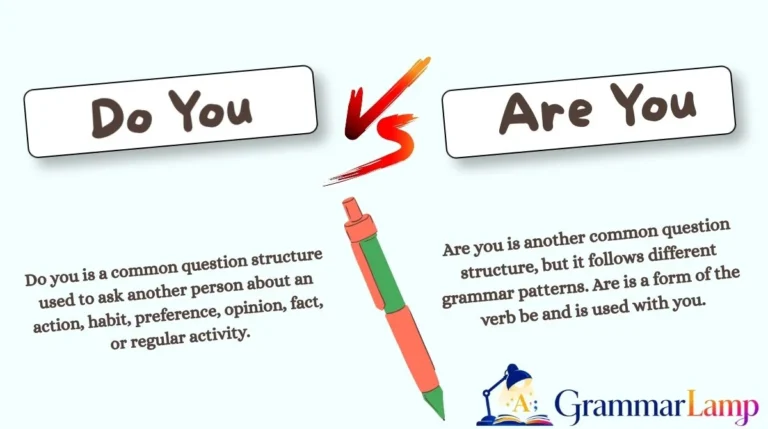
Do you is a common question structure used to ask another person about an action, habit, preference, opinion, fact, or regular activity.
Here, do works as a helping verb. The main verb stays in its base form.
Basic grammar rule
The common structure is:
Do + you + base verb + …?
For example:
- Do you like pizza?
- Do you play football?
- Do you speak English?
- Do you work here?
- Do you know my brother?
- Do you need some help?
- Do you live in Lahore?
- Do you understand this question?
Notice something important: after do you, we normally use the basic form of the verb.
We say:
Do you like coffee?
Not:
Do you likes coffee?
The -s is not added to the main verb because do is already helping to form the question.
When should you use “Do you”?
Use do you when you are asking about what someone does, likes, knows, needs, wants, or usually does.
For example, if you meet someone for the first time, you might ask:
Do you work in this office?
You are asking about the person’s job or regular activity.
If you are talking about hobbies, you might ask:
Do you play tennis?
If you want to know someone’s preference, you can ask:
Do you like chocolate?
If you want to know whether someone has knowledge of something, you can ask:
Do you know the answer?
More examples with “Do you”
- Do you drink coffee every morning?
- Do you like this song?
- Do you study English at school?
- Do you need my phone?
- Do you remember her name?
- Do you watch movies on weekends?
- Do you want some water?
- Do you understand me?
A common learner confusion
Many learners think do means “perform an action” in every sentence. That is not always true.
In a question such as “Do you like tea?”, the word do is mainly a helping verb. The important meaning comes from like.
Similarly:
Do you know him?
Here, do does not mean “perform.” It helps turn the statement “You know him” into the question “Do you know him?”
This is why you should think of do as a question helper in these sentences.
What Does “Are You” Mean?
Are you is another common question structure, but it follows different grammar patterns. Are is a form of the verb be and is used with you.
We use are you to ask about a person’s condition, identity, description, location, or an action happening around now.
The structure depends on what comes after are you.
Basic structures
With an adjective:
Are + you + adjective?
Example:
Are you tired?
With a noun:
Are + you + noun?
Example:
Are you a teacher?
With a place or location:
Are + you + place?
Example:
Are you at home?
With an -ing verb:
Are + you + verb-ing?
Example:
Are you studying?
When should you use “Are you”?
Use are you when the next word describes or identifies the person, or when you are asking about something happening now or around the present time.
For example:
Are you hungry?
Here, hungry is an adjective describing your condition.
Are you a student?
Here, a student is a noun phrase identifying you.
Are you at work?
Here, at work tells us your location.
Are you studying English?
Here, studying is the present participle form and describes an activity in progress.
More examples with “Are you”
- Are you ready?
- Are you busy?
- Are you happy?
- Are you a doctor?
- Are you at school?
- Are you listening to me?
- Are you waiting for John?
- Are you feeling better?
A common learner confusion
A frequent mistake is using are you before an ordinary base verb.
For example:
Are you like coffee? ❌
This is incorrect.
The correct sentence is:
Do you like coffee? ✅
Why? Because like is an ordinary verb here. It is not an adjective and it is not an -ing form.
Another common mistake is:
Do you tired? ❌
The correct sentence is:
Are you tired? ✅
Why? Because tired is an adjective in this sentence, so it needs are, not do.
Difference Between “Do You” and “Are You” (Detailed)
The main difference between do you and are you is the type of word or verb that follows them.
A simple way to see the difference is this:
| Question form | What usually follows it | Example |
|---|---|---|
| Do you + base verb | Ordinary verb | Do you like tea? |
| Are you + adjective | Adjective | Are you tired? |
| Are you + noun | Noun/noun phrase | Are you a student? |
| Are you + place | Location | Are you at home? |
| Are you + verb-ing | Present participle | Are you working? |
1. “Do you” asks about actions, habits, and preferences
Consider:
Do you play football?
The main verb is play. You are asking whether the person plays football.
You can also ask:
Do you like football?
Here, like is the main verb.
Other examples include:
- Do you read books?
- Do you drive?
- Do you cook?
- Do you know Sarah?
- Do you want coffee?
The common pattern is:
Do you + base verb
2. “Are you” describes a person or situation
Now compare:
Are you tired?
The word tired describes the person.
You could also say:
Are you happy?
Are you busy?
Are you ready?
In these questions, are connects you with an adjective.
3. “Are you” can describe an activity happening now
Compare these two questions:
Do you work here?
Are you working now?
They are both correct, but they do not mean exactly the same thing.
Do you work here? asks about a regular situation or fact. It can mean, “Is this your workplace?”
Are you working now? asks about what you are doing at this moment or around this time.
Another example:
Do you study English?
This asks about your general activity or habit.
Are you studying English right now?
This asks what you are doing at the moment.
4. Sentence structure matters
With an ordinary verb:
Do + you + base verb?
With an adjective:
Are + you + adjective?
With a noun:
Are + you + noun?
With an action happening now:
Are + you + verb-ing?
This is the grammar logic behind the two question forms.
Grammar Rules You Must Remember
Rule 1: Use “Do you” before a base verb
When the main word is an ordinary verb, use do you.
Do you like this book? ✅
Do you likes this book? ❌
After do, the main verb stays in its basic form.
More examples:
- Do you speak English?
- Do you play cricket?
- Do you want tea?
- Do you need help?
Rule 2: Use “Are you” before an adjective
If you are describing someone’s condition or feeling, are you is usually the correct choice.
Examples:
- Are you tired?
- Are you hungry?
- Are you angry?
- Are you ready?
- Are you nervous?
Do not say:
Do you tired? ❌
Say:
Are you tired? ✅
Rule 3: Use “Are you” with verb-ing for actions happening now
When the question uses the present continuous tense, use:
Are you + verb-ing?
Examples:
- Are you working?
- Are you sleeping?
- Are you studying?
- Are you watching TV?
- Are you waiting for me?
Compare:
Do you work here? = Is this your regular workplace?
Are you working now? = Are you working at this moment?
Rule 4: “Are you” can be followed by a noun or location
You can use are you when identifying someone or asking where they are.
Examples:
Are you a teacher?
Are you my new neighbor?
Are you at home?
Are you in the office?
These sentences do not need do because are is the verb connecting you with the description, identity, or location.
Common Mistakes Students Make
These mistakes are common because many learners try to translate questions directly from their first language into English. English question patterns do not always match the patterns used in other languages.
Mistake 1: “Are you like coffee?”
Wrong:
Are you like coffee? ❌
Correct:
Do you like coffee? ✅
The word like is an ordinary verb here, so we use do.
Mistake 2: “Do you tired?”
Wrong:
Do you tired? ❌
Correct:
Are you tired? ✅
Here, tired describes your condition. It is functioning as an adjective, so are is needed.
Mistake 3: “Do you working today?”
Wrong:
Do you working today? ❌
Correct:
Are you working today? ✅
The -ing form shows a continuous action, so use are you.
Mistake 4: “Are you work here?”
Wrong:
Are you work here? ❌
Correct:
Do you work here? ✅
The verb work is in its base form, so the question needs do.
Mistake 5: “Do you a student?”
Wrong:
Do you a student? ❌
Correct:
Are you a student? ✅
A student is a noun phrase. We use the verb be, so the question starts with are.
An easy correction tip
Look at the word immediately after you.
If it is an ordinary base verb such as like, work, play, know, want, need, live, think:
Do you + verb?
If it is an adjective such as happy, tired, busy, ready, hungry, think:
Are you + adjective?
If it ends in -ing, such as working, studying, waiting, eating, think:
Are you + verb-ing?
Easy Trick to Remember the Difference
Here is a simple memory trick:
DO = What do you do?
ARE = What are you like / What are you doing?
When you see an ordinary action verb, think DO.
For example:
Do you drive?
Do you cook?
Do you swim?
Do you play cricket?
When you are describing the person, think ARE.
Are you tired?
Are you happy?
Are you busy?
Are you ready?
When something is happening now, think:
ARE + -ING
Are you eating?
Are you working?
Are you studying?
There is also a useful real-life test.
Ask yourself:
“Am I asking what this person does, or am I describing their current state or activity?”
If you are asking about a general action or habit, do you is often right.
If you are asking about a current condition or an action in progress, are you is often right.
For example:
Do you cook?
This asks whether cooking is something you do.
Are you cooking?
This asks whether you are cooking now.
That one pair can help you remember the difference.
Daily Life Examples
These examples show how native and fluent English speakers commonly use these structures in everyday conversations.
Example 1: At work
A: Do you work here?
B: Yes, I work in the sales department.
The question asks about the person’s regular job or workplace.
Example 2: Talking about feelings
A: Are you tired?
B: Yes, I didn’t sleep well last night.
Tired describes the person’s condition, so are you is correct.
Example 3: Talking about hobbies
A: Do you play cricket?
B: Yes, I play every weekend.
The question asks about a regular activity.
Example 4: Something happening now
A: Are you watching the match?
B: Yes, I’m watching it with my brother.
The activity is happening now, so we use are + watching.
Example 5: Asking about food preferences
A: Do you like spicy food?
B: Yes, I love it.
Like is an ordinary verb, so we use do you.
Example 6: Asking about someone’s location
A: Are you at home?
B: No, I’m at the office.
The question asks about location, so are you is correct.
Example 7: Asking about a current activity
A: Are you studying?
B: Yes, I have an English test tomorrow.
The action is happening now or around the present time.
Example 8: Asking about a profession
A: Are you a teacher?
B: No, I’m a university student.
The question identifies the person’s role, so we use are.
Example 9: Asking about a general habit
A: Do you read newspapers?
B: Yes, I read them every morning.
This is a regular habit, so do you is appropriate.
Example 10: Comparing general and current actions
A: Do you work on Saturdays?
B: Usually, yes.
A: Are you working this Saturday?
B: No, I’m taking the day off.
The first question asks about a regular schedule. The second asks about a particular current or planned situation.
Practice Section
Choose Do you or Are you to complete each question.
- ______ you like English grammar?
- ______ you tired after work?
- ______ you watching television?
- ______ you play football?
- ______ you a student?
Answers
- Do you like English grammar?
- Are you tired after work?
- Are you watching television?
- Do you play football?
- Are you a student?
Why?
In sentence 1, like is an ordinary verb, so we use do.
In sentence 2, tired describes a condition, so we use are.
In sentence 3, watching is an -ing form, so we use are.
In sentence 4, play is an ordinary base verb, so we use do.
In sentence 5, a student identifies the person, so we use are.
FAQs
What is the difference between “do you” and “are you”?
Do you is generally used before an ordinary base verb, such as like, work, play, know, or want. Are you is used with adjectives, nouns, locations, and -ing forms. For example, “Do you work here?” asks about a regular fact, while “Are you working?” asks about an activity happening now.
Can we use “do you” in questions?
Yes. Do you is one of the most common question forms in everyday English. Use it with a base verb: “Do you like coffee?”, “Do you speak English?”, or “Do you need help?” Remember that the main verb stays in its base form after do.
Can “are you” be used with a verb?
Yes, but the verb normally appears in its -ing form when are is used to make a present continuous question. For example, “Are you working?” and “Are you studying?” However, you should not normally say “Are you work?” or “Are you study?”
Is “do you” formal or informal?
Do you is neither strictly formal nor informal. It is a normal English question structure used in conversations, school, work, emails, and many other situations. The level of formality depends more on the complete sentence and the situation.
Is “are you” only used for feelings?
No. Are you has many uses. You can ask about feelings (“Are you happy?”), identity (“Are you a student?”), location (“Are you at home?”), and current activities (“Are you working?”). The word that follows are you helps determine the meaning.
Why can’t I say “Are you like pizza?”
Because like is an ordinary verb in the sentence “Are you like pizza?” The correct question is “Do you like pizza?” The word are is needed when like is functioning as an adjective or in another structure, not when it is the ordinary verb meaning “enjoy.”
Conclusion
Understanding do you vs are you is one of those small grammar skills that can make everyday English much easier.
The key is not to memorize hundreds of questions. Instead, pay attention to the word that comes after you.
Use do you + base verb for ordinary actions, habits, preferences, opinions, and facts: Do you like tea? Do you work here? Do you know him?
Use are you + adjective when describing a condition: Are you tired? Are you ready?
Use are you + noun or location when asking about identity or place: Are you a student? Are you at home?
And use are you + verb-ing for an activity happening now: Are you studying? Are you working?
When you hear these structures in real conversations, notice the pattern. Then try making your own questions. A little daily practice will help you choose the correct form naturally, without stopping to think about every grammar rule.

Liam Derren is a language writer at GrammarLamp, creating simple, helpful content about grammar, words, and everyday English. He makes language learning clear, practical, and easy to understand.
1 thought on “Do You vs Are You: What’s the Difference? Complete Guide for 2026”