
Dialog vs dialogue is a common English question, especially for learners who see both spellings in books, websites, software, and everyday writing.
At first, the two words look almost identical, and they often have the same basic meaning: a conversation between two or more people.
So, is one spelling wrong? Not exactly.
Dialogue is the traditional and much more common spelling in general English. Dialog is a shorter variant that is accepted in some forms of English, especially American English and computer-related language.
This is why you may see “dialog” on a computer screen but “dialogue” in a novel or English textbook.
The confusion becomes greater because English has many words with more than one accepted spelling. Sometimes the difference is based on British and American English. Sometimes one spelling is more common in a particular field.
After reading this guide, you will understand when to use dialog and dialogue, how their meanings compare, which form is safer in general writing, and why programmers and software designers often prefer dialog.
You will also see simple examples that show how these words work in real sentences.
Do You vs Are You: What’s the Difference? Complete Guide for 2026
Dateline vs Deadline: Meaning, Difference, Examples & Easy Rules (2026)
Whole vs Hole: Meaning, Difference, Examples, and Easy Rules (2026)
Farther vs Further: The Easy Difference Explained for 2026
What Does “Dialog” Mean?
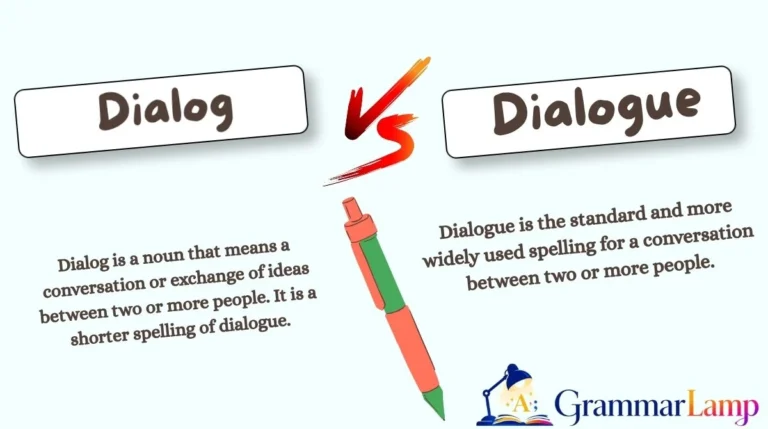
Dialog is a noun that means a conversation or exchange of ideas between two or more people. It is a shorter spelling of dialogue.
In general English, dialog is less common than dialogue. However, it is a recognized spelling, especially in American English. It is also very common in computing and software, where a small window that asks a user to make a choice is called a dialog box or simply a dialog.
For example, when a computer asks, “Are you sure you want to delete this file?” a small window may appear. In software terminology, this is often called a dialog box.
When should you use “dialog”?
Use dialog when the context naturally supports the shorter American spelling. It is particularly common in technical writing, programming, user-interface design, and software documentation.
For ordinary writing, however, dialogue is usually the better choice because it is more widely recognized.
Grammar rule for “dialog”
Dialog is mainly used as a noun.
It can refer to:
- A conversation
- An exchange of ideas
- A conversation in a story, film, or play
- A software window that requires a user’s response
Here are some examples:
- The two leaders had a long dialog about education.
- The movie has very little dialog.
- The characters’ dialog sounds natural.
- The teacher encouraged dialog between the students.
- A dialog box appeared on my screen.
- Click OK to close the dialog.
- The software uses a dialog to ask for your password.
- Open the settings dialog and select your language.
Notice something important: the first five examples can usually be written with dialogue instead of dialog without changing the basic meaning.
For example:
The two leaders had a long dialogue about education.
and
The two leaders had a long dialog about education.
Both can be understood as a conversation.
A common learner confusion
Many students think dialog is simply an incorrect spelling of dialogue. That is not quite right.
It is better to think of dialog as a shorter accepted form that has a narrower role in modern English. If you are writing an essay, school assignment, formal article, or general English text, dialogue is normally the safer choice.
If you are talking about software, you will often see dialog, especially in American technical English.
What Does “Dialogue” Mean?
Dialogue is the standard and more widely used spelling for a conversation between two or more people.
It can also mean an exchange of ideas between people, groups, or organizations. In literature, a dialogue is the spoken conversation between characters in a story, play, movie, or novel.
For most English learners, dialogue should be the main spelling to remember.
When should you use “dialogue”?
Use dialogue when talking about:
- A conversation between people
- Conversation in a book, play, or movie
- A discussion between groups
- An exchange of ideas
- The process of talking to solve a problem
For example:
The teacher had a dialogue with the student.
Here, dialogue means a conversation.
You can also say:
The novel contains realistic dialogue.
Here, the word refers to the words spoken by characters.
Grammar rule for “dialogue”
Dialogue is usually a noun.
It can describe an actual conversation:
We need more dialogue between parents and teachers.
It can also describe written or spoken words between characters:
The dialogue in the movie was funny.
It can describe communication between groups:
The two countries opened a dialogue.
Here are eight useful examples:
- The students had a dialogue about climate change.
- The movie has excellent dialogue.
- The dialogue between the two friends was very funny.
- Good dialogue can help solve problems.
- The manager wants to start a dialogue with the workers.
- The writer spent hours creating realistic dialogue.
- Open dialogue is important in a healthy relationship.
- The characters’ dialogue makes the story interesting.
A common learner confusion
Some learners believe dialogue can only be used for conversations in stories. That is not true.
You can use it for real conversations too:
The government began a dialogue with local communities.
You can also use it for communication between individuals:
We need an honest dialogue about the problem.
So, dialogue has a broader everyday use than many learners realize.
Difference Between Dialog and Dialogue
The main point is simple:
Dialog and dialogue can have the same basic meaning, but dialogue is the more common general-English spelling, while dialog is especially common in American English and computing.
Here is a quick comparison.
| Feature | Dialog | Dialogue |
|---|---|---|
| Basic meaning | Conversation or exchange | Conversation or exchange |
| Spelling | Shorter form | Traditional form |
| General English | Less common | Much more common |
| American English | Accepted | Accepted and common |
| British English | Less common | Standard choice |
| Literature | Possible, but uncommon | Very common |
| Movies and plays | Possible | Standard choice |
| Software | Very common | Less common |
| Dialog box | Standard technical term | Rare |
| Best choice for learners | Mainly in technical contexts | Best general choice |
Usage difference
Imagine that you are writing about two friends talking.
You could write:
The two friends had a dialogue about their future.
This sounds natural.
You could also write:
The two friends had a dialog about their future.
The second sentence may be understood, especially in American English, but it is less usual in general writing.
Now imagine that you are writing software instructions:
Select File > Open and close the dialog box.
Here, dialog is completely natural.
You would not normally write:
Select File > Open and close the dialogue box.
Although the meaning would be understandable, dialog box is the established technical expression in many software contexts.
Grammar logic
The two words are closely related because dialog is essentially a shortened spelling of dialogue.
The difference is therefore not usually a difference in basic meaning. Instead, it is mostly a difference in usage, spelling preference, and context.
Think about it this way:
Dialogue = general English
Dialog = shorter form, especially American/technical English
This is not an absolute rule. English has many exceptions, and real usage can vary by country, company, style guide, and field.
Sentence structure difference
There is no major sentence structure difference between the two words when they mean a conversation.
For example:
The actors practiced the dialogue.
can become:
The actors practiced the dialog.
The grammar is basically the same.
Both words can be used after words such as:
- have
- start
- begin
- encourage
- continue
- write
- create
- improve
For example:
The two groups started a dialogue.
The two groups started a dialog.
The first version is more natural for general writing.
John and Me vs Me and John: Which Is Correct? 2026 Grammar Guide
As Soon As vs As Early As: Easy Difference, Rules & Examples in 2026
Imbalanced vs Disbalanced: What Is the Difference? (2026)
Orientated vs Oriented: What’s the Difference? [2026 Guide]
Grammar Rules You Must Remember
Rule 1: Use “dialogue” for general English
If you are not writing about software and you are unsure which spelling to choose, dialogue is usually the safest option.
Example:
The teacher encouraged dialogue between the students.
This sounds natural in school, academic, and everyday writing.
Rule 2: “Dialog” is common in computing
When talking about a computer window that asks the user to choose something, dialog is very common.
Example:
A dialog box will appear on the screen.
You may see options such as OK, Cancel, Save, or Close inside the dialog.
Rule 3: “Dialogue” can mean spoken words in a story
In literature, movies, television, and plays, dialogue often means the words spoken by characters.
Example:
The writer created realistic dialogue for the main characters.
Here, dialogue is not simply the act of talking. It refers to the actual spoken lines.
Rule 4: Neither word is normally a verb meaning “to talk”
Beginners sometimes try to use these words as verbs.
For example:
We dialogued about the problem.
Although dialogue can be used as a verb in some contexts, this usage is much less common and can sound formal or unusual.
For simple English, use:
We talked about the problem.
or:
We had a dialogue about the problem.
This is clearer and more natural for most learners.
Common Mistakes Students Make
The confusion usually happens because students see both spellings and assume one must be wrong.
Mistake 1: Thinking “dialog” is always incorrect
Wrong idea:
Dialog is not an English word.
Better understanding:
Dialog is an accepted spelling, especially in American English and technical contexts.
You may see:
Open the dialog box.
That is perfectly normal.
Mistake 2: Using “dialog” everywhere
A learner may write:
The novel has interesting dialog.
This is understandable, but dialogue is generally more natural in standard general English.
Better:
The novel has interesting dialogue.
Mistake 3: Writing “dialogue box” for software
Many learners know the word dialogue, so they automatically write:
A dialogue box appeared.
The meaning is clear, but dialog box is the common technical expression.
Better:
A dialog box appeared.
Mistake 4: Thinking the words have completely different meanings
They do not usually represent two completely different ideas.
Compare:
The two countries began a dialogue.
and:
The two countries began a dialog.
The basic meaning is the same. The difference is mainly spelling and usage preference.
Mistake 5: Confusing dialogue with monologue
A dialogue normally involves two or more people.
A monologue is a long speech by one person.
For example:
The actors had a dialogue.
means they talked with each other.
But:
The actor gave a monologue.
means one person spoke for an extended period.
Easy correction tip
Ask yourself one question:
“Am I talking about a conversation in normal English, or am I talking about software?”
If it is normal English, choose dialogue.
If it is a software window or technical interface, dialog is usually the better choice.
Easy Trick to Remember the Difference
Here is a simple memory trick:
Dialogue = people talking
Dialog = computer talking
This is not a perfect rule for every situation, but it is very useful for beginners.
Imagine two people sitting at a table:
Sarah: How was your exam?
Ali: It was difficult.
That is dialogue.
Now imagine a computer showing this:
Save changes?
Yes | No | Cancel
That is a dialog or dialog box.
The longer word, dialogue, is the one you should normally use when you are writing about conversations in everyday English, stories, plays, or movies.
The shorter word, dialog, is strongly associated with software and technical language.
Another useful trick is to remember:
Dialogue has “ue” at the end, just like many traditional English spellings.
When you see dialog, think of the shorter technical spelling.
Daily Life Examples
Here are some natural examples that show how these words appear in real situations.
1. Talking with a friend
We had a long dialogue about our plans for the future.
This is normal general English.
2. Talking to a teacher
The teacher encouraged an open dialogue with the students.
Here, dialogue means honest communication.
3. Watching a movie
I really liked the dialogue in that movie.
This means the words spoken by the characters.
4. Reading a novel
The writer uses simple dialogue to make the characters feel real.
Again, this refers to conversations between characters.
5. Solving a problem
We need more dialogue before we make a final decision.
This means discussion and communication.
6. Using a computer
A dialog box appeared when I clicked the button.
Here, the technical word dialog is natural.
7. Installing software
The installation dialog asks you to choose a folder.
The dialog is a window on the computer.
8. Changing settings
Open the settings dialog and select your preferred language.
This is common technical language.
9. Talking about two groups
The two communities began a peaceful dialogue.
Here, dialogue means communication between groups.
10. Writing a screenplay
The director asked the writer to shorten the dialogue.
This means the spoken lines in the screenplay.
These examples show an important point: context matters more than the spelling alone.
Practice Section
Choose dialog or dialogue in each sentence.
1.
The two teachers had a long ______ about the new school rules.
2.
A ______ box appeared when I clicked “Save.”
3.
The movie has funny and natural ______.
4.
The company wants to open a ______ with its customers.
5.
Click “Cancel” to close the ______.
Answers
1. dialogue
This is a normal conversation, so dialogue is the better choice.
2. dialog
This is a computer window, so dialog is the standard technical choice.
3. dialogue
This refers to the words spoken by characters in a movie.
4. dialogue
This refers to communication between a company and its customers.
5. dialog
This is a software window.
A quick way to check your answers is to remember:
Conversation → dialogue
Software window → dialog
Feel vs Felt: Complete Grammar Guide With Examples (2026)
Role Call or Roll Call? The Correct Spelling and Meaning in 2026
Into or Onto: Complete Difference, Rules, and Examples for 2026
Sole vs Soul: What’s the Difference? Easy Guide With Examples 2026
FAQs
What is the difference between dialog and dialogue?
Dialog and dialogue can both mean a conversation or exchange of ideas. Dialogue is the more common spelling in general English, while dialog is especially common in American English and computer terminology. For most everyday writing, dialogue is the safer choice.
Can we use “dialog” in English questions and sentences?
Yes. Dialog is a real English word and can be used in sentences. It is especially common in technical contexts, such as dialog box, settings dialog, and print dialog. In general conversation or school writing, however, dialogue is usually more natural.
Is “dialogue” formal or informal?
Dialogue can be used in both formal and informal English. You can talk about dialogue in a movie, a conversation between friends, or communication between organizations. The word itself is not limited to formal English.
Is “dialog” American English?
Dialog is especially associated with American English, where it is an accepted shorter spelling of dialogue. It is also widely used in computing and software terminology. British English generally favors dialogue in ordinary writing.
Should I use “dialog” or “dialogue” in an essay?
For a school, college, or general English essay, dialogue is normally the best choice. It is the more familiar spelling and is widely accepted across different varieties of English. Use dialog when a technical context or a particular style guide calls for it.
Why do computers use “dialog” instead of “dialogue”?
Software developers often use the shorter spelling dialog as part of technical terminology. Expressions such as dialog box, dialog window, and dialog control are common in computing. This shorter form became established in user-interface and programming language.
Conclusion
The difference between dialog vs dialogue is much easier once you focus on context.
Dialogue is the standard and more common spelling for general English. Use it when you are talking about conversations, discussions, communication between people, or the spoken words of characters in books, movies, and plays.
Dialog is an accepted shorter spelling. It is particularly common in American English and computer terminology. If you see a dialog box on your computer, the spelling is not a mistake. It is a normal technical term.
For English learners, the simplest rule is this:
Use “dialogue” for normal conversations and general writing. Use “dialog” especially for software and technical contexts.
You do not need to worry every time you see the two spellings. They are closely related, and in many situations they have the same basic meaning.
The best way to remember the difference is to notice the context around the word.
Read examples, write your own sentences, and pay attention to how native speakers and professional writers use each form. With a little practice, choosing between dialog and dialogue will become automatic.

Liam Derren is a language writer at GrammarLamp, creating simple, helpful content about grammar, words, and everyday English. He makes language learning clear, practical, and easy to understand.
1 thought on “Dialog vs Dialogue: What’s the Difference? A Simple English Guide for 2026”