
Into and onto are two small English words that often cause big problems for learners. They look similar, and both can describe movement, but they do not mean the same thing.
A learner may know the meaning of in and on but still feel unsure when choosing between into and onto.
The basic idea is actually quite simple. Into usually shows movement from outside to the inside of something. Onto usually shows movement from a lower or different position to a surface.
For example, we say, “She walked into the room” because she moved from outside the room to its inside. We say, “She stepped onto the stage” because she moved to the surface of the stage.
These words are common in everyday English. You hear them when people talk about rooms, cars, buses, boxes, beds, tables, stages, roads, and many other places.
By the end of this guide, you will know when to use into and onto, how their grammar works, which mistakes to avoid, and how to choose the correct word quickly when speaking or writing.
What Does “Into” Mean?
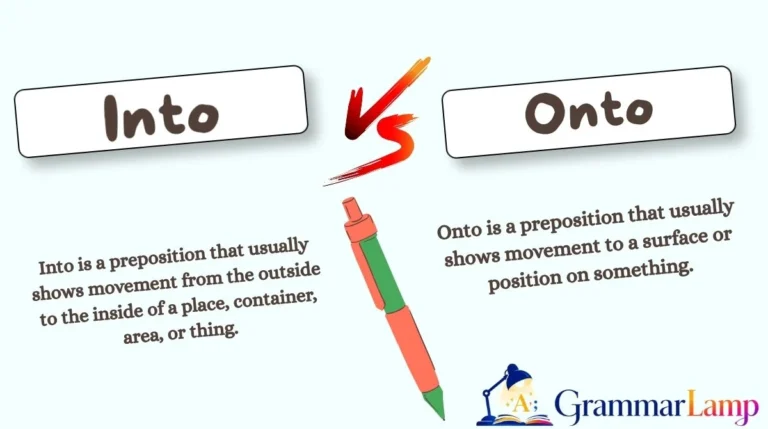
Into is a preposition that usually shows movement from the outside to the inside of a place, container, area, or thing.
Think of into as showing a change of position:
outside → inside
For example:
The boy ran into the house.
The boy was outside first. Then he moved inside the house.
When should you use “into”?
Use into when someone or something moves toward the inside of another place or thing.
The general structure is:
Subject + movement verb + into + place/thing
Common movement verbs used with into include:
- go
- walk
- run
- come
- move
- jump
- fall
- get
- drive
- put
- throw
- pour
Here are some examples:
- She walked into the kitchen.
- The cat jumped into the box.
- He ran into the classroom.
- Please put the clothes into the bag.
- The children got into the car.
- Water fell into the glass.
- The ball rolled into the garden.
- They drove into the city.
In each example, there is an idea of entering or moving toward the inside.
Into can also show transformation
Into is not only about physical movement. It can also describe a change from one form, state, or condition to another.
For example:
The caterpillar changed into a butterfly.
The caterpillar became something different.
Other examples include:
- The ice turned into water.
- The story was made into a movie.
- She changed the old room into an office.
- The company turned the idea into a successful product.
Here, into shows the result of a change.
Into can show interest or involvement
In informal English, into can also mean interested in or enjoying something.
For example:
I’m really into photography.
This means:
I’m really interested in photography.
More examples:
- She’s into modern art.
- He’s really into football.
- Are you into video games?
- My brother isn’t into cooking.
This use does not describe physical movement. It is a different meaning of into, so context is important.
A common learner confusion
Many students use in instead of into when movement is involved.
Compare:
She is in the room.
This describes her position. She is already inside.
She walked into the room.
This describes her movement from outside to inside.
That small difference is very important.
In = position
Into = movement toward the inside
What Does “Onto” Mean?
Onto is a preposition that usually shows movement to a surface or position on something.
Think of it as:
not on the surface → on the surface
For example:
The cat jumped onto the table.
The cat was not on the table before. It moved and ended up on the table.
When should you use “onto”?
Use onto when someone or something moves to a position on a surface.
The common structure is:
Subject + movement verb + onto + surface/place
Examples:
- The child climbed onto the bed.
- She put the book onto the table.
- The cat jumped onto the sofa.
- He stepped onto the bus.
- The athlete ran onto the field.
- The bird flew onto the roof.
- The man climbed onto the horse.
- The ball rolled onto the floor.
In each sentence, the person, animal, or object moves to a position on something.
Onto does not always mean “on top”
This can confuse learners.
When we say:
She stepped onto the stage.
We do not necessarily mean she stepped on top of the stage in a vertical sense. We mean she moved from another position to the stage surface.
Similarly:
He got onto the bus.
A bus has a floor rather than a simple flat “top,” but onto is natural because he moved to a position on or inside the bus’s passenger area.
In everyday English, onto is especially common with things such as:
- a stage
- a platform
- a bed
- a table
- a chair
- a roof
- a horse
- a bicycle
- a bus
- a train
- a field
Onto can also show discovery or contact
Sometimes onto has a less physical meaning.
For example:
The police are onto him.
This means the police have discovered or are investigating what he is doing.
Another example is:
I think we’re onto something.
This can mean that we have discovered an important idea or clue.
These meanings are more advanced, so beginners should first master the basic movement meaning.
Difference Between Into and Onto
The easiest way to understand the difference is to focus on where the movement ends.
Into means movement to the inside.
Onto means movement to a surface or position on something.
| Point | Into | Onto |
|---|---|---|
| Main idea | Movement inside | Movement to a surface |
| Basic direction | Outside → inside | Off/not on → on |
| Common question | Where did it enter? | Where did it move onto? |
| Example | Walk into the room | Walk onto the stage |
| Common objects | Room, box, car, house | Table, bed, stage, roof |
| Position afterward | Inside | On a surface/position |
| Main idea to remember | IN | ON |
Compare these sentences
The dog ran into the house.
The dog entered the house.
The dog jumped onto the sofa.
The dog moved to a position on the sofa.
Now compare:
She got into the car.
She moved inside the car.
She got onto the bus.
She moved onto/in the passenger area of the bus.
This is a useful example because English speakers commonly say get into a car but get onto a bus/train/plane.
Grammar logic
The choice depends on the destination and the type of movement.
If the destination is thought of as an inside space, use into:
- into the room
- into the house
- into the box
- into the bag
- into the car
- into the water
If the destination is thought of as a surface or platform, use onto:
- onto the table
- onto the bed
- onto the stage
- onto the roof
- onto the platform
- onto the floor
The key is not simply the size of the object. It is the relationship between the moving thing and its destination.
Sentence structure
Both words normally follow a verb that describes movement or change.
Verb + into + noun
He walked into the room.
Verb + onto + noun
He stepped onto the platform.
So the grammatical pattern is very similar. The main difference is the meaning of the destination.
Grammar Rules You Must Remember
Rule 1: Use “into” for movement to the inside
When something moves from outside to inside, into is usually correct.
The students went into the classroom.
They were outside the classroom before entering it.
Compare this with:
The students are in the classroom.
There is no movement in the second sentence. It describes location.
Rule 2: Use “onto” for movement to a surface
When something moves to a position on a surface, use onto.
The boy climbed onto the roof.
He moved from a lower position to the roof.
Compare:
The boy is on the roof.
This only tells us where he is now.
A helpful pair is:
Movement: She jumped onto the bed.
Position: She is on the bed.
Rule 3: “Into” can show change
Into can describe a transformation, not just physical movement.
The farmer turned the empty field into a garden.
The field changed from one use or condition to another.
More examples:
The company turned the building into a hotel.
The artist changed the picture into something beautiful.
The cold weather turned the rain into snow.
When something becomes something else, into is often the right choice.
Rule 4: Do not confuse “into” with “in to”
Sometimes into and in to have different grammar.
Into is one preposition:
She went into the room.
But in to can occur when in belongs to the verb and to belongs to another part of the sentence.
For example:
He came in to speak with the manager.
Here, in relates to the verb came in, while to speak gives the purpose.
A useful test is to look at the meaning rather than simply the spelling.
Common Mistakes Students Make
Mistake 1: Using “in” when “into” is needed
Incorrect:
He walked in the room.
If you mean he entered the room, this is not the best sentence.
Correct:
He walked into the room.
But notice:
He walked in the room.
This can be possible if you mean he walked around while already inside the room. The context changes the meaning.
Mistake 2: Using “on” instead of “onto” for movement
Incorrect for movement:
The cat jumped on the table.
In everyday speech, native speakers sometimes use on this way, and the sentence can sound natural. However, onto makes the movement especially clear:
The cat jumped onto the table.
Remember:
on = position
onto = movement to that position
Mistake 3: Saying “onto” when the destination is inside
Incorrect:
She got onto the car.
If she entered the car, say:
She got into the car.
But:
She got onto the bus.
This is normal English because buses are treated differently from cars in common expressions.
Mistake 4: Confusing “into” with “in to”
Incorrect spelling can change the meaning:
He came into talk to me.
The intended meaning is probably:
He came in to talk to me.
Here, came in is the verb phrase, and to talk explains why he came in.
A simple correction tip is to ask:
Does “into” mean movement to the inside?
If yes, one word is probably correct.
Mistake 5: Thinking “onto” always means “on top of”
This can cause problems with buses, stages, and platforms.
The singer walked onto the stage.
The important idea is that the singer moved to the stage area. It does not mean the singer climbed onto the roof of the stage.
Easy Trick to Remember the Difference
Here is the easiest classroom trick:
INTO = IN
ONTO = ON
Now imagine two arrows.
Outside → INSIDE
Not on → ON
If a person moves inside a room, they go into the room.
She walked into the room.
If a person moves to a position on a table, they move onto the table.
She climbed onto the table.
You can also remember the question:
“Where does it end?”
If the answer is inside, think into.
If the answer is on a surface, think onto.
For example:
The boy jumped ___ the pool.
Where does he end? Inside the water.
So:
The boy jumped into the pool.
Now:
The boy jumped ___ the table.
Where does he end? On the table.
So:
The boy jumped onto the table.
This simple mental picture works well when you are speaking quickly.
Daily Life Examples
These examples show how into and onto appear in normal conversations.
1. Getting into a car
A: Where is Ali?
B: He just got into the car.
Ali moved from outside the car to inside it.
2. Getting onto a bus
A: Did Sara catch the bus?
B: Yes. She got onto the bus just before it left.
Here, onto is the normal expression for boarding a bus.
3. Entering a room
Mother: Please come into the kitchen.
Son: Okay, I’m coming.
The person moves from outside the kitchen to inside.
4. Moving onto a chair
Please don’t jump onto the chair.
The movement ends with the person on the chair.
5. Putting something in a bag
Put your phone into your bag before you leave.
The phone moves from outside the bag to inside it.
6. Putting something on a table
Put the keys onto the table.
The keys move to the table’s surface.
7. A dog entering a house
The dog ran into the house when it started raining.
The dog wanted to get inside.
8. A child climbing onto a bed
The baby climbed onto the bed.
The baby moved to a position on the bed.
9. Stepping onto a stage
The actor walked onto the stage and began speaking.
The actor moved to the stage area.
10. Pouring water into a glass
Please pour some water into my glass.
The water moves from outside the glass to inside it.
These examples show why choosing between the two words is mainly about understanding the destination.
Practice Section
Choose into or onto in each sentence.
- The girl walked ___ the classroom.
- The cat jumped ___ the sofa.
- Please put the milk ___ the fridge.
- The man stepped ___ the stage.
- The children ran ___ the house.
- She put her phone ___ the table.
Answers
- The girl walked into the classroom.
- The cat jumped onto the sofa.
- Please put the milk into the fridge.
- The man stepped onto the stage.
- The children ran into the house.
- She put her phone onto the table.
A quick check can help you learn from your mistakes. Ask yourself whether the object ends inside something or on a surface.
FAQs
1. What is the difference between “into” and “onto”?
Into usually shows movement from outside to the inside of something. Onto usually shows movement to a surface or position on something. For example, “He went into the room” means he entered it, while “He climbed onto the roof” means he moved to the roof.
2. Can “into” and “onto” be used in questions?
Yes. Both are common in questions.
Examples:
Did she go into the office?
Did the cat jump onto the table?
The same basic rules apply in questions. Choose into for movement inside and onto for movement to a surface.
3. Is “into” formal or informal?
Into is neither especially formal nor informal. It is a normal English preposition used in speaking and writing. You will find it in everyday conversations, school writing, books, news reports, and professional English.
4. Is “onto” always necessary instead of “on”?
Not always. In some sentences, especially informal English, on can describe movement as well.
For example, “The cat jumped on the table” is commonly heard. However, onto clearly emphasizes movement to the surface: “The cat jumped onto the table.”
5. What is the difference between “in” and “into”?
In normally describes a location, while into usually describes movement toward or inside that location.
She is in the room.
She is already there.
She walked into the room.
She moved from outside to inside.
This position-versus-movement difference is one of the most useful rules to remember.
6. What is the difference between “on” and “onto”?
On normally describes position, while onto usually describes movement to that position.
The book is on the desk.
The book is already there.
She put the book onto the desk.
She moved the book to the desk’s surface.
Conclusion
The difference between into and onto becomes much easier when you focus on movement and destination.
Use into when something moves from outside to inside:
He walked into the house.
Use onto when something moves to a surface or position on something:
He climbed onto the roof.
The same idea works with many everyday situations. You get into a car, walk into a room, put something into a box, step onto a stage, climb onto a bed, or place something onto a table.
Also remember the related pairs in/in-to and on/on-to. Context can sometimes make the difference.
You do not need to memorize hundreds of sentences. Start with the simple picture: inside = into, on a surface = onto.
Then pay attention to these words when you hear native speakers use them. With a little practice, choosing the right word will become natural.

Liam Derren is a language writer at GrammarLamp, creating simple, helpful content about grammar, words, and everyday English. He makes language learning clear, practical, and easy to understand.
2 thoughts on “Into or Onto: Complete Difference, Rules, and Examples for 2026”