
English has many words that sound the same but have completely different meanings. Lieu and loo are a good example. They are pronounced the same in modern English, but they are not used in the same way at all.
If you are learning English, you may see a sentence such as “She received cash in lieu of a gift” and wonder what lieu means.
Then you may hear a British speaker say, “I’m going to the loo,” and wonder if the two words are connected. They are not.
The word lieu is a formal word. In modern English, it is most commonly found in the phrase “in lieu of,” which means “instead of” or “in place of.”
It often appears in formal writing, work-related English, legal language, and official documents. Oxford lists in lieu of as meaning “instead of.”
The word loo, on the other hand, is an informal British English word for a toilet or bathroom. Cambridge labels it as a UK informal noun.
So, although lieu and loo can sound alike, their meanings are completely different. Once you understand the context and the common expressions connected with each word, the difference becomes very easy to remember.
More Useful posts
Role Call or Roll Call? The Correct Spelling and Meaning in 2026
Into or Onto: Complete Difference, Rules, and Examples for 2026
Sole vs Soul: What’s the Difference? Easy Guide With Examples 2026
Is It Worth It vs Does It Worth It? 2026 Grammar Guide
What Does “Lieu” Mean?
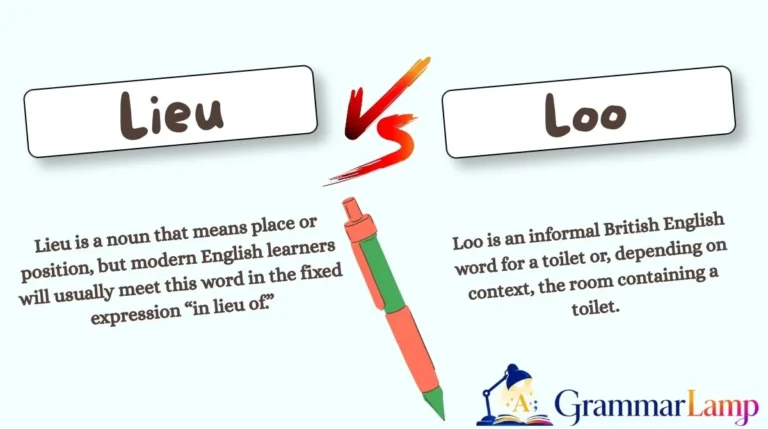
Lieu is a noun that means place or position, but modern English learners will usually meet this word in the fixed expression “in lieu of.”
The phrase in lieu of means instead of or in place of something. Oxford gives examples such as receiving cash in lieu of a prize and taking a day off in lieu of working on a particular day.
The word is considered formal, so it is more common in business, workplace, legal, academic, and official English than in casual everyday conversation.
When Do We Use “Lieu”?
Use lieu when you want to say that one thing is being used, given, or done instead of another thing.
The most important structure is:
in lieu of + noun/pronoun/gerund
For example:
- in lieu of payment
- in lieu of a refund
- in lieu of a gift
- in lieu of cash
- in lieu of working Saturday
- in lieu of the original document
Think of in lieu of as a more formal version of instead of.
For example:
We received a voucher in lieu of a cash refund.
This means:
We received a voucher instead of a cash refund.
The meaning is almost the same, but the first sentence sounds more formal.
Examples of “Lieu”
- The company offered extra vacation days in lieu of overtime pay.
- She received a gift card in lieu of cash.
- The employee took Friday off in lieu of working on Saturday.
- We were given a digital copy in lieu of the original document.
- The customer accepted store credit in lieu of a refund.
- He received compensation in lieu of the damaged equipment.
- The school arranged an online class in lieu of the canceled lesson.
- They provided a replacement product in lieu of the defective one.
Notice that lieu is not normally used by itself in ordinary modern English.
You would not normally say:
“I chose lieu.”
That sounds incorrect and unnatural.
Instead, use the established expression:
I chose this in lieu of that.
Common Learner Confusion About “Lieu”
One common problem is spelling. Because lieu sounds like loo, learners sometimes write:
“in loo of”
That spelling is incorrect.
The correct phrase is:
in lieu of
Another mistake is thinking that lieu means toilet because it sounds like the British word loo. It does not.
For example:
❌ We gave him cash in loo of the prize.
✅ We gave him cash in lieu of the prize.
The second sentence is correct because it uses the formal expression meaning instead of.
What Does “Loo” Mean?
Loo is an informal British English word for a toilet or, depending on context, the room containing a toilet.
Cambridge defines loo as a UK informal word for “toilet.” It also gives the common example, “I’ll just go to the loo.”
This word is especially common in British English. Speakers in the UK may naturally say:
Where is the loo?
An American English speaker is more likely to say:
Where is the bathroom?
or
Where is the restroom?
The word loo is not normally considered formal. It is a casual, everyday word.
When Do We Use “Loo”?
Use loo when talking informally about a toilet, especially in British English.
It is a noun, so it can be used after articles and adjectives just like other countable nouns.
For example:
- the loo
- a loo
- the upstairs loo
- the public loo
- the ladies’ loo
- the men’s loo
The plural is loos.
For example:
There are two loos on this floor.
Cambridge also lists loo roll, meaning toilet paper, as a common expression.
Examples of “Loo”
- Excuse me, where is the loo?
- I need to use the loo.
- She went to the loo before dinner.
- The loo is upstairs.
- There is a loo near the entrance.
- He was waiting outside the loo.
- Could you tell me where the ladies’ loo is?
- The restaurant has two loos downstairs.
These examples are informal and especially natural in British English.
Common Learner Confusion About “Loo”
The biggest problem is confusing loo with lieu because both words are pronounced /luː/. Cambridge specifically notes that for many speakers, lieu and loo are now homophones.
A homophone is a word that has the same pronunciation as another word but a different spelling and meaning.
For example:
lieu → in lieu of = instead of
loo → toilet
So, if someone says:
I need to go to the loo.
They are talking about a toilet.
If someone says:
We gave him a voucher in lieu of cash.
They are talking about a replacement or alternative.
The sound may be the same, but the meaning comes from the surrounding words.
Difference Between Lieu and Loo
The easiest way to understand the difference is to focus on meaning and context.
Lieu is mainly found in the formal phrase in lieu of, meaning instead of.
Loo is an informal British English noun meaning toilet.
Here is a quick comparison:
| Feature | Lieu | Loo |
|---|---|---|
| Meaning | Place; mainly “instead of” in modern use | Toilet |
| Common expression | In lieu of | Go to the loo |
| Word type | Noun | Noun |
| Register | Formal | Informal |
| Variety of English | Used in standard English | Especially British English |
| Common meaning | Instead of | Toilet/bathroom |
| Example | We paid cash in lieu of a voucher. | I need to use the loo. |
| Pronunciation | /luː/ | /luː/ |
| Plural | Rare as a standalone noun in modern use | loos |
Usage Difference
The two words belong to completely different situations.
If you are discussing money, work, compensation, replacement, payment, or alternatives, you may need lieu.
For example:
Employees received a day off in lieu of working on the holiday.
If you are talking about using a toilet, you may need loo.
For example:
I’ll be back soon. I’m just going to the loo.
Grammar Logic
Lieu normally appears as part of the prepositional phrase:
in lieu of + noun
The word of is important.
For example:
She received cash in lieu of a gift.
You can also use a gerund after of:
He took a day off in lieu of working on Sunday.
By contrast, loo is simply a noun.
You can use it with articles:
a loo
the loo
You can also use it after prepositions:
in the loo
near the loo
outside the loo
This difference in sentence structure can help you identify the correct spelling.
Meaning Comparison
Compare these two sentences:
The company gave me a day off in lieu of overtime pay.
Here, lieu has nothing to do with a toilet. It means instead of.
Now compare:
I left my phone in the loo.
Here, loo means toilet or bathroom.
The words sound alike, but the sentences make their meanings clear.
Explore More Posts
Good for Me vs Good to Me: Meaning, Difference, and Examples (2026)
Whether It Be vs Whether It Is: Meaning, Difference, and Correct Use in 2026
EG vs IE: Easy Difference, Meaning, Rules, and Examples in 2026
Dragged vs Drug: What Is the Difference? Easy Guide for 2026
Grammar Rules You Must Remember
Rule 1: Use “in lieu of” to mean “instead of”
The most important expression with lieu is:
in lieu of
It means instead of or in place of.
Example:
The store offered a replacement in lieu of a refund.
You could also say:
The store offered a replacement instead of a refund.
The meaning is very similar.
Rule 2: Use “loo” as a noun for a toilet
Loo is an informal British English noun.
Example:
I need to go to the loo.
You can also say:
The loo is upstairs.
Because loo is a noun, it can appear with words such as the, a, my, and that.
Rule 3: Do not spell “in lieu of” as “in loo of”
This is one of the most common spelling mistakes.
The correct expression is:
in lieu of
Not:
❌ in loo of
Even though the words have the same pronunciation for many speakers, their spelling and meanings are different.
Rule 4: Let the context tell you which word is correct
When you hear the word, you may not know whether the speaker means lieu or loo because they can sound identical.
Look at the context.
If the sentence is about replacement or substitution, think:
in lieu of = instead of
If it is about a toilet, think:
loo = toilet
This is especially useful when listening to British English.
Common Mistakes Students Make
Many learners make mistakes with these words because English spelling does not always match pronunciation.
Mistake 1: Writing “in loo of”
❌ The company paid me in loo of overtime.
✅ The company paid me in lieu of overtime.
The phrase always uses lieu.
A simple way to avoid this mistake is to memorize the complete expression instead of memorizing the word alone:
in lieu of = instead of
Mistake 2: Thinking “lieu” means toilet
A learner may hear a British speaker say loo and assume the spelling is lieu.
That is incorrect.
❌ Where is the lieu?
✅ Where is the loo?
When talking about a toilet, use loo.
Mistake 3: Using “loo” in formal writing
Because loo is informal British English, it may not be the best choice for a formal report or professional document.
For example, in a formal report, this may sound too casual:
The visitors used the loo.
A more neutral option is:
The visitors used the toilet facilities.
The exact choice depends on the audience and the type of writing.
Mistake 4: Thinking the two words are related
The similar pronunciation can make learners think lieu and loo are different spellings of the same word.
They are not.
They have different meanings and different histories. Oxford notes that lieu came into English through French and ultimately relates to the Latin word locus, meaning “place.”
The important point for learners is simple: same sound does not mean same word.
Mistake 5: Forgetting the word “of”
Learners sometimes write:
❌ We received cash in lieu the prize.
The standard expression is:
✅ We received cash in lieu of the prize.
The structure is:
in lieu of + noun
So remember to include of when you are naming the thing being replaced.
Easy Trick to Remember the Difference
Here is a very simple memory trick:
Lieu = instead
Think:
in lieu of = instead of
If one thing replaces another thing, use lieu.
For example:
I received cash in lieu of a gift.
Cash replaced the gift.
Loo = toilet
Think about the British word loo.
I need to go to the loo.
You can connect loo with the place you go when you need to use the toilet.
Another useful trick is to look for the word “of.”
If you see:
in ___ of
the answer is almost certainly:
in lieu of
For example:
We worked on Saturday in lieu of Monday.
But if you see:
the ___
and the sentence is about a bathroom, the word is:
loo
For example:
The loo is at the end of the hallway.
This simple context trick can help you choose the correct spelling quickly.
Daily Life Examples
Here are some natural examples showing how these words work in real situations.
Example 1: At Work
A: Why are you taking Friday off?
B: I worked on Saturday, so I’m taking Friday off in lieu of that day.
Here, in lieu of means instead of.
Example 2: Asking for a Toilet
A: Excuse me, where is the loo?
B: It’s just around the corner.
Here, loo means toilet.
Example 3: Payment
A: Did they give you a refund?
B: No. They gave me store credit in lieu of a refund.
The store credit was given instead of money.
Example 4: At a British Restaurant
A: I’ll be back in a minute.
B: Where are you going?
A: I’m just going to the loo.
This is casual British English.
Example 5: Workplace Compensation
A: Did you get paid for the extra hours?
B: No. I received time off in lieu of overtime pay.
The time off was provided instead of overtime payment.
Example 6: Hotel
A: Is there a loo in this room?
B: Yes, there’s one next to the bedroom.
Here, loo means toilet or bathroom.
Example 7: Replacement
A: What did the company give you for the damaged item?
B: They gave me a new one in lieu of repairing the old one.
The new item replaced the repair.
Example 8: School
A: Why are you studying online today?
B: The school arranged an online lesson in lieu of the classroom lesson.
Again, one thing has been used instead of another.
Example 9: Travel
A: Where can I find the toilet?
B: There’s a loo near the waiting area.
This is a natural informal British English conversation.
Example 10: Office Conversation
A: Are you working Monday?
B: No. I’m off on Monday in lieu of working last weekend.
The speaker has a day off instead of receiving another form of compensation.
Practice Section
Choose the correct word: lieu or loo.
1. We received a voucher in ___ of a refund.
A. loo
B. lieu
2. Excuse me, where is the ___?
A. lieu
B. loo
3. She took Tuesday off in ___ of working on Sunday.
A. loo
B. lieu
4. The restaurant has a ___ upstairs.
A. lieu
B. loo
5. The company offered extra vacation time in ___ of overtime pay.
A. loo
B. lieu
Answers
1. B — lieu
We received a voucher in lieu of a refund.
It means the voucher was given instead of a refund.
2. B — loo
Excuse me, where is the loo?
It means toilet.
3. B — lieu
She took Tuesday off in lieu of working on Sunday.
The day off was given instead of another arrangement.
4. B — loo
The restaurant has a loo upstairs.
It means toilet.
5. B — lieu
The company offered extra vacation time in lieu of overtime pay.
The vacation time was offered instead of overtime payment.
More Useful posts
Consult With, To, On or About: Which Is Correct? 2026
Run vs Ran: What Is the Difference? Easy Grammar Guide 2026
It Worth It or Is It Worth It? Which One Is Correct in 2026?
Symbol vs Cymbal 2026: Meaning, Difference, Examples, and Easy Grammar Rules
FAQs
What is the difference between lieu and loo?
Lieu is mainly used in the phrase “in lieu of,” which means “instead of” or “in place of.” Loo is an informal British English word for a toilet. They can sound the same, but they have completely different meanings.
Are lieu and loo pronounced the same?
Yes, for many English speakers they are homophones and are pronounced /luː/. Cambridge gives this pronunciation for loo and notes that many speakers pronounce lieu and loo the same way.
The spelling and meaning, however, are different.
Is “in lieu of” formal English?
Yes. In lieu of is a formal expression meaning “instead of.” It is common in workplace, legal, business, and official English. In casual conversation, instead of is often simpler and more natural. Oxford labels lieu as formal.
Is “loo” formal or informal?
Loo is informal and especially associated with British English. Cambridge labels it as a UK informal word for a toilet.
In formal writing, you may prefer toilet, restroom, bathroom, or another term that fits the variety of English and situation.
Can I use “lieu” by itself?
In modern English, lieu is most commonly encountered in the expression “in lieu of.” Although it historically relates to the idea of a place or position, learners should focus on the common modern expression rather than trying to use lieu as an everyday replacement for place. Oxford lists in lieu of as the key idiom.
Is “in loo of” correct?
No. “In loo of” is an incorrect spelling when you mean “instead of.”
The correct form is:
in lieu of
For example:
The company offered a refund in lieu of a replacement.
The word loo means a toilet, so it cannot replace lieu in this expression.
Conclusion
Lieu and loo are easy to confuse because they can sound exactly the same, but they have completely different meanings.
The word lieu is mainly used in the formal expression “in lieu of,” meaning “instead of” or “in place of.” You may see it in workplace policies, business documents, legal writing, and formal communication.
The word loo is an informal British English word for a toilet. It is common in everyday conversation, especially in the UK.
The easiest way to remember the difference is:
in lieu of = instead of
loo = toilet
Do not worry if these words seemed confusing at first. Homophones cause problems for many English learners because listening alone cannot always tell you which spelling is correct.
Pay attention to the meaning and the words around them. With a little practice, you will quickly recognize whether a sentence needs lieu or loo.

Liam Derren is a language writer at GrammarLamp, creating simple, helpful content about grammar, words, and everyday English. He makes language learning clear, practical, and easy to understand.
2 thoughts on “Lieu vs Loo: Meaning, Difference, Usage, and Examples in 2026”