
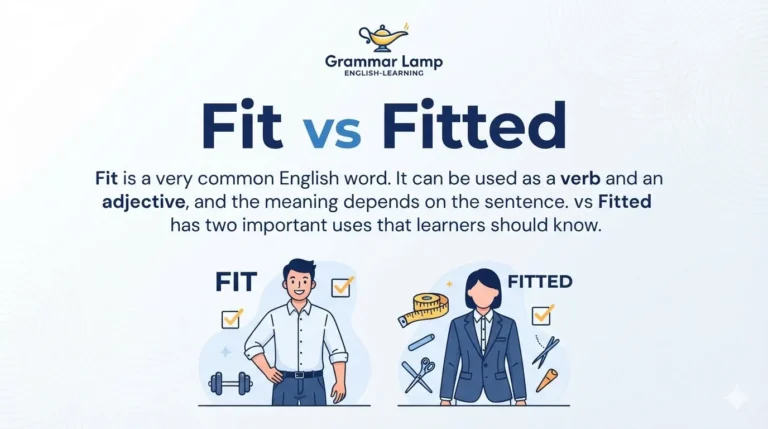
“Fit” and “fitted” look almost the same, so it is easy to think they can always be used in the same way.
For English learners, this becomes especially confusing when talking about clothes, shoes, furniture, machines, or things that are the right size.
You may hear someone say, “This shirt fits me,” while another person says, “This shirt is fitted.” Both sentences are correct, but they do not mean exactly the same thing.
There is another reason learners get confused: fit has more than one grammar role, and its past form can change depending on the type of English being used. In British English, fitted is normally used as the past tense of the verb fit. In American English, fit is also commonly used as the past tense.
The word fitted can also work as an adjective. When we say “a fitted shirt,” we usually mean a shirt designed to follow the shape of the body.
Once you understand these different uses, the choice becomes much easier. You will know when to say “The shoes fit,” “The shoes fitted me,” and “She wore fitted shoes,” without guessing.
More Useful posts
Year Old or Years Old? Easy Grammar Guide for 2026
Lieu vs Loo: Meaning, Difference, Usage, and Examples in 2026
Is It Worth It vs Does It Worth It? 2026 Grammar Guide
Good for Me vs Good to Me: Meaning, Difference, and Examples (2026)
What Does “Fit” Mean?
Fit is a very common English word. It can be used as a verb and an adjective, and the meaning depends on the sentence.
As a verb, fit means that something is the correct size or shape for another person or thing. It can also mean that something can go into a particular space. For example, “This jacket fits me” means the jacket is the right size for me. “The box will fit in the car” means there is enough space for the box.
The basic present-tense pattern is:
I/You/We/They fit
He/She/It fits
Notice the final -s with he, she, and it.
When should you use “fit”?
Use fit when you are talking about something that is the right size, shape, or amount. It is often used for clothes, shoes, furniture, boxes, doors, keys, and spaces.
For example:
- These shoes fit me perfectly.
- This jacket fits you really well.
- The table won’t fit in this small room.
- Does this key fit the lock?
- That box will fit under the bed.
- My old jeans still fit me.
- How many people can fit in this car?
You can also use fit to mean suitable or right for something. For example, “She fits the job well” means her skills or qualities are suitable for the job. Oxford lists fit as a verb meaning to match, agree with, or be suitable for someone or something.
“Fit” as an adjective
Many learners know fit mainly from clothes, but it has another very common meaning. As an adjective, fit can mean healthy and physically strong.
For example:
- He is very fit.
- She exercises every morning to stay fit.
- I am not fit enough to run that far yet.
Oxford also lists fit as an adjective meaning healthy and strong, especially because of regular exercise. It can also mean suitable or good enough for a purpose.
So remember that “fit” does not always talk about size.
A common learner confusion
One major mistake is thinking that fit always has to become fitted in the past. That is not true in every variety of English.
For example, in British English, you will normally hear:
The shoes fitted me last year.
In American English, it is common to hear:
The shoes fit me last year.
Cambridge notes that British English usually uses fitted as the past simple of fit, while American English most often uses fit.
That difference is important, but it does not mean one variety is “wrong.” Both forms are used in standard English.
What Does “Fitted” Mean?
Fitted has two important uses that learners should know.
First, it can be the past tense and past participle of the verb fit, especially in British English. Second, it can be an adjective describing something that has been made or designed to fit a particular shape, body, or space.
“Fitted” as a past form of “fit”
When fit means “be the right size” or “be suitable,” fitted can describe something that was right in size or shape in the past.
For example:
- The dress fitted me perfectly last summer.
- Those shoes fitted him better than these ones.
- The old sofa fitted perfectly into that corner.
- The key fitted the lock, but it was difficult to turn.
- The jacket fitted her well after the alteration.
- The parts fitted together without any problem.
- The new windows fitted the house perfectly.
This use is particularly common in British English. In American English, fit is frequently used instead as the past form. Oxford gives fitted as the normal past simple and past participle, while also noting that North American English usually uses fit.
“Fitted” as an adjective
This is the other use you will see very often.
A fitted shirt, fitted jacket, or fitted dress is made to follow the shape of the body. It is usually closer to the body than a loose piece of clothing. Cambridge defines fitted as something made to fit the shape of someone or something.
For example:
- She bought a fitted jacket for the meeting.
- He prefers fitted shirts to loose shirts.
- The store has fitted dresses in several sizes.
- I need a fitted sheet for this mattress.
- She wore a fitted black coat.
- They installed fitted wardrobes in the bedroom.
- The house has a fitted kitchen.
With furniture, fitted can mean something is specially built or fixed into a particular space, such as a fitted kitchen, fitted wardrobe, or fitted cupboard. Oxford describes this use as especially common in British English.
The key idea
A sentence such as:
This shirt fits me.
talks about whether the shirt is the right size for me.
But:
This is a fitted shirt.
talks about the style or design of the shirt.
That small difference solves much of the confusion.
Difference Between Fit and Fitted
The biggest difference is grammatical. Fit is often the present form of the verb, while fitted can be a past form or an adjective.
Here is a simple comparison:
| Point | Fit | Fitted |
|---|---|---|
| Common role | Verb; also adjective | Verb form; also adjective |
| Present verb | fit / fits | — |
| British past | — | fitted |
| American past | fit | — |
| Clothing meaning | Be the right size | Made to follow a shape |
| Furniture meaning | Be the right size/shape for a space | Built or fixed into a space |
| Example | This shirt fits me. | This is a fitted shirt. |
| Main question | Is the size right? | Is it designed or installed to fit? |
1. Usage difference
Use fit when you are describing the relationship between an item and a person or space.
These shoes fit me.
The shoes have the correct size for you.
Use fitted when you are describing something that has been designed to closely match a shape or fixed into a specific place.
These are fitted shoes.
The focus is on the design or shape rather than simply saying whether they are the correct size for you.
2. Grammar logic
A useful pattern is:
Subject + fit/fits + object
Examples:
- The shirt fits me.
- These shoes fit him.
- The box fits under the desk.
- This key fits the lock.
Here, fit is a verb.
With fitted as an adjective, the structure is different:
fitted + noun
Examples:
- a fitted shirt
- a fitted jacket
- a fitted sheet
- a fitted kitchen
- fitted wardrobes
This is why you cannot automatically replace one word with the other.
3. Sentence structure difference
Compare these two sentences:
This dress fits me.
This is a fitted dress.
The first sentence uses fit as a verb. It tells us about the size or suitability of the dress for the speaker.
The second uses fitted as an adjective. It tells us about the style of the dress.
Another useful pair is:
The cupboard fits in the room.
The room has fitted cupboards.
In the first sentence, fits describes whether the cupboard can go into the room. In the second, fitted cupboards are cupboards designed and fixed for that particular space.
4. Meaning comparison
Think about the difference between result and design.
Fit often answers:
“Is it the correct size or shape?”
Fitted as an adjective often answers:
“Was it made or arranged to follow a particular shape or space?”
That is why both words can appear around the same topic but still have different jobs.
Grammar Rules You Must Remember
Rule 1: Use “fit” for a present situation
When something is the correct size now, use fit or fits.
Examples:
- These trousers fit me well.
- This box fits under the table.
- The key fits the lock.
With he, she, or it, use fits.
This shirt fits Sarah.
Not:
This shirt fit Sarah.
when you mean the present situation.
Rule 2: “Fitted” is commonly the British past form of “fit”
British English normally uses fitted in the simple past.
Present: The shoes fit me.
Past: The shoes fitted me last year.
American English commonly uses fit in both present and past contexts:
The shoes fit me last year.
Cambridge specifically notes this British/American difference in the past tense of fit.
This means the sentence “The jacket fitted me” is not a strange or incorrect form. It is a normal British English construction.
Rule 3: Use “fitted” before a noun for a close or specially made design
When you mean clothing that follows the shape of the body, fitted works as an adjective.
Examples:
- a fitted shirt
- a fitted suit
- a fitted jacket
- a fitted dress
Cambridge and Oxford both give this meaning for fitted.
Compare:
The shirt fits me.
= The size is right for me.
I bought a fitted shirt.
= The shirt has a close, body-shaped design.
Rule 4: “Fitted” can describe something fixed into a particular place
This use is especially common with furniture and parts of a building.
Examples include:
- a fitted kitchen
- fitted wardrobes
- fitted cupboards
- fitted shelves
Oxford defines fitted in this sense as furniture built to be fixed into a particular space.
So:
The wardrobe fits in the bedroom.
means the wardrobe is the correct size to go there.
But:
The bedroom has fitted wardrobes.
means the wardrobes are built or arranged as part of that room.
Explore More Posts
Whether It Be vs Whether It Is: Meaning, Difference, and Correct Use in 2026
EG vs IE: Easy Difference, Meaning, Rules, and Examples in 2026
Dragged vs Drug: What Is the Difference? Easy Guide for 2026
Consult With, To, On or About: Which Is Correct? 2026
Common Mistakes Students Make
Students often make mistakes because they learn fit and fitted as if they were simply two forms of the same word. In reality, grammar and meaning both matter.
Mistake 1: Using “fitted” for every present situation
Incorrect:
This shirt fitted me perfectly.
when you are trying it on right now.
Better:
This shirt fits me perfectly.
The present situation calls for fits.
Mistake 2: Thinking “fit” can never describe the past
Some learners are taught only the pattern “fit → fitted.” That creates another problem.
American English commonly uses fit as the past tense:
The shoes fit me last year.
This is accepted standard American usage.
British English usually uses:
The shoes fitted me last year.
Both patterns are worth recognizing.
Mistake 3: Confusing “fits me” with “fitted shirt”
These sentences have different meanings:
The shirt fits me.
The shirt is fitted.
The first tells us that the shirt is the right size for the speaker.
The second describes the shirt’s design. It normally means the shirt is cut to follow the body’s shape.
Mistake 4: Saying “fitted” when you mean “installed”
This mistake is more interesting because fitted can actually work in this context.
For example:
We fitted a new alarm to the ceiling.
Here, fitted is the past tense of the verb fit, meaning installed or put into position. Oxford gives examples of fit meaning to put or fix something somewhere.
Compare that with:
We have a fitted kitchen.
Here, fitted is an adjective describing the kitchen.
Easy correction tips
When you are unsure, ask yourself one question:
Am I talking about size, or am I describing the design/installation?
For size now:
The shoes fit me.
For a past action in British English:
The shoes fitted me.
For a clothing style:
They are fitted shoes.
For furniture fixed into a space:
They installed fitted cupboards.
That simple check will prevent many common errors.
Easy Trick to Remember the Difference
Here is an easy memory trick:
FIT = “Is the size right?”
Imagine trying on a new shirt in a clothing store.
You look in the mirror and say:
“This shirt fits me.”
You are checking the size and shape.
FITTED = “Made or arranged to fit”
Now imagine a shirt specially designed to follow the body.
You can say:
“It is a fitted shirt.”
The word fitted describes the design.
You can use the same idea with a house.
The sofa fits in the room.
You are checking whether there is enough space.
The house has fitted furniture.
The furniture was made or installed for a particular space.
There is also one useful mental picture:
FIT → check the result
FITTED → describe the design or a completed fitting
It is not a perfect rule for every sentence, because fitted is also a past form of the verb in British English. Still, it is a very helpful starting point for beginners.
Daily Life Examples
Here are natural examples you may hear in everyday English.
Example 1: Shopping for clothes
A: Do these jeans fit me?
B: Yes, they fit you really well.
Here, fit is the present verb because the speaker is checking the jeans now.
Example 2: Talking about an old jacket
A: Why don’t you wear that jacket anymore?
B: It fitted me when I was younger, but it doesn’t now.
This sounds natural in British English. In American English, many speakers would say “It fit me when I was younger.”
Example 3: Choosing a shirt
A: Do you want a loose shirt or a fitted shirt?
B: I prefer fitted shirts.
Here, fitted describes the style of the shirt.
Example 4: Checking a key
A: Does this key fit the door?
B: No, I think it is the wrong one.
Here, fit means to have the correct shape and size.
Example 5: Moving furniture
A: Will this sofa fit through the door?
B: I don’t think so. It’s too wide.
Again, fit describes whether there is enough room.
Example 6: Talking about a kitchen
A: Your kitchen looks beautiful.
B: Thanks. We had a fitted kitchen installed last year.
Here, fitted kitchen describes a kitchen with furniture and units built or fixed for the space.
Example 7: Talking about sheets
A: Where did you buy these sheets?
B: They came with the bed, and they are fitted sheets.
A fitted sheet is designed to fit closely around the mattress. Cambridge lists fitted sheets as an example of fitted meaning made to fit a shape or size.
Example 8: Trying on a suit
A: How does the suit feel?
B: It fits perfectly.
The speaker is talking about size and comfort.
Example 9: Describing the style
A: Is that a loose jacket?
B: No, it’s a fitted jacket.
Here, the adjective fitted tells us about the shape and design.
Example 10: Installing equipment
A: Did they install the smoke alarms?
B: Yes, they fitted smoke alarms throughout the house.
In this British English example, fitted is the past tense of the verb fit, meaning installed. Oxford gives this verb use for putting or fixing something somewhere.
Practice Section
Choose the correct word: fit or fitted.
1. These shoes ___ me perfectly.
a) fit
b) fitted
2. She bought a ___ black dress.
a) fit
b) fitted
3. The table won’t ___ through the door.
a) fit
b) fitted
4. In British English: “The jacket ___ me last year.”
a) fit
b) fitted
5. They installed ___ wardrobes in the bedroom.
a) fit
b) fitted
Answers
1. fit — The sentence talks about the shoes fitting now.
2. fitted — Here, fitted describes the style of the dress.
3. fit — Fit is the verb used to describe whether the table can pass through the door.
4. fitted — In British English, fitted is normally the past simple form of fit.
5. fitted — Fitted wardrobes are wardrobes designed and fixed for a particular space.
More Helpful posts
Run vs Ran: What Is the Difference? Easy Grammar Guide 2026
It Worth It or Is It Worth It? Which One Is Correct in 2026?
Symbol vs Cymbal 2026: Meaning, Difference, Examples, and Easy Grammar Rules
In My Spare Time or On My Spare Time in 2026? The Correct Expression Explained
FAQs
What is the difference between fit and fitted?
Fit is commonly the present form of the verb meaning “to be the right size or shape.” Fitted can be the past form of that verb, especially in British English, and it can also be an adjective. As an adjective, fitted often means made to closely follow a shape or designed for a particular space.
Can we use “fit” in questions?
Yes. Fit is very common in questions about size or space.
For example: “Does this shirt fit me?” or “Will this box fit in the car?”
For a past situation, British English often uses fitted, while American English commonly uses fit.
Is “fitted” formal or informal?
Fitted is neither simply formal nor informal. It is a normal English word used in everyday speech and writing.
You will often see it in phrases such as fitted shirt, fitted sheet, fitted kitchen, and fitted wardrobes.
Is “This shirt is fitted” the same as “This shirt fits me”?
No. “This shirt fits me” means the shirt is the correct size for you.
“This shirt is fitted” usually means the shirt has a close design that follows the shape of the body. The first sentence focuses on size for a person; the second focuses on design.
Is “The dress fitted me” correct?
Yes, particularly in British English when you are talking about the past.
For example: “The dress fitted me perfectly last year.”
In American English, it is common to say “The dress fit me perfectly last year.” Both forms are recognized in standard English, with regional preference differing.
Which is correct: “fitted clothes” or “fit clothes”?
When you mean clothes designed to follow the shape of the body, fitted clothes is the usual expression.
For example: “She prefers fitted clothes.”
Here, fitted is an adjective. It does not mean that someone tried the clothes on and found the size correct.
Conclusion
The difference between fit and fitted becomes much easier when you focus on grammar and meaning instead of the spelling.
Use fit or fits when you are talking about something being the right size, shape, or amount, especially in the present. For example, “These shoes fit me” means the shoes are the right size for the speaker.
Use fitted in two main ways. In British English, it is commonly the past form of the verb fit. In another common use, it is an adjective describing something made to follow a particular shape or fixed into a specific space, as in “a fitted shirt” or “a fitted kitchen.”
The most useful question to ask yourself is: Am I talking about whether something fits, or am I describing something designed or arranged to fit?
Once you start noticing these patterns in real conversations, the difference will feel natural. Try making five sentences with each word today.
A little practice can make this confusing pair much easier.

Liam Derren is a language writer at GrammarLamp, creating simple, helpful content about grammar, words, and everyday English. He makes language learning clear, practical, and easy to understand.