
Have you ever wondered whether you should say “a 10-year-old boy” or “a 10-years-old boy”? Maybe you have also asked yourself why we say “She is 10 years old” but “a 10-year-old girl.” If these sentences look confusing, you are not alone.
Many English learners make mistakes with year old and years old because both forms talk about age.
The meaning is almost the same, but the grammar changes depending on where the expression appears in a sentence.
For example, we say:
- My son is five years old.
- I have a five-year-old son.
The first sentence uses years old after the verb. The second uses year old before a noun as a compound adjective.
This small difference is very common in everyday English. You will see it when people talk about children, adults, pets, schools, products, buildings, and even objects.
The good news is that the rule is quite simple once you understand the sentence structure. You do not need to memorize many complicated grammar rules.
By the end of this guide, you will understand when to use year old, when to use years old, why the word year sometimes stays singular, and how to avoid common mistakes. You will also see many real-life examples that make the difference easier to remember.
More Useful posts
Role vs Roll: Meaning, Difference, Rules & Examples (2026)
John and I or John and Me? The Easy Grammar Guide for 2026
Formal vs Informal Usage: Complete Guide to English in 2026
Please Advise or Please Advice? The Correct Usage Explained (2026)
What Does “Year Old” Mean?
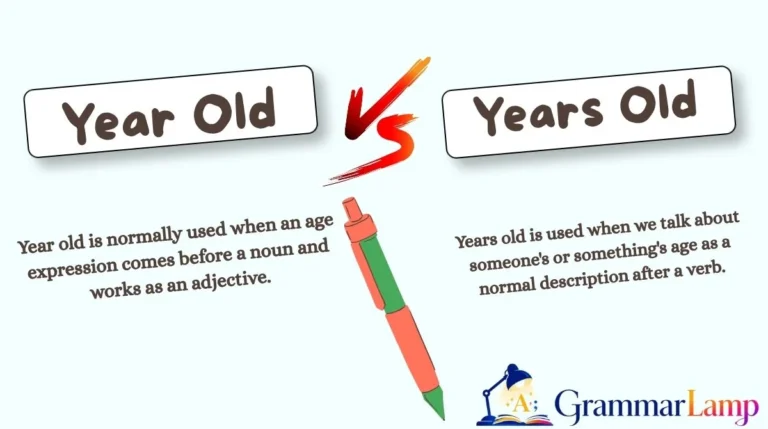
Year old is normally used when an age expression comes before a noun and works as an adjective.
When we put an age directly before a person or thing, we usually use:
number + year + old + noun
Notice that year is singular, even when the number is more than one.
For example:
- a five-year-old boy
- a ten-year-old girl
- a twenty-year-old student
- a three-year-old dog
- a 100-year-old building
It may look strange at first. After all, five means more than one, so why don’t we write five-years-old?
The reason is that five-year-old is acting as one compound adjective. The whole expression describes the noun that comes after it.
Think about this sentence:
She has a five-year-old daughter.
Here, five-year-old describes the word daughter. It works like one adjective.
This is why year remains singular.
Grammar Rule
When an age comes directly before a noun, use:
number + singular year + old + noun
You normally connect the words with hyphens.
Examples
- I have a six-year-old brother.
- She is looking after her three-year-old daughter.
- We met a seven-year-old child at the park.
- He owns a two-year-old car.
- My sister has a four-year-old son.
- They live in a 50-year-old house.
- The company bought a ten-year-old machine.
- A 90-year-old man won the race.
Notice that we use year, not years, in all these examples.
Why Do We Use “Year” Instead of “Years”?
The phrase is functioning as a single description.
Compare:
a five-year-old boy
Here, five-year-old is one adjective phrase describing the boy.
It is similar to other compound adjectives:
- a ten-minute walk
- a five-mile road
- a two-hour movie
- a three-day trip
We say a two-hour movie, not a two-hours movie.
In the same way, we say:
a two-year-old child
not:
a two-years-old child
A Common Learner Confusion
Many learners think that because the age is five, ten, or twenty, the word must be plural.
That is true when the age is used as a normal noun phrase:
He is five years old.
But it changes when the age becomes part of an adjective:
He is a five-year-old boy.
So remember that the position of the age expression matters.
What Does “Years Old” Mean?
Years old is used when we talk about someone’s or something’s age as a normal description after a verb.
The most common structure is:
subject + be + number + years old
For example:
- I am 20 years old.
- She is 15 years old.
- He is 40 years old.
- They are 12 years old.
- My dog is three years old.
Here, years is plural because the number is greater than one.
Grammar Rule
When the age comes after is, am, are, was, or were, we normally use:
number + years old
For example:
My son is six years old.
The age is not directly describing a noun before it. Instead, it tells us the age of the subject.
Examples
- I am 25 years old.
- My sister is 18 years old.
- Their son is eight years old.
- The building is 100 years old.
- Our dog is five years old.
- She was 16 years old when she started school.
- The company is 20 years old.
- How old are you? I am 30 years old.
In all these examples, the age comes after a verb, so we use years old.
What About One Year?
There is one small point to remember.
When the number is one, we use the singular form:
one year old
For example:
- My baby is one year old.
- The puppy is one year old.
- The company is one year old.
We do not say:
one years old
because one takes the singular noun year.
Questions About Age
We can also use this structure when answering questions.
How old is your son?
He is ten years old.
How old is your daughter?
She is seven years old.
In everyday conversation, native speakers often simply say:
He is ten.
or:
She is seven.
The word old is not always necessary when the meaning is clear.
However, ten years old is completely correct and very common.
Difference Between “Year Old” and “Years Old” (Detailed)
The main difference is not really about the age itself. It is about how the age is being used in the sentence.
Look at these two sentences:
My son is five years old.
I have a five-year-old son.
Both sentences tell us that the son’s age is five.
The meaning is almost identical, but the grammar is different.
| Expression | When to use it | Example |
|---|---|---|
| years old | After a verb when stating age | She is ten years old. |
| year old | Before a noun as an adjective | She is a ten-year-old girl. |
| one year old | After a verb for age 1 | The baby is one year old. |
| one-year-old | Before a noun for age 1 | He has a one-year-old baby. |
1. “Years Old” Comes After the Verb
When the age comes after be, use the normal age expression.
He is twenty years old.
My car is five years old.
The house is fifty years old.
The word years is plural when the number is greater than one.
2. “Year Old” Comes Before a Noun
When the age directly describes a noun, use the singular year.
He is a twenty-year-old man.
I bought a five-year-old car.
They live in a fifty-year-old house.
The whole phrase acts as an adjective.
3. Hyphens Are Important
When an age expression comes before a noun, the words are normally joined with hyphens.
Correct:
a ten-year-old boy
Incorrect:
a ten year old boy
The hyphens help the reader understand that ten-year-old works together as one description.
However, when the age comes after the verb, we do not use hyphens:
He is ten years old.
Not:
He is ten-years-old.
4. The Meaning Does Not Change
Both of these sentences describe the same age:
She is a six-year-old girl.
The girl is six years old.
The difference is grammatical, not a difference in age.
Compare the Sentence Structure
Subject + verb + number + years old
Tom is twelve years old.
But:
Subject + verb + a + number-year-old + noun
Tom is a twelve-year-old boy.
This is the easiest way to understand the difference.
Grammar Rules You Must Remember
Rule 1: Use “Years Old” After a Verb
When you state someone’s age after is, am, are, was, or were, use years old.
Example:
My daughter is nine years old.
Another example:
The building is 80 years old.
The age is being given as information about the subject.
Rule 2: Use Singular “Year” Before a Noun
When the age comes directly before a noun, use singular year.
Example:
She has a nine-year-old daughter.
Not:
She has a nine-years-old daughter.
The phrase nine-year-old works as one adjective.
Rule 3: Use Hyphens Before a Noun
When an age expression comes before a noun, connect the words with hyphens.
Example:
He is a 12-year-old student.
But when the age comes after the verb, do not use hyphens.
Example:
He is 12 years old.
This is an important writing rule, especially in formal English.
Rule 4: “One” Uses Singular “Year”
When the age is one, use one year old.
Example:
The baby is one year old.
Before a noun:
She has a one-year-old baby.
Never use one years old or one-years-old.
Explore More Posts
Also Have or Have Also: Which Is Correct? Complete Grammar Guide 2026
Sneaked vs Snuck: What Is the Difference? 2026 Guide
Wether vs Weather vs Whether: What’s the Difference? 2026 Guide
Instructions on vs Instructions for: Meaning, Difference, and Correct Usage in 2026
Common Mistakes Students Make
Many mistakes happen because learners try to apply the same grammar pattern everywhere.
The most common problem is using years before a noun.
Mistake 1: “A Five-Years-Old Boy”
❌ He is a five-years-old boy.
✅ He is a five-year-old boy.
Why?
Because five-year-old is acting as an adjective before boy.
Mistake 2: “He Is Five-Year-Old”
❌ He is five-year-old.
✅ He is five years old.
Here, the age comes after the verb is, so we use years old.
Mistake 3: Using Hyphens After the Verb
❌ My daughter is ten-years-old.
✅ My daughter is ten years old.
The hyphens are not normally used because the age is not directly before a noun.
Mistake 4: Saying “One Years Old”
❌ My baby is one years old.
✅ My baby is one year old.
The number one always takes the singular form year.
Mistake 5: Forgetting the Noun
Sometimes learners use the adjective form when there is no noun after it.
❌ My son is a five-year-old.
This sentence can actually be correct when five-year-old is being used as a noun, but it is less common in careful writing and can sound less natural in some contexts.
A clearer sentence is:
✅ My son is five years old.
Or:
✅ My son is a five-year-old boy.
Easy Correction Tip
Ask yourself one simple question:
Is the age directly before a noun?
If yes:
five-year-old boy
If no, and you are simply stating the age:
five years old
This one question can prevent most mistakes.
Easy Trick to Remember the Difference
Here is a very easy memory trick:
Before a noun → “YEAR”
After a verb → “YEARS”
Think of these two examples:
a ten-year-old boy
The boy is ten years old.
The first one has year because it is part of an adjective.
The second one has years because it is a normal age expression.
You can also remember it like this:
Noun comes next → year
Age comes at the end → years
For example:
a 20-year-old student
The noun student comes right after the age.
But:
The student is 20 years old.
The age finishes the sentence.
Real-Life Logic
Imagine you are introducing your child.
You might say:
I have a six-year-old daughter.
Here, you are describing your daughter.
But if someone asks:
How old is your daughter?
You can answer:
She is six years old.
Same child. Same age. Different grammar.
That is the key idea.
Daily Life Examples (Very Important)
These examples show how native speakers use both forms in normal conversation.
Example 1
A: How old is your son?
B: He is seven years old.
A: Oh, I have a seven-year-old son too.
Both forms are correct because they are used in different sentence structures.
Example 2
A: How old is your daughter?
B: She is five years old.
A: She looks very young.
Example 3
A: Is that your car?
B: Yes. It’s a three-year-old car.
A: It looks brand new!
Here, three-year-old describes the car.
Example 4
A: How old is your car?
B: It’s three years old.
Notice the difference:
a three-year-old car
but:
The car is three years old.
Example 5
A: Who is that little boy?
B: That’s my nephew. He is four years old.
A: He is very cute!
Example 6
A: Do you have children?
B: Yes. I have a two-year-old daughter.
A: Nice! My daughter is also two years old.
Both speakers are talking about the same age, but they use different structures.
Example 7
A: How old is this building?
B: It’s more than 100 years old.
A: Wow! It is very old.
You could also say:
It is a more-than-100-year-old building.
However, the first version is much more natural in everyday speech.
Example 8
A: How old is your dog?
B: He is eight years old.
A: I have an eight-year-old dog too.
Again, both structures are correct.
Example 9
A: Who is the new student?
B: She is a 16-year-old student from Lahore.
A: Does she speak English well?
This uses 16-year-old before the noun student.
Example 10
A: How old were you when you started working?
B: I was 18 years old.
We use years old because the age comes after was.
Practice Section
Choose the correct option in each sentence.
1. My brother is ten ______.
A. year old
B. years old
2. She has a six-______ daughter.
A. year old
B. years old
3. The house is fifty ______.
A. year old
B. years old
4. He is a twenty-______ student.
A. year old
B. years old
5. My dog is one ______.
A. year old
B. years old
Answers
1. B — years old
My brother is ten years old.
2. A — year old
She has a six-year-old daughter.
3. B — years old
The house is fifty years old.
4. A — year old
He is a twenty-year-old student.
5. A — year old
My dog is one year old.
A useful thing to notice is that the answer depends on the position of the age expression, not simply on the number.
More Helpful posts
In My Spare Time or On My Spare Time in 2026? The Correct Expression Explained
May or May Not: Meaning, Grammar Rules, Examples, and Common Mistakes in 2026
Peaked vs Peeked vs Piqued: Meaning, Differences, Examples, and Grammar Rules (2026)
If There Is Any vs If There Are Any: Meaning, Difference, and Examples (2026)
FAQs
1. What is the difference between “year old” and “years old”?
Years old is normally used when stating someone’s age after a verb.
She is ten years old.
Year old is used when an age expression comes before a noun.
She is a ten-year-old girl.
2. Is “five-year-old” correct?
Yes. Five-year-old is correct when it comes before a noun.
He is a five-year-old boy.
The word year stays singular because the entire expression works as one adjective.
3. Is “five-years-old” correct?
Not when it is directly before a noun.
❌ a five-years-old boy
✅ a five-year-old boy
But after a verb, use:
✅ The boy is five years old.
4. Can I say “He is five-year-old”?
No, not in standard English.
Say:
He is five years old.
Or:
He is a five-year-old boy.
The first sentence states his age. The second uses the age as an adjective before boy.
5. Do I need hyphens in “ten years old”?
No. When you simply state an age, do not use hyphens.
She is ten years old.
Use hyphens when the age comes before a noun:
She is a ten-year-old girl.
6. Is “one year old” or “one years old” correct?
One year old is correct.
My son is one year old.
Because one is singular, we use year, not years.
Before a noun, write:
My son is a one-year-old child.
Conclusion
Understanding year old and years old becomes easy when you focus on the sentence structure.
Use years old when you are simply stating someone’s or something’s age:
She is 12 years old.
Use year old when the age comes directly before a noun and works as a compound adjective:
She is a 12-year-old girl.
Remember that the adjective form uses singular year, even when the number is more than one. Also remember the hyphens: a five-year-old boy, but the boy is five years old.
The best way to learn this difference is to practice with real sentences. Try making your own examples about your age, your family, your pets, your car, or your home.
Once you get used to these two sentence patterns, year old vs years old will stop being confusing. It is a small grammar point, but using it correctly can make your English sound much more natural and accurate.

Liam Derren is a language writer at GrammarLamp, creating simple, helpful content about grammar, words, and everyday English. He makes language learning clear, practical, and easy to understand.
2 thoughts on “Year Old or Years Old? Easy Grammar Guide for 2026”