
Wether, weather, and whether look and sound confusingly similar. For English learners, this can be a real problem because two of these words are used very often, while the third is much less common.
When speaking, you may not notice the difference because weather, whether, and wether can sound very similar in many accents. However, their meanings are completely different.
The word weather is connected with the conditions outside, such as rain, sunshine, wind, heat, and snow. For example, you can say, “The weather is beautiful today.”
The word whether is used when talking about two possibilities or choices. For example, “I don’t know whether he will come.” It is especially common when we are not sure about something.
The word wether is different from both. It is a real English word, but it is uncommon in everyday English.
A wether is a male sheep or goat that has been castrated. Most English learners do not need to use this word in normal conversation, but it is useful to know why you may see it in a dictionary or an older text.
After learning these differences, you should be able to recognize which word belongs in a sentence.
You will also learn simple grammar rules, common mistakes, memory tricks, and everyday examples that make these three words easier to remember.
More Useful posts
Alternative of vs Alternative for vs Alternative to: Which Is Correct? 2026 Guide
Realise or Realize: Which Spelling Is Correct in 2026?
Berth vs Birth: Meaning, Difference, Examples & Easy Rules for 2026
Insight vs Incite: What’s the Difference? Easy Guide for 2026
What Does “Wether” Mean?
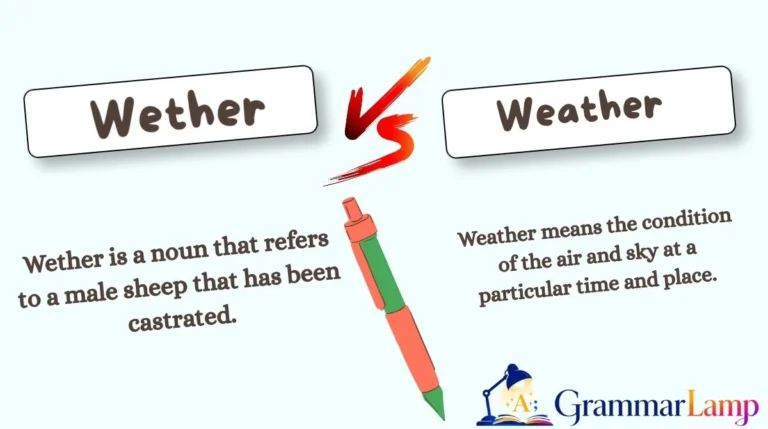
Wether is a noun that refers to a male sheep that has been castrated. The word can also be used for a castrated male goat, although its use with sheep is more common.
This is a very uncommon word in modern everyday English. You are much more likely to see weather or whether in normal writing and conversation.
Simple definition of wether
Wether = a castrated male sheep, or sometimes a castrated male goat.
For example:
- The farmer bought a young wether.
- The wether was kept with the other sheep.
- The farmer separated the wether from the breeding animals.
- We saw several wethers in the field.
- The shepherd was taking care of an old wether.
- The wether was calm and easy to handle.
- They moved the wether into another enclosure.
When do we use “wether”?
You normally use wether only when talking about animals, farming, sheep, goats, or related subjects.
It is not a word you would normally use when talking about rain, sunshine, or choices.
For example:
The wether was standing near the fence.
Here, wether is a noun referring to an animal.
You cannot use it like this:
❌ I don’t know wether he will come.
The correct word is whether:
✅ I don’t know whether he will come.
You also cannot use wether when talking about conditions outside:
❌ The wether is cold today.
The correct sentence is:
✅ The weather is cold today.
Grammar rule for “wether”
Wether is a countable noun. You can use words such as a, the, one, or several with it.
Examples:
- a wether
- the wether
- one wether
- several wethers
Because the word is uncommon, English learners often do not need to use it actively. The important thing is to recognize it and avoid confusing it with weather and whether.
What Does “Weather” Mean?
Weather means the condition of the air and sky at a particular time and place. It includes things such as rain, sunshine, clouds, wind, snow, heat, and cold.
This is one of the most common uses of the word.
For example:
The weather is nice today.
Here, weather tells us about the conditions outside.
Simple definition of weather
Weather = the condition of the atmosphere outside at a particular time and place.
We use this word every day because weather affects our travel, clothes, plans, work, school, and outdoor activities.
When do we use “weather”?
Use weather when talking about:
- rain
- sunshine
- wind
- snow
- clouds
- temperature
- storms
- hot or cold conditions
- general outdoor conditions
Here are some examples:
- The weather is beautiful today.
- The weather looks bad this morning.
- I don’t like cold weather.
- The weather forecast says it will rain tomorrow.
- We stayed home because of the bad weather.
- What is the weather like today?
- The weather changed suddenly.
- Warm weather makes me feel happy.
Grammar rule for “weather”
Weather is usually an uncountable noun.
We normally say:
The weather is nice.
Not:
❌ The weather are nice.
And normally not:
❌ a weather
Instead, you can say:
a type of weather
or:
a period of bad weather
For example:
We had a week of cold weather.
Common learner confusion with “weather”
Many learners confuse weather with whether because they sound almost the same.
Compare:
I don’t like the weather.
and:
I don’t know whether he likes it.
The first sentence talks about conditions outside.
The second sentence talks about uncertainty or a choice.
A simple question can help:
Am I talking about rain, sunshine, wind, heat, or cold?
If yes, you probably need weather.
What Does “Whether” Mean?
Whether is used when we talk about two or more possibilities, choices, or uncertainty.
It is a very common word in English, especially in sentences where someone does not know which possibility is true.
For example:
I don’t know whether she is at home.
This means:
I don’t know if she is at home or not.
Simple definition of whether
Whether = used to talk about possibilities, choices, or uncertainty.
Here are some examples:
- I don’t know whether he will come.
- She asked whether I was ready.
- We need to decide whether to stay or leave.
- I’m not sure whether this is correct.
- He is wondering whether she knows the truth.
- Tell me whether you agree or disagree.
- I can’t decide whether to buy it.
- We don’t know whether the shop is open.
When do we use “whether”?
A very common structure is:
whether + clause
For example:
I don’t know whether he is coming.
Another common structure is:
whether + to + verb
For example:
I don’t know whether to go.
We can also use:
whether … or …
For example:
I don’t know whether to call him or wait.
This structure clearly shows two choices.
“Whether” in questions and statements
Although whether can appear in sentences about questions, it does not usually introduce a direct question.
For example:
I don’t know whether she is coming.
This is an indirect question.
The direct question would be:
Is she coming?
Another example:
He asked whether I needed help.
The direct question would be:
Do you need help?
So, whether is often used to report or discuss a question or uncertainty inside a larger sentence.
Whether vs if
In many everyday sentences, whether and if can have similar meanings.
For example:
I don’t know whether he will come.
and:
I don’t know if he will come.
Both are natural.
However, whether is especially useful when there are clear alternatives:
I don’t know whether to stay or leave.
It is also preferred in some formal structures, such as:
It depends on whether they agree.
Difference Between Wether, Weather, and Whether
These three words have completely different meanings even though their spelling and pronunciation can cause confusion.
| Word | Meaning | Part of Speech | Common Use |
|---|---|---|---|
| wether | A castrated male sheep or goat | Noun | Farming/animals |
| weather | Conditions outside | Noun | Rain, wind, heat, snow |
| whether | Possibility, uncertainty, or choice | Conjunction | Choices and indirect questions |
1. Wether = an animal
If you see wether in a sentence about sheep or farming, it probably refers to a castrated male sheep.
The farmer moved the wether to another field.
2. Weather = conditions outside
If the sentence talks about rain, sunshine, wind, temperature, clouds, or storms, use weather.
The weather is very hot today.
3. Whether = choice or uncertainty
If the sentence talks about not knowing, deciding, or choosing between possibilities, use whether.
I don’t know whether he will call.
Compare these three sentences
The weather is cold.
This talks about outdoor conditions.
I don’t know whether the weather will improve.
This talks about uncertainty.
The farmer owns a wether.
This talks about an animal.
Notice how changing only a few letters completely changes the meaning.
Sentence structure difference
Weather normally works as a noun:
The weather is terrible.
Wether also works as a noun:
The wether is in the field.
Whether works differently. It usually connects one part of a sentence to another:
I don’t know whether he is coming.
It can also appear before to + verb:
She cannot decide whether to stay.
This grammar difference is extremely useful. If you need a noun for outdoor conditions, use weather. If you need to show uncertainty or a choice, use whether.
Explore More Posts
Mine as Well or Might as Well? The Correct Phrase Explained in Simple English (2026)
Alternative of vs Alternative for vs Alternative to: Which Is Correct? 2026 Guide
Realise or Realize: Which Spelling Is Correct in 2026?
Berth vs Birth: Meaning, Difference, Examples & Easy Rules for 2026
Grammar Rules You Must Remember
Rule 1: Use “weather” for conditions outside
When you are talking about rain, sunshine, wind, heat, cold, snow, or storms, use weather.
Example:
The weather is rainy today.
Another example:
We canceled the picnic because of the bad weather.
Think about what you can see when you look outside. If the sentence is about those conditions, weather is the correct word.
Rule 2: Use “whether” for choices or uncertainty
Use whether when you are not sure about something or when there are two possible choices.
Example:
I don’t know whether he is coming.
The meaning is that you are uncertain about his arrival.
Another example:
She is deciding whether to accept the job.
Here, she has a choice.
Rule 3: Use “wether” only for the animal
Wether is not another spelling of weather.
It has a special meaning related to sheep or goats.
Example:
The farmer sold the wether.
If your sentence is not about an animal, you probably do not need wether.
Because this word is uncommon, learners should be especially careful when typing it.
Rule 4: Remember the difference between “whether” and “weather”
Try replacing the word with a simpler phrase.
If you can replace it with:
“if” or “if or not”
you probably need whether.
Example:
I don’t know whether she is ready.
You can think:
I don’t know if she is ready.
But if you can replace the word with:
“conditions outside”
you need weather.
Example:
The weather is getting colder.
Think:
The conditions outside are getting colder.
This quick test can prevent many spelling mistakes.
Common Mistakes Students Make
These words are often confused because weather and whether sound very similar. Autocorrect can also make the problem worse because a spell-checker may not understand the meaning you want.
Mistake 1: Using “whether” for outdoor conditions
❌ The whether is beautiful today.
✅ The weather is beautiful today.
Why?
Because the sentence talks about outdoor conditions.
Easy tip:
Rain, wind, sun, snow, heat, and cold = weather.
Mistake 2: Using “weather” when talking about a choice
❌ I don’t know weather he will come.
✅ I don’t know whether he will come.
Why?
The speaker is uncertain about whether he will come or not.
Easy tip:
Uncertainty or choice = whether.
Mistake 3: Thinking “wether” is just a spelling mistake
Not always.
Wether is actually a real English word. It refers to a castrated male sheep and, in some usage, a male goat.
However, it is not common in everyday English.
So if you see:
The wether was grazing in the field.
the writer may be using the word correctly.
Mistake 4: Writing “whether” when you mean “weather”
This is especially common in online messages.
❌ What is the whether like today?
✅ What is the weather like today?
The phrase “What is the weather like?” is one of the most common ways to ask about conditions outside.
Mistake 5: Forgetting “whether” before a choice
❌ I can’t decide to stay or leave.
This sentence can sometimes be understood, but a clearer structure is:
✅ I can’t decide whether to stay or leave.
The word whether makes the two choices clear.
Easy Trick to Remember the Difference
Here is a simple memory trick that can help you remember all three words.
Weather = Sky
Think about clouds, rain, sunshine, and temperature. If you are talking about the sky, use weather.
Whether = Choice
Think about two possible answers or decisions. If you are unsure or choosing between options, use whether.
Wether = Farm Animal
Think about a castrated male sheep or goat. This word belongs mainly to farming.
Use Real-Life Logic
Imagine you wake up in the morning and look outside.
You see dark clouds. You might say, “The weather looks bad.”
Then your friend asks if you want to go for a walk. You might say, “I don’t know whether I should go.”
Later, you visit a farm and see a castrated male sheep. The farmer may call it a wether.
The words sound alike, but the situations are different.
A Quick Question to Ask Yourself
Before writing one of these words, ask:
- Am I talking about the sky? Use weather.
- Am I talking about a choice or possibility? Use whether.
- Am I talking about a castrated male sheep or goat? Use wether.
This small habit can help you avoid many spelling mistakes.
Daily Life Examples (Very Important)
The following conversations show how these words are used in real situations.
1. Talking About the Weather
Ali: Are we going to play cricket today?
Hassan: I think so. The weather looks nice.
Ali: Great! Let’s meet at the ground at 4 p.m.
Here, weather refers to the outdoor conditions.
2. Making a Decision
Sara: Are you coming to the party tonight?
Ayesha: I’m not sure whether I can come.
Sara: That’s okay. Just let me know later.
Here, whether shows uncertainty about a decision.
3. Checking the Forecast
Father: Did you check the weather forecast?
Son: Yes, it says it may rain tomorrow.
Father: Then take an umbrella to school.
The word weather is used when discussing a forecast.
4. Choosing Between Two Things
Friend 1: Do you want tea or coffee?
Friend 2: I can’t decide whether to have tea or coffee.
Friend 1: I’ll make both. You can choose.
Here, whether introduces two options.
5. Talking About a Farm Animal
Farmer: Do you know what this animal is called?
Visitor: I’m not sure.
Farmer: It is a wether, a castrated male sheep.
The word wether is used in an animal-related situation.
6. Planning a Trip
Mariam: Are you going to Lahore this weekend?
Noor: I don’t know whether my brother can drive me.
Mariam: You could take a bus if he is busy.
Here, whether introduces uncertainty about the trip.
7. Talking About Rain
Ahmed: Should we take our bikes to the park?
Usman: Let’s check the weather first.
Ahmed: Good idea. I don’t want to get caught in the rain.
Weather refers to the outdoor conditions that may affect their plans.
8. Asking an Indirect Question
Teacher: Do you know whether the school is open tomorrow?
Student: I’m not sure. I’ll ask my father.
Teacher: All right. Please tell me when you find out.
Here, whether introduces an indirect yes-or-no question.
9. Going Out Despite the Weather
Friend 1: What if it rains during the match?
Friend 2: We’ll play whether it rains or not.
Friend 1: That’s the spirit!
The phrase whether it rains or not means the decision will stay the same in either situation.
10. Visiting a Farm
Visitor: How many sheep do you have?
Farmer: I have twelve sheep, including two wethers.
Visitor: What does that mean?
Farmer: They are male sheep that have been castrated.
This conversation shows the special farming meaning of wether.
Practice Section
Choose the correct word to complete each sentence: wether, weather, or whether.
1. I hope the _____ stays sunny this weekend.wetherweatherwhether
2. I don’t know _____ he will come to the meeting.wetherweatherwhether
3. The farmer has a young _____ in the field.wetherweatherwhether
4. We need to decide _____ to leave now or wait.wetherweatherwhether
5. The _____ was cold and windy yesterday.wetherweatherwhetherCheck Answers
Practice Answers and Explanations
- Weather — The sentence is about sunny outdoor conditions.
- Whether — It expresses uncertainty about someone coming.
- Wether — It refers to a castrated male sheep or goat.
- Whether — It introduces two possible choices: leave or wait.
- Weather — It describes cold and windy conditions.
Try to understand why each answer is correct instead of simply memorizing the spelling. When you understand the meaning, choosing the right word becomes much easier.
More Helpful posts
Better Understand vs Understand Better: Meaning, Grammar, and Correct Usage (2026)
Hear vs Here: Meaning, Difference, Grammar Rules & Examples in 2026
Hasn’t vs Haven’t: Easy Grammar Rules, Examples & Differences in 2026
Smooth vs Smoothe: Which Spelling Is Correct? Complete Guide for 2026
FAQs
1. What is the difference between wether, weather, and whether?
Wether is a castrated male sheep or goat. Weather refers to outdoor conditions such as rain, sunshine, and temperature. Whether is used to introduce choices, possibilities, or uncertainty.
2. Is wether a real English word?
Yes, wether is a real English word. It refers to a castrated male sheep or goat. It is mainly used in farming and animal-related discussions, so you may not see it often in everyday English.
3. Can whether be used in questions?
Yes, whether can be used in indirect questions and questions involving choices. For example, “Do you know whether she is coming?” It can also introduce alternatives, as in “I can’t decide whether to stay or leave.”
4. Is weather a noun or a verb?
Weather is usually a noun when it refers to outdoor conditions. It can also be a verb meaning to survive a difficult situation or withstand the effects of the environment. For example, “The family weathered the storm.”
5. Is whether formal or informal?
Whether is used in both formal and informal English. You can use it in everyday conversations, schoolwork, emails, and professional writing. In some sentences, if can replace it, but whether is needed in certain grammar patterns.
6. How can I remember whether to use weather or whether?
Use weather when talking about the sky, rain, wind, or temperature. Use whether when talking about a choice or something you are unsure about. If the sentence is about a farm animal, use wether.
Conclusion
The difference between wether, weather, and whether becomes simple when you focus on meaning instead of sound. These words may sound alike, but each one has its own job.
Use weather when talking about outdoor conditions, such as rain, sunshine, wind, and temperature.
Use whether when discussing choices, possibilities, or something you are unsure about. Use wether only when referring to a castrated male sheep or goat.
The most helpful habit is to pause for a moment and think about what your sentence means.
Are you talking about the sky, making a choice, or describing a farm animal? The answer will help you choose the correct spelling.
You do not need to memorize every example at once. Start by practicing a few simple sentences each day. Try using these words in your messages, schoolwork, and conversations.
With a little practice, you will begin to recognize the correct word naturally.
Keep learning, keep writing, and do not worry about making mistakes. Every mistake is a chance to improve your English.

Liam Derren is a language writer at GrammarLamp, creating simple, helpful content about grammar, words, and everyday English. He makes language learning clear, practical, and easy to understand.