
If you have ever stopped while writing and wondered whether the correct word is smooth or smoothe, you are not alone.
English has many words whose spelling seems to follow a pattern, but then suddenly breaks that pattern. This is one of those cases.
The confusion often comes from the way English verbs work. Words such as soothe, teethe, and bathe contain a final e, so learners may naturally think that smoothe should also be correct.
You may even see the spelling smoothe online or in older books, which makes the question even harder.
The good news is that the modern choice is simple: smooth is the normal and standard spelling. It can work as an adjective, verb, adverb, and noun.
The spelling smoothe has appeared historically and is still recorded as an alternative form of the verb, but it is much less common and may look old-fashioned or incorrect to modern readers.
Collins, for example, records smoothe as an alternative spelling of smooth, while historical sources show that the form has existed for a long time.
By the end of this guide, you will know exactly when to use smooth, what smoothe means, why people confuse them, and which spelling is safest in school, work, exams, emails, and everyday English.
What Does “Smooth” Mean?
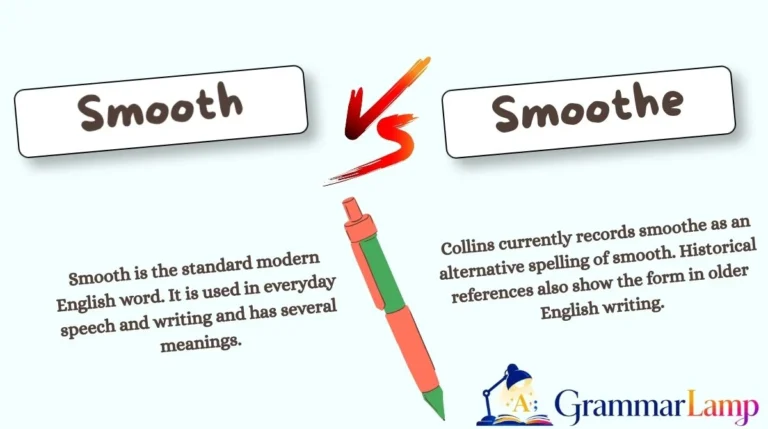
Smooth is the standard modern English word. It is used in everyday speech and writing and has several meanings.
As an adjective, smooth usually describes something that has an even surface and is not rough.
For example:
- This table has a smooth surface.
- Her skin feels smooth and soft.
- The road is smooth after the repairs.
- I like this smooth fabric.
- The glass is completely smooth.
But smooth is not limited to physical surfaces. We also use it when something happens easily, calmly, or without problems.
Consider these examples:
- We had a smooth journey home.
- The meeting went smoothly.
- She made a smooth transition to her new job.
- Everything went smooth after the problem was fixed.
Here, smooth does not mean “not rough” in a physical sense. It means that something happens without sudden problems or interruptions. Dictionaries also give meanings connected with ease, calm movement, pleasant texture, and freedom from difficulties.
Smooth as an adjective
The most common use is as an adjective.
The basic pattern is:
subject + linking verb + smooth
Examples:
- The surface is smooth.
- Her hair looks smooth.
- The road feels smooth.
- The sauce is smooth.
You can also put smooth directly before a noun:
- a smooth road
- a smooth surface
- smooth skin
- a smooth voice
- a smooth process
Smooth as a verb
An important point for learners is that smooth is also a verb.
As a verb, it means to make something even, flat, calm, or free from problems.
Examples:
- Please smooth the paper before you fold it.
- She smoothed her dress with her hands.
- He smoothed the wrinkles out of his shirt.
- The worker smoothed the rough edges.
- We need to smooth out this problem.
- She tried to smooth the situation.
The standard verb forms are:
smooth → smooths → smoothed → smoothing
For example:
- I smooth the surface.
- She smooths the surface.
- He smoothed the surface yesterday.
- They are smoothing the wall.
Notice something important here: the past form is smoothed, not smoothed with an extra spelling change. Collins lists smooths, smoothed, and smoothing as the normal forms.
Common confusion about “smooth”
A learner may think:
“If smooth is an adjective, I need another spelling when it becomes a verb.”
You do not.
Smooth can already be a verb.
So these are correct:
- Smooth the paper.
- Smooth the cream over your skin.
- She smoothed her hair.
- He is smoothing the surface.
You do not need to change smooth to smoothe to make it a verb.
What Does “Smoothe” Mean?
Smoothe is the confusing form in this pair.
The word is not simply a completely invented spelling. Historically, smoothe has been used as an alternative form of smooth, especially as a verb. Collins currently records smoothe as an alternative spelling of smooth. Historical references also show the form in older English writing.
However, there is an important practical rule for modern learners:
Do not normally use “smoothe” in modern English. Use “smooth” instead.
Why? Because smooth is the established modern spelling used in ordinary English. Smoothe is rare, old-fashioned, or nonstandard-looking in most modern contexts.
For example, if you are writing an essay, email, application, school assignment, website, or business document, write:
- Please smooth the surface. ✅
rather than:
- Please smoothe the surface. ⚠️
The second form may be understood, but it is not the spelling a modern learner should choose.
Historical use of “smoothe”
Older English spelling was much less standardized than modern English spelling. A word could appear in different forms in different periods and texts.
The spelling smoothe has been recorded as an alternative form of smooth, including in older works. Wiktionary describes the verb as a less common alternative form and the adjective as an archaic form.
This explains why you might occasionally find smoothe in an old book, historical document, or quotation.
For example, a historical text might contain:
- He tried to smoothe the rough metal.
That does not mean modern writers should copy the spelling.
Examples involving “smoothe”
You may encounter examples such as:
- He attempted to smoothe the rough surface.
- The worker used a tool to smoothe the edges.
- She carefully tried to smoothe the fabric.
These examples show the historical or alternative use of the word. In modern standard writing, however, the preferred versions are:
- He attempted to smooth the rough surface.
- The worker used a tool to smooth the edges.
- She carefully tried to smooth the fabric.
So, for a student learning English today, smooth is the safe choice.
A common learner confusion
Many learners see soothe and smooth and assume they should have the same spelling pattern.
But soothe and smooth are separate words.
Soothe means “to calm, comfort, or reduce pain.”
- The mother tried to soothe the crying baby.
- This cream helps soothe irritated skin.
Smooth means “to make even” or “free from roughness,” among other meanings.
- Please smooth the paper.
- The road is smooth.
Dictionary sources distinguish these words clearly: soothe is a verb meaning to calm or relieve, while smooth can describe an even surface or mean to make something even.
Difference Between Smooth and Smoothe
The easiest way to understand the difference is to separate modern usage from historical usage.
| Point | Smooth | Smoothe |
|---|---|---|
| Modern standard English | Yes | Rare/alternative |
| Common in everyday English | Yes | No |
| Used as an adjective | Yes | Historically |
| Used as a verb | Yes | Historically/alternatively |
| Safe for school writing | Yes | No |
| Safe for formal writing | Yes | Generally avoid |
| Meaning | Even, soft, easy, or to make smooth | Essentially the same as smooth in its historical/alternative use |
| Recommended for learners | Yes | No |
1. Usage difference
The biggest difference is frequency and modern acceptance.
Smooth is normal English:
Please smooth the paper.
Smoothe is unusual:
Please smoothe the paper.
A reader will probably understand the second sentence, but may think it is a spelling mistake.
2. Grammar difference
There is no useful modern grammar rule saying:
“Use smooth for the adjective and smoothe for the verb.”
That is a common misunderstanding.
In fact, smooth itself is a verb.
Correct:
- She smooths the paper.
- She smoothed the paper.
- She is smoothing the paper.
You do not need smoothe.
3. Sentence structure
Because smooth can be an adjective and a verb, its sentence structure changes according to its role.
Adjective:
The floor is smooth.
Here, smooth describes the floor.
Verb:
She smoothed the floor.
Here, smoothed describes the action.
Adverb:
The car moved smoothly.
Here, smoothly tells us how the car moved.
This gives us a useful word family:
smooth → smoothly → smoothness → smoother → smoothest → smoothed → smoothing
4. Meaning comparison
The core idea remains similar: something is even, gentle, easy, or free from roughness.
For physical objects:
The stone is smooth.
For movement:
The car had a smooth ride.
For processes:
We had a smooth transition.
For communication:
She gave a smooth presentation.
For action:
He smoothed the wrinkles from his shirt.
In all these cases, smooth is the natural modern spelling.
Grammar Rules You Must Remember
Rule #1: Use “smooth” as the normal adjective
When you describe something as even, soft, polished, calm, or without bumps, use smooth.
Examples:
- The wall is smooth.
- She has smooth hair.
- This cream makes your skin smooth.
- We enjoyed a smooth flight.
Do not write smoothe as the adjective in normal modern English.
Rule #2: “Smooth” is also a verb
You do not need to add -e to make it a verb.
Correct forms include:
- smooth
- smooths
- smoothed
- smoothing
Examples:
I will smooth the paper.
She smooths her dress before leaving.
He smoothed his hair.
They are smoothing the surface.
Rule #3: The past tense is “smoothed”
The past tense of smooth is smoothed.
Example:
She smoothed the wrinkles out of the shirt.
The spelling contains -ed because this is a regular verb.
Similarly:
- clean → cleaned
- wash → washed
- polish → polished
- smooth → smoothed
Rule #4: Use “smoothly” when you need an adverb
If you want to explain how an action happens, use smoothly.
Examples:
- The machine is working smoothly.
- The meeting went smoothly.
- She spoke smoothly and confidently.
- The car moved smoothly along the road.
Compare:
It was a smooth meeting.
Here, smooth is an adjective.
The meeting went smoothly.
Here, smoothly is an adverb.
This small difference is useful in both speaking and writing.
Common Mistakes Students Make
Mistake 1: Writing “smoothe” as the normal verb
Wrong or not recommended in modern standard English:
Please smoothe the paper.
Better:
Please smooth the paper.
The confusion happens because learners may think every verb needs a special ending. But smooth already works as a verb.
Mistake 2: Thinking “smoothe” is the adjective
A student may write:
The table is very smoothe.
Use:
The table is very smooth.
The standard adjective is smooth.
Mistake 3: Confusing “smooth” with “soothe”
These two words look similar, but their meanings are different.
Please smooth the blanket.
This means make it flat or even.
Please soothe the child.
This means calm or comfort the child.
A simple spelling difference creates a completely different word.
Mistake 4: Writing “smoothen” when “smooth” is simpler
You may also see smoothen, which is a real but uncommon verb meaning “to make or become smooth.” Collins records it, but ordinary English usually needs only smooth.
For example:
Smooth the surface.
is simpler and more natural than:
Smoothen the surface.
For learners, smooth is usually the best choice.
Mistake 5: Assuming an extra “e” makes a word more correct
English spelling does not always work by adding letters that seem to match pronunciation.
Learners may think:
soothe → smoothe
But the two words developed differently and have different meanings.
The spelling you should remember is simply:
smooth
Easy Trick to Remember the Difference
Here is a simple memory trick:
If you mean “even, soft, easy, or make even,” think SMOOTH.
You can also remember this sentence:
Smooth is the smooth choice.
When you are writing an email, exam answer, essay, message, or website content and you are unsure between smooth and smoothe, choose smooth.
Think of the extra e in smoothe as an old spelling that you do not normally need.
There is another useful trick.
Remember the basic word family:
smooth → smooths → smoothed → smoothing → smoothly
Notice that none of these requires the spelling smoothe.
For example:
- smooth the paper
- smooths the paper
- smoothed the paper
- smoothing the paper
- moves smoothly
Once you learn this family, the spelling becomes much easier.
Daily Life Examples
Here are some natural examples you may hear or use in everyday English.
1. Talking about skin
This lotion makes my skin feel smooth.
Here, smooth describes the skin.
2. Talking about a road
The new road is much smoother than the old one.
Smoother is the comparative form of smooth.
3. Talking about a journey
We had a smooth journey home.
This means there were no major problems.
4. Talking about work
Everything is going smoothly today.
This means everything is happening without problems.
5. Talking about clothing
She smoothed her dress before taking the picture.
Here, smoothed is the past tense of the verb.
6. Talking about paper
Smooth the paper before you write on it.
Here, smooth is an instruction or command.
7. Talking about food
Keep stirring until the sauce is smooth.
A mixture can be smooth when it has no unwanted lumps. This is a common everyday meaning.
8. Talking about communication
He gave a smooth presentation.
This suggests that the presentation was confident, controlled, and without awkward interruptions.
9. Talking about movement
The car stopped smoothly.
The adverb tells us how the car stopped.
10. Talking about solving problems
We need to smooth out a few problems before the event.
Smooth out is a common phrasal verb. It means to remove difficulties or make a situation easier.
Practice Section
Choose the correct option in each sentence.
1. The table has a very ______ surface.
A. smooth
B. smoothe
2. Please ______ the paper before putting it in the folder.
A. smooth
B. smoothe
3. The meeting went ______.
A. smooth
B. smoothly
4. She ______ the wrinkles from her dress.
A. smoothed
B. smootheded
5. The new road is much ______ than the old road.
A. smoother
B. smoothe
Answers
1. A — smooth
The table has a very smooth surface.
2. A — smooth
Please smooth the paper before putting it in the folder.
3. B — smoothly
The meeting went smoothly.
4. A — smoothed
She smoothed the wrinkles from her dress.
5. A — smoother
The new road is much smoother than the old road.
If you remember only one thing from this exercise, remember this: smooth is the standard modern form.
FAQs About Smooth vs Smoothe
What is the difference between smooth and smoothe?
Smooth is the standard modern English spelling. It can be an adjective meaning even or not rough, and it can also be a verb meaning to make something even or easier.
Smoothe is an older or alternative spelling, especially associated with the verb. It is rare today, so modern learners should normally use smooth.
Is “smoothe” a correct word?
Historically, yes, smoothe has been used as an alternative spelling of smooth, particularly as a verb. Some dictionaries still record it in that sense.
However, it is not the normal choice for modern English. In school, professional writing, exams, and everyday communication, smooth is the safer and more natural spelling.
Can we use “smooth” as a verb?
Yes. Smooth is both an adjective and a verb.
As a verb, it means to make something even, flat, calm, or easier.
For example:
She smoothed her hair.
Please smooth the paper.
The regular verb forms are smooth, smooths, smoothed, and smoothing.
Is “smoothe” formal or informal?
It is better not to think of smoothe as a modern formal version of smooth. It is an alternative spelling with historical use and is now uncommon.
Using it in ordinary formal writing can distract the reader or make the word look misspelled. For modern English, choose smooth.
Should I write “smooth” or “smoothe” in an exam?
Write smooth.
For example:
The surface is smooth.
Please smooth the paper.
She smoothed her hair.
Although smoothe has historical dictionary support as an alternative form, smooth is the standard spelling that modern English learners should use.
Is “smoothly” related to “smooth”?
Yes. Smoothly is the adverb formed from smooth.
Compare:
She gave a smooth presentation.
Here, smooth is an adjective.
She spoke smoothly during the presentation.
Here, smoothly is an adverb describing how she spoke.
The word smooth also forms smoothness, smoother, and smoothest.
Conclusion
The difference between smooth and smoothe becomes much easier once you understand that smooth already works as both an adjective and a verb.
Use smooth to describe something that is even, soft, polished, calm, or free from difficulties. You can also use it as a verb when you mean “make something smooth” or “make something easier.” Its common verb forms are smooth, smooths, smoothed, and smoothing.
Smoothe is not simply a modern alternative that you should use whenever you want to sound formal. It has a real history in English and is recorded as an alternative form, but it is now uncommon.
So, when you are writing today, keep the choice simple: smooth is the spelling to remember.
A few examples will make it stick:
The table is smooth.
Please smooth the paper.
She smoothed her dress.
Everything went smoothly.
Practice these forms in your everyday English, and this spelling confusion will soon disappear.

Liam Derren is a language writer at GrammarLamp, creating simple, helpful content about grammar, words, and everyday English. He makes language learning clear, practical, and easy to understand.
1 thought on “Smooth vs Smoothe: Which Spelling Is Correct? Complete Guide for 2026”