
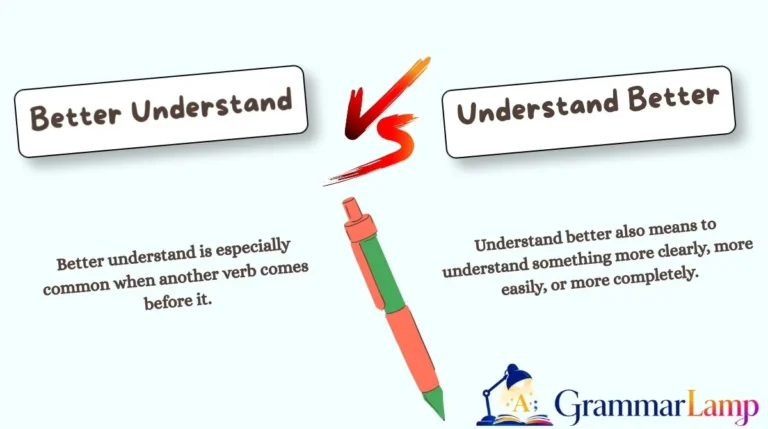
Many English learners get confused by “better understand” and “understand better.” Both expressions contain the same three words, but their position in a sentence is different.
This can make learners wonder if one is correct and the other is wrong.
The good news is simple: both are correct.
The difference is mainly about sentence structure, word position, and what comes after the verb. In some sentences, better understand sounds more natural.
In others, understand better is the better choice. Sometimes both forms are possible, but the sentence pattern changes slightly.
You hear these expressions often in everyday English. For example, a teacher might say, “I want you to better understand this rule.” A student might say, “I understand this topic better now.” Both sentences are natural, but they are built differently.
Understanding this small difference can make your English sound much more natural. It also helps you avoid common mistakes when speaking and writing.
By the end, you will know what better understand means, what understand better means, how their grammar works, when to use each one, and how native speakers commonly use them.
What Does “Better Understand” Mean?
Better understand means to understand something more clearly or more completely than before.
Here, better comes before the main verb understand.
The basic structure is:
better + understand
For example:
I want to better understand English grammar.
This means:
I want to understand English grammar more clearly.
The word better is an adverb here. It tells us how well someone understands something.
When should you use “better understand”?
Better understand is especially common when another verb comes before it.
A very common structure is:
want/need/hope/try + to + better understand + something
Examples:
- I want to better understand this lesson.
- She needs to better understand the problem.
- We are trying to better understand our customers.
- He hopes to better understand his teacher.
- They need to better understand the situation.
- I want to better understand how this machine works.
- You should better understand the rules before starting.
- The company is trying to better understand its customers.
The first six examples are especially natural because better understand follows to.
The grammar rule
When better understand follows to, the pattern is:
to + better + understand
For example:
I want to better understand the question.
Not:
I want to better understanding the question.
After to in this structure, we use the base form understand, not understanding.
Another common pattern is:
can/will/may/should + better understand
For example:
You will better understand the lesson after this example.
However, in everyday conversation, speakers often choose other word orders depending on the sentence.
Why does “better understand” sound slightly formal sometimes?
The expression better understand is very common in writing, teaching, business English, and formal speech.
For example:
This example will help students better understand the difference.
That sounds polished and natural.
In casual conversation, however, people may often say:
This example will help students understand the difference better.
Both are correct. The second one can sound more conversational.
Common learner confusion
Some learners think better understand means that understand is somehow a different verb.
It is not.
The main verb is still understand. Better simply modifies it.
Compare:
I understand English.
and:
I better understand English now.
The second sentence means your understanding has improved.
Another important point is that better understand does not usually mean “understand perfectly.” It means understand more clearly or to a greater degree.
What Does “Understand Better” Mean?
Understand better also means to understand something more clearly, more easily, or more completely.
The difference is that better comes after the verb.
The basic structure is:
understand + better
For example:
I understand this lesson better now.
This means:
I understand this lesson more clearly now than I did before.
When should you use “understand better”?
Understand better is very common when understand is already followed by an object.
The pattern is:
understand + object + better
Examples:
- I understand English grammar better now.
- She understands the problem better after your explanation.
- We understand the situation better today.
- He understands his parents better now.
- I understand this lesson better than yesterday.
- They understand the rules better after practicing.
- You will understand the idea better with an example.
- She understands her students better after talking to them.
Notice where better appears. The object often comes between understand and better.
For example:
I understand the lesson better.
Not:
I understand better the lesson.
The second version is possible in some special or formal structures, but it is not the normal choice for beginners.
“Understand better” in everyday speech
This form is extremely natural in spoken English.
Imagine a student talking to a teacher:
“Thank you. I understand the topic better now.”
That sounds very normal.
A friend might say:
“Can you explain it again? I want to understand it better.”
Again, this is natural everyday English.
Can “understand better” appear without an object?
Yes.
For example:
I understand better now.
The object is understood from the context.
If two people are discussing a difficult lesson, one person can simply say:
“Oh, I understand better now.”
The listener already knows what the person means.
Common learner confusion
A common mistake is putting better in the wrong position:
❌ I understand better this lesson.
For normal everyday English, say:
✅ I understand this lesson better.
Another natural option is:
✅ I better understand this lesson.
The two correct sentences have slightly different structures, but both communicate improved understanding.
Difference Between Better Understand and Understand Better
The most important thing to remember is that both expressions are grammatically correct.
The main difference is where “better” is placed.
| Expression | Common structure | Example | Meaning |
|---|---|---|---|
| better understand | better + understand | I want to better understand this rule. | Understand more clearly |
| understand better | understand + object + better | I understand this rule better now. | Understand more clearly |
| better understand | modal + better + understand | You will better understand it later. | Have improved understanding |
| understand better | understand + better | I understand better now. | My understanding has improved |
1. Word position
With better understand, the adverb comes before the verb:
I want to better understand the problem.
With understand better, the adverb usually comes after the object:
I understand the problem better now.
This is the clearest grammatical difference.
2. The sentence structure changes
Look at these two sentences:
I want to better understand English.
and:
I understand English better now.
In the first sentence, better understand follows want to.
The structure is:
want + to + better understand + object
In the second sentence, better comes after the object:
understand + object + better
This is why you should not simply move the words around without checking the whole sentence.
3. The meaning is almost the same
Both sentences can describe an improvement in understanding.
For example:
I want to better understand mathematics.
means:
I want to understand mathematics more clearly.
And:
I understand mathematics better now.
means:
My understanding of mathematics has improved.
The first focuses more on the goal or desire to improve understanding.
The second usually focuses more on the current result or improvement.
4. “Better understand” often appears in formal writing
You may see this structure in education, business, reports, and professional writing:
The study helps us better understand the problem.
The meeting allowed employees to better understand the new policy.
This guide will help readers better understand English grammar.
This construction is perfectly standard.
5. “Understand better” is very natural in conversation
In casual speech, you will often hear:
I understand it better now.
Can you explain that so I can understand it better?
I understand you better than before.
These sentences sound friendly and conversational.
That does not mean “better understand” is formal only. Native speakers use both forms. The surrounding sentence determines which one fits best.
Grammar Rules You Must Remember
Rule 1: “Better” can come before “understand”
You can place better before understand, especially in structures with another verb.
I want to better understand the situation.
She hopes to better understand her students.
A useful pattern is:
to + better + base verb
So:
to better understand
is correct.
Rule 2: “Better” can come after the object
When understand has a direct object, a very common structure is:
understand + object + better
For example:
I understand the lesson better now.
He understands the problem better after the discussion.
The object is placed between understand and better.
This is one of the safest structures for beginners.
Rule 3: Do not automatically put “better” after “understand”
A common mistake is:
❌ I understand better the lesson.
For ordinary modern English, the natural version is:
✅ I understand the lesson better.
Or:
✅ I better understand the lesson.
The second sentence is grammatical, although the first may sound more natural in casual conversation.
Rule 4: “Better” means improvement, not perfection
When you say:
I understand it better now.
you are saying your understanding has improved.
You are not necessarily saying:
I understand it perfectly now.
For example:
I understand the instructions better now, but I still have a few questions.
This is completely natural.
Common Mistakes Students Make
Mistake 1: Thinking one expression is correct and the other is wrong
Some learners believe:
“better understand” = correct
“understand better” = incorrect
That is not true.
Both are correct.
The important question is where the phrase appears in the sentence.
Compare:
I want to better understand you.
I understand you better now.
Both sentences are correct.
Mistake 2: Using “understand better” with the object in the wrong place
A learner may say:
❌ I understand better English now.
A more natural sentence is:
✅ I understand English better now.
The object English normally comes before better in this structure.
Another example:
❌ She understands better the problem.
Better:
✅ She understands the problem better.
Or:
✅ She better understands the problem.
Mistake 3: Adding “to” incorrectly
Some learners say:
❌ I want to better understanding this topic.
The problem is understanding.
After to in this structure, use the base verb:
✅ I want to better understand this topic.
You can also say:
✅ I want to understand this topic better.
Mistake 4: Thinking “better understand” always sounds more natural
Not necessarily.
If you are talking casually about an improvement, this often sounds very natural:
I understand the instructions better now.
You do not need to force better understand into every sentence.
A simple tip is: choose the structure that fits the rest of your sentence naturally.
Mistake 5: Confusing “better” with “more”
English normally uses better because good/well has the comparative form better.
So we say:
I understand it better now.
Not:
❌ I understand it more good now.
And usually not:
❌ I understand it more well now.
Better is the natural comparative adverb here.
Easy Trick to Remember the Difference
Here is a simple trick:
BETTER UNDERSTAND = before the verb
Think:
BETTER → UNDERSTAND
Example:
I want to better understand English.
UNDERSTAND BETTER = after the object
Think:
UNDERSTAND → THING → BETTER
Example:
I understand English better.
So remember:
Better understand → better comes before the verb.
Understand better → better usually comes after the thing being understood.
There is another easy way to think about it.
When you are talking about a goal, “better understand” is often useful:
I want to better understand this.
You want your understanding to improve.
When you are talking about a result, “understand better” is very common:
I understand this better now.
Your understanding has already improved.
This is not an absolute rule, but it is a helpful guide for learners.
Daily Life Examples
These examples show how native and fluent English speakers might use both expressions in real situations.
1. In a classroom
Student: I was confused about fractions before.
Teacher: I hope this example helps you better understand them.
Here, better understand follows helps you.
2. Talking about a lesson
I understand this lesson better now.
The student is talking about an improvement that has already happened.
3. Asking a friend for help
Can you explain that again? I want to better understand the idea.
The speaker has a goal: clearer understanding.
4. After watching a video
I watched a video about the topic, and now I understand it better.
This is very natural in everyday speech.
5. At work
We need to better understand what our customers want.
This sounds natural in a workplace setting.
6. Talking about people
After spending more time together, I understand him better.
The speaker’s understanding of the person has improved.
7. Learning a language
Speaking with native speakers helps me better understand everyday English.
This sentence describes something that helps improve understanding.
8. After receiving an explanation
Thanks for explaining it. I understand the problem better now.
This is a very common conversational pattern.
9. Talking to a teacher
Could you give me another example so I can understand the rule better?
This sounds natural and polite.
10. Understanding a difficult situation
After hearing both sides, I understand the situation better.
The speaker now has a clearer picture.
Practice Section
Choose the option that fits each sentence best.
1. I want to ______ this grammar rule.
A. better understand
B. understand better the
2. I ______ this grammar rule now.
A. understand this grammar rule better
B. understand better this grammar rule
3. This example will help you ______ the difference.
A. better understand
B. better understanding
4. After the teacher explained it, I ______.
A. understand better now
B. better understanding now
5. We need to ______ our customers.
A. better understand
B. understand better our customers
Answers
1. A — better understand
I want to better understand this grammar rule.
2. A — understand this grammar rule better
I understand this grammar rule better now.
3. A — better understand
This example will help you better understand the difference.
4. A — understand better now
I understand better now.
The object can be left out because it is already clear from the conversation.
5. A — better understand
We need to better understand our customers.
FAQs
What is the difference between “better understand” and “understand better”?
Both mean understand more clearly or more completely. The main difference is word order.
Better understand places better before understand, while understand better usually places better after the object.
Can we use “better understand” in questions?
Yes.
For example:
How can I better understand this topic?
You can also say:
How can I understand this topic better?
Both are correct and natural.
Is “better understand” formal or informal?
It can be used in both formal and informal English.
However, better understand is especially common in writing, education, business, and professional English. Understand it better is also very common in everyday conversation.
Is “understand better” grammatically correct?
Yes, it is completely correct.
For example:
I understand English better now.
The important point is to use the correct word order when an object is present.
Which is better: “I better understand” or “I understand better”?
It depends on the sentence.
I better understand the problem now.
and
I understand the problem better now.
Both are grammatical. The second often sounds more conversational, while the first can sound slightly more formal or polished.
Can I say “I understand better”?
Yes. You can use it when the object is already clear.
For example:
“Do you understand the lesson now?”
“Yes, I understand better now.”
The listener already knows what you understand better, so there is no need to repeat the object.
Conclusion
Better understand and understand better are both correct English expressions. They have almost the same basic meaning: to understand something more clearly or to a greater degree.
The main difference is word order.
Use better understand when better comes before the verb:
I want to better understand this topic.
Use understand better when better comes after the object:
I understand this topic better now.
For beginners, a useful pattern is to remember:
better + understand
and
understand + thing + better
Do not worry about choosing the “perfect” form every time. Both are widely used.
Pay attention to the structure of the whole sentence and listen to how fluent speakers use these expressions.
The best way to learn the difference is to make your own sentences. Try using one sentence about school, one about work, and one about a conversation with a friend.
With a little practice, the word order will start to feel natural.

Liam Derren is a language writer at GrammarLamp, creating simple, helpful content about grammar, words, and everyday English. He makes language learning clear, practical, and easy to understand.
3 thoughts on “Better Understand vs Understand Better: Meaning, Grammar, and Correct Usage (2026)”