
Breath and breathe are two small English words that confuse many learners. They look almost the same, have a similar meaning, and are connected to the same action. The main difference is simple: breath is a noun, while breathe is a verb.
The pronunciation is also different. Breath ends with a soft “th” sound, like in think. Breathe ends with a vibrating “th” sound, like in this. That small sound difference can make these words even harder for English learners.
You see both words in everyday English. People talk about taking a breath, breathing deeply, holding their breath, and having trouble breathing.
You may also hear them in health conversations, sports, exercise, stories, songs, and normal daily speech.
The good news is that you do not need to memorize complicated grammar rules to understand them. Once you know whether you need a thing or an action, choosing the correct word becomes much easier.
By the end of this guide, you will understand the meaning, grammar, pronunciation, sentence patterns, and common mistakes connected with breath vs breathe.
You will also see simple examples that you can use in real conversations.
Inside of vs Inside: The Easy Difference Explained in 2026
Attend vs Tend: Meaning, Differences, Grammar Rules & Examples (2026)
Better Understand vs Understand Better: Meaning, Grammar, and Correct Usage (2026)
Hear vs Here: Meaning, Difference, Grammar Rules & Examples in 2026
What Does “Breath” Mean?
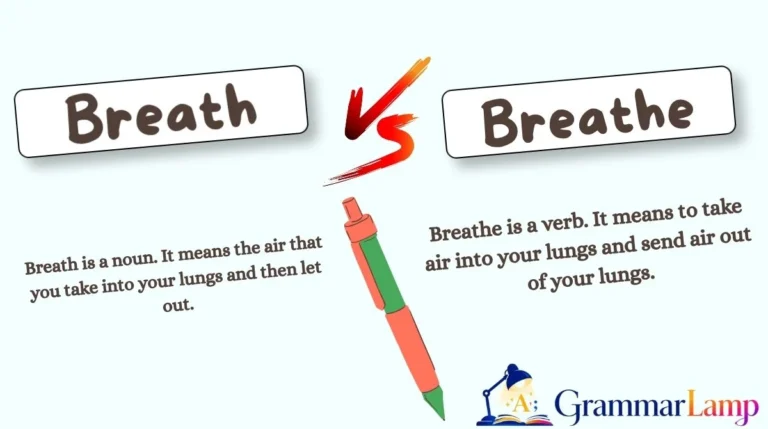
Breath is a noun. It means the air that you take into your lungs and then let out.
Think of breath as the thing involved in breathing.
For example:
Take a deep breath before you speak.
Here, breath is the name of something. You can take it, hold it, lose it, or catch it.
When should you use “breath”?
Use breath when you are talking about the air entering or leaving your lungs as a noun.
Common expressions include:
- take a breath
- take a deep breath
- hold your breath
- catch your breath
- lose your breath
- out of breath
- a breath of fresh air
- bad breath
Notice that breath often appears after words such as a, your, my, his, or her.
Grammar rule for “breath”
The most important rule is:
Breath = noun
You can often put an article or possessive word before it.
For example:
- a breath
- one breath
- my breath
- your breath
- his breath
- her breath
You can also use the plural form breaths when you are talking about more than one breath.
Examples with “breath”
- Take a deep breath and relax.
- She held her breath while swimming underwater.
- I was out of breath after running up the stairs.
- He took a quick breath before answering the question.
- The cold air felt wonderful with every breath.
- I need to catch my breath after that long walk.
- She was so surprised that she could hardly catch her breath.
- Take a breath before you start speaking.
In each sentence, breath names the air or the single act of taking air as a noun.
Common learner confusion
A common mistake is using breath when an action is needed.
For example:
❌ I cannot breath properly.
This is incorrect because cannot needs a verb after it.
The correct sentence is:
✅ I cannot breathe properly.
Another common mistake is writing:
❌ Take a deep breathe.
The correct version is:
✅ Take a deep breath.
Why? Because take is being followed by a noun. You take a breath, not a breathe.
A useful question to ask yourself is:
“Am I naming the air/action as a thing, or am I describing the action?”
If you need a noun, choose breath.
What Does “Breathe” Mean?
Breathe is a verb. It means to take air into your lungs and send air out of your lungs.
Think of breathe as the action.
For example:
Please breathe slowly.
Here, breathe tells someone what action to do.
When should you use “breathe”?
Use breathe when you are talking about the action of taking air in and letting it out.
It can be used with different subjects and verb forms:
- I breathe
- you breathe
- we breathe
- they breathe
- he breathes
- she breathes
- breathing
- breathed
The spelling changes depending on the tense or grammar structure.
Grammar rule for “breathe”
The main rule is:
Breathe = verb
You can use it after helping verbs such as:
- can breathe
- cannot breathe
- should breathe
- must breathe
- will breathe
You can also use its -ing form:
- breathing slowly
- breathing deeply
- breathing heavily
With he, she, or it in the simple present, the word becomes breathes.
For example:
She breathes slowly when she is nervous.
Examples with “breathe”
- Try to breathe slowly.
- I could not breathe because the smoke was everywhere.
- Take a moment to breathe and relax.
- He breathes deeply before every race.
- The baby is breathing quietly.
- You should breathe through your nose.
- She stopped to breathe after running.
- It is difficult to breathe in such a small room.
Notice that breathe describes an action in every example.
Common learner confusion
The biggest problem is confusing the verb breathe with the noun breath.
For example:
❌ You need to breath deeply.
Correct:
✅ You need to breathe deeply.
After need to, we use the base form of a verb. Breathe is the verb.
Another example:
❌ I took a deep breathe.
Correct:
✅ I took a deep breath.
After took, we need the noun that names what was taken. That noun is breath.
Difference Between Breath and Breathe
The easiest way to understand breath vs breathe is to remember their parts of speech.
Breath is a noun.
Breathe is a verb.
Their meanings are closely connected, but their jobs in a sentence are different.
Comparison table
| Feature | Breath | Breathe |
|---|---|---|
| Part of speech | Noun | Verb |
| Basic meaning | Air taken into or released from the lungs | The action of taking in and releasing air |
| Example | Take a deep breath. | Breathe deeply. |
| Common pattern | take + a + breath | can + breathe |
| Plural/form | breaths | breathes, breathing, breathed |
| Pronunciation | Ends with a soft “th” | Ends with a voiced “th” |
| Main idea | A thing | An action |
Usage difference
Compare these two sentences:
Take a deep breath.
Breathe deeply.
The first sentence tells you to take a thing: a breath.
The second sentence tells you to perform an action: breathe.
This is the basic difference you need to remember.
Grammar logic
English often uses different word forms for related ideas.
For example:
- advice = noun
- advise = verb
- choice = noun
- choose = verb
- belief = noun
- believe = verb
- breath = noun
- breathe = verb
So, breath and breathe are not two different things. They are related forms with different grammatical jobs.
Sentence structure difference
Look at these patterns:
Verb + noun
She took a breath.
Here, took is the verb and breath is the noun.
Modal + verb
She can breathe.
Here, can is a modal verb and breathe is the main verb.
Verb + adverb
She breathed slowly.
Here, breathed is the verb.
Possessive + noun
I could feel his breath.
Here, his describes the noun breath.
These sentence patterns can help you choose the right word without thinking too much about the spelling.
Meaning comparison
Both words relate to respiration, but they focus on different ideas.
Breath focuses on the air or a single intake of air:
I held my breath.
Breathe focuses on the action:
I cannot breathe.
This distinction is useful in almost every sentence where these words appear.
A Majority of vs The Majority of: Easy Grammar Guide for 2026
Tomatoes or Tomatos: Which Spelling Is Correct? [2026]
In the Morning vs On the Morning: Complete Grammar Guide for 2026
Inside of vs Inside: The Easy Difference Explained in 2026
Grammar Rules You Must Remember
Rule 1: Use “breath” as a noun
If you can put a, my, your, his, or her before the word, you probably need breath.
Examples:
Take a breath.
Hold your breath.
I could feel his breath.
You cannot say a breathe because breathe is a verb.
Rule 2: Use “breathe” as a verb
If the word describes the action of taking air in and letting it out, use breathe.
Examples:
Try to breathe slowly.
I need to breathe.
She can breathe normally now.
A helpful test is to look for words such as can, should, must, will, to, or did.
For example:
You should breathe slowly.
I want to breathe fresh air.
Rule 3: “Breathes” is the third-person singular form
When the subject is he, she, or it in the simple present tense, use breathes.
Examples:
He breathes slowly.
She breathes through her nose.
The dog breathes heavily after running.
Do not confuse breathes with breaths.
- breathes = verb
- breaths = plural noun
For example:
She breathes deeply.
She takes three deep breaths.
Rule 4: “Breathing” and “breathed” come from “breathe”
When you need an -ing form, use breathing.
He is breathing normally.
When you need the past form, use breathed.
She breathed a sigh of relief.
The spelling is important:
breathe → breathing
breathe → breathed
Do not write breathing as breathing or confuse it with the noun breath.
Common Mistakes Students Make
These mistakes happen because the two words look and sound very similar. Learners often remember the meaning but forget which grammatical form they need.
Mistake 1: “Take a deep breathe”
❌ Take a deep breathe.
✅ Take a deep breath.
After a, we need a noun. Breath is the noun.
Easy tip: You take a breath.
Mistake 2: “I can’t breath”
❌ I can’t breath.
✅ I can’t breathe.
After can’t, we need a base-form verb. Breathe is the verb.
Easy tip: You can breathe, but you take a breath.
Mistake 3: “She breath slowly”
❌ She breath slowly.
✅ She breathes slowly.
The subject she requires the third-person singular verb breathes in the simple present.
Mistake 4: “Hold your breathe”
❌ Hold your breathe.
✅ Hold your breath.
The word after your is a noun here.
You hold your breath.
Mistake 5: “I am breath deeply”
❌ I am breath deeply.
✅ I am breathing deeply.
After am in this structure, we need the present participle breathing.
Why do these mistakes happen?
English learners often learn words as pairs or memorize spelling without thinking about grammar. But grammar gives you a much easier way to choose.
Instead of asking:
“Which spelling looks right?”
Ask:
“Do I need a noun or a verb?”
That one question solves most breath vs breathe mistakes.
Easy Trick to Remember the Difference
Here is a simple memory trick:
Breath = thing
Breathe = action
Think of these two sentences:
Take a breath.
Breathe slowly.
You can imagine breath as a small package of air. You can take it, hold it, or catch it.
Breathe is what your body does with that air.
There is also a useful spelling clue.
Breathe has an extra e at the end.
That extra e can remind you that breathe is the action word.
You do not need to depend only on this trick, though. Grammar is more reliable.
Try remembering this mini-pair:
I take a breath.
I breathe.
If you can remember those two sentences, you can usually choose the correct word.
Daily Life Examples
These words appear naturally in everyday conversations. Here are some situations you might hear at home, at school, at work, or while exercising.
1. Before a presentation
Student: I’m really nervous about my presentation.
Teacher: Take a deep breath and speak slowly.
Here, breath is a noun because the student is being told to take something.
2. During exercise
Coach: Don’t run too fast. Breathe normally.
The coach is giving an instruction, so breathe is the verb.
3. After running
Ali: Give me a minute. I’m out of breath.
Sam: Sure. Sit down and relax.
The expression out of breath means breathing hard after physical activity or another effort.
4. While swimming
Sara: How long can you hold your breath?
Mina: Maybe thirty seconds.
Again, breath is the noun.
5. When someone is nervous
Mom: You look worried.
Son: I am worried about the exam.
Mom: Just breathe slowly. You’ll be fine.
The word describes an action, so breathe is correct.
6. In a crowded room
He: It’s so hot in here.
She: I know. It’s hard to breathe.
The speaker is talking about the action of breathing.
7. After good news
He: The doctor said everything is fine.
She: That’s wonderful. I can finally breathe easily.
Here, breathe is a verb.
8. During meditation
Teacher: Close your eyes and take a slow breath.
Student: Should I breathe through my nose?
Teacher: Yes, and try to stay relaxed.
Both words appear correctly because they have different grammatical jobs.
9. Talking about fresh air
Friend: Open the window.
You: Good idea. I need a breath of fresh air.
The expression a breath of fresh air can be literal, but it can also describe something pleasant and refreshing.
10. After climbing stairs
Brother: Why are you standing there?
Sister: I just climbed four floors. I need to catch my breath.
Here, catch my breath is a common expression meaning to stop and recover normal breathing after effort.
Practice Section
Choose breath or breathe to complete each sentence.
1. Please take a deep ______ before you begin.
2. I can’t ______ in this smoky room.
3. She took three slow ______ and relaxed.
4. You should ______ slowly when you feel nervous.
5. He was out of ______ after the race.
Answers
- breath
- breathe
- breaths
- breathe
- breath
The key is to check the grammar, not just the meaning. If the word is a noun, use breath. If it is an action, use breathe.
Sleeve vs Sleave: Which Is Correct? Meaning, Difference, and Examples in 2026
I’m vs I Am: Complete Difference, Rules, Examples & Usage Guide 2026
Time off vs time-off: The Complete Grammar Guide for 2026
Sun vs Son: Meaning, Difference, Rules, and Examples (2026)
FAQs
What is the difference between breath and breathe?
Breath is a noun that refers to the air you take into or release from your lungs. Breathe is a verb that means to take air into your lungs and release it. For example, you take a breath, but you breathe slowly.
Can we use “breathe” in questions?
Yes. Breathe can be used in questions whenever you are asking about the action of breathing.
For example:
Can you breathe normally?
Are you breathing comfortably?
But when you need the noun, use breath:
How long can you hold your breath?
Is “breath” formal or informal?
Breath is a normal English noun used in both formal and informal situations. You can use it in everyday conversation, school writing, medical discussions, and professional communication. Expressions such as take a breath and hold your breath are very common.
Is “breathe” formal or informal?
Breathe is also a normal English verb and works in both formal and informal English. You might hear it in a doctor’s office, a sports class, a classroom, or a casual conversation. The word itself is neither especially formal nor informal.
Is it “take a breath” or “take a breathe”?
The correct expression is take a breath. Breath is the noun in this phrase.
For example:
Take a deep breath and relax.
You cannot use breathe because it is a verb.
Is it “I can’t breath” or “I can’t breathe”?
The correct sentence is:
I can’t breathe.
After can’t, English uses the base form of a verb. Since breathe is the verb, it is the correct choice.
A quick comparison is:
I can’t breathe.
I need to take a breath.
Conclusion
Understanding breath vs breathe becomes much easier when you stop focusing only on their spelling and think about their grammatical roles.
Breath is a noun. It refers to the air that enters or leaves your lungs, or to a single intake of air. You can take a breath, hold your breath, or catch your breath.
Breathe is a verb. It describes the action of taking air into your lungs and releasing it. You can breathe slowly, breathe deeply, or say that you cannot breathe.
When you are unsure, remember the simple pair:
Take a breath.
Breathe slowly.
Practice these words in short sentences, especially sentences you might actually say during the day. After a little practice, the difference will start to feel natural.
The spelling may still look similar, but the grammar will tell you which word belongs in your sentence.

Liam Derren is a language writer at GrammarLamp, creating simple, helpful content about grammar, words, and everyday English. He makes language learning clear, practical, and easy to understand.
1 thought on “Breath vs Breathe: Easy Difference, Meaning, Examples & Rules in 2026”