
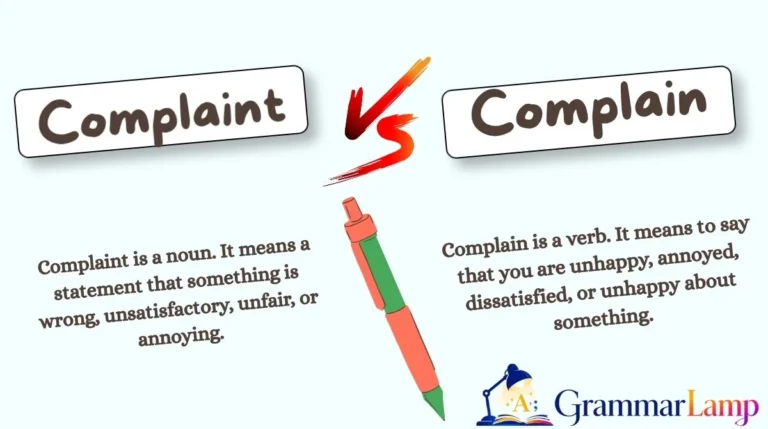
Complaint and complain are two very common English words, but many learners mix them up because they are closely related.
The main difference is simple: complaint is a noun, while complain is a verb.
For example:
- I have a complaint about the service.
- I want to complain about the service.
The meaning is almost the same, but the grammar is different. You cannot normally replace one word with the other without changing the sentence.
This small difference matters a lot in everyday English. You may need these words when talking to a shop worker, writing an email to a company, speaking about a bad experience, or simply telling a friend that something is bothering you.
The good news is that once you understand the job each word does in a sentence, the difference becomes easy.
You will learn how to use complaint and complain, which prepositions commonly follow them, how to make questions, what mistakes students often make, and how native speakers use these words in daily conversations.
By the end, you should be able to choose the correct word without stopping to think too much.
Enamor vs Enamour: What’s the Difference? Meaning, Usage & Examples in 2026
Breath vs Breathe: Easy Difference, Meaning, Examples & Rules in 2026
No Longer Exist vs No Longer Exists: Which Is Correct? (2026 Guide)
Favourite vs Favorite: Meaning, Difference, Spelling & Usage Guide 2026
What Does “Complaint” Mean?
Complaint is a noun. It means a statement that something is wrong, unsatisfactory, unfair, or annoying.
In simple English, a complaint is something you say or write when you are unhappy about something.
For example:
I made a complaint about the noisy neighbors.
Here, complaint is the name of the thing the person made. The action is expressed by made.
You can use complaint when you are talking about a problem, an objection, or an expression of dissatisfaction.
Grammar rule
Because complaint is a noun, it can appear after articles and determiners such as:
- a complaint
- the complaint
- my complaint
- your complaint
- several complaints
- many complaints
A very common structure is:
make + a complaint
Examples:
- I want to make a complaint about this product.
- She made a complaint to the manager.
- We received a complaint from a customer.
- He has a complaint about the food.
- The company investigated the complaint.
- I have one small complaint about the hotel.
- They made several complaints about the service.
- Her complaint was taken seriously.
Notice that complaint is something that can be made, received, investigated, handled, or discussed.
You can also use the plural form complaints when there is more than one problem or objection.
The manager received three complaints yesterday.
Common learner confusion
A common mistake is using complaint where a verb is needed.
❌ I complaint about the service.
✅ I complain about the service.
Why is the first sentence wrong? Because complaint is a noun. After I, you need a verb to describe the action.
Another common mistake is forgetting the article:
❌ I want to make complaint.
✅ I want to make a complaint.
When you mean one complaint in this general sense, a complaint is normally needed.
Also remember the spelling:
complaint = noun
complaints = plural noun
The word ends in -aint, not -ain.
What Does “Complain” Mean?
Complain is a verb. It means to say that you are unhappy, annoyed, dissatisfied, or unhappy about something.
In simple English:
Complain = to say that something is wrong or that you are unhappy about it.
For example:
I want to complain about the service.
Here, complain describes the action the speaker wants to take.
Grammar rule
Because complain is a verb, it can change according to the subject and tense.
For example:
- I complain
- She complains
- They complained
- We are complaining
- He has complained
A very common structure is:
complain + about + thing/person/problem
Examples:
- I complained about the cold food.
- She always complains about her job.
- They are complaining about the noise.
- He complained about the high price.
- We complained to the manager about the service.
- My brother complains about everything.
- The customers complained about the delay.
- I need to complain about this problem.
You can also use complain to when you want to say who receives the complaint.
I complained to the manager about the service.
Here:
- to the manager = the person who hears the complaint
- about the service = the thing causing the complaint
This pattern is very useful:
complain to someone about something
For example:
She complained to her teacher about the difficult test.
“Complain that” is also possible
You can use complain that before a full clause.
He complained that the room was too small.
She complained that nobody had helped her.
This structure is useful when you want to explain the exact problem in a complete sentence.
Common learner confusion
Some students use complain as if it were a noun.
❌ I made complain about the food.
✅ I made a complaint about the food.
Or:
✅ I complained about the food.
The choice depends on your sentence structure.
If you use make, you normally need the noun complaint:
make a complaint
If you want to describe the action directly, use the verb:
complain
Difference Between Complaint and Complain
The easiest way to understand complaint vs complain is to remember their parts of speech.
Complaint = noun
Complain = verb
They are related in meaning, but they do different jobs in a sentence.
Quick comparison table
| Feature | Complaint | Complain |
|---|---|---|
| Part of speech | Noun | Verb |
| Basic meaning | An expression of dissatisfaction | To express dissatisfaction |
| Example | I made a complaint. | I complained. |
| Common structure | make a complaint | complain about something |
| Can take “a”? | Yes: a complaint | No: a complain |
| Plural form | complaints | No plural form |
| Past form | complaint remains a noun | complained |
| Common preposition | complaint about | complain about |
| Person receiving it | complaint to the manager | complain to the manager |
Compare these sentences
I made a complaint about the hotel.
I complained about the hotel.
Both sentences tell us that the speaker was unhappy with the hotel.
However, the grammar is different.
In the first sentence, complaint is a noun. The verb is made.
I + made + a complaint
In the second sentence, complained itself is the verb.
I + complained + about the hotel
This is the key grammar idea.
Noun vs verb logic
Think about other word pairs:
- advice / advise
- choice / choose
- belief / believe
- decision / decide
- complaint / complain
The forms are related, but they do not have the same grammatical job.
You cannot say:
❌ I complaint about it.
because English needs a verb after I.
You also cannot say:
❌ I made complain.
because after made, this sentence needs a noun phrase.
The correct choices are:
✅ I complained about it.
or
✅ I made a complaint about it.
Meaning comparison
Complain focuses more on the action.
Customers complained about the delay.
The sentence tells us what customers did.
Complaint focuses more on the statement, problem, or formal expression of dissatisfaction.
The company received several complaints about the delay.
Here, the complaints are things the company received and possibly investigated.
This is especially important in formal English.
For example:
I complained to the manager yesterday.
This sounds like a direct description of an action.
I submitted a complaint to the manager yesterday.
This can sound more formal and may suggest a written or official complaint.
Grammar Rules You Must Remember
Rule 1: Use “complaint” as a noun
When you need a noun, use complaint.
Common expressions include:
- make a complaint
- receive a complaint
- file a complaint
- handle a complaint
- investigate a complaint
- have a complaint
Examples:
The hotel received a complaint from a guest.
I want to make a complaint about the room.
Remember: complaint is a thing, not an action.
Rule 2: Use “complain” as a verb
When you need to describe the action of expressing dissatisfaction, use complain.
Examples:
I complained about the food.
She complains about her neighbors.
They are complaining about the price.
The verb changes with tense:
- Present: complain
- Third-person singular: complains
- Past: complained
- Present participle: complaining
- Past participle: complained
For example:
He complains a lot.
He complained yesterday.
He is complaining now.
Rule 3: Use “complain about” for the problem
When you say what is causing the unhappiness, about is very common.
complain about + thing
Examples:
She complained about the noise.
I complained about the poor service.
They complained about the long wait.
Do not confuse this with the person who receives the complaint.
You can say:
I complained to the manager about the food.
The basic pattern is:
complain to someone about something
This is one of the most useful structures to remember.
Rule 4: “Complaint” often needs a determiner
Because complaint is normally a countable noun when referring to a specific expression of dissatisfaction, you usually need something before singular complaint.
Correct:
I have a complaint.
She made a complaint.
His complaint was reasonable.
Incorrect:
❌ I have complaint.
❌ She made complaint.
You can use other determiners too:
my complaint
your complaint
the complaint
one complaint
several complaints
This small rule can prevent many mistakes.
Foul or Fowl: Meaning, Difference, Examples & Easy Rules for 2026
Dialog vs Dialogue: What’s the Difference? A Simple English Guide for 2026
Learned vs Learnt: What’s the Difference? A Simple Guide for 2026
It’s vs Its: Simple Difference, Rules, Examples & Practice (2026)
Common Mistakes Students Make
The confusion between complaint and complain usually happens because the two words look and sound very similar.
Learners often know that both are connected with being unhappy, but they do not notice the grammar difference.
Mistake 1: “I complaint about…”
❌ I complaint about the noise.
✅ I complain about the noise.
Complaint is a noun, so it cannot normally be used as the main verb here.
Think:
I complain.
Not:
I complaint.
Mistake 2: “I made complain…”
❌ I made complain about the service.
✅ I made a complaint about the service.
The verb made needs the noun complaint in this structure.
A useful phrase to memorize is:
make a complaint
Mistake 3: Forgetting “about”
Learners sometimes say:
❌ She complained the food.
For the normal meaning of expressing dissatisfaction, say:
✅ She complained about the food.
You can also say:
She complained to the waiter about the food.
Here, to introduces the person she spoke to, while about introduces the problem.
Mistake 4: Confusing “complain to” and “complain about”
These two prepositions have different jobs.
I complained to the manager about the service.
to + person = who you spoke to
about + problem = what you were unhappy about
Another example:
He complained to his teacher about the homework.
He complained to his teacher.
He complained about the homework.
Mistake 5: Using “a” before complain
❌ I have a complain.
This is incorrect when you mean a statement of dissatisfaction.
✅ I have a complaint.
But:
✅ I want to complain.
Remember:
a complaint = noun
complain = verb
Easy correction tip
Before choosing the word, ask yourself:
Am I naming the problem or describing the action?
If you are naming the thing, use complaint.
I have a complaint.
If you are describing what someone does, use complain.
I want to complain.
That one question can solve most mistakes.
Easy Trick to Remember the Difference
Here is a simple classroom trick:
Complaint = a thing
Complain = an action
Imagine this situation.
Your food arrives cold at a restaurant.
You can complain to the waiter.
That is the action.
After you speak to the waiter, there may be a complaint.
That is the noun.
So think:
I complain → I make a complaint.
This is similar to saying:
I decide → I make a decision.
I explain → I give an explanation.
The words are connected, but one is a verb and the other is a noun.
Another easy memory trick is to look at the ending.
complain looks like a verb:
I complain.
She complains.
They complained.
complaint behaves like a noun:
a complaint
the complaint
my complaint
several complaints
If you remember just one sentence, remember this:
I complain about a problem, and I can make a complaint about it.
Daily Life Examples
These words appear in many normal situations, not only in formal customer service.
1. At a restaurant
Customer: The food is cold.
Friend: Why don’t you complain to the waiter?
Customer: I think I will.
Here, complain describes the action.
2. Talking about customer service
I made a complaint about the poor customer service yesterday.
Here, complaint is a noun.
3. At a hotel
The guests complained about the noise all night.
The guests expressed that they were unhappy.
4. At work
She complained to her manager about her working hours.
She spoke to her manager because she was unhappy with her working hours.
5. Talking with a friend
Friend: Why are you upset?
You: I’m not upset. I just want to complain about my internet connection.
This is a natural spoken-English use of complain.
6. In a company
The company received a complaint from a customer.
The company did not necessarily hear the customer complain directly. It received the complaint.
7. About the weather
My brother always complains about the weather.
This is a common informal use.
People can complain about small everyday things, not only serious problems.
8. In a classroom
Several students complained about the difficult homework.
The students said they were unhappy about the homework.
9. In an email
I am writing to make a complaint about my recent order.
This is more formal. It is common in customer-service emails and letters.
10. In casual conversation
Ali: Why is Sara leaving the party?
Hamza: She complained about the music.
Ali: Really? I thought the music was good.
This is a natural example of complained about in everyday speech.
Practice Section
Choose complaint or complain to complete each sentence.
1.
I want to ______ about the broken chair.
2.
The customer made a ______ about the service.
3.
They always ______ about the weather.
4.
We received a ______ from a customer yesterday.
5.
She plans to ______ to the manager about the problem.
Answers
1. complain
I want to complain about the broken chair.
2. complaint
The customer made a complaint about the service.
3. complain
They always complain about the weather.
4. complaint
We received a complaint from a customer yesterday.
5. complain
She plans to complain to the manager about the problem.
Quick test
If you see a, the, my, your, or several before the word, complaint is often the correct choice:
a complaint
my complaint
several complaints
If you need an action after a subject such as I, you, she, or they, you probably need complain:
I complain.
She complains.
They complained.
Licence or License: Which Spelling Is Correct in 2026?
I’ve Added vs I Added: Easy Difference, Rules & Examples (2026)
This Is She or This Is Her? The Correct Choice in English in 2026
Jewel vs Joule: Meaning, Difference, Examples & Easy Rules (2026)
FAQs
What is the difference between complaint and complain?
Complaint is a noun, while complain is a verb. A complaint is an expression of dissatisfaction, while to complain means to express dissatisfaction.
For example: I made a complaint about the service.
Or: I complained about the service.
Can we use “complain” in questions?
Yes. Complain can be used naturally in questions.
For example:
Did you complain to the manager?
Why are you complaining?
What did she complain about?
Notice that complain changes according to the tense and sentence structure.
Is “complaint” formal or informal?
Complaint can be used in both formal and informal English.
For example, you can casually say, “I have a complaint about this food.” In formal situations, you may see phrases such as “I would like to make a formal complaint.”
The word itself is not limited to formal English.
Is it correct to say “I complaint about it”?
No. I complaint about it is incorrect because complaint is a noun.
The correct sentence is:
I complain about it.
If you want to use the noun, say:
I have a complaint about it.
What is the difference between “complain about” and “complain to”?
They tell us different information.
Complain to someone tells us who receives the complaint.
Complain about something tells us what the problem is.
For example:
I complained to the manager about the food.
to the manager = person
about the food = problem
Can I say “make a complaint” and “complain” in the same situation?
Yes. Both can describe the same situation, but the grammar is different.
I complained about the service.
I made a complaint about the service.
The first uses the verb complained. The second uses the noun complaint with the verb made.
The second version can sound slightly more formal, especially in official customer-service situations.
Conclusion
The difference between complaint and complain is much easier when you focus on grammar instead of trying to memorize two separate definitions.
Complaint is a noun. It is the thing you make, receive, discuss, or handle.
I made a complaint about the service.
Complain is a verb. It describes the action of saying that something is wrong or unsatisfactory.
I complained about the service.
The most useful patterns to remember are make a complaint, have a complaint, complain about something, and complain to someone about something.
When you are unsure, ask yourself: Do I need a thing or an action? If you need an action, choose complain. If you need a noun, choose complaint.
Try using these words in your own sentences today. A few simple examples can make the difference stick much faster.
Once this noun-and-verb pattern becomes familiar, complaint vs complain will no longer be a confusing pair.

Liam Derren is a language writer at GrammarLamp, creating simple, helpful content about grammar, words, and everyday English. He makes language learning clear, practical, and easy to understand.
2 thoughts on “Complaint vs Complain: Meaning, Difference, Grammar Rules & Examples (2026)”