
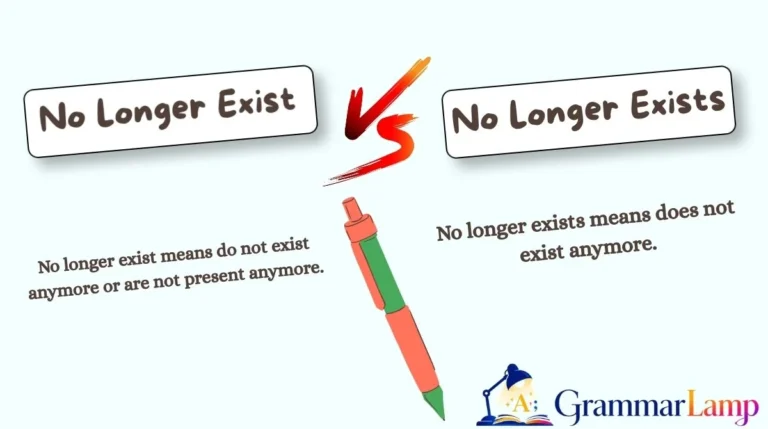
“No longer exist” and “no longer exists” look almost the same, so it is easy to choose the wrong one. Many English learners know that no longer means “not anymore,” but they are not always sure whether to use exist or exists after it.
The good news is that the rule is quite simple. The choice depends mainly on the subject of the sentence. If the subject is singular, we normally use exists. If the subject is plural, we use exist.
For example:
- The old system no longer exists. ✅
- The old systems no longer exist. ✅
The meaning is almost the same, but the verb changes because the subjects are different.
This small grammar point matters in everyday English, academic writing, business communication, and formal writing.
You may use these expressions when talking about old traditions, deleted files, extinct animals, outdated technology, lost places, or things that have disappeared.
By the end of this guide, you will know exactly when to use no longer exist and no longer exists. You will also learn why “no longer exists” is correct in some sentences while “no longer exist” is correct in others.
The examples and simple tricks below will make the difference much easier to remember.
Licence or License: Which Spelling Is Correct in 2026?
I’ve Added vs I Added: Easy Difference, Rules & Examples (2026)
This Is She or This Is Her? The Correct Choice in English in 2026
Jewel vs Joule: Meaning, Difference, Examples & Easy Rules (2026)
What Does “No Longer Exist” Mean?
No longer exist means do not exist anymore or are not present anymore.
The important point is that exist is the base form of the verb. We normally use this form when the subject is plural or when another verb requires the base form.
When do we use “no longer exist”?
Use no longer exist when the subject is plural.
For example:
These traditions no longer exist.
The subject is these traditions. It is plural, so we use exist, not exists.
Here are some more examples:
- Many old customs no longer exist.
- Those buildings no longer exist.
- Some ancient languages no longer exist.
- The original rules no longer exist.
- Several small businesses no longer exist.
- These problems no longer exist.
- The old files no longer exist on my computer.
- Some species no longer exist in the wild.
Notice something important in every example: the subject contains more than one thing.
- customs → plural
- buildings → plural
- languages → plural
- rules → plural
- businesses → plural
- problems → plural
- files → plural
- species → can be singular or plural, but here it refers to multiple species
“No longer” means “not anymore”
The phrase no longer tells us that something was true in the past but is not true now.
Compare:
These shops exist.
This simply says that the shops are present now.
But:
These shops no longer exist.
This tells us that the shops existed before, but they do not exist now.
You can often replace no longer with not anymore:
These shops no longer exist.
These shops don’t exist anymore.
Both sentences have almost the same meaning.
A common learner confusion
Some learners see no longer and think the verb should always be exists because the phrase sounds complete.
That is not how English verb agreement works.
The verb does not agree with no longer. It agrees with the subject.
Compare:
The company no longer exists. ✅
The subject is company, which is singular.
But:
The companies no longer exist. ✅
The subject is companies, which is plural.
So, do not ask:
“Should I use exist or exists after no longer?”
Instead, ask:
“Is my subject singular or plural?”
That question will usually give you the answer immediately.
What Does “No Longer Exists” Mean?
No longer exists means does not exist anymore.
We use exists when the subject is singular in the present simple tense.
For example:
The old theater no longer exists.
The subject is the old theater. It is one theater, so we use exists.
Here are several examples:
- The old theater no longer exists.
- My childhood home no longer exists.
- That company no longer exists.
- The original website no longer exists.
- The ancient city no longer exists.
- This problem no longer exists.
- The traditional market no longer exists.
- The old version of the software no longer exists.
All these subjects are singular.
Why does “exist” become “exists”?
In the present simple tense, English usually adds -s or -es to the verb when the subject is he, she, it, or another singular noun.
For example:
- The dog runs.
- The machine works.
- The company exists.
- The problem remains.
But with plural subjects, we use the base form:
- The dogs run.
- The machines work.
- The companies exist.
- The problems remain.
The same rule applies to exist.
The building exists.
The buildings exist.
Adding no longer does not change this grammar rule:
The building no longer exists.
The buildings no longer exist.
What does “exists” tell us?
The -s in exists is a useful signal. It tells you that the subject is singular.
Look at these examples:
This tradition no longer exists.
“This tradition” = one tradition → exists
These traditions no longer exist.
“These traditions” = more than one tradition → exist
This is one of those small grammar rules that becomes automatic with practice.
Difference Between “No Longer Exist” and “No Longer Exists”
The main difference is subject-verb agreement.
The meaning of the two expressions is almost identical. Both say that something existed before but does not exist now.
The difference is the subject.
| Expression | Subject | Example | Meaning |
|---|---|---|---|
| no longer exists | Singular | The shop no longer exists. | The shop is gone now. |
| no longer exist | Plural | The shops no longer exist. | The shops are gone now. |
1. Singular subject → “no longer exists”
Use exists when you are talking about one person, place, thing, idea, system, organization, or other singular noun.
Examples:
The old bridge no longer exists.
That rule no longer exists.
The original plan no longer exists.
The company no longer exists.
You can often replace the subject with it:
It no longer exists.
That is a useful test.
If you can naturally say:
It no longer exists.
then the original singular subject will usually take exists.
2. Plural subject → “no longer exist”
Use exist when you are talking about two or more things.
Examples:
The old bridges no longer exist.
Those rules no longer exist.
Several companies no longer exist.
Many traditional practices no longer exist.
You can often replace the subject with they:
They no longer exist.
That tells you that exist is the correct form.
The basic sentence structure
The usual structure is:
Subject + no longer + verb
For a singular subject:
The museum + no longer + exists.
For a plural subject:
The museums + no longer + exist.
The word no longer stays in the middle. The verb changes according to the subject.
Compare these pairs
Singular:
The restaurant no longer exists.
Plural:
The restaurants no longer exist.
Singular:
This tradition no longer exists.
Plural:
These traditions no longer exist.
Singular:
That technology no longer exists.
Plural:
Those technologies no longer exist.
The meaning changes only because the number of things changes.
Realise or Realize: Which Spelling Is Correct in 2026?
Berth vs Birth: Meaning, Difference, Examples & Easy Rules for 2026
Insight vs Incite: What’s the Difference? Easy Guide for 2026
In the Same Day vs On the Same Day: Which Is Correct? A Simple Guide for 2026
Grammar Rules You Must Remember
Rule 1: Singular subjects use “exists”
When the subject is singular, use exists in the present simple.
The old library no longer exists.
“The old library” refers to one library, so exists is correct.
More examples:
The problem no longer exists.
The organization no longer exists.
The original document no longer exists.
Rule 2: Plural subjects use “exist”
When the subject is plural, use exist.
The old libraries no longer exist.
“Libraries” means more than one library, so the base verb exist is correct.
More examples:
The problems no longer exist.
Those organizations no longer exist.
The original documents no longer exist.
Rule 3: “No longer” does not control the verb
This is a very important point.
Some learners think that because no longer is placed before the verb, it somehow determines whether the verb needs -s.
It does not.
The subject controls the verb.
The company no longer exists.
The subject is company → singular → exists.
The companies no longer exist.
The subject is companies → plural → exist.
Rule 4: “Does” takes the base form “exist”
There is another useful rule when you make questions or negative sentences.
After does or doesn’t, use exist, not exists.
Correct:
Does the old system no longer exist?
The old system doesn’t exist anymore.
Incorrect:
Does the old system no longer exists? ❌
Why?
Because does already carries the third-person singular grammar. The main verb returns to its base form.
Compare:
The system exists.
But:
Does the system exist?
And:
The system doesn’t exist.
This rule is extremely useful because learners often add -s twice.
Common Mistakes Students Make
Mistake 1: Using “exists” with a plural subject
Incorrect:
These traditions no longer exists. ❌
Correct:
These traditions no longer exist. ✅
Why? Traditions is plural.
An easy correction is to replace the subject with they:
They no longer exist.
You would never say:
They no longer exists.
So the same applies to these traditions.
Mistake 2: Using “exist” with a singular subject
Incorrect:
The old building no longer exist. ❌
Correct:
The old building no longer exists. ✅
The subject is building, which is singular.
Think:
It no longer exists.
Therefore:
The old building no longer exists.
Mistake 3: Adding “exists” after “does”
Incorrect:
Does this company no longer exists? ❌
Correct:
Does this company no longer exist? ✅
Remember the rule:
does + base verb
So:
- does exist
- does work
- does go
- does happen
Not:
- does exists
- does works
- does goes
- does happens
Mistake 4: Confusing “no longer” with “never”
These expressions are not exactly the same.
The store no longer exists.
This means the store existed before but does not exist now.
The store never existed.
This means the store did not exist at any time, or at least not during the time being discussed.
That difference can be very important.
Mistake 5: Using “no longer exists anymore”
This combination is usually unnecessary.
For example:
The old shop no longer exists anymore.
It is understandable, but no longer and anymore express the same basic idea here.
Better:
The old shop no longer exists. ✅
Or:
The old shop doesn’t exist anymore. ✅
Choose one structure rather than using both together.
Easy Trick to Remember the Difference
Here is the simplest trick:
Ask: “One or many?”
If it is one, use:
no longer exists
If it is many, use:
no longer exist
You can also use the it/they test.
One thing → IT
It no longer exists.
So:
The house no longer exists.
More than one → THEY
They no longer exist.
So:
The houses no longer exist.
This trick works because it takes exists, while they takes exist.
Think of it this way:
ONE → IT → EXISTS
MANY → THEY → EXIST
There is no need to memorize a complicated grammar explanation. Just look at the subject.
Daily Life Examples
These expressions are common in real conversations and everyday writing.
1. Talking about an old shop
A: Do you remember the bakery near the station?
B: Yes, but it no longer exists. There is a bank there now.
2. Talking about several old shops
Many of the small shops no longer exist because the area has changed.
3. Talking about technology
That old phone model no longer exists.
Here, model is singular.
4. Talking about old technologies
Many of those technologies no longer exist.
Here, technologies is plural.
5. Talking about a tradition
The tradition no longer exists in this village.
One tradition → exists.
6. Talking about traditions
Some traditional customs no longer exist in modern cities.
Several customs → exist.
7. Talking about a company
That company no longer exists. It closed several years ago.
8. Talking about companies
Several companies from that industry no longer exist.
9. Talking about a website
I tried to visit the old website, but it no longer exists.
This is a very natural use in spoken English.
10. Talking about old files
The files from my old computer no longer exist.
Here, files is plural, so we use exist.
A useful everyday alternative: “doesn’t/don’t exist anymore”
In casual spoken English, people often use anymore instead of no longer.
For example:
The store no longer exists.
can become:
The store doesn’t exist anymore.
And:
Those stores no longer exist.
can become:
Those stores don’t exist anymore.
Both forms are natural.
No longer can sound slightly more formal, especially in writing. Not anymore or doesn’t exist anymore is very common in everyday speech.
Practice Section
Choose the correct option in each sentence.
1. The old cinema no longer ______.
A. exist
B. exists
2. These traditions no longer ______.
A. exist
B. exists
3. That company doesn’t ______ anymore.
A. exist
B. exists
4. Several old buildings no longer ______.
A. exist
B. exists
5. Does the original website still ______?
A. exist
B. exists
Answers
1. B — exists
The old cinema no longer exists.
“Cinema” is singular.
2. A — exist
These traditions no longer exist.
“Traditions” is plural.
3. A — exist
That company doesn’t exist anymore.
After doesn’t, use the base form.
4. A — exist
Several old buildings no longer exist.
“Buildings” is plural.
5. A — exist
Does the original website still exist?
After does, use the base form.
Hasn’t vs Haven’t: Easy Grammar Rules, Examples & Differences in 2026
Smooth vs Smoothe: Which Spelling Is Correct? Complete Guide for 2026
Mine as Well or Might as Well? The Correct Phrase Explained in Simple English (2026)
Alternative of vs Alternative for vs Alternative to: Which Is Correct? 2026 Guide
FAQs
1. What is the difference between “no longer exist” and “no longer exists”?
The meaning is almost the same: something existed before but does not exist now. The difference is grammatical.
Use no longer exists with a singular subject: “The shop no longer exists.”
Use no longer exist with a plural subject: “The shops no longer exist.”
2. Can I use “no longer exists” with a plural noun?
No. A plural subject normally takes exist, not exists.
For example:
These problems no longer exist. ✅
Not:
These problems no longer exists. ❌
Remember: plural subject → base verb.
3. Is “no longer exists” formal or informal?
No longer exists is grammatically neutral and can be used in both everyday English and formal writing.
It may sound slightly more formal than doesn’t exist anymore, especially in academic or professional writing.
Both are natural:
The old system no longer exists.
The old system doesn’t exist anymore.
4. Can “no longer exist” be used in questions?
Yes, but remember that questions with does use the base form exist.
For example:
Does this organization no longer exist?
You can also say:
Does this organization still exist?
The second version is often more natural when you simply want to ask whether something is still present.
5. Is “no longer exists anymore” correct?
It is understandable, but it is usually unnecessary because no longer and anymore already express a similar idea.
Prefer:
The company no longer exists.
or:
The company doesn’t exist anymore.
Using both can make the sentence sound repetitive.
6. What is easier to say: “no longer exists” or “doesn’t exist anymore”?
Both are correct. Doesn’t exist anymore is very common in everyday spoken English.
No longer exists is also very natural and can be especially useful in writing.
For example:
The old restaurant no longer exists.
The old restaurant doesn’t exist anymore.
The choice often depends on your style and the situation, not on correctness.
Conclusion
The difference between “no longer exist” and “no longer exists” is simple once you focus on the subject.
Use no longer exists when the subject is singular:
The old school no longer exists.
Use no longer exist when the subject is plural:
The old schools no longer exist.
The phrase no longer does not change the basic subject-verb agreement rule. The same rule applies whether you are talking about a building, company, tradition, website, animal species, or idea.
There is one more rule worth remembering: after does or doesn’t, use exist, not exists.
Does it exist?
It doesn’t exist anymore.
When you are unsure, try the simple it/they test. If the subject can be replaced by it, use exists. If it can be replaced by they, use exist.
A few minutes of practice with real sentences will make this choice feel natural. Once you stop focusing on the phrase no longer and start looking at the subject, the correct form becomes much easier to choose.

Liam Derren is a language writer at GrammarLamp, creating simple, helpful content about grammar, words, and everyday English. He makes language learning clear, practical, and easy to understand.