
English learners often get confused by small words such as in, on, and at. These words look simple, but choosing the right one can change whether a sentence sounds natural or awkward.
One common example is “in the same day” vs “on the same day.” Both expressions may seem possible because we use in for periods of time and on for days.
The problem becomes clearer when we talk about a particular day that two events share.
For example:
I met Sarah on the same day I started my new job.
Here, on the same day is the natural and standard choice.
But why do we say on instead of in? And is in the same day always wrong? The answer is a little more interesting than simply saying “never use in.”
Understanding this difference will help you write better English and speak more naturally. It is especially useful when talking about appointments, meetings, birthdays, school events, travel, work, deliveries, and other daily activities.
By the end, you will know when to use on the same day, when in the same day may appear, and when you can simply say the same day.
You will also learn some easy rules and examples that you can remember without studying complicated grammar terms.
In Development vs Under Development: Meaning, Differences, and Examples (2026)
Non-Restrictive Clauses: Meaning, Rules, Examples & Differences in 2026
Conform With vs Conform To (2026): What’s the Difference? Easy Grammar Guide for English Learners
Who’s vs Whose (2026): What’s the Difference? Easy Grammar Rules, Examples, and Common Mistakes
What Does “In the Same Day” Mean?
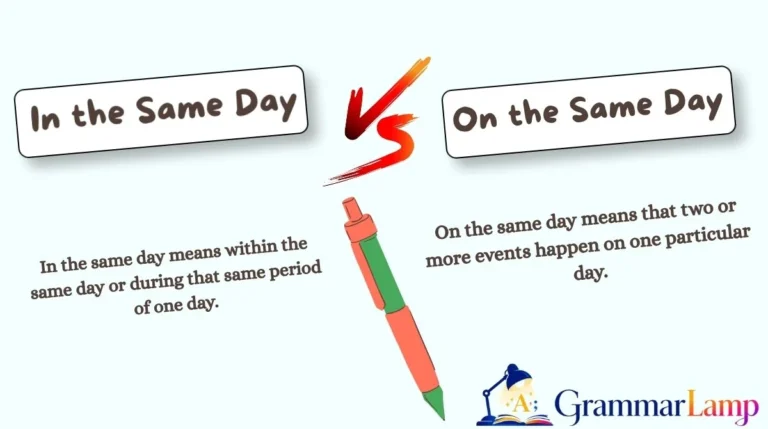
In the same day means within the same day or during that same period of one day. However, this expression is not usually the best choice when you are talking about a specific calendar day.
For most everyday situations, native speakers prefer on the same day.
For example:
We ordered the food and received it on the same day.
This tells us that both events happened on one particular day.
The phrase in the same day can sometimes be understood, especially when in has the idea of “within a period.” However, it often sounds unnatural in standard everyday English.
Compare:
❌ I visited the doctor and the dentist in the same day.
✅ I visited the doctor and the dentist on the same day.
The second sentence is much more natural.
When can “in” make sense?
In is commonly used when we think about a period of time rather than a specific calendar date.
For example:
I can finish this work in one day.
Here, in one day means that the work takes one day or can be completed within one day.
We can also say:
She learned the basic rules in a day.
This means that she learned them within a period of one day.
The problem appears when we add the same. If we are pointing to a particular day shared by two events, on the same day is normally the right choice.
Examples with “in the same day”
You may sometimes see or hear sentences such as:
- He answered three difficult questions in the same day.
- She received two job offers in the same day.
- The team played two matches in the same day.
- They made several important decisions in the same day.
- We completed all the work in the same day.
- The weather changed completely in the same day.
- He traveled to two cities in the same day.
- The company announced two new products in the same day.
These sentences can be understood, but many of them sound more natural with on the same day if the meaning is that the events happened on one particular day.
For example:
The team played two matches on the same day.
A common learner confusion
Students sometimes learn that in is used with longer periods:
- in the morning
- in January
- in 2026
- in winter
Then they think:
day = period → in the day
But English does not work that simply.
We normally say:
- on Monday
- on Friday
- on my birthday
- on the same day
- on that day
So, when day refers to a particular calendar day, on is normally used.
What Does “On the Same Day” Mean?
On the same day means that two or more events happen on one particular day.
This is the standard and natural expression when comparing the timing of events.
For example:
Tom arrived on the same day as Mary.
Both Tom and Mary arrived on one particular day.
Another example:
I submitted my application on the same day I received the email.
The email arrived first, and the application was submitted later, but both events happened on the same day.
When should you use “on the same day”?
Use on the same day when you are talking about:
- a particular calendar day
- two events happening on one day
- an appointment or meeting
- a delivery
- a birthday or special occasion
- a school or work event
- a date connected to another event
For example:
We moved into our new house on the same day.
My brother got married on the same day as his best friend.
The package arrived on the same day I ordered it.
Grammar rule
The basic pattern is:
on + the same + day
Examples:
on the same day
on the same day as me
on the same day as the meeting
on the same day that we arrived
You can also use a clause after the phrase:
She called me on the same day that I started my new job.
Or:
We met on the same day we moved to London.
The word that is often omitted in natural English.
More examples
- I started school on the same day as my sister.
- The meeting took place on the same day as the interview.
- He left the company on the same day he received the offer.
- We arrived on the same day.
- She bought the dress on the same day she saw it.
- They announced the results on the same day.
- My flight arrived on the same day as yours.
- The two students submitted their projects on the same day.
Common learner confusion
Some students think on the same day means that the events happened at exactly the same time.
It does not.
For example:
I had breakfast and went to the bank on the same day.
Breakfast may have been at 8 a.m., while the bank visit happened at 11 a.m. The phrase only tells us that both events happened during the same calendar day.
If you want to say that two events happened at exactly the same time, you need a different expression:
They arrived at the same time.
So remember:
same day ≠ same time
Difference Between “In the Same Day” and “On the Same Day”
The easiest way to understand the difference is to think about calendar days.
When day refers to a particular day on the calendar, use on.
on Monday
on Tuesday
on my birthday
on that day
on the same day
When you are talking about how long something takes or what can happen within a period, in may be used with expressions such as in a day or in one day.
Comparison table
| Expression | Main idea | Natural use | Example |
|---|---|---|---|
| on the same day | One particular shared day | Standard and very common | We met on the same day. |
| in the same day | Within that same period of one day | Less common and often awkward | He did several things in the same day. |
| in a day | Within one day / during one day | Common | I can finish it in a day. |
| within the same day | Before that day ends | Clear and useful | The payment must arrive within the same day. |
| the same day | That very day | Very common, especially as an adverbial phrase | I called her the same day. |
Usage difference
Consider these two sentences:
I met him on the same day.
I finished the project in one day.
The first sentence identifies which day the event happened.
The second sentence focuses on how much time the project took.
That is the main difference.
Grammar logic
English commonly uses on with specific days:
on Monday
on Saturday
on Christmas Day
on my birthday
on the first day
on the same day
It uses in for larger or more general periods:
in January
in 2026
in winter
in the morning
in two weeks
It also uses in when describing the amount of time needed to complete something:
I can do it in two hours.
She learned it in three days.
He finished the book in one day.
This is why on the same day is normally the correct expression when you are comparing events that happened on one particular day.
Sentence structure difference
A common structure is:
Subject + verb + on the same day + as + person/event
I arrived on the same day as John.
Another structure is:
Subject + verb + on the same day + clause
I arrived on the same day I started work.
You can also use:
Subject + verb + in one day
I finished the report in one day.
So the structures have different purposes.
Do You vs Are You: What’s the Difference? Complete Guide for 2026
Dateline vs Deadline: Meaning, Difference, Examples & Easy Rules (20
26)
Whole vs Hole: Meaning, Difference, Examples, and Easy Rules (2026)
Farther vs Further: The Easy Difference Explained for 2026
Grammar Rules You Must Remember
Rule 1: Use “on” with a specific day
When day refers to a particular calendar day, use on.
We met on the same day.
Not:
❌ We met in the same day.
Other examples:
She arrived on Monday.
He called me on the same day.
They got married on Saturday.
A simple question to ask yourself is: Am I talking about a particular day?
If yes, on is usually the answer.
Rule 2: Use “in” when talking about the time needed to do something
Use in when you mean that something happens within a certain amount of time.
I can finish this in one day.
She learned the song in two days.
We completed the project in three days.
Here, the focus is not a named or particular calendar day. The focus is duration.
Rule 3: “The same day” can often work without “on”
English speakers often leave out the preposition when the same day is used as an adverbial expression.
For example:
I called him the same day.
She sent the documents the same day.
We received the payment the same day.
These are natural, especially in everyday English.
You can also say:
I called him on the same day.
Both can be correct, but the sentence structure is slightly different.
Rule 4: Use “within the same day” when you want to stress a time limit
Sometimes you want to make it clear that something must happen before the day ends.
In that case, within the same day is very useful.
Please reply within the same day.
The order should be processed within the same day.
The patient was treated within the same day.
This expression focuses on a time limit, rather than simply saying that two events occurred on the same calendar day.
Common Mistakes Students Make
Many mistakes happen because learners try to translate directly from their first language into English.
Another reason is that students memorize one rule, such as “use in with time,” without learning the exceptions and patterns that English actually uses.
Mistake 1: Using “in” for a particular day
❌ I saw her in the same day.
✅ I saw her on the same day.
Correction tip: If you can imagine the day on a calendar, on is usually the better choice.
Mistake 2: Confusing “same day” with “same time”
❌ We arrived on the same time.
✅ We arrived at the same time.
Use:
- on the same day
- at the same time
For example:
We arrived on the same day, but not at the same time.
Mistake 3: Saying “in Monday”
❌ I will see you in Monday.
✅ I will see you on Monday.
Monday is a particular day, so use on.
The same pattern works with:
on Tuesday
on Friday
on my birthday
on the same day
on that day
Mistake 4: Using “on” for duration
❌ I finished the work on two days.
✅ I finished the work in two days.
Here, two days tells us how long the work took.
So use in for duration.
Mistake 5: Assuming “in the same day” is always completely impossible
This is a little more advanced.
You may see in the same day in informal speech or writing. It can sometimes be understood as “during that same day.” But for learners, it is safer to use on the same day when you mean a particular shared calendar day.
Instead of:
He had two interviews in the same day.
Say:
He had two interviews on the same day.
This sounds clearer and more natural.
Easy Trick to Remember the Difference
Here is a simple classroom trick:
ON = a day on the calendar
Imagine a calendar hanging on a wall.
You can point on a particular square:
on Monday
on July 10
on my birthday
on the same day
Now think about IN = inside a period of time.
You can be inside:
in a week
in a month
in a year
You can also finish something:
in two days
So remember:
Specific day → ON
Amount of time → IN
For example:
We met on the same day.
But:
We finished the job in two days.
There is one more useful phrase:
within the same day
Think of this as a deadline. Something needs to happen before the day finishes.
This three-part memory trick is enough for most everyday situations:
ON the day = which day
IN two days = how long
WITHIN the day = before the day ends
Daily Life Examples
Here are some natural examples you might hear at work, school, home, or while traveling.
1. At work
Ali: When did you send the report?
Sara: I sent it on the same day you sent yours.
Both reports were sent during one particular day.
2. At school
My friend and I submitted our assignments on the same day.
The assignments may have been submitted at different times.
3. At the airport
My flight arrived on the same day as my brother’s flight.
The two flights shared the same calendar day.
4. At a restaurant
We booked the table and received a confirmation on the same day.
The two events happened during one day.
5. Talking about delivery
I ordered the shoes in the morning, and they arrived the same day.
Here, the same day works naturally without on.
6. Talking about a deadline
Please send the documents within the same day.
This stresses that the documents should be sent before the day ends.
7. Talking about travel
We arrived in Lahore on the same day.
The phrase identifies the day of arrival.
8. Talking about duration
We traveled across the city in one day.
Here, in one day tells us the amount of time the trip took.
9. Talking about appointments
I had a dentist appointment and a doctor’s appointment on the same day.
The appointments did not have to be at the same time.
10. Talking about an important event
She got the job offer on the same day she finished her interview.
Both events happened during one calendar day.
Practice Section
Choose the correct option in each sentence.
1. I met my new teacher ___ the same day I joined the school.
A. in
B. on
2. We finished the work ___ two days.
A. in
B. on
3. She received the package ___ the same day she ordered it.
A. in
B. on
4. They arrived ___ Monday.
A. in
B. on
5. I learned the basic rules ___ one day.
A. in
B. on
Answers
1. B — on
I met my new teacher on the same day I joined the school.
It refers to one particular day.
2. A — in
We finished the work in two days.
This tells us how long the work took.
3. B — on
She received the package on the same day she ordered it.
The phrase compares two events that happened on one particular day.
4. B — on
They arrived on Monday.
Monday is a specific day.
5. A — in
I learned the basic rules in one day.
This describes the amount of time needed to learn them.
John and Me vs Me and John: Which Is Correct? 2026 Grammar Guide
As Soon As vs As Early As: Easy Difference, Rules & Examples in 2026
Imbalanced vs Disbalanced: What Is the Difference? (2026)
Orientated vs Oriented: What’s the Difference? [2026 Guide]
FAQs
What is the difference between “in the same day” and “on the same day”?
On the same day is the normal and standard choice when you mean that two events happened on one particular calendar day.
In the same day can sometimes be understood as “during that same day,” but it is less natural in many everyday sentences. For learners, on the same day is usually the safest choice.
Can we use “on the same day” in questions?
Yes, absolutely. It is very common in questions.
For example:
Did you arrive on the same day as your brother?
You can also ask:
Did the two events happen on the same day?
The phrase works naturally in both questions and answers.
Is “on the same day” formal or informal?
On the same day is neither too formal nor too informal. It is normal English and works in conversation, school writing, emails, news writing, and professional communication.
For example:
The meeting was held on the same day as the conference.
Is “in the same day” grammatically wrong?
It is better not to call it completely impossible. In the same day can appear when a writer means “during that same day,” but it is less common and often sounds awkward when talking about a particular calendar day.
In most cases, replace it with on the same day.
Can I say “the same day” without “on”?
Yes. This is very common.
For example:
I called her the same day.
He sent the email the same day.
The phrase can work without a preposition, especially in natural spoken and written English.
Should I say “in the same day” or “within the same day”?
They do not have exactly the same purpose.
Use on the same day to identify a shared calendar day. Use within the same day when you want to stress that something happens before that day ends.
For example:
The two meetings happened on the same day.
Please complete the form within the same day.
Conclusion
The most important point is simple: use “on the same day” when you are talking about a particular day shared by two or more events.
For example:
We met on the same day.
She started her job on the same day I graduated.
The package arrived on the same day I ordered it.
Use in when you are talking about the amount of time needed for something:
I finished it in one day.
He learned the skill in three days.
You can also use the same day without on:
I called her the same day.
And when you want to stress a deadline before the day ends, within the same day can be useful.
You do not need to memorize a long grammar rule. Just ask yourself one question: Am I talking about which day, or how long something takes? If it is a particular day, choose on. If it is duration, choose in.
A few simple examples will make the pattern feel natural. The more you hear and use these expressions in real conversations, the easier the choice will become.

Liam Derren is a language writer at GrammarLamp, creating simple, helpful content about grammar, words, and everyday English. He makes language learning clear, practical, and easy to understand.
3 thoughts on “In the Same Day vs On the Same Day: Which Is Correct? A Simple Guide for 2026”