
Many English learners wonder whether they should say “after long time” or “after a long time.” The two expressions look almost the same, so it is easy to leave out one small word and think the sentence is still correct.
However, in standard English, that small word “a” matters.
The normal and grammatically correct expression is “after a long time.” We use it when something happens following a long period of waiting, silence, separation, or inactivity. For example, you can say, “After a long time, I finally saw my old friend again.”
The phrase “after long time” is generally not correct in standard English when long time means a long period.
English grammar normally requires a determiner such as “a” before this singular noun phrase.
Cambridge Grammar specifically notes that when we talk about something continuing for a large amount of time, we say “a long time,” not simply “long time.”
This difference is important because these phrases often appear in everyday conversations. Learners may hear or see forms without “a” in informal speech, social media, translated English, or learner English, which can make the rule confusing.
Once you understand how time works in this expression, the choice becomes very easy. You will know when to use “after a long time,” why “after long time” usually sounds wrong, and how to avoid similar article mistakes in your own English.
More Useful posts
In the Same Day vs On the Same Day: Which Is Correct? A Simple Guide for 2026
Licence or License: Which Spelling Is Correct in 2026?
I’ve Added vs I Added: Easy Difference, Rules & Examples (2026)
This Is She or This Is Her? The Correct Choice in English in 2026
What Does “After Long Time” Mean?
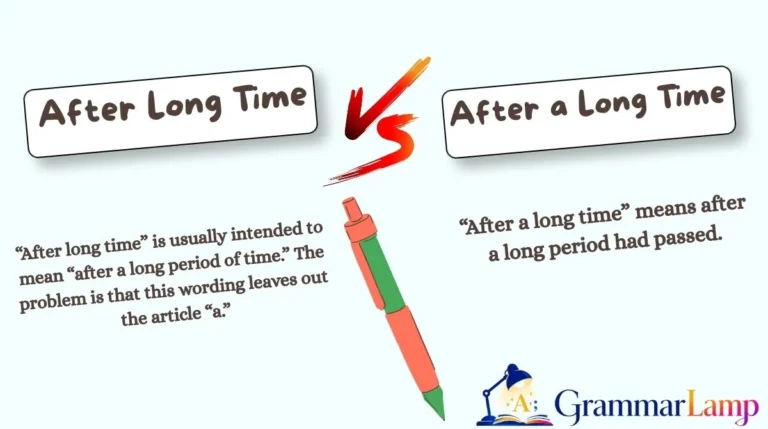
“After long time” is usually intended to mean “after a long period of time.” The problem is that this wording leaves out the article “a.”
In standard English, we normally do not use long time by itself when we mean one long period. Cambridge Grammar gives the same basic rule: use “a long time” rather than “long time” when describing a large amount of time in this way.
So, when a learner writes:
After long time, he came back.
the standard correction is:
After a long time, he came back.
The word “a” tells the reader that we are talking about one period of time. British Council grammar guidance explains that singular countable nouns generally need an article or another determiner.
Is “After Long Time” Ever Used?
You may still see “after long time” in English written by non-native speakers, in quick online messages, or in language influenced by another grammar system. It may be understandable, but that does not make it the preferred form in standard English.
For formal writing, school assignments, professional communication, exams, and careful everyday English, use “after a long time.”
There are also fixed expressions where English does not follow the normal pattern. A famous example is “long time no see,” an established informal greeting meaning that you have not seen someone for a long period. Cambridge lists it as an idiom.
That fixed expression should not be used as a reason to remove “a” from other sentences.
Examples
Here are some common sentences that show the problem:
- Incorrect: After long time, she called me.
Correct: After a long time, she called me. - Incorrect: He returned after long time.
Correct: He returned after a long time. - Incorrect: After long time, they met again.
Correct: After a long time, they met again. - Incorrect: I visited my village after long time.
Correct: I visited my village after a long time. - Incorrect: After long time, the shop opened again.
Correct: After a long time, the shop opened again. - Incorrect: She smiled after long time.
Correct: She smiled after a long time. - Incorrect: After long time, we spoke to each other.
Correct: After a long time, we spoke to each other. - Incorrect: He started working again after long time.
Correct: He started working again after a long time.
The important point is simple: “after long time” is generally missing “a.”
A Common Learner Confusion
Learners sometimes think that time is always an uncountable noun, so they believe “a” should never be used before it.
That is not how English works here.
The word time can have different grammatical uses. We can say:
- I don’t have much time.
- Time passes quickly.
- We need more time.
Here, time refers to time in a general or uncountable sense.
But we can also talk about a period of time:
- It took a long time.
- We had a good time.
- I need a short time to finish this.
- After a long time, they met again.
So, the exact meaning and structure matter.
What Does “After a Long Time” Mean?
“After a long time” means after a long period had passed.
It is used when something happens later than expected or after a person, event, activity, or situation has been absent for a considerable period.
For example:
After a long time, I finally received her message.
This means that a considerable amount of time passed before the message arrived.
The phrase can appear at the beginning or end of a sentence:
After a long time, he returned home.
or:
He returned home after a long time.
Both structures are grammatically correct.
When Should You Use It?
Use “after a long time” when you want to show that something happened after a lengthy period.
It can describe:
- meeting someone again
- hearing from someone
- returning somewhere
- starting something again
- waiting for something
- reconnecting with someone
- seeing a change
- ending a period of silence
You can use it in everyday speech and in normal writing. It is not unusually formal or unusually informal.
Examples
- After a long time, I met my school friend again.
- She came back after a long time.
- After a long time, he finally answered my question.
- We visited our old neighborhood after a long time.
- After a long time, the two brothers started talking again.
- I heard from him after a long time.
- After a long time, the rain finally stopped.
- They returned to the restaurant after a long time.
These examples all describe an event that happens following a lengthy period.
One More Useful Point: “A Long Time” and “For a Long Time”
Do not confuse “after a long time” with “for a long time.”
After a long time tells us when something happened.
I saw him again after a long time.
For a long time tells us how long something continued.
I waited for a long time.
This small difference is very useful.
Compare:
She stayed there for a long time.
This means her stay lasted a long period.
Now compare:
She returned there after a long time.
This means a long period passed before she returned.
Cambridge also distinguishes the use of long in duration expressions and notes that affirmative statements commonly use “a long time.”
Difference Between After Long Time and After a Long Time
The central difference is grammatical rather than a major difference in meaning.
In most normal sentences, “after a long time” is the standard form. “After long time” is generally an incorrect omission of the article.
| Expression | Standard English? | Meaning | Example |
|---|---|---|---|
| after long time | Generally no | Intended to mean after a long period | ❌ After long time, he returned. |
| after a long time | Yes | After a long period had passed | ✅ After a long time, he returned. |
Usage Difference
The phrase “after a long time” is the form you should choose in standard English.
For example:
After a long time, she visited us again.
It clearly tells us that the visit happened after a lengthy gap.
By contrast:
After long time, she visited us again.
The meaning can be understood, but the sentence does not follow the normal article pattern of standard English.
Grammar Logic
The main grammar issue is the noun phrase “a long time.”
Here, “a” is an indefinite article, and “long” is an adjective describing “time.”
The structure is:
a + adjective + singular noun
Examples include:
- a long time
- a short time
- a difficult day
- a busy week
- a good idea
- a serious problem
British Council explains that singular countable nouns normally need a/an, the, or another determiner.
In “a long time,” English treats the expression as one period or stretch of time, so the article is needed.
Sentence Structure
You can use the phrase in two common positions.
At the beginning:
After a long time, I saw him again.
At the end:
I saw him again after a long time.
The comma is normally used when the introductory phrase comes first.
Meaning Comparison
There is usually no intended difference in basic meaning between the two forms. The real difference is correctness and standard usage.
The learner’s intended meaning is normally:
after a long period
The natural English form is:
after a long time
So, this is mainly an article problem, not a vocabulary problem.
Explore More Posts
Jewel vs Joule: Meaning, Difference, Examples & Easy Rules (2026)
Foul or Fowl: Meaning, Difference, Examples & Easy Rules for 2026
Dialog vs Dialogue: What’s the Difference? A Simple English Guide for 2026
Learned vs Learnt: What’s the Difference? A Simple Guide for 2026
Grammar Rules You Must Remember
Rule 1: Use “a” before “long time” when you mean one long period
This is the most important rule.
Say:
It took a long time to finish the project.
Not:
It took long time to finish the project.
Cambridge Grammar directly recommends “a long time” rather than “long time” for this type of meaning.
Rule 2: “After a long time” refers to a gap or delay
Use the phrase when something happens after a considerable period has passed.
After a long time, they met again.
The meeting happened later, following a long gap.
It can also appear after the main clause:
They met again after a long time.
Rule 3: Do not confuse “after” with “for”
Use after to show what happens later.
I called him after a long time.
Use for to show duration.
I talked to him for a long time.
These two prepositions answer different questions.
After = When did it happen?
For = How long did it continue?
Rule 4: Fixed expressions are different
Some English expressions have unusual grammar because they are fixed idioms.
For example:
Long time no see!
This is an established informal greeting. Cambridge defines it as something said when you meet someone you have not seen for a long period.
Do not copy that pattern into ordinary sentences.
Say:
After a long time, I saw my cousin again.
not:
After long time, I saw my cousin again.
A fixed idiom follows its own pattern.
Common Mistakes Students Make
One of the most common mistakes is simply dropping “a.” This often happens because learners translate directly from their first language or because they hear short informal phrases and apply them everywhere.
Mistake 1: Leaving out “a”
❌ After long time, he came home.
✅ After a long time, he came home.
The correction is very small, but it makes the sentence standard.
Mistake 2: Using “for” when “after” is needed
❌ For a long time, I met my friend again.
✅ After a long time, I met my friend again.
The first sentence suggests that the meeting itself lasted a long time, which is not the intended meaning.
Mistake 3: Confusing “in a long time” with “after a long time”
These expressions can describe different situations.
I haven’t seen her in a long time.
This means a long period has passed since the last time you saw her.
I saw her again after a long time.
This describes the later event of seeing her again.
Mistake 4: Thinking “long time no see” proves “after long time” is correct
This is a very common trap.
Long time no see is a fixed informal idiom. It does not provide a general grammar rule for ordinary sentences.
Easy Correction Tip
Whenever you want to use long time to mean one long period, quickly check whether you need “a.”
Try asking yourself:
Am I talking about one period of time?
If yes, “a long time” is often the form you need.
For example:
a long time
a short time
a good time
a difficult time
This simple habit can prevent many article mistakes.
Easy Trick to Remember the Difference
Here is an easy memory trick:
Long time = Think “A.”
When long time means one period, imagine putting a small “a” in front of it.
a + long + time
Say it like a three-part team:
A — long — time
Now use the same pattern in sentences:
I waited a long time.
It took a long time.
After a long time, he returned.
Another useful trick is to replace “a long time” with “a long period.”
For example:
After a long time, he returned.
Change it mentally to:
After a long period, he returned.
That sounds natural. The article makes sense because “a long period” is clearly one period.
But:
After long time, he returned.
sounds incomplete in standard English.
Real-Life Logic
Imagine waiting for a friend.
The friend is late.
You wait for 10 minutes, then 30 minutes, then one hour. Finally, your friend arrives.
You can say:
After a long time, my friend arrived.
The phrase describes the long gap before the arrival.
You cannot normally say:
After long time, my friend arrived.
So whenever you are talking about one long stretch or period, remember the little word “a.”
Daily Life Examples
These examples show how native and fluent speakers commonly use “after a long time” in normal conversations.
Example 1
Ali: Did you see Ahmed recently?
Bilal: Yes. I met him after a long time yesterday.
Ali: Really? How is he?
Bilal: He is doing well.
Example 2
Sara: Why are you so happy today?
Mina: I finally visited my hometown after a long time.
Sara: That must have been special.
Example 3
Father: Who called you?
Son: My old school friend.
Father: You still talk to him?
Son: Yes, but I heard from him after a long time.
Example 4
John: Did your brother come back?
Mike: Yes, he came home after a long time abroad.
John: I’m sure the family was happy to see him.
Example 5
Teacher: Why were you absent yesterday?
Student: I wasn’t feeling well, but I came back to class after a long time away.
A more natural version in many situations would simply be:
I came back to class after a long break.
This shows another useful alternative.
Example 6
A: Have you spoken to your cousin?
B: Yes, we talked after a long time.
A: What did you talk about?
Example 7
A: Is the old café open again?
B: Yes. It reopened after a long time.
A: Great! Let’s go there this weekend.
Example 8
A: You look different!
B: Really?
A: Yes. I haven’t seen you in a long time.
B: You’re right. We should meet more often.
Notice that this conversation uses “in a long time” rather than “after a long time.” Both expressions are useful, but they have different jobs.
Example 9
A: When did your team win again?
B: We won after a long time without a victory.
A: That must have felt good.
Example 10
A: What happened to the old website?
B: It came back online after a long time.
A: I thought it was gone forever.
These examples show that “after a long time” fits naturally into stories, conversations, messages, and everyday situations.
Practice Section
Choose the correct option in each sentence.
1. ________, she finally replied to my message.
A. After long time
B. After a long time
2. I saw my childhood friend ________.
A. after long time
B. after a long time
3. ________, the store opened again.
A. After long time
B. After a long time
4. He returned to his hometown ________.
A. after long time
B. after a long time
5. ________, they started talking again.
A. After long time
B. After a long time
Answers
- B — After a long time
- B — after a long time
- B — After a long time
- B — after a long time
- B — After a long time
The reason is the same in every case: “a long time” is the standard noun phrase used to describe one long period.
More Helpful posts
It’s vs Its: Simple Difference, Rules, Examples & Practice (2026)
Enamor vs Enamour: What’s the Difference? Meaning, Usage & Examples in 2026
Breath vs Breathe: Easy Difference, Meaning, Examples & Rules in 2026
No Longer Exist vs No Longer Exists: Which Is Correct? (2026 Guide)
FAQs
What is the difference between “after long time” and “after a long time”?
“After a long time” is the standard and grammatically correct form when you mean after a long period has passed. “After long time” normally leaves out the article “a” and is not preferred in standard English.
Can we use “after a long time” in questions?
Yes. It can be used naturally in questions when asking about something that happened following a long period.
For example: “Did you talk to him again after a long time?” You can also ask, “What happened after a long time?”, although the exact wording may depend on the context.
Is “after a long time” formal or informal?
“After a long time” works in both everyday and more careful English. It is not limited to formal writing. In some situations, speakers may choose alternatives such as “after a long period,” “after a long break,” or “after many years.”
Why is “after long time” wrong?
The usual problem is the missing article. When time is used to describe one long period in “a long time,” English uses the indefinite article “a.” Standard grammar therefore gives us “after a long time,” not “after long time.”
Is “long time no see” grammatically correct?
Yes, “long time no see” is an established informal idiom. It is used as a greeting when you meet someone you have not seen for a long period. It is a fixed expression, so learners should not use its unusual structure as a model for ordinary sentences.
Should I say “after a long time” or “for a long time”?
They have different meanings. “After a long time” describes something that happens following a long period, while “for a long time” describes how long an action or situation continues.
Compare: “I saw him after a long time.” and “I waited for a long time.”
Conclusion
The difference between “after long time” and “after a long time” is small but important. In standard English, the correct expression is normally “after a long time.”
The word “a” is needed because the phrase refers to one long period of time. For example, you can say, “After a long time, they met again,” or “She returned home after a long time.”
Remember that “after a long time” tells us about something happening after a lengthy gap, while “for a long time” tells us how long something continues. Also, expressions such as “long time no see” are fixed idioms and should not be used to create other sentences without an article.
This is one of those small grammar details that becomes easy with practice. Each time you want to say “long time” as one period, pause for a second and check for “a.” That little habit will make your English sound more natural and accurate.

Liam Derren is a language writer at GrammarLamp, creating simple, helpful content about grammar, words, and everyday English. He makes language learning clear, practical, and easy to understand.