
If you have ever wondered whether you should write “I learned something new” or “I learnt something new,” you are not alone.
Many English learners see both forms and think one must be wrong. The good news is that both “learned” and “learnt” are correct.
The difference is mainly connected with English varieties and usage habits. In American English, learned is by far the more common form. In British English and some other varieties of English, learnt is also very common.
You may see both forms in books, newspapers, classrooms, websites, and everyday conversations.
This can be confusing because English has many verbs that change when they become past tense.
For example, go becomes went, and write becomes wrote. But learn has two accepted past forms: learned and learnt.
The important thing is knowing when both forms mean the same thing, where each form is more common, and how to use them correctly in a sentence.
By the end, you will understand the difference between learned and learnt, know which form to choose in American or British English, and be able to use both naturally in everyday English.
Feel vs Felt: Complete Grammar Guide With Examples (2026)
Role Call or Roll Call? The Correct Spelling and Meaning in 2026
Into or Onto: Complete Difference, Rules, and Examples for 2026
Sole vs Soul: What’s the Difference? Easy Guide With Examples 2026
What Does “Learned” Mean?
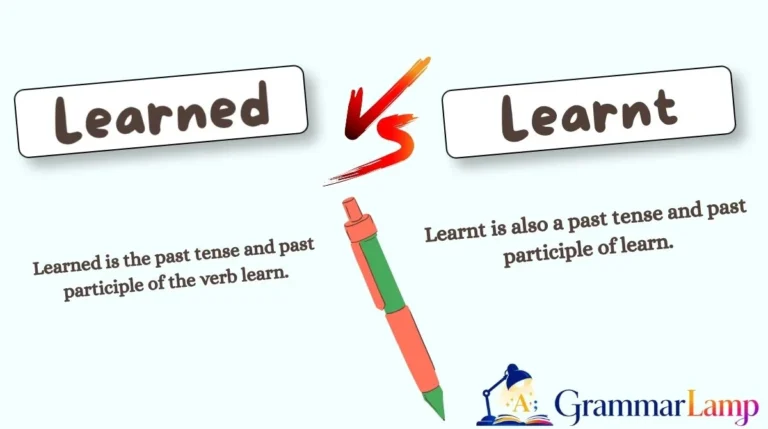
Learned is the past tense and past participle of the verb learn.
The verb learn means to gain knowledge, understand something, or develop a skill through study, practice, experience, or teaching.
For example:
I learn English every day.
When we talk about something that happened in the past, we can say:
I learned English at school.
The form learned is especially common in American English. It is also completely correct in British English and other varieties of English.
The basic grammar rule
The verb forms can be shown like this:
| Tense/Form | Verb |
|---|---|
| Present | learn |
| Past | learned / learnt |
| Past participle | learned / learnt |
| -ing form | learning |
So we can say:
- I learn new words every day.
- I learned five new words yesterday.
- I have learned a lot this year.
- She is learning Spanish.
Notice that learned can work as both the simple past and the past participle.
Examples with “learned”
- I learned how to drive when I was eighteen.
- She learned English from her mother.
- We learned an important lesson yesterday.
- He learned to cook during college.
- They learned about history at school.
- I have learned a lot from my mistakes.
- Sarah learned how to use the new computer.
- My brother learned the truth last night.
In each example, learned is related to gaining knowledge or a skill.
When should you use “learned”?
Use learned when you need the past form of learn and you are writing or speaking in a variety of English where learned is preferred.
It is the safest choice for American English. If your audience is mainly in the United States, learned will sound completely natural.
For example:
I learned a new word today.
We learned about climate change in class.
She learned to play the piano.
A common confusion about “learned”
There is another use of learned that sometimes causes confusion.
The word learned can also be an adjective meaning very knowledgeable or highly educated.
For example:
He is a learned professor.
Here, learned does not mean “gained knowledge in the past.” It describes a person who has a lot of knowledge.
This adjective is usually pronounced differently. As a verb, learned is normally pronounced like “lernd.” As an adjective meaning highly educated, it is often pronounced “learn-id.”
For most English learners, however, the main point is simple: learned is a correct past form of learn.
What Does “Learnt” Mean?
Learnt is also a past tense and past participle of learn.
It has exactly the same basic meaning as learned when it is used as the verb learn.
For example:
I learnt a new word yesterday.
This means the same thing as:
I learned a new word yesterday.
The main difference is not meaning. It is regional preference.
Learnt is especially common in British English. You may also see it in Australian, New Zealand, and other varieties influenced by British English.
The basic grammar rule
Like learned, learnt can be used as both the simple past and the past participle.
For example:
She learnt French at school.
Simple past.
She has learnt French at school.
Past participle.
The second sentence is less natural in some contexts depending on what you want to say, but grammatically the form learnt can follow have/has/had.
Examples with “learnt”
- I learnt English at school.
- She learnt how to swim when she was six.
- We learnt an important lesson.
- He learnt to drive last year.
- They learnt about the problem yesterday.
- I have learnt a lot from my teachers.
- Tom learnt the rules very quickly.
- She learnt how to make bread from her grandmother.
These sentences are especially natural in British English.
When should you use “learnt”?
Use learnt when following British English usage or when your school, workplace, publication, or audience normally uses British English.
For example, a British English speaker might naturally say:
I learnt to swim when I was seven.
An American English speaker would more likely say:
I learned to swim when I was seven.
Neither sentence is grammatically wrong.
Common learner confusion
Some learners think learnt is an informal or incorrect version of learned. That is not true.
Learnt is a standard English word.
It appears in dictionaries and is widely used in British English. It is simply less common in American English.
The same kind of regional difference appears with other verbs, such as:
- dreamed / dreamt
- burned / burnt
- spelled / spelt
- spilled / spilt
English has several verbs with both -ed and -t forms.
Difference Between Learned and Learnt
The most important fact is this:
Learned and learnt have the same meaning when they are past forms of the verb “learn.”
The main difference is which variety of English prefers each form.
Comparison table
| Feature | Learned | Learnt |
|---|---|---|
| Base verb | learn | learn |
| Meaning | Gained knowledge or a skill | Gained knowledge or a skill |
| Past tense | Yes | Yes |
| Past participle | Yes | Yes |
| American English | Very common | Less common |
| British English | Common | Very common |
| Formal English | Correct | Correct |
| Informal English | Correct | Correct |
| Meaning difference | None as a verb | None as a verb |
Usage difference
Consider these two sentences:
I learned English at school.
I learnt English at school.
They mean the same thing.
The first sentence is more likely to appear in American English. The second is very natural in British English.
So, if you are taking an English exam, writing an essay, or creating content for an international audience, the key is to stay consistent with your chosen variety of English.
Grammar logic
Both forms follow the same grammar patterns.
With the simple past:
She learned the answer.
or:
She learnt the answer.
With the present perfect:
She has learned the answer.
or:
She has learnt the answer.
With the past perfect:
She had learned the answer.
or:
She had learnt the answer.
The helping verb does not change the choice between learned and learnt.
Sentence structure
The sentence structure is also the same.
Subject + learned/learnt + object
I learned the lesson.
I learnt the lesson.
Or:
Subject + learned/learnt + to + verb
He learned to swim.
He learnt to swim.
Or:
Subject + have/has/had + learned/learnt
We have learned a lot.
We have learnt a lot.
The grammar is not different. The regional preference is.
Ardor vs Ardour: Meaning, Difference, Spelling & Examples (2026)
Fillet vs Filet: What’s the Difference? Meaning, Spelling, and Examples in 2026
Complaint vs Complain: Meaning, Difference, Grammar Rules & Examples (2026)
Differential vs Deferential: Meaning, Difference, Examples, and Grammar Rules (2026)
Grammar Rules You Must Remember
Rule 1: Both “learned” and “learnt” are correct past forms
You do not need to worry that one is grammatically wrong.
I learned something new yesterday.
I learnt something new yesterday.
Both are correct.
The choice depends mainly on the variety of English you are using.
Rule 2: “Learned” is more common in American English
If you are writing for an American audience, learned is usually the best choice.
For example:
I learned how to use the software.
My students learned three new words.
She learned an important lesson.
American speakers and writers generally prefer the -ed form.
Rule 3: “Learnt” is very common in British English
British English commonly uses learnt, although learned is also accepted.
For example:
I learnt how to ride a bike.
We learnt about the environment at school.
She has learnt a lot from her experience.
If you are following British English spelling and grammar, using learnt is perfectly natural.
Rule 4: Do not mix varieties without a reason
There is nothing wrong with using either word, but consistency makes your writing look cleaner.
If you are writing an American English article, you might choose:
learned, burned, spelled
If you are following British English, you might choose:
learnt, burnt, spelt
This does not mean you must never see mixed forms. Real English is flexible. The goal is simply to follow the style you have chosen when you have control over your writing.
Common Mistakes Students Make
Many mistakes with learned vs learnt come from the belief that one word must be correct and the other must be incorrect.
That is the biggest misunderstanding.
Mistake 1: Thinking “learnt” is wrong
❌ I think “learnt” is bad English.
✅ “Learnt” is a standard form, especially common in British English.
If your British teacher writes:
I learnt this at school.
there is no grammar mistake.
Mistake 2: Thinking “learned” is only American
❌ British people cannot use “learned.”
✅ British English also uses “learned.”
Although learnt is very common in British English, learned is also used. You should not treat the two forms as a strict American-versus-British rule.
Mistake 3: Changing the meaning
Some learners think:
learned = studied
and:
learnt = experienced
That is not a general grammar rule.
Both can describe gaining knowledge, developing a skill, or understanding something through experience.
For example:
I learned from my mistake.
I learnt from my mistake.
Both mean that the speaker gained knowledge from an experience.
Mistake 4: Using “learn” for a completed past event
❌ I learn English last year.
✅ I learned English last year.
or:
✅ I learnt English last year.
Because last year refers to a completed past time, the simple past form is needed.
Mistake 5: Forgetting the past participle after “have”
❌ I have learn a lot.
✅ I have learned a lot.
or:
✅ I have learnt a lot.
After have, has, or had, use the past participle.
Easy correction tip
When you see learned or learnt, ask yourself:
“Am I talking about the past form of learn?”
If yes, either form may be correct. Then ask:
“Which type of English am I using?”
American English → learned is usually the natural choice.
British English → learnt is very common, and learned is also acceptable.
Easy Trick to Remember the Difference
Here is a simple memory trick:
Learned = the -ed form
Learnt = the shorter -t form
Now connect them to English varieties:
American English → learned
British English → learnt
This is not an absolute rule, but it is a useful shortcut for beginners.
Think about a student saying:
“Yesterday, I learned something new.”
An American speaker is very likely to say this.
A British speaker might say:
“Yesterday, I learnt something new.”
The idea is exactly the same.
Another useful trick is to remember that you do not need to change the sentence structure when you change the word.
For example:
I learned to cook.
can become:
I learnt to cook.
Nothing else needs to change.
That makes this pair much easier than many other confusing English words.
Daily Life Examples
Here are some natural examples you may hear in everyday English.
1. Talking about school
Student: What did you learn today?
Teacher: We learned about the solar system.
In British English, the teacher could say:
We learnt about the solar system.
2. Talking about a skill
I learned to drive when I was twenty.
Or:
I learnt to drive when I was twenty.
Both are correct.
3. Talking about experience
I learned a lot from my first job.
A British speaker could naturally say:
I learnt a lot from my first job.
4. Talking about mistakes
I learned not to trust every website I see online.
Or:
I learnt not to trust every website I see online.
5. Talking about cooking
My mother taught me how to cook, but I learned most of my skills by practicing.
In British English:
My mother taught me how to cook, but I learnt most of my skills by practising.
6. Talking about languages
Where did you learn English?
Possible answer:
I learned it at school.
In British English:
I learnt it at school.
7. Talking about work
We learned how to use the new computer system yesterday.
A British colleague might say:
We learnt how to use the new computer system yesterday.
8. Talking about life lessons
He learned an important lesson from his mistake.
Or:
He learnt an important lesson from his mistake.
9. Talking about a new fact
I just learned that the shop closes at six.
A British speaker may say:
I just learnt that the shop closes at six.
10. Talking about personal growth
She has learned a lot since she started working here.
Or:
She has learnt a lot since she started working here.
Again, the meaning remains the same.
Practice Section
Choose learned or learnt in each sentence.
1.
I ______ how to swim when I was eight.
2.
She has ______ a lot from her teacher.
3.
We ______ about World War II at school.
4.
He ______ an important lesson from his mistake.
5.
They have ______ how to work together.
Answers
1. learned / learnt — Both are correct.
2. learned / learnt — Both work because the past participle is needed after has.
3. learned / learnt — Both are correct.
4. learned / learnt — Both are correct.
5. learned / learnt — Both are correct.
If you want to sound more American, choose learned. If you are following British English, learnt is a very natural choice.
Favourite vs Favorite: Meaning, Difference, Spelling & Usage Guide 2026
No Thank You vs No, Thank You: Which Is Correct in 2026?
Creek vs Creak: Meaning, Difference, Examples & Easy Rules (2026)
Ardor vs Ardour: Meaning, Difference, Spelling & Examples (2026)
FAQs
What is the difference between learned and learnt?
When they are forms of the verb learn, there is no basic difference in meaning. Both mean that someone gained knowledge, understanding, or a skill.
Learned is more common in American English, while learnt is especially common in British English.
Can we use learned in British English?
Yes. Learned is completely acceptable in British English.
British speakers commonly use learnt, but they also use learned in many situations. The choice can depend on personal preference, context, and writing style.
Can we use learnt in American English?
Yes, Americans can understand learnt, and it is not grammatically impossible in American English.
However, learned is much more common in standard American usage. If you are writing specifically for an American audience, learned is usually the safer and more natural choice.
Is learnt formal or informal?
Learnt is neither simply formal nor informal. It is a standard past form of learn and is especially common in British English.
You can find it in everyday speech as well as formal writing.
Can “learned” and “learnt” be used after “have”?
Yes. Both can be past participles.
For example:
I have learned a lot.
and:
I have learnt a lot.
Both sentences are grammatically correct. The choice again depends mainly on regional English preference.
Is “learned” always pronounced the same way?
No. When learned is the past tense of learn, it is normally pronounced like “lernd.”
When learned is an adjective meaning highly educated or knowledgeable, it can be pronounced “learn-id.”
For example:
She learned the answer.
Here it is the past form of learn.
He is a learned scholar.
Here it is an adjective meaning highly knowledgeable.
Conclusion
The difference between learned and learnt is much simpler than it first appears. When they are used as forms of the verb learn, both words have the same meaning.
They can both describe gaining knowledge, understanding something, or developing a skill.
The main difference is regional usage. Learned is the usual choice in American English, while learnt is especially common in British English. However, British English also accepts learned, so the difference is not a strict grammar rule.
If you are learning American English, using learned will usually feel easiest and most natural. If you are learning British English, you will often see and hear learnt.
The best way to become comfortable with these forms is to notice them in real sentences and practice making your own. Once you understand that both are correct, this common English confusion becomes much easier.
Learned or learnt? Choose the form that fits your variety of English—and keep using it with confidence.

Liam Derren is a language writer at GrammarLamp, creating simple, helpful content about grammar, words, and everyday English. He makes language learning clear, practical, and easy to understand.
1 thought on “Learned vs Learnt: What’s the Difference? A Simple Guide for 2026”