
Feel vs felt is a common grammar question for English learners. The two words come from the same verb, but they are not normally used in the same situations.
The confusion usually starts when learners talk about emotions, health, opinions, or physical sensations.
For example, you might say, “I feel tired” when you are talking about how you are now. But if you are talking about yesterday, you normally say, “I felt tired yesterday.”
There is another reason this pair can be tricky. English uses feel in many ways. You can feel happy, feel sick, feel the cold, feel the fabric, or feel that something is wrong. The meaning changes slightly depending on the sentence, but the basic tense rule stays the same.
After reading this guide, you will know exactly when to use feel and felt, how they work in questions and negative sentences, and how to avoid common mistakes.
You will also see natural examples from everyday English so you can use both forms confidently.
What Does “Feel” Mean?
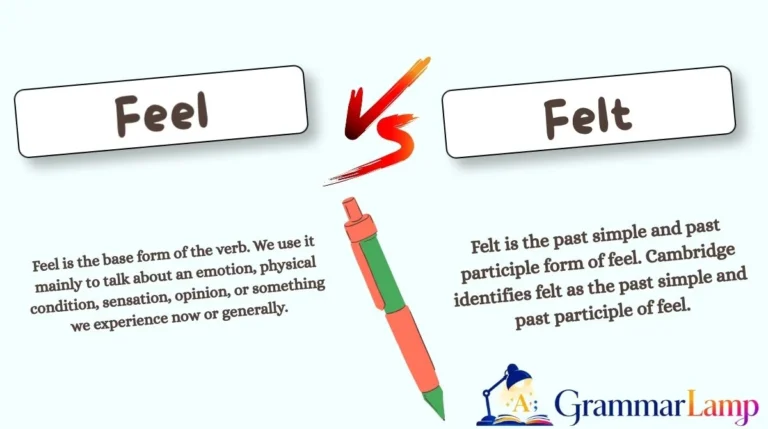
Feel is the base form of the verb. We use it mainly to talk about an emotion, physical condition, sensation, opinion, or something we experience now or generally.
Cambridge Dictionary defines feel as experiencing something physical or emotional, and it also uses the verb for having an opinion and for touching something to discover what it is like.
When should you use “feel”?
Use feel when the situation is happening now, happens regularly, or is true in general.
For example:
- I feel happy today.
- I feel tired after work.
- My hands feel cold.
- I feel nervous before exams.
- Do you feel better now?
The word can describe both physical and emotional experiences.
Basic grammar rule
The basic form is:
Subject + feel + adjective
Examples:
- I feel tired.
- You feel happy.
- We feel nervous.
- They feel sick.
With he, she, or it in the present simple, use feels, not feel:
- She feels tired.
- He feels nervous.
- The room feels cold.
This is an important point. Feel is the base form, while feels is the third-person singular present form.
8 examples with “feel”
- I feel much better today.
- Do you feel nervous before a test?
- I feel happy when I spend time with my family.
- These shoes feel comfortable.
- I feel that we need more time.
- You may feel tired after the journey.
- I feel something moving under the table.
- Do you feel the heat from the fire?
Notice that feel does not always mean “have an emotion.” It can also mean to experience something through your body, to touch something, or to have an opinion.
A common confusion
Many learners use felt simply because they are describing an emotion:
❌ I felt happy now.
If now is the time you mean, use the present form:
✅ I feel happy now.
But if you are talking about an earlier time:
✅ I felt happy yesterday.
The important question is not “Is this an emotion?” The important question is “When did this feeling happen?”
What Does “Felt” Mean?
Felt is the past simple and past participle form of feel. Cambridge identifies felt as the past simple and past participle of feel.
Use felt when you are talking about a feeling, experience, sensation, or opinion that belongs to the past.
When should you use “felt”?
Use felt when the feeling happened before now.
For example:
- I felt tired yesterday.
- She felt nervous before the interview.
- We felt happy after hearing the news.
- He felt sick on the bus.
The past time can be stated directly:
I felt cold last night.
Or it can be understood from the context:
I went to the doctor because I felt terrible.
The listener understands that the feeling happened before the present moment.
Basic grammar rule
For a normal past statement:
Subject + felt + adjective
Examples:
- I felt tired.
- She felt happy.
- They felt nervous.
- We felt cold.
Unlike feel, felt does not change according to the subject.
You say:
- I felt
- You felt
- He felt
- She felt
- We felt
- They felt
Not felts.
8 examples with “felt”
- I felt tired after the long journey.
- She felt nervous before her speech.
- He felt sick after eating too much.
- We felt happy when our team won.
- They felt cold during the night.
- I felt that something was wrong.
- She felt the fabric before buying the dress.
- He felt better after taking a short rest.
Here, felt can describe emotions, physical sensations, opinions, and touch. These are all normal uses of the past form of feel.
Another common confusion
Do not confuse felt with fell.
They sound somewhat similar, but they come from different verbs:
- feel → felt
- fall → fell
For example:
I felt tired.
I fell off my bike.
Cambridge specifically notes that fell is the past simple of fall, while felt is the past simple of feel.
Difference Between Feel and Felt
The easiest way to understand the difference is to think about time.
Feel = present/base form
Felt = past form
Both words describe experiences, emotions, sensations, and opinions. The main difference is when the experience happens.
Comparison table
| Point | Feel | Felt |
|---|---|---|
| Basic form | Feel | Felt |
| Tense | Present/base form | Past simple/past participle |
| Main time | Now or generally | Before now |
| Example | I feel tired. | I felt tired yesterday. |
| Question | Do you feel okay? | Did you feel okay? |
| Negative | I don’t feel well. | I didn’t feel well. |
| With he/she | She feels happy. | She felt happy. |
| Verb type | Irregular verb | Past form of feel |
Cambridge’s grammar guidance explains that irregular verbs can have a different form for the base, past simple, and participle, and gives feel, felt, felt as an example where the past and participle forms are the same.
1. Present situation: “feel”
Imagine your friend asks:
How do you feel today?
You can answer:
I feel great.
You are describing your current condition.
Another example:
I feel nervous about my exam.
The nervousness is connected to the present situation.
2. Past situation: “felt”
Now imagine your friend asks about yesterday:
How did you feel yesterday?
You answer:
I felt terrible.
The feeling happened in the past.
Another example:
I felt nervous before my exam yesterday.
The time reference tells us to use the past form.
3. Present questions use “feel”
For simple present questions, use do/does + feel:
- Do you feel tired?
- Do they feel ready?
- Does she feel better?
- Does he feel nervous?
Notice that after do or does, we use feel, not felt.
❌ Does she felt sick?
✅ Does she feel sick?
4. Past questions use “felt” after “did”? No.
This is one of the most important grammar rules.
After did, use the base form of the verb.
So:
❌ Did you felt tired?
✅ Did you feel tired?
Even though the question is about the past, did already shows the past tense. Therefore, the main verb returns to its base form: feel.
The same pattern appears with many irregular verbs:
Did you go?
Not: Did you went?
Did she feel better?
Not: Did she felt better?
5. Present negative: “don’t/doesn’t feel”
Use:
do not/don’t + feel
or
does not/doesn’t + feel
Examples:
- I don’t feel well.
- They don’t feel ready.
- She doesn’t feel happy.
- He doesn’t feel comfortable.
6. Past negative: “didn’t feel”
Use:
did not/didn’t + feel
Not didn’t felt.
❌ I didn’t felt well.
✅ I didn’t feel well.
Again, didn’t carries the past meaning, so the verb after it must be the base form.
Grammar Rules You Must Remember
Rule 1: Use “feel” for the present
When you are describing how someone feels now, use feel or feels.
I feel tired now.
With he, she, or it:
She feels tired now.
The present simple normally uses -s with third-person singular subjects.
Rule 2: Use “felt” for a finished past situation
If the feeling happened in the past, use felt.
I felt nervous before the interview.
The interview is a past event, so felt is correct.
You can also use past time expressions such as:
- yesterday
- last night
- last week
- two days ago
- when I was young
- earlier
- this morning, when the morning is finished
For example:
I felt sick yesterday.
Rule 3: After “did,” use “feel”
This rule causes many mistakes.
Did + subject + feel…?
Examples:
Did you feel better?
Did she feel nervous?
Did they feel safe?
Never use felt immediately after did in a normal past question.
❌ Did you felt happy?
✅ Did you feel happy?
Rule 4: After “didn’t,” use “feel”
The same rule applies to negative past sentences.
I didn’t feel well.
She didn’t feel comfortable.
They didn’t feel ready.
Do not say:
❌ She didn’t felt comfortable.
Say:
✅ She didn’t feel comfortable.
A useful way to remember this is:
Did/didn’t + base verb
So:
did + feel
didn’t + feel
Not:
did + felt
didn’t + felt
Common Mistakes Students Make
Mistake 1: Using “felt” with “now”
❌ I felt tired now.
✅ I feel tired now.
The word now clearly points to the present, so feel is normally the correct choice.
Mistake 2: Using “feel” for a finished past event
❌ Yesterday, I feel very nervous.
✅ Yesterday, I felt very nervous.
Because yesterday is in the past, the simple past form is needed.
Mistake 3: Saying “Did you felt?”
This is probably the most common error.
❌ Did you felt happy?
✅ Did you feel happy?
Why? Because did already makes the question past.
Think of it as:
Did + base verb
Mistake 4: Saying “didn’t felt”
❌ I didn’t felt well yesterday.
✅ I didn’t feel well yesterday.
Again, didn’t already carries the past tense.
Mistake 5: Confusing “felt” and “fell”
These are different verbs.
Feel → felt
I felt tired.
Fall → fell
I fell down.
A quick spelling reminder:
- feel has two e’s
- felt changes the ending
- fall becomes fell
Cambridge also warns learners about the distinction between fell and felt.
Mistake 6: Forgetting “feels” with he or she
❌ She feel tired.
✅ She feels tired.
In the present simple:
I/you/we/they feel
but:
he/she/it feels
However, after does, return to feel:
Does she feel tired?
Not:
❌ Does she feels tired?
The helping verb does takes the third-person marking, so the main verb stays in its base form.
Easy Trick to Remember the Difference
Here is a very simple trick:
FEEL = NOW
FELT = BEFORE
Imagine two boxes.
Today box: FEEL
I feel happy today.
Yesterday box: FELT
I felt happy yesterday.
That’s the basic idea.
You can also remember it as:
Feel = current experience
Felt = past experience
For example, if your friend asks:
“How are you?”
You might say:
I feel good.
If your friend asks:
“How were you yesterday?”
You might say:
I felt good.
The feeling itself can be almost identical. Only the time changes.
One more useful trick is to look for time words.
Words such as now, today, usually, every day often point toward present forms.
Words such as yesterday, last night, last year, two hours ago usually point toward the past.
Of course, context matters. You should not depend only on a time word. But this trick is excellent for beginners.
Daily Life Examples
Here are natural examples you might hear in everyday English.
1. Talking about your health
A: How do you feel today?
B: I feel much better, thanks.
The person is talking about their condition now.
2. Talking about yesterday
A: How did you feel yesterday?
B: I felt really tired.
The word did is used in the question, so the main verb is feel, not felt.
3. Talking about an exam
I feel nervous before every exam.
This describes a regular experience.
4. Talking about one past exam
I felt nervous before my English exam last week.
The event happened last week, so felt is appropriate.
5. Talking about food
I don’t feel hungry right now.
This describes the speaker’s current condition.
6. Talking about a past illness
I felt sick after lunch yesterday.
The sickness happened in the past.
7. Asking about someone’s feelings
Do you feel happy in your new job?
This asks about the person’s current or general experience.
8. Asking about a past experience
Did you feel nervous when you started your new job?
Notice the important pattern:
Did + feel
9. Talking about physical sensations
My hands feel cold.
This describes how the hands seem or feel now.
10. Describing an earlier sensation
My hands felt cold when I went outside this morning.
Here, felt connects the sensation to an earlier time.
Practice Section
Choose feel or felt to complete each sentence.
1.
I ______ tired after work yesterday.
2.
Do you ______ nervous before exams?
3.
She ______ much better today.
4.
Did he ______ sick after the meal?
5.
We didn’t ______ comfortable in that hotel.
Answers
1. felt
I felt tired after work yesterday.
2. feel
Do you feel nervous before exams?
After do, use the base form.
3. feels
She feels much better today.
Remember the third-person singular -s in the present simple.
4. feel
Did he feel sick after the meal?
After did, use feel, not felt.
5. feel
We didn’t feel comfortable in that hotel.
After didn’t, use the base form.
FAQs
What is the difference between feel and felt?
Feel is the base/present form, while felt is the past form of feel. Use feel for something happening now or something that happens generally. Use felt for a past experience.
I feel tired now.
I felt tired yesterday.
Can we use “feel” in questions?
Yes. Feel is very common in questions.
For present situations, use do/does + feel:
Do you feel okay?
Does she feel better?
For past questions, use did + feel:
Did you feel okay yesterday?
Remember that did is followed by feel, not felt.
Is “feel” formal or informal?
Feel is neither simply formal nor informal. It is a normal, everyday English verb used in conversations, writing, school, business, and formal situations.
For example:
I feel that this decision is important.
This can work in both everyday and more formal English. Cambridge also lists feel as a verb used to express an opinion.
Is “felt” the past tense of “feel”?
Yes. Felt is the past simple of feel. It is also the past participle form.
The basic verb forms are:
feel – felt – felt
For example:
I feel happy now.
I felt happy yesterday.
I have felt happy since I moved here.
Cambridge’s grammar reference lists feel, felt, felt among irregular verb forms.
Is “Did you felt” correct?
No. The correct sentence is:
Did you feel tired?
After did, use the base form of the verb.
The same rule works with negative sentences:
I didn’t feel tired.
Not:
❌ I didn’t felt tired.
This is one of the most useful rules to remember when using feel in the past.
What is the difference between “I feel” and “I felt”?
I feel usually refers to the present or a general experience.
I feel happy today.
I felt refers to an earlier experience.
I felt happy yesterday.
The difference is mainly about time. The type of feeling does not have to change.
Conclusion
Understanding feel vs felt becomes much easier when you focus on time and sentence structure.
Feel is the base form and is used for present or general situations. For example, “I feel tired” means the speaker is tired now. With he, she, or it in the present simple, use feels, as in “She feels happy.”
Felt is the past form of feel. Use it when the experience happened before now: “I felt tired yesterday.”
The most important rule is this: after did or didn’t, always use feel, not felt. So we say “Did you feel okay?” and “I didn’t feel well.”
You do not need to memorize dozens of complicated rules. Start by asking yourself one question: Is the feeling happening now, or did it happen before? With regular practice, the correct form will start to feel natural.
Try making a few sentences about how you feel today and how you felt yesterday. That small exercise can make a big difference.

Liam Derren is a language writer at GrammarLamp, creating simple, helpful content about grammar, words, and everyday English. He makes language learning clear, practical, and easy to understand.
6 thoughts on “Feel vs Felt: Complete Grammar Guide With Examples (2026)”