
Have you ever seen the words brite and bright and wondered which one is correct? You are not alone. Many English learners get confused because the two words look almost the same and are usually pronounced the same way.
The main difference is actually quite simple. Bright is the normal and standard English spelling.
It is the word you should use when you are talking about light, colors, intelligent people, cheerful moods, or a hopeful future. For example, we say, “The room is bright,” “She wore a bright red dress,” and “He is a bright student.”
Cambridge and Merriam-Webster both list these everyday meanings of bright.
Brite, on the other hand, is generally seen as a special or stylized spelling rather than the normal spelling of the adjective.
It is especially common in product names, advertising, and brand names. The spelling variant has also appeared historically in phonetic spelling and older English uses, so saying that it has never existed would be too strong.
This difference matters when you are writing school assignments, emails, essays, website content, applications, or professional messages.
After reading this guide, you will know when to write bright, when brite may appear, why they sound alike, and how to avoid the most common mistakes.
Feel vs Felt: Complete Grammar Guide With Examples (2026)
Role Call or Roll Call? The Correct Spelling and Meaning in 2026
Into or Onto: Complete Difference, Rules, and Examples for 2026
Sole vs Soul: What’s the Difference? Easy Guide With Examples 2026
What Does “Brite” Mean?
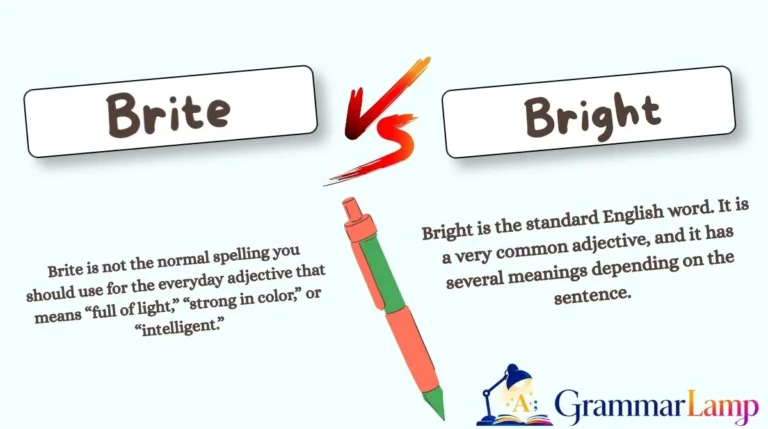
Brite is not the normal spelling you should use for the everyday adjective that means “full of light,” “strong in color,” or “intelligent.”
In modern English, brite is most often used as a stylized spelling, especially in a product name, company name, trademark, advertising phrase, or deliberately simplified spelling.
The idea behind it is usually connected with bright, but the spelling has been changed from bright to brite.
For example, a company might choose a name such as Brite Clean, Star-Brite, or another creative business name. In such a case, you should copy the official spelling because it is part of the name. The spelling does not mean that brite has replaced bright in standard English.
There is also an older dictionary use worth knowing. Noah Webster’s 1828 dictionary recorded brite as a regional verb meaning “to be or become overripe,” especially when talking about wheat, barley, or hops.
This is a historical and uncommon meaning, not the everyday meaning most learners are looking for today.
When should you use “brite”?
For ordinary English writing, you normally should not use brite instead of bright.
You may see brite when:
- it is part of an official brand or product name;
- a business intentionally uses that spelling;
- a marketing slogan uses it as a creative spelling;
- an older or historical text uses the word in a special sense;
- someone is deliberately using playful or nonstandard spelling.
Grammar rule for “brite”
There is no general modern grammar rule that says you can replace bright with brite.
The safe rule for learners is:
Use “bright” for the standard English adjective. Use “brite” only when the spelling is part of a specific name or special usage.
Examples of “brite” in special use
- The package was labeled Star-Brite.
- The company sells a product called Brite Clean.
- I saw the word Brite printed in the brand name.
- The logo uses Brite instead of Bright.
- Please write the product name as Brite, not Bright.
- The old dictionary gives brite a different historical meaning.
- That unusual spelling is part of the company’s identity.
- The advertisement uses brite as a creative spelling.
Notice something important in these examples: brite is not functioning as the ordinary adjective in standard modern English. It is usually being treated as part of a special name or spelling choice.
Common learner confusion about “brite”
A learner may think that because brite sounds like bright, both spellings must be correct.
That is not how English spelling works.
English has many words that sound alike but are spelled differently. A person may hear bright in a conversation and write brite, especially when they are learning through listening rather than reading.
This is why spelling practice is important. In normal writing, remember bright.
What Does “Bright” Mean?
Bright is the standard English word. It is a very common adjective, and it has several meanings depending on the sentence.
The most basic meaning is full of light or shining strongly. For example, “The sun is bright.” It can also describe a strong or vivid color, such as “a bright yellow shirt.” Cambridge also lists meanings connected with intelligence, happiness, and hope.
Merriam-Webster similarly defines bright as something that radiates or reflects light, uses it for vivid colors, and gives meanings such as cheerful, intelligent, and promising.
When should you use “bright”?
Use bright in normal English when you mean:
- full of light;
- shining strongly;
- strong or vivid in color;
- intelligent or quick to learn;
- cheerful or lively;
- hopeful or promising.
It can be used in everyday conversation, school writing, business writing, books, newspapers, and formal documents.
Grammar rule for “bright”
Bright is mainly an adjective.
It usually comes before a noun:
a bright room
a bright star
a bright student
a bright future
It can also come after a linking verb:
The room is bright.
Her dress looks bright.
His future seems bright.
The word can also be changed into forms such as brighter and brightest:
This room is brighter than the other one.
That was the brightest star in the sky.
Examples of “bright”
- The sun is very bright today.
- She wore a bright yellow dress.
- We sat in a bright room.
- Ahmed is a bright student.
- She had a bright idea.
- He has a bright future ahead of him.
- The children were happy and bright.
- The stars looked bright in the clear sky.
These sentences show why bright is such a useful word. Its exact meaning comes from context.
Common learner confusion about “bright”
Some learners think bright only means “full of light.”
That is not true.
Compare:
The lamp is bright.
She is a bright student.
He painted the wall bright blue.
They have a bright future.
In the first sentence, bright describes light. In the second, it describes intelligence. In the third, it describes color. In the fourth, it describes hope or promise.
So, do not memorize just one meaning. Learn the common meanings together.
Difference Between Brite and Bright (Detailed)
The easiest way to understand the difference is to remember that bright is the standard English word, while brite is usually a stylized or special spelling.
| Feature | Brite | Bright |
|---|---|---|
| Standard everyday English spelling | Usually no | Yes |
| Common dictionary adjective | No, not as the normal modern form | Yes |
| Main everyday meanings | Usually connected to a brand or stylized spelling | Light, vivid color, intelligent, cheerful, hopeful |
| Common in school writing | No | Yes |
| Common in professional writing | Only as an exact name | Yes |
| Common in advertisements | Yes | Yes |
| Usually pronounced | /braɪt/ | /braɪt/ |
| Can describe a person as intelligent | No in standard usage | Yes |
| Can describe a color | Not normally | Yes |
| Can describe a future | Not normally | Yes |
| Safe choice for learners | No | Yes |
Usage difference
The biggest difference is standard usage.
If you are writing about a room with lots of light, write:
The room is bright.
Not:
The room is brite.
If you are describing a color, write:
She wore a bright blue shirt.
Not:
She wore a brite blue shirt.
If you are describing an intelligent person, write:
He is a bright student.
Not:
He is a brite student.
If you are talking about hope or success, write:
She has a bright future.
Again, bright is the standard choice.
Grammar logic
This is less about grammar and more about spelling and usage.
The word bright belongs to ordinary English vocabulary. It behaves like a normal adjective and can appear in many grammatical structures.
For example:
a bright light
bright colors
a bright child
a bright idea
a bright future
The spelling brite does not normally create a second standard adjective with all these same grammatical uses.
Sentence structure difference
There is no normal sentence pattern where you must choose brite instead of bright.
That means you should not think:
“Brite is for informal sentences, while bright is for formal sentences.”
That rule is too simple and can lead to mistakes.
A better rule is:
Bright is the normal English spelling. Brite is used when a special name or styling deliberately chooses that spelling.
Meaning comparison
Bright has clear dictionary meanings. It can describe light, colors, intelligence, happiness, and promising situations.
Brite normally does not give you a separate everyday meaning. When you see it in modern life, ask yourself whether it is a brand name, product name, logo, or creative spelling.
That simple question will solve most cases.
Based Out of vs Based In (2026): What’s the Difference? Easy Grammar Guide with Examples
Crews vs Cruise (2026): What’s the Difference? Easy Grammar Guide with Examples
Everything vs Every Thing: Easy Difference, Rules, Examples & Practice (2026)
All Is vs All Are: Which One Is Correct? Complete Grammar Guide for 2026
Grammar Rules You Must Remember
Rule 1: Use “bright” in normal English writing
When you mean shining, colorful, intelligent, cheerful, or promising, use bright.
Example:
She is a bright student.
Not:
She is a brite student.
Rule 2: Use “brite” only when the special spelling is intentional
If a product, company, or brand officially spells its name Brite, keep that spelling.
Example:
I bought a product called Brite Clean.
Here, Brite is part of the name. Changing it to Bright could make the name incorrect.
Rule 3: Do not choose spelling based only on pronunciation
Both forms can be pronounced like /braɪt/, so listening alone may not tell you which spelling is intended.
Example:
The bright light hurt my eyes.
You may hear bright clearly but still need to remember its spelling.
Rule 4: In school and professional writing, choose “bright”
For exams, essays, reports, emails, applications, and ordinary website writing, bright is the safe and correct choice when you mean the normal adjective.
Example:
The classroom was bright and comfortable.
This is standard English.
Common Mistakes Students Make
Mistake 1: Writing “brite” because it sounds shorter
A learner may think:
“Bright” sounds like “brite,” so both must be correct.
But spelling is not always based on sound.
Wrong: The room is brite.
Correct: The room is bright.
Mistake 2: Using “brite” in an exam
A student may remember seeing Brite on packaging and assume it is normal English.
Wrong: She is a brite student.
Correct: She is a bright student.
In an exam or formal assignment, the standard spelling is the better choice.
Mistake 3: Replacing every “bright” with “brite”
Some learners think the shorter spelling is simply an alternative spelling.
Wrong: He has a brite future.
Correct: He has a bright future.
Do not treat brite as a free replacement for bright.
Mistake 4: Assuming advertising spelling is grammar
Brands often use creative spellings because unusual names can stand out.
That does not mean the spelling becomes a standard English word.
Think about names such as:
Brite
Lite
Nite
A business can choose a creative spelling for a name without changing the normal spelling rules of English.
Easy correction tip
Whenever you write brite, stop for one second and ask:
“Am I writing an official name?”
If the answer is no, you almost certainly want bright.
Easy Trick to Remember the Difference
Here is a simple memory trick:
Bright has “gh” because it is the normal English word. Brite is mainly a special spelling.
You do not need to memorize a complicated grammar rule.
Imagine you are writing a school sentence:
The room is very ______.
Which word looks right?
Bright.
Now imagine you are copying the name from a package:
The company is called ______.
If the package says Brite, keep Brite because names can use unusual spellings.
Here is another easy way to remember it:
Bright = normal English
Brite = special name or style
The most important thing is not to panic when you see brite. Seeing the word does not automatically mean it is a spelling mistake. It may be a brand name. Simply look at the context.
Daily Life Examples
Here are some natural examples you might hear or use in everyday English.
1. Talking about sunlight
“Wow, the sun is really bright today.”
Here, bright means full of strong light.
2. Talking about a room
“Can we open the curtains? I want the room to be brighter.”
Brighter is the comparative form of bright.
3. Talking about clothes
“She bought a bright red jacket.”
Here, bright describes a strong, vivid color.
4. Talking about a student
“Ali is very bright. He understands new ideas quickly.”
Here, bright means intelligent.
5. Talking about an idea
“That’s a bright idea!”
This means the idea is clever or good.
6. Talking about the future
“She works hard, so she has a bright future.”
Here, bright means hopeful or promising.
7. Reading a product label
“The box says Brite Clean.”
Here, Brite is part of the product’s name, so you keep the exact spelling.
8. Talking about a logo
“Why does that company spell it Brite?”
The question is about a particular spelling used by the company.
9. Correcting a message
“You wrote ‘brite light,’ but the normal spelling is ‘bright light.’”
This is a simple spelling correction.
10. Talking about headlights
“Those headlights are too bright.”
Here, bright means producing a lot of light. Cambridge also records brights as an informal noun in American English for a car’s high-beam headlights.
Practice Section
Choose brite or bright in each sentence.
- The classroom is very ______ this morning.
- She is a ______ student.
- He has a ______ future.
- The product is called ______ Clean.
- I love those ______ colors.
- The headlights are too ______.
Answers
- bright
- bright
- bright
- Brite
- bright
- bright
Notice the pattern. In the first, second, third, fifth, and sixth sentences, we are using the normal adjective. In sentence 4, Brite is treated as part of a product name.
Apportion vs Portion vs Proportion: Meaning, Differences, and Easy Examples (2026)
Case in Point vs Case and Point: Which Is Correct? (2026)
Work Alongside You vs Work Alongside With You (2026): Which One Is Correct in English?
Lets vs Let’s (2026): What’s the Difference? Easy Grammar Guide with Examples
FAQs
What is the difference between brite and bright?
Bright is the standard modern English spelling. It can mean full of light, vivid in color, intelligent, cheerful, or promising. Brite is generally a stylized spelling used in names, branding, advertising, or other special contexts.
Is “brite” a correct English word?
It depends on the context. Brite can appear as a special spelling, especially in names and product branding, and older dictionaries also recorded a rare historical use. However, it is not the normal spelling of the everyday adjective that learners should use instead of bright.
Can I use brite in formal writing?
Normally, no. In an essay, school assignment, professional email, report, or other formal writing, use bright when you mean the usual adjective. Use Brite only when you are referring to a name that officially uses that spelling.
Are brite and bright pronounced the same?
In modern English, they are generally pronounced the same, /braɪt/. This is one reason the spelling can be confusing for learners. The sound does not tell you whether the written form should contain gh.
Is bright only used for light?
No. Bright has several common meanings. It can describe light, strong colors, intelligent people, cheerful moods, and hopeful situations. For example, we can say bright light, bright colors, a bright student, and a bright future.
When is Brite acceptable?
Brite is acceptable when it is the official spelling of a product, business, brand, title, or other named item. It can also occur in historical or specialized language. When writing ordinary modern English, however, bright should be your default spelling.
Conclusion
The difference between brite and bright becomes much easier once you focus on context.
Bright is the standard English word. Use it when you are talking about something full of light, a vivid color, an intelligent person, a cheerful mood, a good idea, or a hopeful future.
It is the spelling you should normally use in school, work, exams, emails, and everyday writing.
Brite is different. In modern usage, you are most likely to see it as a creative or stylized spelling in a brand, company, product, advertisement, or logo.
Historical dictionaries also show that brite has had other specialized uses, which explains why it cannot simply be described as a completely invented spelling.
When you are unsure, use this simple rule:
Bright = standard English
Brite = special spelling or name
Practice this distinction in your own sentences, and the confusion will quickly disappear. Once you start noticing the context, choosing the correct spelling becomes almost automatic.

Liam Derren is a language writer at GrammarLamp, creating simple, helpful content about grammar, words, and everyday English. He makes language learning clear, practical, and easy to understand.