
“All is” and “all are” look very similar, so it is easy to choose the wrong verb. Many English learners think the rule is simply that all = plural, so all are must always be correct. But English is a little more interesting than that.
The correct choice depends on what “all” refers to. Sometimes “all” means a whole amount or one complete thing, and sometimes it refers to several people or things. That small difference changes the verb from is to are.
For example:
- All is well.
- All are ready.
- All the water is gone.
- All the students are ready.
Both is and are can be correct. The important thing is understanding the noun, pronoun, or idea that “all” represents.
This matters because “all” appears constantly in normal English. You hear it at home, at school, at work, in conversations, in emails, and in books.
Once you understand the basic agreement rule, sentences such as all is lost, all are welcome, all of it is correct, and all of them are correct become much easier.
By the end of this guide, you will know when to use all is, when to use all are, how to use all of it and all of them, what happens in questions, and which common mistakes to avoid.
What Does “All Is” Mean?
Simple definition
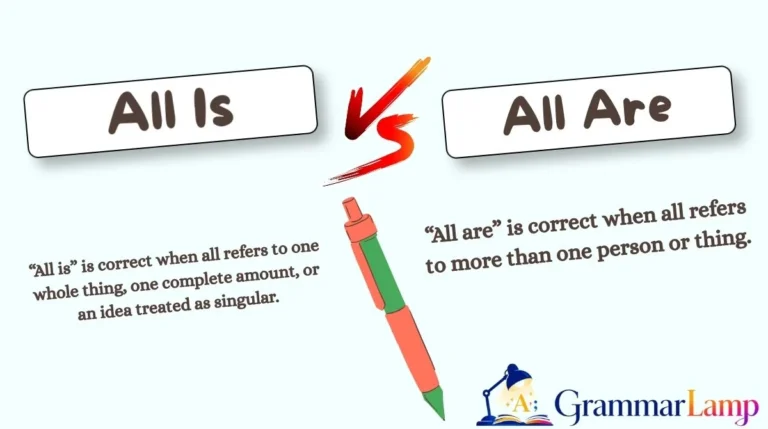
“All is” is correct when all refers to one whole thing, one complete amount, or an idea treated as singular.
Here, is is the singular form of the verb be.
For example:
- All is well.
- All is lost.
- All is ready.
- All is quiet.
In these sentences, “all” does not mean several separate people or objects. It means everything, the whole situation, or the entire condition.
Cambridge explains that all can mean “every one,” “the complete number or amount,” or “the whole.” It can also function as a pronoun, as in expressions such as All is well or All I need is a break.
When should you use “all is”?
Use all is when “all” represents:
- everything
- one complete situation
- one whole amount
- one complete idea
Compare these examples:
All is well.
Here, “all” means the whole situation.
All the students are well.
Here, “students” is plural, so the verb is are.
The difference becomes much clearer when you look at what “all” represents.
Examples of “all is”
- All is well now.
- All is lost.
- All is quiet in the house.
- All is ready for the meeting.
- All is forgiven.
- All is not what it seems.
- All that matters is your safety.
- All I need is a little rest.
Notice something important in the last two sentences. The word all can represent a whole idea rather than a group of separate things.
For example:
All that matters is your safety.
The subject means roughly the only thing that matters. That whole idea is treated as singular, so is is natural.
A common learner confusion
Many students see “all” and automatically think about many things.
That is the main reason they write:
❌ All is ready.
or
❌ All are well.
without looking at the meaning.
The correct choice depends on the thing being discussed.
If “all” means everything as one whole, is may be correct.
If “all” refers to multiple people or objects, are is normally correct.
There is another useful clue: when “all” is followed by an uncountable noun, the verb is usually singular.
For example:
- All the information is correct.
- All the water is dirty.
- All the money is gone.
- All the furniture is new.
That is because information, water, money, and furniture are treated as uncountable nouns in these sentences.
What Does “All Are” Mean?
Simple definition
“All are” is correct when all refers to more than one person or thing.
The verb are is the plural form of be in the present tense.
Examples:
- All are welcome.
- All are ready.
- All are invited.
- All the students are here.
When “all” means every member of a group, the verb is usually plural if the group contains plural people or countable things.
Cambridge notes that all refers to a complete group and is used with plural nouns and uncountable nouns. The verb then follows the number of the noun that “all” refers to.
When should you use “all are”?
Use all are when “all” refers to:
- several people
- several animals
- several countable objects
- a plural group
For example:
- All the players are ready.
- All my friends are busy.
- All the books are on the table.
- All the children are sleeping.
Examples of “all are”
- All are welcome here.
- All are invited to the party.
- All the children are happy.
- All my friends are busy today.
- All the workers are safe.
- All these answers are correct.
- All the cars are outside.
- All of them are waiting.
In each example, the subject refers to several people or things.
Common learner confusion
Students sometimes think:
“All” sounds like one word, so I should use is.
But grammar does not work that way. The verb depends on the meaning and the noun being represented.
Compare:
All the money is gone.
“Money” is uncountable, so is is used.
Now compare:
All the coins are gone.
“Coins” is plural, so are is used.
This simple comparison solves many problems.
Difference Between “All Is” and “All Are”
The main difference is singular meaning versus plural meaning.
| Expression | Meaning | Verb | Example |
|---|---|---|---|
| all is | everything / one whole situation | singular | All is well. |
| all are | every person or thing in a plural group | plural | All are welcome. |
| all of it is | the complete amount or thing | singular | All of it is useful. |
| all of them are | every person or thing in a group | plural | All of them are useful. |
| all + uncountable noun + is | complete amount | singular | All the water is cold. |
| all + plural noun + are | complete group | plural | All the bottles are cold. |
Usage difference
The easiest question to ask yourself is:
“What does all refer to?”
If it refers to one whole thing, one amount, or everything as one idea, use is.
If it refers to several people or things, use are.
Look at these pairs:
All is quiet.
All the children are quiet.
All the water is dirty.
All the bottles are dirty.
All of it is finished.
All of them are finished.
The word “all” has the same basic idea of totality in each sentence, but the verb changes because the thing being referred to changes.
Grammar logic
A useful grammar principle is:
The verb agrees with the noun or pronoun that “all” refers to.
This is especially clear with all of.
For example:
- All of it is useful.
- All of us are learning.
- All of them are tired.
The British Council gives the same basic agreement rule: with all of, the verb agrees with the noun or pronoun that follows. Thus, all of it is, but all of us are and all of them are.
Sentence structure difference
Here are some common patterns:
All + uncountable noun + is
All the information is correct.
All + plural noun + are
All the answers are correct.
All of + singular/uncountable pronoun + is
All of it is correct.
All of + plural pronoun + are
All of them are correct.
All + whole idea + is
All I want is some peace.
This pattern is why there is no single rule saying “all always takes are.”
Grammar Rules You Must Remember
Rule 1: Use “is” when “all” refers to one whole thing or amount
When “all” means everything or a complete amount viewed as one whole, use is.
Example:
All is well.
Here, “all” means the whole situation.
Another example:
All the water is gone.
“Water” is uncountable, so is is correct.
Rule 2: Use “are” when “all” refers to a plural group
When “all” refers to several people or countable things, use are.
Example:
All the students are ready.
The noun students is plural.
More examples:
- All the teachers are here.
- All the books are new.
- All my friends are busy.
- All the players are tired.
Rule 3: With “all of,” look at the word after “of”
This is one of the easiest rules to remember.
All of it is correct.
All of them are correct.
All of us are ready.
All of the money is gone.
All of the students are here.
The word after of usually gives you the clue.
The British Council specifically states that the verb after all of agrees with the noun or pronoun following all of.
Rule 4: Do not confuse “all” with “every”
All and every have related meanings, but their grammar is different.
We normally use:
all + plural noun
but:
every + singular noun
For example:
All students are welcome.
Every student is welcome.
Both sentences talk about a complete group, but the first uses a plural noun and plural verb, while the second uses a singular noun and singular verb. Cambridge gives the same distinction: all refers to a complete group, while every focuses on each individual member and takes a singular noun and singular verb.
Common Mistakes Students Make
Mistake 1: Thinking “all” always needs “are”
A student may write:
❌ All the money are gone.
But money is uncountable here.
The correct sentence is:
✅ All the money is gone.
The same idea applies to:
- All the information is correct.
- All the furniture is old.
- All the water is clean.
- All the equipment is ready.
Mistake 2: Using “is” with a plural group
Some learners make the opposite mistake:
❌ All the students is ready.
Correct:
✅ All the students are ready.
The noun students is plural.
A good habit is to notice the noun after all.
Mistake 3: Confusing “all of it” with “all of them”
These two expressions are extremely useful.
All of it = the complete thing or amount.
All of it is important.
All of them = every member of a plural group.
All of them are important.
Do not say:
❌ All of them is important.
when “them” refers to several people or things.
Mistake 4: Saying “all are” when talking about everything
The sentence:
All are ready.
is correct when “all” refers to several people.
But:
❌ All are well.
may be wrong if you mean everything is okay.
The common expression is:
✅ All is well.
Context matters.
Mistake 5: Making questions incorrectly
Learners sometimes create questions such as:
❌ All are ready?
That can sound unnatural as a standard question.
A clearer question is:
✅ Are all the students ready?
For a singular or uncountable idea:
✅ Is all the work finished?
The auxiliary verb comes before the subject in a normal English question.
Easy Trick to Remember the Difference
Here is a classroom trick that works well:
Think: “One whole” or “many members?”
If you mean one whole, think IS.
If you mean many members, think ARE.
For example:
One whole amount:
All the milk is gone.
Imagine one full amount of milk. That is why is works.
Many separate things:
All the bottles are empty.
Now imagine many bottles. That is why are works.
Another easy trick is to replace all with something clearer.
Try replacing it mentally with:
- everything → usually is
- all of it → is
- all of them → are
- the whole situation → is
For example:
All is well.
You can think:
Everything is well.
And:
All are ready.
You can think:
All of them are ready.
The second version makes the plural idea much easier to see.
Daily Life Examples
Here are natural examples you might hear in real conversations.
1. At home
A: Is everything okay?
B: Yes, all is well now.
2. At school
Teacher: Are the students ready?
Student: Yes, all are ready.
3. Talking about money
A: How much money is left?
B: All the money is in the bank.
4. Talking about friends
A: Where are your friends?
B: All of them are at the café.
5. At work
Manager: Are the reports finished?
Employee: Yes, all the reports are finished.
6. Talking about food
A: Is there any cake left?
B: No, all of it is gone.
7. Talking about children
Parent: Where are the children?
Teacher: All the children are in the classroom.
8. Talking about information
A: Can I trust these details?
B: Yes, all the information is correct.
9. At an event
Host: Who can enter the room?
Staff member: All are welcome.
10. Talking about a situation
A: Are you worried?
B: Not anymore. All is well.
These examples show why you cannot choose is or are just by looking at the word all. You need to understand what it refers to.
Practice Section
Choose is or are to complete each sentence.
1. All the students ___ ready.
2. All the water ___ cold.
3. All of them ___ excited.
4. All of it ___ mine.
5. All ___ well now.
Answers
1. are
All the students are ready.
2. is
All the water is cold.
3. are
All of them are excited.
4. is
All of it is mine.
5. is
All is well now.
Quick challenge
Try this without looking at the answers:
All the books ___ on the desk.
All the information ___ useful.
All of us ___ tired.
All of it ___ finished.
All ___ forgiven.
The answers are:
are, is, are, is, is
The more you practice this pattern, the more natural it will feel.
FAQs
What is the difference between “all is” and “all are”?
All is is generally used when “all” refers to one whole thing, one complete amount, or an idea treated as singular. All are is used when “all” refers to several people or things.
Examples:
All is well.
All the students are ready.
Can we use “all is” in questions?
Yes, but it is usually more natural to put the verb before the subject in a question.
Instead of:
❌ All is ready?
say:
✅ Is all the work ready?
Or:
✅ Is all of it finished?
For plural groups, use:
✅ Are all the students ready?
Is “all is” formal or informal?
All is can sound somewhat formal, literary, or traditional in expressions such as All is well and All is lost. However, these expressions are still perfectly normal in modern English.
In everyday speech, speakers often use everything is instead.
For example:
Everything is fine.
instead of:
All is fine.
Both can work, but the first is more common in casual conversation.
Should I say “all are” or “all is ready”?
It depends on what you mean.
Use:
All are ready
when “all” means several people or things.
Use:
All is ready
when “all” means the entire situation or everything as one whole.
However, in everyday English, everything is ready is often a more natural way to express the second meaning.
Is “all of it is” correct?
Yes. All of it is is correct because it is singular.
Examples:
All of it is important.
All of it is finished.
All of it is mine.
Compare that with:
All of them are important.
All of them are finished.
All of them are mine.
It → is
Them → are
That is a very useful pattern to memorize.
Which is correct: “all the information is” or “all the information are”?
The correct form is:
All the information is
because information is an uncountable noun in standard English.
For example:
All the information is correct.
You would use are with a plural countable noun:
All the facts are correct.
This is one of the most common places where learners make mistakes.
Conclusion
The key to choosing between all is and all are is not the word all by itself. The real question is: What does all refer to?
When all means one whole thing, one complete amount, everything, or a singular idea, use is:
All is well.
All the water is gone.
All of it is ready.
When all refers to several people or countable things, use are:
All are welcome.
All the students are ready.
All of them are waiting.
Remember this simple rule:
One whole = IS.
Many members = ARE.
Also pay special attention to all of it and all of them. These two expressions make the difference very clear.
Do not worry if the rule feels confusing at first. Read real English sentences, notice what “all” refers to, and practice making your own examples. After a little practice, choosing between is and are will become much more natural.

Liam Derren is a language writer at GrammarLamp, creating simple, helpful content about grammar, words, and everyday English. He makes language learning clear, practical, and easy to understand.
1 thought on “All Is vs All Are: Which One Is Correct? Complete Grammar Guide for 2026”