English learners often stop when they see two possible forms of the same adjective: simpler and more simple.
Both may look correct because English uses two common ways to make comparative adjectives. For example, we say small → smaller but beautiful → more beautiful.
So when learners see simple, it is natural to ask: Should we say simpler or more simple?
This question matters because simple is used very often in everyday English. We talk about simple ideas, simple instructions, simple answers, simple solutions, and simple ways to do things.
Choosing the right comparative form can make your English sound more natural and clear.
The good news is that you do not need to memorize a difficult rule. Simpler is the usual and more natural comparative form of simple.
However, more simple is also possible in some situations, especially when a speaker wants to emphasize the meaning or avoid a particular structure.
There is also an important difference between grammar rules and natural English usage. A form can be grammatically possible but less common in normal conversation.
By the end, you will understand when to use simpler, when more simple can appear, how to form comparative sentences, and which mistakes to avoid.
More Useful posts
Upmost vs Utmost: Meaning, Difference, and Correct Usage in 2026
Seam vs Seem: Difference, Meaning, Examples & Grammar Rules (2026)
All the Time vs Every Time: Meaning, Difference, Rules & Examples (2026)
Afterward or Afterwards? Meaning, Difference, and Correct Usage in 2026
What Does “Simpler” Mean?
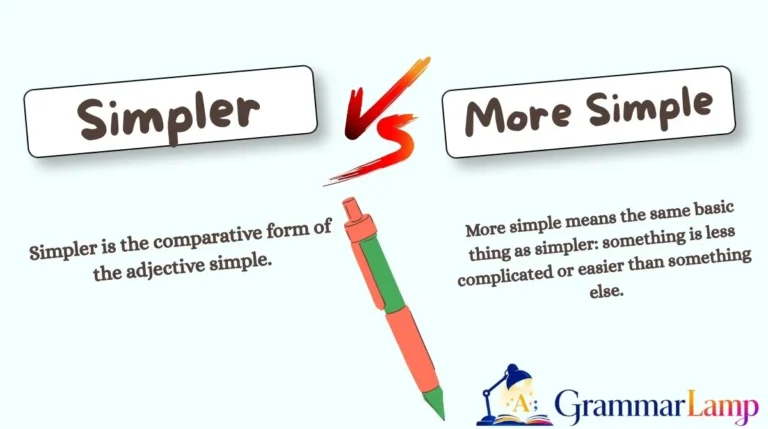
Simpler is the comparative form of the adjective simple.
The adjective simple means easy to understand, easy to do, not complicated, or made of only a few parts.
When we compare two things, we can use simpler to say that one thing is less complicated than another.
Basic grammar rule
For many short adjectives, English adds -er to make the comparative form:
- simple → simpler
- small → smaller
- fast → faster
- clean → cleaner
- bright → brighter
So the normal comparative form is:
simple → simpler
We commonly use simpler when comparing two ideas, methods, systems, answers, instructions, or situations.
Examples with “simpler”
- This method is simpler than the old one.
- Can you give me a simpler explanation?
- The second question is simpler than the first.
- I need a simpler way to solve this problem.
- Her instructions are much simpler now.
- This design is simpler and easier to use.
- We need to find a simpler solution.
- The new process is simpler than the previous process.
Notice that than is often used when the comparison is stated directly.
This method is simpler than that method.
But we can also use simpler without saying what we are comparing it with:
I need a simpler answer.
The listener can understand that you want an answer that is less complicated than the current one.
Why do we say “simpler”?
The word simple is relatively short and has a common comparative form ending in -er.
Although the spelling has two syllables, English speakers commonly use simpler in everyday English.
For example:
This explanation is simpler.
This sounds very natural.
This explanation is more simple.
This is possible, but it usually sounds less natural in ordinary conversation.
A common learner confusion
Many learners think that every adjective with two syllables must use more.
That is not always true.
For example:
- simple → simpler
- clever → cleverer
- narrow → narrower
- quiet → quieter
English comparative forms depend on more than simply counting syllables. Some two-syllable adjectives can take -er, while others normally use more.
That is why simpler is the form you should normally remember.
What Does “More Simple” Mean?
More simple means the same basic thing as simpler: something is less complicated or easier than something else.
The difference is mainly about form and natural usage, not a completely different meaning.
The structure is:
more + adjective
So:
more + simple = more simple
This follows a general English pattern:
- more useful
- more careful
- more important
- more difficult
- more expensive
However, simple is one of those adjectives where English speakers very commonly prefer the -er form.
Examples with “more simple”
You may sometimes see or hear sentences such as:
- We need a more simple explanation.
- The new design is more simple than the old design.
- They wanted a more simple way to organize the information.
- His approach is more simple and direct.
- The second version is more simple in structure.
- We are looking for a more simple solution.
These examples can be understood, and more simple is not automatically impossible.
However, in many of these sentences, a native speaker would probably choose simpler instead:
We need a simpler explanation.
The new design is simpler than the old design.
They wanted a simpler way to organize the information.
Why might someone use “more simple”?
There can be a few reasons.
Sometimes a writer wants to emphasize the adjective itself. Sometimes the phrase appears in formal, technical, or carefully structured writing. In other cases, a speaker may simply choose the more + adjective pattern.
There are also cases where more simple may be useful for clarity or emphasis in a particular sentence.
For everyday learners, however, there is an easy choice:
Use “simpler” as your normal comparative form.
Another important point
Do not confuse more simple with more simply.
These are different.
More simple is an adjective phrase:
We need a more simple explanation.
More simply is an adverb phrase:
Can you explain it more simply?
Here, simply describes the way someone explains something.
Compare:
Give me a simpler explanation.
and
Explain it more simply.
Both sentences are natural, but their grammar is different.
Difference Between Simpler and More Simple
The biggest point to remember is that simpler and more simple can have the same basic comparative meaning, but simpler is generally the more natural and commonly preferred form.
| Point | Simpler | More simple |
|---|---|---|
| Base adjective | simple | simple |
| Comparative structure | simple + -er | more + simple |
| Meaning | less complicated | less complicated |
| Common in everyday English | Very common | Less common |
| Natural choice for learners | Yes | Sometimes |
| Example | This is simpler. | This is more simple. |
1. Usage difference
If you are speaking naturally in everyday English, simpler is usually the better choice.
For example:
Can you give me a simpler example?
This sounds natural and direct.
You can say:
Can you give me a more simple example?
The meaning is understandable, but many speakers would choose simpler instead.
2. Grammar logic
There are two main comparative patterns in English:
Adjective + -er
simple → simpler
and:
more + adjective
difficult → more difficult
The mistake learners often make is treating these patterns as if they were completely interchangeable with every adjective.
They are not.
Some adjectives strongly prefer -er:
small → smaller
Some normally use more:
expensive → more expensive
And some can appear with either form, although one may be much more common.
Simple normally goes with -er:
simpler
3. Sentence structure
Both forms can fit into similar sentence structures.
With simpler:
This exercise is simpler than the previous one.
With more simple:
This exercise is more simple than the previous one.
The structure is grammatically understandable in both cases, but simpler is the more natural choice for most normal situations.
4. Meaning comparison
There is usually no major difference in basic meaning.
This explanation is simpler.
means:
This explanation is less complicated.
Likewise:
This explanation is more simple.
can communicate the same basic idea.
The main difference is naturalness and usage preference, rather than a completely different definition.
5. What should English learners use?
If you are writing an email, speaking to someone, answering a grammar question, or writing normal website content, simpler is usually the safest choice.
For example:
We need a simpler solution.
This is short, clear, and natural.
Explore More Posts
Everything vs Every Thing: Easy Difference, Rules, Examples & Practice (2026)
All Is vs All Are: Which One Is Correct? Complete Grammar Guide for 2026
At the Weekend or On the Weekend? 2026 Guide to British and American English
To Discuss or Discuss About: Which Is Correct? | Easy Grammar Guide 2026
Grammar Rules You Must Remember
Rule 1: Use “simpler” as the normal comparative form
When comparing two things and meaning “less complicated,” use simpler in most everyday situations.
Example:
This question is simpler than the last one.
Here, simpler means that the question is less difficult or less complicated.
Another example:
I need a simpler explanation.
The speaker wants an explanation that is easier to understand.
Rule 2: Use “than” when making a direct comparison
When you clearly compare one thing with another, than is often used after the comparative adjective.
Examples:
This plan is simpler than the old plan.
My new phone is simpler than my previous phone.
The second explanation was simpler than the first.
Remember:
simpler + than + comparison
This is one of the most useful patterns to learn.
Rule 3: Do not think every two-syllable adjective needs “more”
This is a very common mistake.
Learners sometimes learn a simple rule such as:
One-syllable adjective → -er
Long adjective → more
But real English has more detail.
Some two-syllable adjectives can naturally take -er.
Examples include:
- simple → simpler
- narrow → narrower
- quiet → quieter
- clever → cleverer
So do not automatically write more simple just because simple has two syllables.
For this word, simpler is the standard choice for most everyday use.
Rule 4: Do not confuse “simpler” with “more simply”
These words belong to different grammar categories.
Simpler is a comparative adjective.
We need a simpler method.
More simply is a comparative adverb.
Can you explain it more simply?
A quick way to remember the difference is to ask:
Am I describing a thing or an action?
If you describe a thing, person, idea, or method, you may need simpler.
a simpler method
If you describe how an action is performed, you may need more simply.
explain it more simply
Common Mistakes Students Make
Many learners make mistakes with simpler vs more simple because they try to apply one fixed comparative rule to every adjective.
Mistake 1: Always using “more” with two-syllable adjectives
Wrong or less natural:
I need a more simple answer.
Better:
I need a simpler answer.
The first sentence can be understood, but simpler is the normal choice.
Mistake 2: Using both comparative forms together
Do not say:
This is more simpler than that.
This combines two comparative markers.
You should use either:
This is simpler than that.
or, where appropriate:
This is more simple than that.
Never:
more simpler
The same rule applies to other adjectives:
- more easier ❌
- easier ✅
- more difficult ✅
Mistake 3: Confusing “simpler” with “more simply”
Consider these two sentences:
I want a simpler explanation.
Please explain it more simply.
The first describes explanation.
The second describes how the person should explain.
So the words are not interchangeable.
Mistake 4: Thinking “more simple” is always wrong
It is better not to make the opposite mistake.
More simple can occur in English. It is not necessary to treat every use as a serious grammatical error.
The important lesson is that simpler is usually the more natural comparative form.
Easy correction tip
Whenever you want to compare something and your meaning is “less complicated,” first try simpler.
Ask yourself:
Can I say “a simpler…”?
Usually, the answer will be yes.
Examples:
a simpler answer
a simpler plan
a simpler method
a simpler explanation
a simpler design
Easy Trick to Remember the Difference
Here is a simple classroom trick:
Think: SIMPLE → SIMPLER
When you compare something and want to say “less complicated,” attach -r to the comparative idea:
simple → simpler
You do not need to spend time asking yourself:
Should I use more simple or simpler?
For normal English, make simpler your first choice.
Real-life logic
Imagine your friend gives you a very complicated set of instructions.
You could say:
Can you give me simpler instructions?
That sounds natural.
Imagine you are choosing between two computer programs.
You might say:
This program is simpler to use.
Again, simpler feels natural because you are comparing the difficulty or complexity of two things.
One sentence to remember
Simple has a simple comparative: simpler.
That little sentence can help you remember the form when you are speaking or writing quickly.
Daily Life Examples
The easiest way to understand a grammar point is to see it in normal conversation.
Example 1: Asking for an explanation
Ali: I don’t understand this rule.
Sara: I can explain it in a simpler way.
Here, simpler means easier to understand.
Example 2: At school
Student: Which question should I answer first?
Teacher: Start with Question 2. It is simpler than Question 5.
The teacher is comparing two questions.
Example 3: At work
Manager: This process takes too much time.
Employee: I think we can create a simpler process.
The new process would have fewer complicated steps.
Example 4: Giving instructions
Friend: How do I get there?
You: There is a simpler route. Take the main road.
Here, simpler route means an easier route to follow.
Example 5: Technology
User: This app has too many buttons.
Developer: We are working on a simpler design.
The new design will be easier to understand and use.
Example 6: Cooking
Friend: This recipe looks difficult.
You: I found a simpler recipe online.
The second recipe has fewer difficult steps.
Example 7: Writing
Teacher: Your idea is good, but this sentence is too long.
Student: Should I make it simpler?
Teacher: Yes. A simpler sentence will be easier to understand.
Example 8: Solving a problem
Tom: How did you solve this math problem?
John: I used a simpler method.
The speaker chose a method with less complexity.
Example 9: Everyday conversation
A: Why did you change the plan?
B: We wanted a simpler plan.
This means they wanted a plan that was easier to manage.
Example 10: Learning English
Student: Can you use easier words?
Teacher: Of course. I’ll give you a simpler explanation.
This is a very common use for English learners.
Practice Section
Choose the better option in each sentence: simpler or more simple.
1. Can you give me a ______ explanation?
A. simpler
B. more simpler
2. This method is ______ than the old method.
A. simpler
B. more simpler
3. We need a ______ way to solve this problem.
A. simpler
B. more simpler
4. The new instructions are ______ to follow.
A. simpler
B. more simpler
5. Can you explain the idea ______?
A. simpler
B. more simply
Answers
1. A — simpler
Can you give me a simpler explanation?
2. A — simpler
This method is simpler than the old method.
3. A — simpler
We need a simpler way to solve this problem.
4. A — simpler
The new instructions are simpler to follow.
5. B — more simply
Can you explain the idea more simply?
Number 5 is different because simply is an adverb. It describes how the explanation should be given.
More Helpful posts
Everything vs Every Thing: Easy Difference, Rules, Examples & Practice (2026)
Crews vs Cruise (2026): What’s the Difference? Easy Grammar Guide with Examples
Based Out of vs Based In (2026): What’s the Difference? Easy Grammar Guide with Examples
Lets vs Let’s (2026): What’s the Difference? Easy Grammar Guide with Examples
FAQs
What is the difference between simpler and more simple?
Both can express the idea of something being less complicated. However, simpler is the usual and more natural comparative form of simple in everyday English. More simple can also appear, but it is less commonly chosen in ordinary conversation.
Is “simpler” grammatically correct?
Yes. Simpler is the standard comparative form of simple and is widely used in both speaking and writing.
For example:
This explanation is simpler than the previous one.
It means the explanation is easier to understand or less complicated.
Is “more simple” wrong?
Not necessarily. More simple can be found in English and can be understood as a comparative form. However, simpler is generally the more natural choice when you simply want to compare two things.
For most learners, using simpler is the best default.
Can I use “simpler” in questions?
Yes. Simpler is very common in questions.
For example:
Can you give me a simpler example?
Is there a simpler way to do this?
Do you have a simpler solution?
These are natural questions in everyday English.
Should I say “more simpler”?
No. Avoid more simpler because it uses two comparative markers together.
Use:
This is simpler.
or, where appropriate:
This is more simple.
Do not combine them as more simpler.
What is the difference between “simpler” and “more simply”?
Simpler is an adjective, while more simply is an adverb phrase.
Compare:
We need a simpler explanation.
and:
Please explain it more simply.
The first describes the explanation. The second describes the way someone explains something.
Conclusion
The choice between simpler vs more simple can seem confusing at first, but the main rule is easy to remember.
Simpler is the normal and more natural comparative form of simple. When you want to say that something is less complicated, easier to understand, or easier to use, simpler will usually be your best choice.
For example, you can say:
This is a simpler solution.
Can you give me a simpler explanation?
The new method is simpler than the old one.
More simple is also possible in some contexts, but it is less common in everyday English. You should not use more simpler, because that combines two comparative forms.
Also remember the difference between simpler and more simply. The first is an adjective, while the second is an adverb phrase.
The easiest habit is this: when you mean “less complicated,” think simple → simpler. With a little practice, choosing the natural form will become automatic.

Liam Derren is a language writer at GrammarLamp, creating simple, helpful content about grammar, words, and everyday English. He makes language learning clear, practical, and easy to understand.
1 thought on “Simpler vs More Simple: Which One Is Correct? (2026)”