
Many English learners are unsure whether they should say “to discuss something” or “to discuss about something.”
The confusion is understandable because we normally say “talk about something,” “speak about something,” and “write about something.” Because of this pattern, learners often add about after discuss too.
For example, you may hear someone say, “We need to discuss about the problem.” It may sound natural, especially if English is not your first language.
However, in standard English, this sentence is not correct. The natural sentence is “We need to discuss the problem.”
The word discuss already works as a verb that takes its topic directly. It does not normally need about before the thing being discussed. This small grammar point is important because discuss is very common in school, university, business, meetings, emails, and everyday conversations.
There is another useful point to remember: discuss and talk about are both correct, but their sentence structures are different.
You can say “We discussed the plan” and “We talked about the plan.” You cannot normally combine the two structures and say “We discussed about the plan.”
By the end of this guide, you will understand exactly when to use discuss, why discuss about is usually incorrect, how to avoid the mistake, and how native speakers naturally use these expressions in real-life English.
What Does “Discuss” Mean?
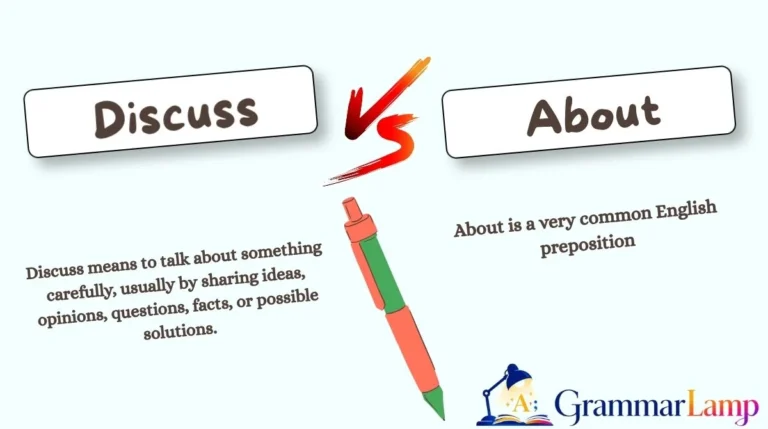
Discuss means to talk about something carefully, usually by sharing ideas, opinions, questions, facts, or possible solutions.
The important grammar rule is simple:
Discuss + thing/person/topic
You normally put the object directly after discuss.
For example:
- We need to discuss the problem.
- They discussed the new project.
- She wants to discuss her plans.
- The teacher discussed the lesson with the students.
Notice that there is no about between discuss and the topic.
The basic grammar pattern
The most common structure is:
Subject + discuss + object
Examples:
I discussed the problem.
She discussed the situation.
We discussed our plans.
They discussed the new policy.
The object tells us what the discussion is about. Because discuss is a transitive verb, it can take a direct object.
This is one of the main differences between discuss and verbs such as talk.
When should you use “discuss”?
Use discuss when you want to say that people are talking about a particular subject, often in a serious, organized, or detailed way.
For example:
- We need to discuss this matter.
- The students discussed the question.
- I would like to discuss your application.
- They discussed the problem for two hours.
- She discussed her future plans with her parents.
- The manager discussed the new rules with the staff.
- Can we discuss the project tomorrow?
- The committee discussed several possible solutions.
All of these sentences use discuss correctly.
Can “discuss” be used in questions?
Yes. You can easily use discuss in questions.
For example:
- Can we discuss the problem?
- Did you discuss the issue with your teacher?
- When will they discuss the new plan?
- Have you discussed this matter with your parents?
- Can we discuss your idea later?
Again, the topic comes directly after discuss.
What about “discuss with”?
You can use with when you want to mention the person you are talking to.
For example:
I discussed the problem with my teacher.
Here, the problem is the thing being discussed, while my teacher is the person you discussed it with.
The pattern is:
discuss + topic + with + person
Examples:
- I discussed the problem with my friend.
- She discussed her plans with her mother.
- We discussed the project with our manager.
- He discussed the issue with the doctor.
This is completely different from saying discuss about.
A common learner confusion
Learners often think:
talk about → discuss about
But English does not always work by copying the grammar pattern of one verb to another.
We say:
talk about the movie
but:
discuss the movie
We say:
speak about the problem
but:
discuss the problem
The meaning can be similar, but the grammar pattern is different.
What Does “About” Mean?
About is a very common English preposition. It can have several meanings, but in expressions such as talk about, think about, write about, and learn about, it introduces the subject or topic.
For example:
- We talked about the movie.
- She wrote about her childhood.
- I was thinking about you.
- They learned about history.
- He asked about the new job.
In these examples, about connects the action with its topic.
When do we use “about”?
We use about with many verbs when the grammar of that verb requires or naturally allows the preposition.
Some common combinations are:
- talk about something
- speak about something
- think about something
- learn about something
- read about something
- write about something
- hear about something
- worry about something
- ask about something
For example:
We talked about the exam.
I read about the new technology.
She is worried about the test.
The word about is correct in all these sentences.
Six useful examples with “about”
- We talked about our weekend.
- She wrote a story about her family.
- I learned about climate change at school.
- He is thinking about his future.
- They asked about the price.
- Have you heard about the new restaurant?
- She spoke about her experience.
- I read a book about space.
These examples show why learners sometimes make the mistake “discuss about.” They know that about often introduces a topic, so they naturally want to use it after discuss.
However, discuss already takes the topic directly.
“About” is not wrong by itself
It is important to understand that about is not a bad word.
The problem is using it with a verb that does not need it in that structure.
For example:
Correct: We talked about the problem.
Correct: We discussed the problem.
Incorrect in standard English: We discussed about the problem.
So the issue is not the word about. The issue is the combination discuss + about + object.
Difference Between Discuss and About — Detailed
The easiest way to understand the difference is to remember that discuss is a verb, while about is usually a preposition when it introduces a topic.
They do different grammatical jobs.
Comparison Table
| Point | Discuss | About |
|---|---|---|
| Word type | Verb | Preposition |
| Main use | To talk about a topic | To introduce a topic or subject |
| Common structure | discuss + object | verb + about + object |
| Example | We discussed the plan. | We talked about the plan. |
| Needs “about” after it? | Usually no | Not applicable |
| Common mistake | discuss about the plan | Usually used correctly with suitable verbs |
Discuss takes a direct object
This is the most important grammar point.
You can say:
We discussed the problem.
Here, the problem is the direct object of discuss.
You do not need a preposition between the verb and the object.
Compare this with:
We talked about the problem.
Here, the problem comes after the preposition about.
That is why the structures are different.
Compare the sentence structures
Discuss:
Subject + discuss + topic
We discussed the exam.
Talk about:
Subject + talk + about + topic
We talked about the exam.
Both sentences communicate almost the same basic idea. The difference is grammatical structure.
Why “discuss about” sounds wrong
The phrase discuss about is usually treated as a grammatical error in standard English when about is followed by the topic.
The learner may be thinking:
“If I discuss something, I am talking about it, so I should say discuss about it.”
The meaning is logical, but English grammar does not always follow that kind of word-for-word logic.
You simply need to learn the verb pattern:
discuss something
not:
discuss about something
Compare these pairs
Incorrect: We discussed about the problem.
Correct: We discussed the problem.
Incorrect: She discussed about her plans.
Correct: She discussed her plans.
Incorrect: They discussed about the new rule.
Correct: They discussed the new rule.
Correct: They talked about the new rule.
This last pair is especially useful. If you want to use about, change discuss to talk:
discuss the problem
or
talk about the problem
Both work.
Grammar Rules You Must Remember
Rule 1: Use “discuss” directly before the topic
The basic pattern is:
discuss + noun/pronoun/topic
Examples:
- We discussed the problem.
- She discussed her idea.
- They discussed the results.
- I discussed it with him.
Do not add about before the direct object.
Wrong: We discussed about the problem.
Right: We discussed the problem.
Rule 2: Use “talk about” when you want “about”
If you naturally want to use about, talk about is a good alternative.
Examples:
- We talked about the problem.
- She talked about her new job.
- They talked about their holiday.
- I talked about the issue with my friend.
The two patterns are:
discuss + topic
talk + about + topic
Remembering these two patterns will prevent most mistakes.
Rule 3: You can use “discuss with” for the person
You can say:
I discussed the problem with John.
The topic comes directly after discuss.
The person comes after with.
The structure is:
discuss + topic + with + person
For example:
She discussed the matter with her teacher.
Do not confuse with and about.
Correct: I discussed the problem with my manager.
Correct: I talked about the problem with my manager.
Incorrect: I discussed about the problem with my manager.
Rule 4: “Discuss” can be used with questions and different tenses
The rule does not change just because you change the tense.
Present:
We discuss the issue every Monday.
Past:
We discussed the issue yesterday.
Future:
We will discuss the issue tomorrow.
Present perfect:
We have discussed the issue already.
Question:
Did you discuss the issue?
The topic still follows discuss directly.
Common Mistakes Students Make
The biggest mistake is adding about after discuss.
Mistake 1: “Discuss about”
Wrong: We need to discuss about the problem.
Correct: We need to discuss the problem.
Why does this happen? Learners often translate directly from their first language or copy the pattern of talk about.
An easy correction is to memorize:
Discuss something, not discuss about something.
Mistake 2: “Discuss about the issue with my boss”
This sentence contains two different ideas:
- the issue = topic
- my boss = person
The correct sentence is:
I discussed the issue with my boss.
Not:
I discussed about the issue with my boss.
Mistake 3: Thinking “discuss” and “talk” have identical grammar
They are similar in meaning, but they do not always behave the same way.
Talk about the movie.
Discuss the movie.
You cannot simply replace talk with discuss and keep every part of the sentence unchanged.
Mistake 4: Using “discuss” without an object when an object is needed
In many normal situations, discuss is followed by the topic.
For example:
We discussed the budget.
This is clearer than trying to force about into the sentence.
Easy correction tips
When you write or speak, ask yourself:
Am I using “discuss”?
If yes, put the topic immediately after it.
discuss + topic
If you want to use about, use a verb that naturally works with about, such as talk.
Easy Trick to Remember the Difference
Here is a simple trick that works well for students:
Discuss grabs the topic directly. Talk needs “about.”
Think of discuss as a strong verb that can take the topic by itself.
discuss + the plan
No extra word is needed.
But talk normally uses about when you name the topic:
talk + about + the plan
You can remember these two mini-formulas:
DISCUSS → something
TALK → about something
For example:
I discussed the movie.
I talked about the movie.
Both sentences are easy to understand, but their grammar is different.
A second memory trick
Think of about as a bridge.
With talk, the bridge is needed:
talk → about → the subject
With discuss, there is no bridge:
discuss → the subject
So:
talk about football
but:
discuss football
This little picture can make the rule easier to remember.
Daily Life Examples
The best way to learn this grammar point is to see it in normal conversations.
Example 1: At work
Ali: Can we discuss the new project?
Sara: Sure. What time are you free?
Here, discuss the new project is correct.
Example 2: At school
Student: Did you discuss the homework?
Teacher: Yes, we discussed it this morning.
The pronoun it directly follows discussed.
Example 3: With a friend
Friend: Did you talk about your trip?
You: Yes, we talked about it last night.
Here, talk about is the natural structure.
You could also say:
We discussed our travel plans.
Example 4: Family conversation
Mother: Have you discussed your future plans with your father?
Son: Yes, we discussed them yesterday.
Notice the pattern:
discussed + plans
and:
with + person
Example 5: A business meeting
Manager: Today, we need to discuss the sales results.
Employee: I have prepared some notes.
Again, there is no about after discuss.
Example 6: Asking for help
A: Can I discuss something with you?
B: Of course. What happened?
This is a very useful everyday structure:
discuss something with someone
Example 7: Talking casually
A: What were you talking about?
B: We were talking about our exams.
Here, about is correct because the verb is talking, not discussing.
Example 8: A serious issue
A: We should discuss this problem before making a decision.
B: I agree.
The phrase discuss this problem is natural and standard.
Example 9: A phone conversation
A: I need to discuss something important with you.
B: Sure. Go ahead.
Again:
discuss something with someone
Example 10: Making plans
A: Should we discuss the details now?
B: Yes. We can talk about the schedule first.
This conversation shows both patterns naturally:
discuss the details
but:
talk about the schedule
Practice Section
Choose the correct option in each sentence.
1. We need to ______ the problem.
A. discuss about
B. discuss
C. discuss on
2. They talked ______ the new movie.
A. the
B. about
C. with
3. She discussed her plans ______ her parents.
A. with
B. about
C. on
4. Did you ______ the exam with your teacher?
A. discuss about
B. discussed
C. discuss
5. We talked about the project, and then we ______ the budget.
A. discussed
B. discussed about
C. discuss about
Answers
1. B — discuss
Correct sentence: We need to discuss the problem.
2. B — about
Correct sentence: They talked about the new movie.
3. A — with
Correct sentence: She discussed her plans with her parents.
4. C — discuss
After did, use the base form discuss.
5. A — discussed
Correct sentence: We talked about the project, and then we discussed the budget.
FAQs
What is the difference between “discuss” and “discuss about”?
Discuss is a verb that normally takes its topic directly.
You say “We discussed the problem,” not “We discussed about the problem.”
If you want to use about, say “We talked about the problem.”
Is “discuss about” grammatically correct?
In standard English, discuss about + topic is generally considered incorrect.
Use discuss + topic instead.
For example, say “They discussed the issue” rather than “They discussed about the issue.”
Can we say “discuss with”?
Yes. Discuss with is correct when you identify the person you have the discussion with.
For example:
I discussed the problem with my teacher.
The topic comes after discuss, while the person comes after with.
Can we use “discuss” in questions?
Yes. You can use discuss in questions very naturally.
Examples include:
Can we discuss the problem?
Did you discuss the matter with Sarah?
When will they discuss the new plan?
Remember that did is followed by the base verb discuss.
Is “discuss” formal or informal?
Discuss is common in both everyday and formal English, but it often sounds a little more organized or serious than talk about.
For example, “We need to discuss the problem” can sound more purposeful than “We need to talk about the problem.”
Both can be natural depending on the situation.
Should I say “discuss the issue” or “discuss about the issue”?
Say:
“discuss the issue.”
Do not normally say:
“discuss about the issue.”
The word issue is the direct object of discuss, so no preposition is needed.
Conclusion
The difference between “discuss” and “discuss about” is small, but learning it can make your English sound much more natural.
The main rule is easy:
Use “discuss + topic,” not “discuss about + topic.”
Say:
We discussed the problem.
She discussed her plans with her parents.
They discussed the new project.
When you want to use about, choose a verb that naturally takes it, such as talk:
We talked about the problem.
She talked about her plans.
The key is not to translate the structure word for word. Different English verbs follow different grammar patterns. Once you learn these patterns, the correct choice becomes automatic.
Try using discuss in a few sentences today. For example, say what you discussed with a friend, teacher, family member, or coworker.
A little practice will help you stop saying “discuss about” and start using the natural pattern confidently.

Liam Derren is a language writer at GrammarLamp, creating simple, helpful content about grammar, words, and everyday English. He makes language learning clear, practical, and easy to understand.